OZ Media Digital
Look for someone who can show you measurable business outcomes, not just a nice-looking feed. The right social media manager understands your specific customers and platforms, can point to past campaigns with real numbers attached, is comfortable using AI tools without letting them replace your brand's voice, and gives you clear, specific answers about posting frequency, approval process, and reporting, not vague promises about "growing your socials." If a candidate or agency can't do all four of those things, keep looking.
That's the short version. The rest of this guide walks through exactly what to check before you sign anything, the skills that actually matter in 2026, the questions worth asking, the red flags that should end the conversation, and what a fair price looks like once you've found someone good.
TL;DR
- A good social media manager in 2026 needs short-form video skills, analytics fluency, AI-tool competency, and genuine platform-specific knowledge, not just "knowing how to post."
- Ask for a portfolio with measurable outcomes (leads, bookings, enquiries), not follower counts or engagement screenshots.
- Walk away from anyone who sends a polished proposal before asking about your business, promises specific follower or engagement numbers, or locks you into a 12-month contract with no exit clause.
- Reporting should explain what happened and why, not just paste a screenshot of numbers.
- A social media manager in Australia typically earns around $79,555 a year in-house (Indeed, July 2026); outsourced management is usually billed as a monthly retainer instead of a salary.
- Decide what you're actually hiring for first, content creation, paid ads management, or both, because the skill set and the price both change depending on the answer.
What Does a Social Media Manager Actually Do for a Small Business?
Before you can judge a candidate, you need to be clear on what you're actually hiring for, because "social media manager" covers a wide range of jobs depending on the business.
At the simplest end, it's organic content management: planning a posting calendar, writing captions, sourcing or shooting images and video, scheduling posts, and responding to comments and messages. At the more involved end, it includes running paid Facebook and Instagram advertising, managing ad budgets, building audiences, and reporting on cost per lead and return on ad spend. Some businesses need both; many only need one.
This matters because a brilliant content creator isn't automatically good at paid media, and a strong paid-ads operator isn't automatically a strong writer or community manager. Before you start interviewing anyone, write down which of these you actually need:
- Organic content (posts, stories, reels, community management)
- Paid social advertising (campaign setup, budget management, audience targeting)
- Both, under one person or team
- Strategy only (someone to plan, with your team executing)
Candidates and agencies should ask you this question early. If they don't, that's worth noting, see the red flags section below.
What Skills Should You Actually Look For in 2026?
The job has changed substantially in the last two years, and "can write a caption and schedule a post" is no longer enough on its own. According to Hootsuite's 2026 guide to social media hiring, the skills that actually separate strong candidates from weak ones now include:

- Short-form video production, the ability to shoot, edit and hook an audience within the first few seconds, specifically for TikTok, Reels and Shorts, not just repurpose a static image.
- Data analysis and analytics fluency, comfort reading platform insights and connecting them to business metrics, not just reporting reach and likes.
- AI tool proficiency, using AI for drafting, scheduling and workflow efficiency, while still producing content that sounds like your business, not like a generic AI output.
- Platform-specific knowledge, understanding how each platform's algorithm and audience behaviour actually works. As Hootsuite puts it, "Almost everyone knows how to publish an Instagram post or write a tweet. But do they understand how to hook a TikTok scroller?"
- Copywriting and community-building, the human skills that AI tools don't replace: tone, personality, and the judgement to respond to comments and messages the way your brand actually would.
A useful filter during any conversation: ask the person to talk you through a platform you don't use much yourself (say, LinkedIn if you're a bricks-and-mortar retailer, or TikTok if you're a professional services firm). A strong candidate will have a view on whether it's worth your time and why. A weak one will give you a generic "yes, we should be everywhere" answer.
What Should You Ask Before You Hire Them?
Sendible's 2026 interview guide for hiring social media managers sets out the kinds of questions that separate a genuinely strategic hire from someone who can just operate the tools. Adapted for a small business owner doing the interviewing rather than an HR team, the most useful ones are:

"Which platforms would you actually recommend for my business, and why?" A good answer references your specific customers and how they behave on each platform, not a generic list of "the big four." A weak answer is platform-agnostic and could apply to any business in Australia.
"What goals would you set for our accounts, and how would you measure them?" You want to hear about conversions, enquiries, leads or bookings tied to your business, not "get as many likes as possible." Vanity metrics with no connection to revenue are the single most common way social media spend gets wasted.
"How do you use AI in your work, and how do you keep it from sounding generic?" The honest answer in 2026 is "I use it, but I check and rewrite for voice", not blanket reliance on AI output, and not an outright refusal to use any AI tools at all. Either extreme is worth probing further.
"Can you walk me through a campaign that didn't work, and what you changed?" Anyone who claims a flawless record either hasn't done enough real work yet or isn't being straight with you. You're listening for whether they diagnose problems and adjust, not for a perfect scorecard.
"How do you handle a negative comment, review, or a brewing PR issue?" You want a specific protocol, not "I'd just delete it" and not "I'd ignore it." Deleting legitimate criticism or ignoring a complaint are both common ways a small business's reputation gets worse, not better.
"Can we see examples of your past work, with results attached?" Covered in detail below, but if the answer to this one is vague or evasive, that alone is reason enough to move on.
What Should You Expect to See in Their Portfolio?
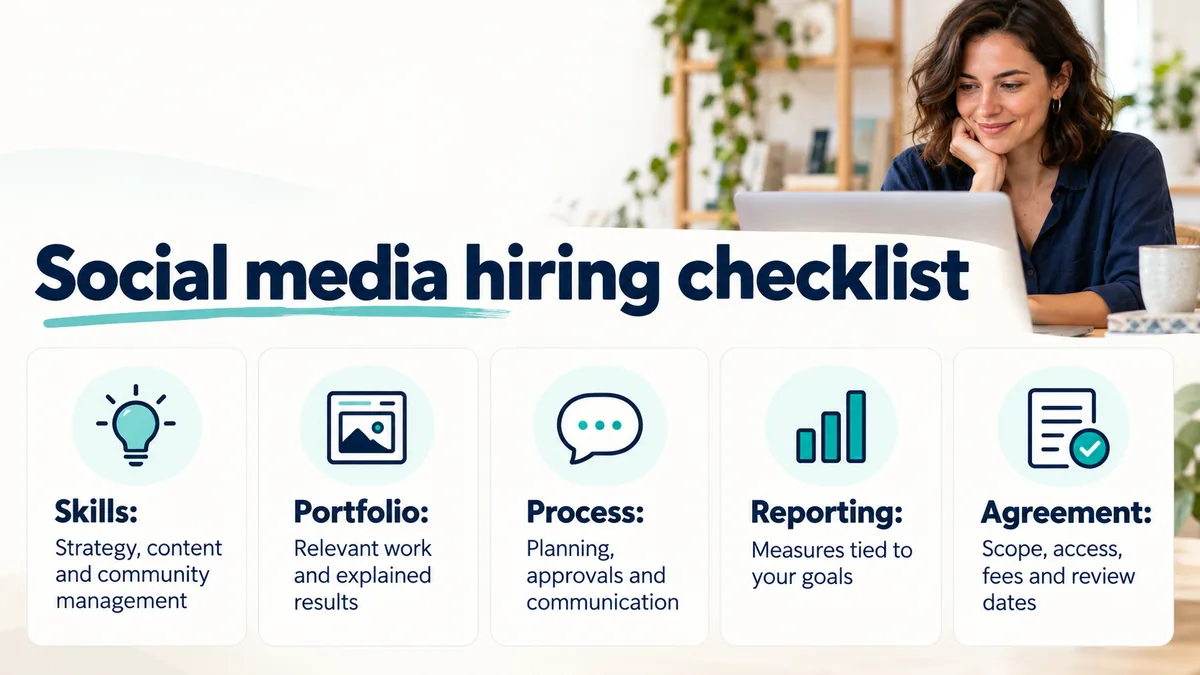
A portfolio that shows pretty graphics and nothing else is not a portfolio, it's a design sample. What you actually want to see, for each example they show you:

- What the business was trying to achieve (more enquiries, more foot traffic, more bookings, not "more engagement" as the end goal)
- What they did specifically, including platforms, content types, and whether paid spend was involved
- What changed as a result, in terms that connect to the business, not just "reach went up"
- Whether the business is similar in size or category to yours, a results history built entirely on large retail or hospitality brands may not translate cleanly to a trades or professional-services business with a smaller, more local audience
It's reasonable to ask for a client reference, particularly for a retainer arrangement running several months or longer. It's not reasonable to expect someone to breach another client's confidentiality by showing you private dashboards or exact financial figures, a de-identified summary with directional numbers is the normal, professional standard.
What Red Flags Should Make You Walk Away?
Adelaide Socials, an Australian social media agency, published a list of red flags worth watching for when hiring a social media agency or manager, several of which apply just as directly to an individual freelancer or an in-house hire:
- A polished proposal within 24 hours, with no discovery questions first. Nobody can genuinely understand your business, audience and goals that fast. A fast proposal with no questions is a template, not a strategy.
- Vague deliverables. "We will manage your social media" is not a deliverable. You want specifics: how many posts per week, on which platforms, who approves content before it goes live, and what the monthly report actually contains.
- No active work in your industry or category. This doesn't need to be an exact match, but someone who can't point to any comparable business should be able to explain how they'd learn your industry quickly, not wave the question away.
- Reliance on stock photography with no plan for original content. For a local, service-based business, generic stock images are one of the fastest ways to look like every other business in your area.
- Promises of specific follower or engagement growth numbers. This is the clearest red flag on the list, and it isn't just a quality issue, the ACCC's own guidance on social media promotions is explicit that any performance claim a business makes must be accurate and something the business can actually substantiate. A manager or agency guaranteeing you "500 new followers a month" either doesn't understand how platform algorithms work or is making a claim they can't back up.
- A 12-month lock-in with no performance checkpoints or exit clause. Reasonable minimum terms exist in this industry (three to four months is common, to allow enough time for content and testing to actually show results), but a long lock-in with no review point removes your ability to course-correct.
- Frequent account manager turnover. If you're told upfront that your account will be handled by a rotating pool of junior staff, ask how continuity and brand knowledge are maintained.
- Reporting that's just a screenshot of numbers. A report should explain what happened and why, and what's changing next month as a result. A number with no interpretation isn't a report, it's a receipt.
If you notice two or more of these in an initial conversation, that's a pattern worth taking seriously, not a collection of individually forgivable quirks.
In-House, Freelancer, or Agency, Does the Hiring Checklist Change?
The core things you're checking for, platform knowledge, measurable results, clear communication, realistic promises, don't change based on who you hire. What does change is where the risk sits.

An in-house hire gives you the most control and the deepest brand knowledge over time, but you're relying on one person's skill set, and if they leave, institutional knowledge leaves with them. You're also responsible for keeping their skills current as platforms change, which happens often.
A freelancer is usually more cost-effective than an agency for straightforward content management, and you often get direct access to the person doing the work rather than going through an account manager. The trade-off is capacity, a freelancer juggling several clients may not have the bandwidth to react quickly if something urgent comes up, and if they're unavailable, there's typically no backup.
An agency gives you a team with backup capacity and usually broader paid-media expertise, which matters if advertising spend is a significant part of what you need. The trade-off is cost, and the account-manager-turnover risk flagged above, ask directly who will actually be working on your account day to day, not just who signs the proposal.
None of these is automatically the right answer for every business. What matters is that whichever structure you choose, you apply the same checklist above before committing.
What Does This Actually Cost?
Costs vary a lot depending on scope, so treat any number here as context rather than a quote. For an in-house hire, Indeed's Australian salary data puts the average social media manager salary at $79,555 a year, based on 112 salary reports as of July 2026, before the usual on-costs of superannuation, leave and equipment that come with any employee.
For outsourced management, pricing is typically a monthly retainer rather than a salary, and scales with how much is included, organic content only, organic plus paid advertising management, and the number of platforms and posts per week all move the number. As a general principle: a price that seems unusually low relative to everything described above is usually low because something on that checklist, strategy, original content, proper reporting, platform-specific expertise, has been cut to make the number work. That's not always a dealbreaker, but it's worth asking directly what's been left out to hit that price, rather than assuming it's simply a good deal.
Frequently Asked Questions
Do I need to hire someone with experience in my exact industry?
It helps, but it's not essential. What matters more is whether they can show you they understand how to research and adapt to a new audience quickly, and whether they're asking you specific questions about your customers rather than assuming your business is like every other one they've worked with.
How long should I give a new social media manager before judging results?
Most reasonable minimum terms in this industry run three to four months, which reflects how long it genuinely takes to test content, build an audience, and start seeing a pattern, particularly if paid advertising is involved and platforms need time to optimise delivery. Expecting clear results inside the first few weeks is usually unrealistic, regardless of who you hire.
Should I expect them to use AI tools?
Most capable social media managers now use AI for drafting, scheduling, and workflow efficiency, that's a normal and often sensible part of the job in 2026. The distinction that matters is whether a human is still checking, editing and approving the output so it sounds like your business, not a generic AI voice.
What's a reasonable number of posts per week?
There's no single right answer, it depends on your industry, platform and goals, but it should be a specific number you agree on upfront, not left open-ended. If a proposal doesn't state a posting frequency, ask for one before you sign anything.
Can I ask to see their other clients' actual results?
You can ask, but expect a de-identified summary rather than someone else's private dashboard or financial figures, sharing exact numbers from another client without permission would be a breach of that client's confidentiality, so a professional manager or agency should decline to show you raw data even if you ask.
Is it a bad sign if they can't guarantee results?
No, the opposite is true. Nobody can honestly guarantee specific follower growth, engagement, or sales from social media, and a manager or agency who makes that guarantee is either overstating what they can deliver or making a claim they can't substantiate, which the ACCC's own guidance on social media promotions treats as a genuine compliance risk, not just an empty sales pitch.
Where to Go From Here
Hiring well here isn't about finding the cheapest option or the most polished pitch deck, it's about finding someone who can show you real numbers, ask you real questions, and give you a straight answer about what a reasonable timeline and price actually look like. Use the checklist and red-flag list above in your next conversation, whether you're talking to a freelancer, an agency, or a candidate for an in-house role.
If you'd rather compare your options directly, OZ Media Digital's social media marketing service covers both organic content management and paid Facebook and Instagram advertising, with specifics on what's included at each tier rather than a vague "we'll manage your socials" promise, and it's also bundled into our broader marketing packages if you need social media handled alongside SEO, ads or your Google Business Profile. Related reading if you're weighing up other hiring decisions at the same time: Should You Hire a Google Ads Manager, or Run Your Own Account?, What Questions Should You Ask Before Hiring a Web Designer?, and if you're still deciding whether social is even the right channel for your budget, Which Marketing Channels Should Your Small Business Actually Use in 2026?
If you'd like a second opinion on a proposal you've already received, or want to talk through what your business actually needs before you hire anyone, book a free 30-minute strategy session with OZ Media Digital, there's no cost and no obligation, and it's a useful sanity check either way.
Sources and References
- Sendible, "26 Social Media Manager Interview Questions to Ask When Hiring in 2026", published 29 June 2026, updated 12 January 2026, interview question framework.
- Hootsuite Blog, "Social media hiring in 2026: How to build a high-performing team", published 17 June 2026, skills and red flags for 2026 hiring.
- Adelaide Socials, "Red Flags When Hiring a Social Media Marketing Agency", published 24 May 2026, Australian-specific red-flags list.
- Sprout Social, "Australia Social Media Statistics: 2026", published 16 April 2026, updated 21 September 2026, Australian platform usage and ad-spend figures.
- Indeed Australia, "Social media manager salary in Australia", average salary $79,555/year, based on 112 salaries, last updated 8 July 2026.
- Australian Competition and Consumer Commission (ACCC), "Social media promotions", primary source on misleading claims and substantiation requirements for performance/growth promises made on or about social media.
No ranking, follower-growth, or sales guarantees are made anywhere in this article. Figures and statistics were verified live against their sources on 3 October 2026 and are dated accordingly; platform data and salary benchmarks should be treated as indicative and will shift over time.