 OZ Media Digital
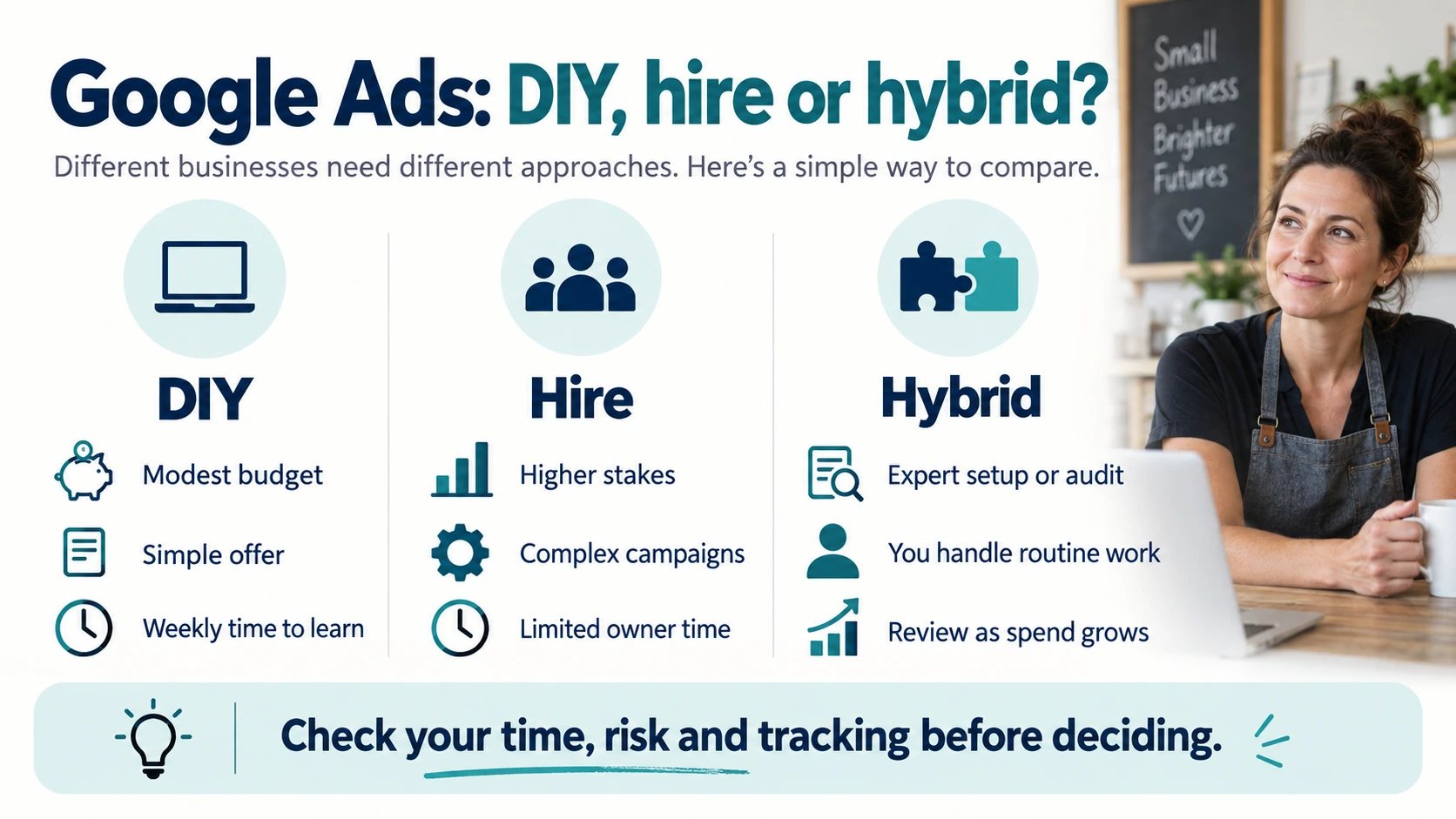
If you're asking this question, you've probably already spent a few hours inside Google Ads wondering why the interface has forty settings for something that used to be "type in some keywords." The honest, direct-answer version: DIY makes sense if you have genuinely spare hours every week, a modest budget where mistakes are cheap to make, and the patience to learn a platform that changes its own rulebook every few months. Hiring a Google Ads manager makes sense the moment your ad spend is big enough that a bad week costs more than a specialist's fee, or your time is worth more doing the thing your business actually sells. Most small businesses land somewhere in between, and the right call depends less on your budget size and more on how much of your own time you're willing to put against it.
TL;DR
- Running Google Ads well is a genuine skill, not a one-off setup task, it requires ongoing attention to search terms, bidding, budget pacing, and ad testing, week after week, for as long as the campaign runs.
- Google's own Smart Bidding systems need real conversion volume, typically around 30 conversions in the past 30 days for most automated strategies, before they optimise properly, which means both DIY and hired accounts go through a genuine learning period; hiring doesn't skip this, it just makes the setup more likely to survive it.
- DIY tends to work when budgets are modest (rough content, not a hard rule, some businesses run $500–$1,500/month accounts capably), the business owner has 3–5+ hours a week free, and the offer is simple enough that Google's automation doesn't need much hand-holding.
- Hiring tends to pay for itself once monthly spend gets large enough that a manager's fee is a small percentage of the account, once the account structure gets complex (multiple locations, product lines, or campaign types), or once your own time is better spent running the business than running the ads account.
- A specialist doesn't just "save you time", a decent one catches account-structure mistakes, wasted spend on irrelevant search terms, and mismatched bidding strategies that a first-time DIY advertiser typically won't notice until months of spend have gone past.
- There's a middle path: DIY the setup with a strong initial structure, then bring in a specialist for a one-off audit or ongoing light-touch management, rather than treating it as all-or-nothing.
What Does "Managing a Google Ads Account" Actually Involve, Week to Week?
Setting up a campaign is the easy part. Managing one, the part that actually determines whether it makes money, is a recurring set of tasks that doesn't stop once the ads go live:

Search term mining. Google Ads matches your keywords to actual searches, and a meaningful share of those matches will be irrelevant to your business, right suburb, wrong service; right product category, wrong price point. Someone has to review the search terms report regularly and add negative keywords, or the account quietly bleeds spend on clicks that were never going to convert.
Bid and budget management. Whether you're on manual bidding or one of Google's automated Smart Bidding strategies, budgets need pacing (so you don't blow the month's spend by the 12th), and bid strategies need monitoring for whether they're actually hitting your target cost-per-acquisition or return on ad spend, not just running.
Ad testing and creative refresh. Ad copy fatigues. Responsive Search Ads and Performance Max both reward accounts that keep testing new headlines, descriptions, and assets rather than setting-and-forgetting the same three lines of copy for a year.
Conversion tracking maintenance. Tracking breaks, a website update strips a tag, a form field changes, a new page doesn't fire the pixel. An account with broken conversion tracking looks like it's underperforming when the real problem is that Google simply can't see the sales that are happening.
Structural decisions as the account grows. Adding a new service, a new location, or a seasonal promotion usually means restructuring campaigns and ad groups, not just bolting new keywords onto old ones, and doing this badly is one of the most common ways DIY accounts end up a mess a specialist later has to unpick.
None of this is exotic. It's the same discipline any recurring business process needs.
The question isn't whether it's possible to do yourself. It clearly is. It's whether you have, and want to keep having, the hours for it.
What managing Google Ads involves, week to week
InteractiveSetting up a campaign is the easy part. These five jobs repeat for as long as the campaign runs. Watch the loop, or tap a step.
The tasks described in this article. How often each one is needed depends on your account.
Why Does This Take Longer Than It Looks Like It Should?
Because Google Ads has become genuinely more automated and genuinely more complex at the same time, a combination that trips up a lot of first-time advertisers. Performance Max and AI Max campaigns hand more of the day-to-day optimisation to Google's own machine learning, which sounds like less work, but it also means the manual levers you'd use to fix a problem (pausing a specific keyword, excluding a specific placement) are less visible or unavailable entirely. When something's not working in an AI Max or Performance Max campaign, diagnosing why takes more platform fluency, not less, you can read the fuller picture in our guide to Google Ads in the AI era.
On top of that, Google's automated bidding strategies are built around conversion volume. Google's own help documentation on the Smart Bidding learning period is explicit that campaigns typically need a meaningful run of recent conversions, commonly cited around 30 in the trailing 30 days for many Target CPA and Target ROAS setups, before the algorithm has enough signal to bid efficiently. A low-volume account (which describes most small local businesses starting out) can sit in an extended learning phase, and a first-time DIY advertiser often reads that normal ramp-up period as "Google Ads doesn't work," pauses the campaign, and starts again from zero, resetting the learning phase and repeating the problem. This is one of the single most common reasons small business Google Ads accounts underperform, and it has nothing to do with the offer or the market, it's a process mistake anyone can make once.
Is your account getting enough signal to learn?
InteractiveSmart Bidding needs real conversion volume. Drag the slider to the number of conversions your account recorded in the last 30 days.
Google’s documentation commonly cites around 30 conversions in the trailing 30 days for many Target CPA and Target ROAS setups. It varies by campaign, so treat it as a guide.
When Does DIY Actually Make Sense?
DIY isn't a bad option, plenty of small business owners run capable accounts themselves, particularly when:

Your budget is modest and the downside of a mistake is genuinely small. An account spending a few hundred dollars a month has a low ceiling on how much a bad week can cost you, which makes it a reasonable place to learn.
You have real, recurring hours to give it, not "I'll look at it when I remember," but a standing block of time each week, because search term reviews and bid checks that get skipped for a month are usually the reason DIY accounts underperform, not the platform itself.
Your offer and funnel are simple. A single service, a clear call to action, and straightforward conversion tracking (a phone call, a form fill, a simple purchase) are much easier to manage without specialist help than a multi-location business with dozens of product lines and several conversion types.
You're using the account as a genuine learning exercise, not just trying to save money. Google's own Skillshop certification content is free, and the platform's built-in recommendations tab, while it needs to be filtered critically (not every "recommendation" is worth accepting), is a reasonable place to build baseline literacy.
When Should You Hire a Google Ads Manager Instead?
The calculation flips once one or more of these becomes true:

Your monthly spend is large enough that a manager's fee is a small percentage of the account, and the cost of inefficiency (wasted clicks, poor Quality Scores driving up your cost-per-click, a bidding strategy that's optimising for the wrong goal) is larger in dollar terms than the fee itself. This is the same logic that makes understanding your true return on Google Ads spend worth doing properly rather than guessing.
Your account structure is genuinely complex, multiple locations, multiple services with different margins and target costs, Shopping and Search and Performance Max running together, where the compounding effect of small structural mistakes is much larger than in a single-campaign account.
Your own time is worth more doing something else. If an hour spent reviewing search terms is an hour not spent on a paying job, a client meeting, or running the parts of the business only you can run, the maths often favours paying someone else to do the ads work, even at a modest monthly cost.
You've tried DIY for a reasonable stretch (several months, not two weeks) and the account still isn't performing, and you can't tell why. That's usually the point where an outside pair of eyes, someone who's seen dozens of accounts, not just your one, finds the structural issue fast that you'd otherwise keep guessing at.
If you're weighing this against what specialist help typically costs in Australia, that's a separate, detailed question with its own numbers, hourly rates, percentage-of-spend fees, flat monthly retainers, worth working through properly before you commit either way, and our Google Ads management page explains how we price it.
What is your time actually worth?
InteractiveCompare the monthly cost of your own hours against a specialist fee. Move the sliders to your real numbers.
Illustrative only. This counts your time, not the cost of mistakes or the learning curve, and the default numbers are examples, not benchmarks.
What Mistakes Do DIY Advertisers Make Most Often?
A few patterns show up again and again in accounts we've reviewed after a business owner has run them solo for a while:
Broad match with no negative keyword discipline, which burns budget on searches with the right words in the wrong order or context, a classic case is a tradie bidding on "plumber" broad match and paying for clicks from people searching for plumbing supplies, plumbing apprenticeships, or plumber jokes.
Judging performance too early, before an account has exited its learning phase, and abandoning a setup that just needed another two to three weeks of stable settings to find its footing.
Optimising for clicks instead of the outcome that actually matters, chasing a low cost-per-click while ignoring cost-per-lead or cost-per-sale, which can mean an account "performing well" on the metric you're watching while actually losing money on the metric that counts.
Setting a bidding strategy target that doesn't match reality, a Target CPA set well below what the market can realistically deliver, which throttles the account's ability to spend the budget at all, or a Target ROAS set without knowing your actual margins.
Skipping conversion tracking checks after a website change, so the account looks like it's failing when it's actually just gone blind, a mistake that's genuinely common even in professionally managed accounts, but far more likely to go unnoticed for months in a DIY setup with no one specifically watching for it.
How Should You Actually Decide?
Run through this in order:

First, be honest about your hours, not your intentions. "I'll find the time" is not the same as a standing weekly block already in your calendar. If you can't name when you'll do the search term review each week, you probably won't do it consistently, and inconsistency is where DIY accounts fail.
Second, work out what a bad month actually costs you at your current spend level. If your monthly budget is small, the downside of learning-by-doing is capped and manageable. If it's substantial, a few wasted weeks while you find your feet is real money, money that's roughly the same order of magnitude as what a specialist would have charged to avoid the mistake in the first place.
Third, consider a hybrid. You don't have to choose DIY forever or hired forever. A common, sensible middle path is: set the account up yourself (or with a one-off setup service) with a clean structure and solid conversion tracking, run it for a defined trial period, then bring in a specialist either for a one-off audit to catch what you've missed, or for ongoing light-touch management once spend justifies it. This avoids paying full management fees on a small account while still getting expert eyes on the parts most likely to go wrong. If you're still working out how much of your overall marketing budget should go toward ads versus other channels in the first place, our small business marketing budget guide is worth reading before you commit spend either way.
Fourth, if you do decide to hire, treat it the way you'd treat hiring for any other specialist role, ask about their reporting cadence, what they consider a successful result, and how they'd approach your specific account structure, not just their price. A local, trade-specific example of how this plays out in practice, a real cost breakdown for a service business, is in our Google Ads cost guide for Hornsby-area trades.
Hire or DIY? A five-question check
InteractiveAnswer honestly, using your real hours rather than your intentions. Your result follows the decision framework in this article.
Frequently Asked Questions
Can I really learn Google Ads myself with no marketing background?
Yes, to a genuinely useful level, Google's own Skillshop training is free, and the platform is far more forgiving to learn on than it was five years ago. What's harder to self-teach is judgement: knowing which of Google's in-platform recommendations to accept and which to ignore, and recognising when a slow week is normal learning-phase behaviour versus a real problem.
How long should I try DIY before deciding it's not working?
Give a new account at least six to eight weeks of stable settings before judging it, factoring in the Smart Bidding learning period discussed above. Changing targets, budgets, or campaign structure every few days resets that learning process and makes it look like the account never settles, when the real cause is the constant changes.
Is it cheaper to just hire a freelancer instead of an agency?
It can be, but "cheaper" isn't the only variable, a freelancer typically has less bench strength if something goes wrong or they're unavailable, while an agency spreads risk across a team. The right comparison is value for the fee, not just the headline rate.
What if I've already been running my own account for months and it's not working?
That's one of the clearest signals it's worth a professional audit, even a one-off one rather than ongoing management. An experienced set of eyes can usually identify the two or three structural issues causing most of the underperformance within a single review, which is often far faster than continuing to troubleshoot alone.
Does hiring a manager guarantee better results?
No, and be wary of anyone who promises it will. What a competent manager reliably provides is experience-informed decision-making and the ongoing hours to actually execute consistently, which improves your odds, but results still depend on your offer, your market, and your budget being realistic for what you're trying to achieve.
Can I hire someone just to fix my account once, rather than manage it ongoing?
Yes, a one-off audit and restructure is a common, sensible entry point if you want to keep running the account yourself day-to-day but want a professional check on the structure, tracking, and settings first.
The Bottom Line
There's no universally right answer here, only the right answer for your budget, your hours, and how much risk you're comfortable carrying while you learn.
Make the choice deliberately, not by default. Don't keep DIY-ing an account you don't have time for out of habit, and don't hire a manager for a $300 a month account where the fee outweighs any realistic upside.
If you want a second opinion on where your account currently sits, whether that's a light-touch audit of what you're already running, or a conversation about what ongoing management would look like, OZ Media Digital's Google Ads management service covers both ends of that spectrum, including flexible package options for businesses not ready for a full ongoing retainer. You can book a no-obligation chat directly at ozmedia.digital/booking.
Not ready for ongoing management? OZ Media Digital’s Google Ads management covers both a light-touch audit of the account you already run and ongoing management, so you can start with a second opinion.
Sources and References
- Google Ads Help, Duration of the learning period for campaigns and what affects it. Smart Bidding strategies typically need sustained recent conversion volume, commonly cited at around 30 conversions in the trailing 30 days for several Target CPA and Target ROAS configurations, and repeated setting changes reset the learning period.
- OZ Media Digital's own account management experience and observed patterns across client accounts, used for the qualitative sections on common DIY mistakes and the decision framework.
No savings, ROI or ranking figures are guaranteed anywhere in this article. Google’s help content changes over time, so check the current documentation for the latest learning-period guidance.