OZ Media Digital
If your business is still getting by on whatever you can post between jobs, the honest answer is: it depends on what "getting by" is actually costing you. There's no rule that says every small business needs a dedicated social media manager, plenty run perfectly well on a light, owner-managed presence. But there's a point where DIY social media stops being a minor task and starts quietly costing you leads, consistency and your own time, and most business owners cross that line well before they notice it. This guide walks through how to tell which side of that line you're actually on.
TL;DR
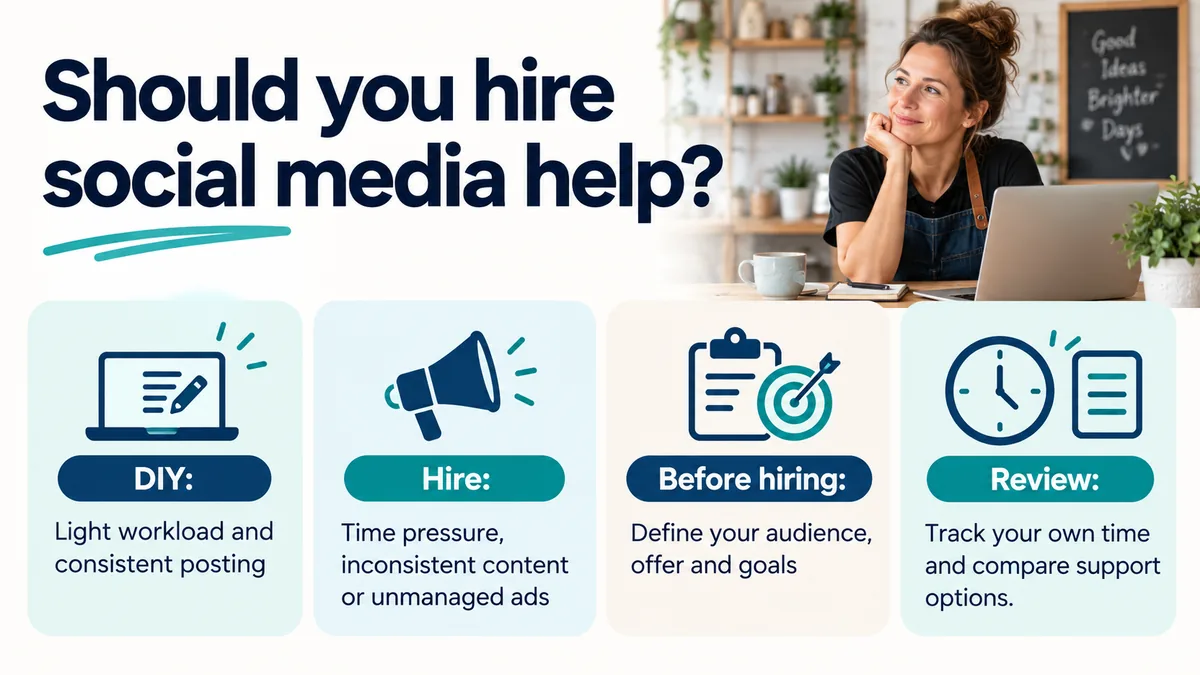
- DIY social media is genuinely fine for businesses with light, simple needs, a handful of posts a month, one or two platforms, no paid ads.
- The real cost of doing it yourself isn't zero, it's your own time, and that time has a value whether or not you're putting a number on it.
- Three signs it's time to stop DIY-ing it: your posting has gone inconsistent, you can't remember your last content plan, or social media has quietly become a task you resent rather than one you do well.
- Hiring doesn't have to mean a full-time employee, freelancers and agencies exist specifically because most small businesses don't need in-house capacity.
- The decision isn't "DIY vs hire" as a permanent choice, it's a question worth re-asking every time your business grows, adds a platform, or starts running paid ads.
What Does Managing Your Own Social Media Actually Involve?
It's worth being specific about this, because "just post a few photos" undersells what consistent, effective social media management actually requires.

At a genuinely useful standard, it involves planning content ahead of time rather than scrambling on the day; writing captions that do more than describe the photo; shooting or sourcing decent images and video; scheduling posts at times your audience is actually online; replying to comments and direct messages in a reasonable window; and periodically checking what's actually working so you're not just guessing.
None of that is complicated in isolation. What makes it hard is doing all of it consistently, week after week, on top of running the actual business. Sprout Social's own Social Media Productivity Report, which surveyed full-time social media professionals, not small business owners, found that even a dedicated, full-time social media marketer spends an average of five hours a week on content creation and approvals alone. That figure doesn't include strategy, community management, reporting, or responding to messages, just making the content. If a professional whose entire job is social media needs that much time for one slice of the workload, it's a reasonable prompt to ask honestly how much time your own version of "just posting a few photos" is actually taking you.
How Much Time Does DIY Social Media Really Take?
There's no single defensible number here, how long it takes depends heavily on how many platforms you're maintaining, how much original content you're producing versus reposting, and how much community management your audience expects. Anyone who tells you "small businesses should spend exactly X hours a week" is oversimplifying a genuinely variable workload.
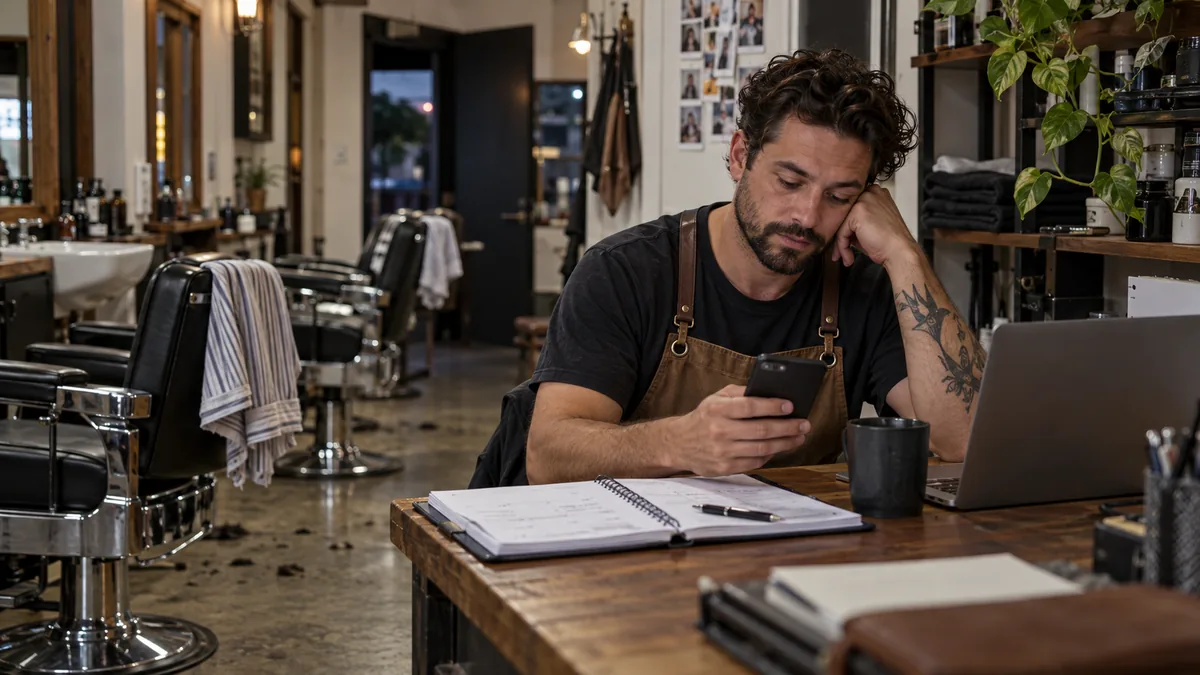
What's more useful than a fake-precise number is a rough self-audit. Over one typical week, track the actual time you spend: planning what to post, taking or sourcing photos and video, writing captions, scheduling, checking and replying to comments and DMs, and looking at what performed well. Most business owners who do this exercise honestly are surprised by the total, not because any single task took long, but because it's spread across small, constant interruptions rather than one blocked-out session, which makes it feel cheaper than it actually is.
That matters because interrupted time has a cost beyond its hours. Ten minutes replying to an Instagram comment between customers isn't just ten minutes, it's ten minutes plus the cost of losing your place in whatever you were doing before.
What Are the Signs You Should Stop Doing It Yourself?
A few patterns tend to show up consistently once DIY social media has genuinely outgrown what an owner can sustain:

Your posting has become inconsistent. A burst of five posts after a slow week, then nothing for a fortnight, is a common symptom, not of laziness, but of social media being the first thing dropped whenever the business gets busy. Inconsistent posting doesn't just look unprofessional; most platforms' own distribution tends to favour accounts that post regularly, so sporadic activity actively works against you.
You can't remember the last time you had an actual content plan. If your posts are entirely reactive, whatever's happening that day, whenever you remember to grab your phone, you've likely drifted from "strategy" to "just filling the feed." That's a sign the strategic layer has quietly disappeared, even if posting itself hasn't stopped.
It's become a task you resent, not one you do well. This is the most reliable signal, and the easiest to ignore. If checking your business's social accounts has become a low-grade dread rather than something you're even mildly interested in, the quality of what goes out has almost certainly already declined, whether or not you've consciously noticed it.
You're running paid ads without anyone actually managing them. Boosting a post occasionally isn't the same as running paid social properly, and unmanaged ad spend is one of the more expensive ways to discover you needed help sooner. This is worth taking seriously in its own right, not just as a social-media-time problem.
Your business has genuinely grown since you set your current approach up. What worked for a two-person operation often doesn't scale cleanly to a team of eight, more locations, or a broader service range, not because the old approach was wrong, but because it was sized for a business that no longer exists.
If two or more of these sound familiar, that's a reasonably strong signal DIY has stopped being the efficient choice it once was.
What Are the Signs DIY Is Still the Right Call?
It's just as important to be honest about when DIY genuinely still makes sense, because outsourcing too early wastes money on a problem you don't actually have yet.
DIY tends to remain the right call when your posting needs are genuinely light, a handful of posts a month rather than several a week; when you're not running paid social ads at any meaningful spend; when one or two platforms cover your actual audience, rather than needing a presence everywhere; and when you (or a staff member with real capacity, not just spare minutes) can produce content without it consistently displacing higher-value work.
Designloud's 2026 State of Small Business Marketing survey, which polled 527 small business owners and marketing decision-makers across service, ecommerce, SaaS and local/retail businesses in Q1 to Q2 2026, found that 62% cited limited staff as their single biggest marketing constraint, while 24% were actively considering hiring an external agency or consultant. That's a useful reality check either way: if you're in the 62% feeling the staffing squeeze, that's a real signal worth acting on. If you're not, if social media genuinely isn't competing with anything more valuable you could be doing with that time, there's no obligation to outsource it just because it's an option.
What Does Hiring Actually Solve (and What Doesn't It Solve)?
Hiring help, a freelancer, an agency, or eventually someone in-house, solves a specific, narrow set of problems well: it buys back your time, brings consistency that's hard to maintain solo, and usually improves content quality once someone whose actual job is social media is doing the planning and execution.
What hiring doesn't automatically solve: a business with no clear customer, no clear offer, or no clear idea of what social media is actually meant to achieve for it. Handing an unclear strategy to a freelancer or agency doesn't clarify it, it just means someone else is now executing an unclear strategy on your behalf, at a cost. If you genuinely can't answer "who is this content for and what do I want them to do after seeing it," that's worth solving before you hire anyone, DIY or otherwise. Our guide on which marketing channels your small business should actually use is a reasonable place to sort that out first.
It's also worth being clear that "hiring" doesn't have to mean a full-time employee. Most small businesses that decide to stop DIY-ing land on a freelancer or a mid-tier agency arrangement long before an in-house hire makes financial sense, that's specifically why those options exist, and it's a far smaller step than most owners assume before they've actually looked into it.
Freelancer, Agency, or In-House? A Quick Way to Think About It
Without getting into specific pricing here, the rough shape of the decision looks like this:

A freelancer tends to suit businesses that need consistent posting and some strategic input, but not paid ad management or heavy production, and where you're comfortable managing that one relationship directly yourself.
An agency tends to suit businesses that want strategy, real content creation and community management handled properly as a coordinated package, particularly once paid social is part of the mix and you'd rather have one team managing organic and paid together than juggling separate specialists.
An in-house hire only tends to make financial sense once your volume and complexity have grown large enough, multiple platforms, daily content, active paid campaigns, that you'd otherwise be paying full-service agency rates anyway, and you specifically want that capability embedded in your business rather than shared across an agency's client list.
This decision has a genuinely close cousin worth reading if you're weighing it up: Should You Hire a Google Ads Manager, or Run Your Own Account? walks through the same DIY-vs-hire logic for paid search, and the same underlying question, is this still the best use of your time, applies just as directly to managing your Google Business Profile yourself versus hiring it out.
A Simple Self-Assessment
Before you decide either way, answer these honestly:
- How many hours a month am I actually spending on social media, tracked over a real week rather than guessed?
- What is an hour of my own time genuinely worth elsewhere in the business?
- Has my posting consistency gotten worse over the last three months?
- Do I have an actual content plan, or am I purely reactive?
- Am I running any paid social spend, and is anyone actually managing it?
- Has my business grown or changed since I last set up how I handle this?
If your answers point toward light, sustainable, and genuinely low-cost-to-you, DIY is still a reasonable call. If they point toward inconsistent, resented, or quietly expensive in time you don't have, it's worth pricing out what a freelancer or agency would actually cost you before assuming DIY is the cheaper option. It frequently isn't, once your own time is honestly accounted for.
Frequently Asked Questions
How do I know if my business is too small to need a social media manager?
Size alone isn't the deciding factor, workload and consistency are. A very small business posting a handful of times a month across one platform can manage that comfortably without help. The signal to watch for isn't your revenue or headcount, it's whether your current approach is actually sustainable and consistent, regardless of how small the business is.
Can I just hire someone part-time or for a few hours a week?
Yes, this is exactly what freelance social media management is built for, and it's a far more common arrangement than a full-time in-house hire for small businesses. Scope can range from a few scheduled posts a week up to full strategy, content creation and community management, so it's worth being specific about what you actually need rather than assuming "hiring" means a full-time role.
Will hiring someone guarantee better results on social media?
No, and be wary of anyone who claims otherwise. Hiring buys you time, consistency and usually better execution, but it doesn't guarantee follower growth, engagement, or leads on its own, those still depend on having a clear offer, a defined audience, and (for paid social specifically) a genuine budget behind it. What hiring reliably solves is the time and consistency problem; the strategic and commercial fundamentals still need to be right underneath it.
What if I've tried hiring before and it didn't work out?
That's common, and it's usually a scoping or expectations problem rather than evidence that outsourcing doesn't work for your business. Being specific up front about deliverables, response times, reporting, and what "success" actually looks like for your business avoids most of the mismatches that sink a first attempt at outsourcing.
Should I do organic content myself and outsource paid ads, or the other way around?
Either split can work, and plenty of small businesses run exactly that hybrid, DIY-ing organic posting while outsourcing paid social, since paid ad management genuinely benefits from specialist knowledge of targeting, budgets and optimisation in a way organic posting doesn't always require. The reverse is less common in practice, since organic content is usually the more time-consuming half day to day.
Is it cheaper to keep doing it myself?
Only if you're honest about what your own time is actually worth. DIY has no invoice attached to it, which makes it feel free, but the hours still come from somewhere, usually from time you could have spent on higher-value parts of the business. For a light posting schedule, DIY genuinely can be the more cost-effective option. For anything beyond that, it's worth actually running the comparison rather than assuming free-of-invoice means cheapest.
Where to Go From Here
The real question underneath "do I need to hire a social media manager" isn't really about social media at all, it's about where your own time is best spent in the business right now, and whether your current approach to social media is actually serving your business or just quietly running on autopilot. If you want to sort out where social media should sit relative to your other marketing channels before deciding anything else, Which Marketing Channels Should Your Small Business Actually Use in 2026? and How Much Should You Spend on Digital Marketing in 2026? are both worth reading alongside this one.
If you've read through the self-assessment above and landed on "this genuinely isn't sustainable anymore," OZ Media Digital's social media marketing service is built specifically for Australian small businesses that want organic content, paid social, or both handled properly, you can see current packages on our pricing page, or book a time to talk through what your business actually needs before committing to anything.
Sources and References
- DataReportal, Digital 2026: Australia, published 5 November 2025 (fetched live 2026-09-29), Australian social media platform user numbers and population penetration.
- Sprout Social, Social Media Productivity Report, published 23 March 2026, updated 4 August 2026 (fetched live 2026-09-29), full-time social media professional content-creation time benchmark (5 hours/week on content creation and approvals alone), explicitly not a small-business-specific figure.
- Designloud, 2026 State of Small Business Marketing Report (fetched live 2026-09-29), original survey data, 527 small business owners and marketing decision-makers, Q1 to Q2 2026; staffing constraint and agency-consideration figures.
- Indeed Australia, Social media manager salary in Australia, average $79,555/year based on 112 salaries, updated 8 July 2026 (fetched live 2026-09-29), cited as background context only, consistent with the figure used in the 2026-09-24 cost-guide article.
- OZ Media Digital, Social Media Marketing service page (fetched live 2026-09-29), current organic and paid social pricing structure.
This article provides general guidance only, based on publicly available data and OZ Media Digital's own market experience as of September 2026. It is not a substitute for advice tailored to your specific business.