OZ Media Digital
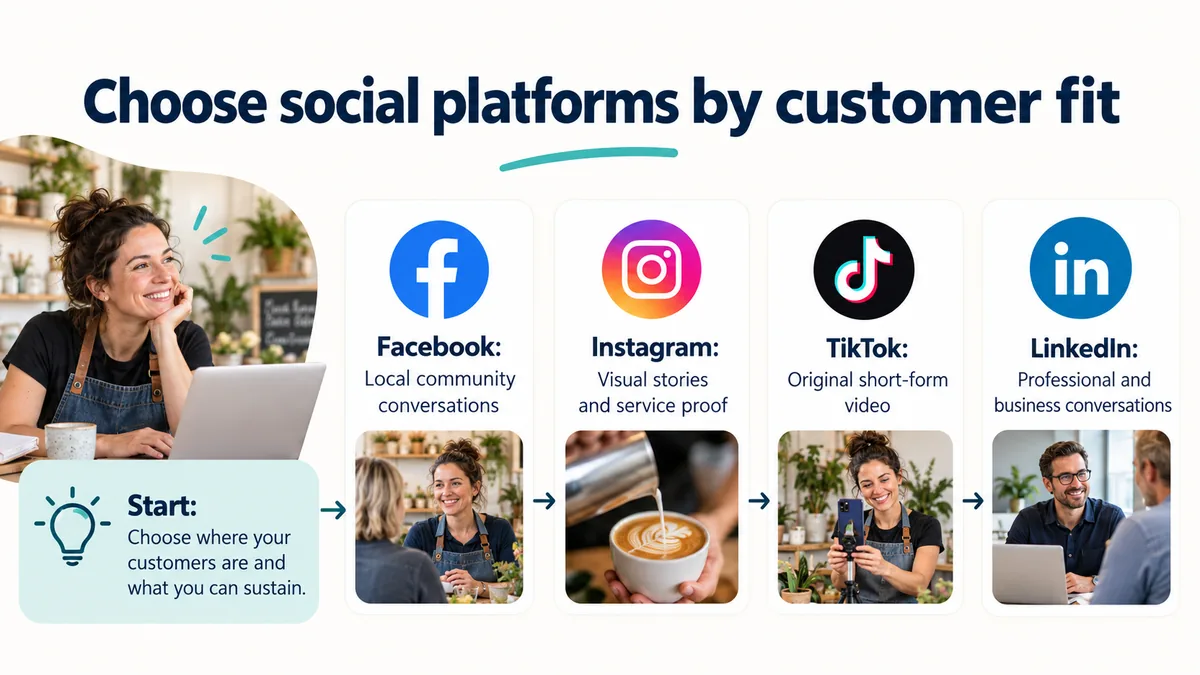
There isn't one "best" social media platform for small business, there's the platform your specific customer is already spending time on, in the mindset to notice you. A Hornsby plumber and a Sydney mortgage broker should not be running the same social strategy, and most of the generic "top 10 platforms for 2026" advice doesn't tell you that. Facebook still reaches the broadest slice of the Australian population and skews older; Instagram is the default for visually-driven, considered-purchase services; TikTok reaches younger audiences through genuinely different content, not repurposed Instagram clips; and LinkedIn is the only platform built for B2B targeting by job title and company size. Pick based on where your customer already is, not on what's trending.
TL;DR
- Facebook reaches 17.7 million Australians (65.3% of the population) and still skews toward Baby Boomers and Gen X, the strongest default for local community-based businesses and broad-reach local advertising (DataReportal, 5 November 2025; Sprout Social, updated 21 September 2026).
- Instagram reaches 15.2 million Australians (56%), skewing toward women aged 25 to 34, and is the strongest fit for visually-driven services, trades with before/after work, wellness, hospitality, property (DataReportal; Sprout Social).
- TikTok reaches 10.9 million Australian adults and now takes more daily attention than any other platform (around 74 minutes a day per user), skewing under-34, a real option for businesses genuinely targeting younger customers, not a mandatory add-on for everyone (Sprout Social, 2026).
- LinkedIn reaches 18 million members and is the only platform that lets you target by job title and company size, the only sensible primary platform for B2B, professional and high-value consulting services (Sprout Social, 2026).
- A platform needs roughly $3,000, $5,000 a month in ad spend before it can optimise properly, spreading a modest budget across three or four platforms usually means none of them get a fair test (Shout Digital, 2026).
- From 10 December 2025, platforms assessed as "age-restricted" must take reasonable steps to stop under-16s holding an account, under the Online Safety Amendment (Social Media Minimum Age) Act, this is shrinking some platforms' reach, particularly ones that previously skewed younger (Australian Government Department of Infrastructure, accessed 6 October 2026).
What's the actual difference between choosing a marketing channel and choosing a platform?
Our guide on which marketing channels your small business should actually use covers the bigger decision, search versus social versus local versus paid advertising as categories. This article picks up one level down: once you've decided social media deserves a seat at the table, which platform inside that category earns your time and budget? Those are different questions with different answers, and conflating them is how businesses end up running a Facebook page, an Instagram account, a TikTok they post to twice and abandon, and a LinkedIn profile nobody checks, all mediocre, none properly resourced.
Which social media platforms do Australians actually use in 2026?
Before picking a platform, it's worth knowing the actual Australian numbers rather than assuming global trends apply locally.
| Platform | Australian reach | Share of population | Core demographic skew |
|---|---|---|---|
| 17.7 million | 65.3% | Baby Boomers, Gen X; broad community use | |
| YouTube | 21.0 million | 77.7% | Broadest reach of any platform; long-form content |
| 18.0 million | 66.6% | Working professionals; only platform with job-title/company-size targeting | |
| 15.2 million | 56.0% | Skews female, 25 to 34; visual discovery and commerce | |
| TikTok | 10.9 million (adults) | 51.2% (adults) | Skews under-34; highest average daily time spent of any platform |
| 5.68 million | 21.0% | Skews heavily female; purchase inspiration, not social networking | |
| X (Twitter) | 4.74 million | 17.5% | Declining; real-time conversation niche |
| Threads | 1.35 million | 5.0% | Early-stage, text-based micro-blogging |
(DataReportal, "Digital 2026: Australia," 5 November 2025; Sprout Social, "Social Media Statistics Australia," published 16 April 2026, updated 21 September 2026.)
The headline takeaway: Facebook and LinkedIn still have the broadest reach in Australia, Instagram and TikTok have the strongest engagement for visually-driven content, and everything below Pinterest is a genuine niche play rather than a default inclusion.
Which platform is right for your type of business?
This is where generic advice runs out, because the right answer depends entirely on how your customer buys.

Trades and urgent home services (plumbers, electricians, locksmiths). Facebook first, for local community groups, Marketplace visibility and an older, local-skewing audience that's already there. Instagram second, if you have genuinely good before/after or on-the-job photo and video content, it's a strong secondary channel for trust-building, not a primary lead source. TikTok is optional and only worth it if someone on the team genuinely enjoys making short, authentic video content; forced TikTok content reads as exactly that. See also our guide on how local tradies can rank on Google without paying for ads, for most trades, search still does more lead-generation work than any single social platform.
Health, allied health and wellness (dental, physio, fitness studios, wellness clinics). Instagram is the primary platform, visual, trust-building content (clinic environment, practitioner introductions, client results where appropriate) performs well with the 25 to 34 female-skewing audience that dominates health and wellness decision-making in most households. Facebook stays relevant for community groups and an older patient base. TikTok can work specifically for fitness and allied health businesses targeting a younger demographic, but it's a considered addition, not a default.
Finance, property and high-value professional services (mortgage brokers, buyers agents, financial advisers, accountants, lawyers). LinkedIn is very often the only platform that matters here. It's the single platform where you can target by job title, seniority and company size, directly relevant for B2B-adjacent services and for reaching professionals making high-value personal decisions. Our piece on how buyers agents get clients in Australia with local SEO covers the search side of this same audience; LinkedIn complements it for relationship-building and referral-adjacent visibility rather than direct lead capture.
Hospitality, fitness studios and visually-driven retail. Instagram first, TikTok a close and genuinely useful second, this is one of the few business categories where TikTok's younger, highly engaged audience and trend-driven content format can outperform Instagram for actual discovery and foot traffic, provided the content is made for TikTok rather than repurposed from elsewhere.
Professional and consulting services more broadly (beyond finance/property). LinkedIn for anything B2B or relationship-driven; Facebook for anything with a genuine local-community angle; Instagram only if there's a visual story to tell (office culture, team, physical workspace), for many pure consulting businesses, none of these outperform a well-run email list and referral network, and that's a legitimate answer too.
Is Instagram or Facebook better for a small business in Australia?
Neither is universally better, they reach genuinely different slices of the same market. Facebook's 17.7 million Australian reach is still the largest of any platform below YouTube, and it over-indexes on Baby Boomers and Gen X, plus anyone using local community groups and Facebook Marketplace. Instagram's 15.2 million reach is smaller but skews younger and female, and its format rewards visual storytelling far better than Facebook's. If your customer is making a visually-informed decision (what will my new bathroom actually look like, what does this gym actually feel like) Instagram usually wins. If your customer is locally embedded and slightly older, the kind of person who still checks a local community Facebook group before calling a tradesperson, Facebook usually wins. Many businesses eventually run both, but a $500, $1,000-a-month marketing budget rarely does, so pick the one that matches your actual customer first.

Is TikTok worth it for a small business, or just for brands chasing Gen Z?
It depends entirely on whether your customer is actually there. TikTok now claims more average daily attention per Australian user than any other platform, around 74 minutes a day, and it grew 13.9% year-on-year in Australia, adding roughly 1.33 million users (Shout Digital, 2026; Sprout Social, 2026). That's a genuinely large, genuinely engaged audience. But it skews firmly under 34, and the format punishes content that's visibly repurposed from Instagram or Facebook, TikTok users can tell, and it performs worse than no post at all. If your customer base is meaningfully younger than 35 and you have the appetite to make native, slightly rougher-edged video content, TikTok is worth testing with a real budget. If your customers are mostly 40-plus, or nobody on your team wants to be on camera regularly, this isn't the platform to force, your time is better spent doing Facebook or Instagram properly.

When is LinkedIn the only platform that matters?
When your customer is a business, a senior decision-maker, or someone making a high-value, research-heavy personal purchase (a mortgage, a financial plan, a property purchase through a buyers agent). LinkedIn's 18 million Australian members and its unique ability to target by job title, seniority and company size make it functionally irreplaceable for B2B and professional services, no other platform offers that targeting precision. The trade-off is cost: LinkedIn's ad CPMs run significantly higher than Meta or TikTok's, because you're paying for precision, not reach. For a finance, property, legal or consulting business, that premium is usually worth it. For a hair salon or a café, it almost never is, your customer isn't making a job-title-relevant decision when they're booking a haircut or a coffee.

What about Pinterest, X, Threads and other emerging platforms?
Treat these as genuine niche plays, not defaults. Pinterest reaches 5.68 million Australians and skews heavily female, it's a real option for home, interiors, fashion and beauty-adjacent businesses, since Pinterest's own data shows the large majority of its users are there specifically for purchase inspiration rather than social browsing, and its ad CPMs run well below Meta's (Shout Digital, 2026). X has declined to 4.74 million Australian reach and makes sense only if your business has a specific reason to participate in real-time public conversation, most small businesses don't, and that ad budget is better spent on Meta, TikTok or LinkedIn. Threads, at 1.35 million reach, is still early-stage in Australia and not yet a sound primary platform for a small business budget, though it's worth monitoring as it matures.
How much does it actually cost to run a platform properly?
Costs vary meaningfully by platform, and knowing the rough numbers helps you avoid spreading a budget too thin.
- Meta (Facebook/Instagram) paid advertising: structured around monthly management tiers, commonly from roughly $997 to $3,500+ a month plus ad spend for a small-to-medium business, depending on campaign complexity and the number of ad sets and creatives involved.
- TikTok advertising: campaign-level minimum spend around $50 a day, with average cost-per-click around $0.99 and cost-per-1,000-impressions (CPM) typically $6, $15 depending on format, a lower entry cost than Meta in absolute terms, but the content production overhead (native video, not repurposed stills) is real and often underestimated (megadigital.ai, 13 January 2026).
- LinkedIn advertising: CPMs run significantly higher than both Meta and TikTok, the trade-off for precision B2B targeting discussed above.
- General rule of thumb: a platform typically needs $3,000, $5,000 a month in ad spend before it has enough data to optimise meaningfully (Shout Digital, 2026). Below that, you're often paying to stay in the platform's "learning phase" rather than generating a predictable return.
This is a large part of why running one platform well usually beats running three thinly, the fixed cost of getting any single platform's algorithm to actually work for you is higher than most small business owners expect.
How many platforms should your business actually be on?
For most service businesses under roughly $2,000, $3,000 a month in total marketing spend, one platform, the one that best matches your customer's demographic and buying behaviour, properly resourced, beats two or three run thinly. Our guide on choosing the right marketing channel mix covers the broader staging logic (when to add a second channel, when to cut one); the same discipline applies one level down, inside social media specifically. Add a second platform only once your first is consistently producing engagement, leads or bookings and you have genuine spare capacity, not because a competitor just started posting on TikTok.
Does Australia's under-16 social media ban change anything for business owners?
It's worth knowing about, even though it isn't primarily a business-marketing rule. From 10 December 2025, the Online Safety Amendment (Social Media Minimum Age) Act requires platforms assessed as "age-restricted", broadly, services built around account-based recommendation feeds with features like infinite scroll or disappearing stories, to take reasonable steps to stop under-16s holding an account, with penalties for non-compliant platforms running up to $49.5 million (Australian Government Department of Infrastructure, accessed 6 October 2026). The practical effect for a business owner: platforms that previously skewed younger, particularly TikTok and Instagram, have already seen a measurable reduction in under-16 accounts, which slightly changes the audience composition you're advertising into, one more reason to check current platform demographics rather than relying on a figure from a few years ago. It has no direct compliance obligation for the businesses advertising on these platforms, that responsibility sits with the platforms themselves.
Frequently Asked Questions
Is Instagram or Facebook better for a small business in Australia?
Neither is universally better. Facebook has the broader reach (17.7 million Australians) and skews older; Instagram is smaller (15.2 million) but skews younger and performs better for visually-driven, considered purchases. Match the platform to your actual customer's age and buying behaviour rather than picking the more popular option in general.
Should tradies be on TikTok?
Only if your customer base is genuinely younger, TikTok skews firmly under 34. For most trades, whose customer base tends to be older homeowners, Facebook and good before/after Instagram content usually outperform TikTok, and search (Google Business Profile and local SEO) typically outperforms all social platforms for direct lead generation.
Is LinkedIn worth it if I'm not a B2B business?
Generally no. LinkedIn's advantage is its job-title and company-size targeting, which only matters if you're selling to businesses or to professionals making a role-relevant decision. A café, salon or fitness studio gets little benefit from LinkedIn's premium-priced targeting and is better served by Facebook or Instagram.
How long before a new platform starts producing leads?
Give a paid channel on any platform roughly 90 days with adequate budget to exit the platform's learning phase, and give organic content at least 3 to 6 months of consistent posting before judging results. Platforms generally need $3,000, $5,000 a month in spend to optimise properly, underfunding a platform and judging it after a month usually just means the platform never got a fair test.
Can I use the same content on every platform?
Not successfully. Audiences on TikTok in particular can tell when content is repurposed from Instagram or Facebook, and it tends to underperform genuinely native content. Adapting format and tone per platform matters more than most small businesses expect, this is a key reason to run fewer platforms well rather than many platforms with recycled content.
Do I need a different approach for ads versus organic content on the same platform?
Often yes. Organic content needs to hold attention without a "watch this now" incentive, while paid content needs a clear, fast hook and call to action because you're interrupting someone's feed rather than earning their attention through a following they've chosen. The platforms that reward strong organic content (TikTok, Instagram) don't always reward the same creative approach in paid placements.
Where to go from here
Choosing a platform isn't a branding decision, it's a budget decision, because every platform needs to be properly resourced to actually produce leads rather than just likes. If you want help working out which platform your specific customers are actually on, and what running it properly would cost, our social media marketing service covers both organic content management and paid social advertising across Facebook, Instagram and beyond, and our packages page breaks down bundled pricing if you want social media considered alongside the rest of your marketing. If you'd rather talk it through first, book a free 30-minute strategy call and we'll help you work out where your customers actually are, not where everyone else happens to be posting.
Sources and References
- DataReportal, "Digital 2026: Australia", published 5 November 2025.
- Sprout Social, "Social Media Statistics Australia", published 16 April 2026, updated 21 September 2026.
- Shout Digital, "Social Media Marketing Australia 2026", accessed 6 October 2026.
- megadigital.ai, "TikTok Ads Pricing 2026", published 13 January 2026.
- Australian Government Department of Infrastructure, "Social media minimum age", accessed 6 October 2026.