

A limited marketing budget does not mean you skip the plan. It means the plan has to be tighter. Pick one goal, one or two channels you can actually run well, and a simple way to track cost per lead rather than just spend. Everything else is noise you cannot afford yet.

In this article:
- A real plan starts with one goal and one number to hit, not a wish list of channels.
- Owned and earned channels (your Google Business Profile, email list, and organic social) earn their keep before any paid channel does.
- Running two channels properly beats running five badly. Most tight-budget plans fail from spreading too thin, not from spending too little.
- Google's own guidance on daily budgets shows spend naturally varies day to day, and a tight budget needs a plan that survives that variance, not one that assumes perfectly even spend.
- Track cost per lead and cost per customer, not impressions or followers. Vanity metrics are the fastest way to lose a small budget without noticing.
Why Does a Tight Budget Need a Different Kind of Plan, Not Just a Smaller One?
A lot of small business owners treat a limited marketing budget as a scaled-down version of what a bigger competitor does: a bit of everything, just less of it. That is the mistake. When money is tight, the plan needs fewer moving parts, not the same number of channels run thinner.
Australia's small business sector is overwhelmingly built around exactly this constraint. The Australian Bureau of Statistics counted 2,814,778 actively trading businesses at 30 June 2026, and 2,741,087 of them, about 97 per cent, have fewer than 20 employees.1 Most of the businesses reading this do not have a marketing department. They have an owner doing marketing between jobs, appointments, or shifts.
The Australian Small Business and Family Enterprise Ombudsman's February 2026 Small Business Pulse report found over 60 per cent of small businesses operate with no additional employees beyond the owner, and described margin pressure, high business costs and regulatory complexity as the backdrop shaping cautious spending decisions across the sector.2 That is not a reason to skip marketing. It is the reason the plan has to be disciplined about where every dollar goes.
What Should Actually Go Into the Plan Before You Spend a Cent?
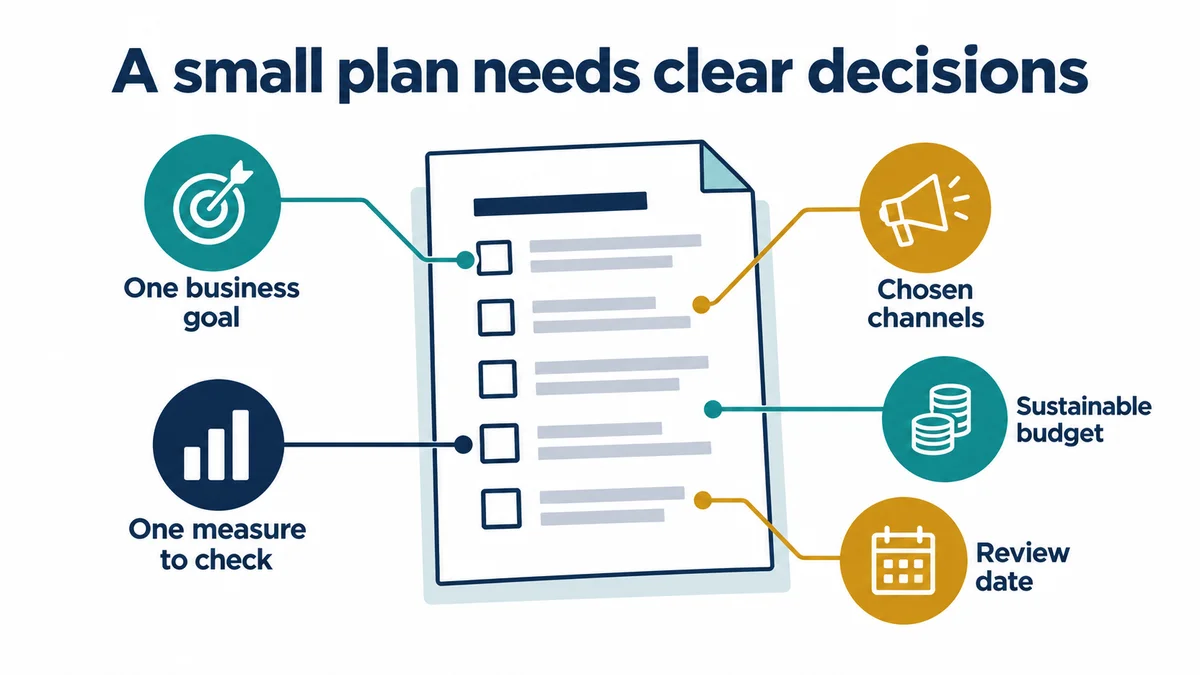
Three things, in this order, before any channel gets picked:
One business goal, stated as a number. Not "get more customers," but "generate 15 qualified enquiries a month for kitchen renovations" or "fill 8 extra appointment slots a week." A vague goal makes every channel look equally justifiable, which is exactly how tight budgets get spread too thin.
One number you will actually check. Cost per lead, not cost per click or cost per impression. A $4 click that never converts is worse than a $12 click that books a job. If you cannot measure cost per lead yet, your first budget line item might be a basic way to track where enquiries come from, even a simple "how did you hear about us?" field on your enquiry form counts.
A monthly, not annual, review point. With a small budget, you cannot afford to run a bad channel for six months before noticing. Review monthly: what did each channel cost, what did it produce, and is that worth repeating.
Should You Build a 12-Month Plan or Something Shorter?
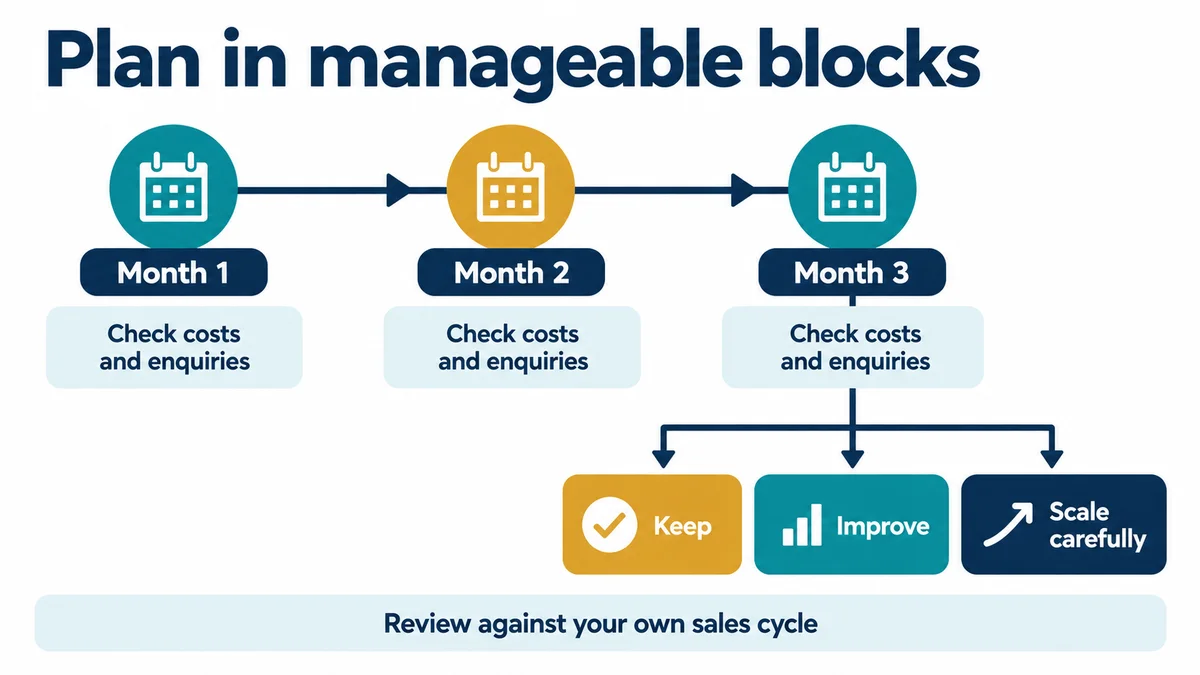
Build the plan in three-month blocks. A full annual plan looks professional, but with a limited budget it mostly commits you to decisions made months before you had any real data. A 90-day block gives you enough time to see a channel actually perform, most channels need 60 to 90 days to show a genuine trend, not a lucky week, while still letting you redirect spend quickly if something clearly is not working.
Inside each 90-day block, keep the structure simple: one primary channel getting most of the budget, one secondary channel getting a smaller test allocation, and a fixed decision point at the end: keep, cut, or scale.
Which Channels Should Get the Money First When the Budget Is Small?

Start with what is free or near-free before anything paid:
- Your Google Business Profile. Fully completed, with current photos, accurate categories and a steady trickle of reviews, it costs nothing and is often the first thing a local customer sees. If you have not optimised it properly, that is the highest-leverage unpaid move available.
- Your existing customer and enquiry list. Email marketing remains one of the most cost-efficient channels for small businesses precisely because you already own the audience. You are not paying a platform to reach them again.
- Organic social media, used consistently rather than occasionally, on the one or two platforms your actual customers use, not every platform that exists.
Only once those are genuinely running should paid channels enter the plan, and even then, one paid channel run properly outperforms three run on autopilot. A Constant Contact-commissioned survey of Australian and New Zealand small and medium businesses, reported by IT Brief Australia on 18 June 2026, found unpaid social media, 45.8 per cent, and email marketing, 41 per cent, were the most-used channels among respondents, ahead of paid social advertising at 29.5 per cent, which lines up with the owned-channels-first order above, even if the survey does not frame it that way itself.3
The same survey found marketing being seen as "too expensive" was cited by around 24 per cent of respondents as a challenge, and difficulty tracking what is actually working by around 22 per cent. Those two numbers are connected: a channel feels expensive when you cannot tell if it is working. Fix the tracking before you judge the cost.
How Much Should You Actually Spend if the Budget Really Is Tight?

There is no single right number. It depends on your margins, your sales cycle, and what a new customer is worth to you, and any agency promising a specific figure without knowing those details is guessing. What is worth understanding is how the spend mechanics work, so a small budget does not quietly underperform because of how it is structured, not because it was too small to begin with.
Google's own Ads Help documentation explains that an average daily budget is just that, an average. Google can shift spending toward days when clicks and conversions are more likely, which means on some days you might not reach your average daily budget, and on others you might exceed it.4 Even with that variation, Google caps actual daily spend at no more than roughly twice the average daily budget, and monthly spend at no more than about 30.4 times it. In practice, that means a $10 a day budget should never cost more than around $304 in a calendar month, but it might cost $4 on a quiet Tuesday and $19 on a busy Saturday. If you are watching daily numbers and panicking on the expensive days, you are reading the data wrong.
The practical takeaway for a tight budget: pick a monthly figure you can sustain for at least 90 days without touching it, divide it to set the daily number, and then leave it alone long enough to see a real pattern, not a single expensive day. We have covered whether $10 a day is actually enough for Google Ads in more detail if that is the budget range you are working with.
What Are the Most Common Mistakes Small Businesses Make With a Limited Marketing Budget?
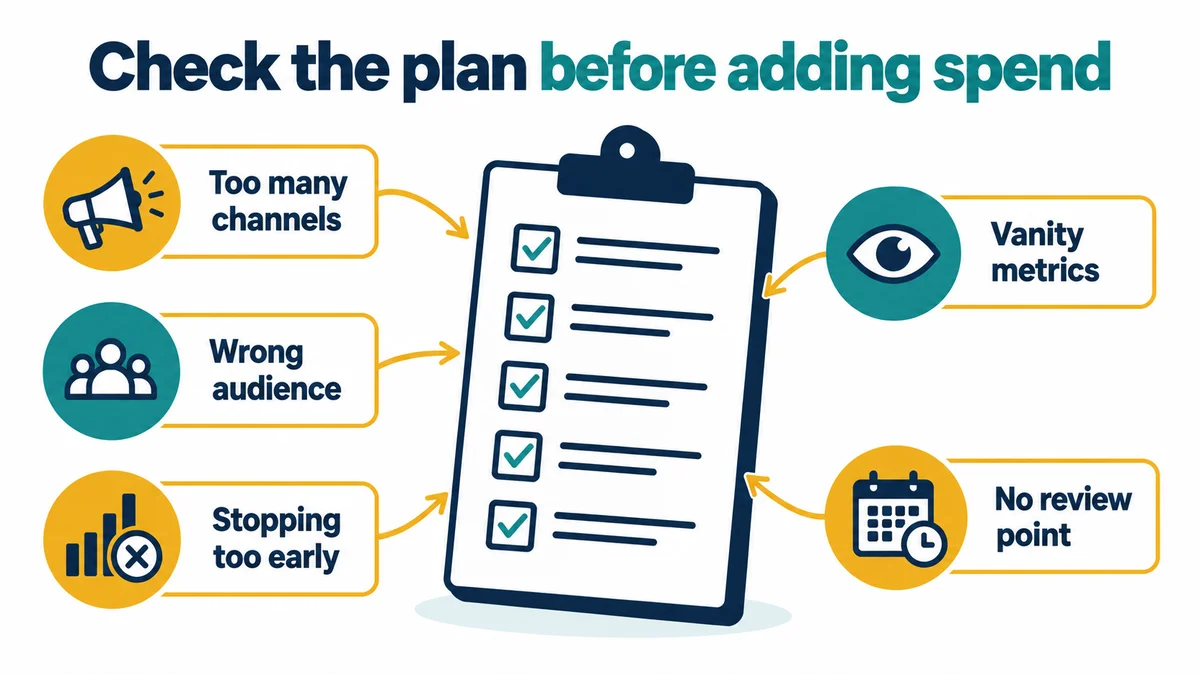
- Spreading across too many channels. This is the single most common one. Five channels at $100 a month each almost always underperforms two channels at $250 a month each, because each channel needs a minimum level of consistency before it produces anything measurable.
- Chasing the newest platform instead of the one customers actually use. A new social platform or AI tool getting attention in marketing circles is rarely where a local tradie, allied health clinic, or boutique retailer's actual customers are searching.
- Judging a channel too early. Cutting a channel after two or three weeks because "nothing's happening yet" before it has had time to build any signal.
- Tracking vanity numbers instead of business numbers. Followers, impressions, and likes feel like progress, but they do not pay the bills. Cost per lead and cost per booked job do.
- No review point at all. Without a fixed monthly check-in, budget keeps flowing to whatever was decided three months ago, whether or not it is still working.
How Does This Fit Into a Bigger Digital Marketing Strategy?

A budget-limited plan is not a lesser version of a full digital marketing strategy. It is a disciplined subset of one. Our broader pillar article on what actually matters in digital marketing for Australian small businesses covers the full picture this plan sits inside. The same structure, one goal, the right channel mix for your business, consistent measurement, scales up as your budget grows, it does not get replaced. Our guide on which marketing channels small businesses should actually use is a useful next read once you have got the basics running, and our broader breakdown of how much Australian small businesses should budget for digital marketing overall is worth checking if you are still deciding the top-line number before allocating it.
If you are working with a genuinely limited budget, the highest-value thing we can usually do is not run more channels for you. It is helping you choose the right one or two and set them up properly so the budget is not wasted on preventable mistakes. That is the thinking behind our All-in-One Packages, built for businesses that need a coordinated plan without a full in-house marketing team, and our AI Marketing services, which can handle a lot of the time-consuming consistency, posting, follow-up, basic tracking, that a tight budget usually cannot afford to pay a person to do manually. Have a look at our full range of marketing services if you are still working out where to start. No ranking or lead-volume guarantees here, every business's starting point, margins and market are different. If you want a second opinion on your current budget and channel mix before committing to a plan, book a free session and we will go through it with you.
FAQ
Do I need a formal written marketing plan if my budget is small?
You need a plan, but it does not need to be a long document. One page covering your goal, your chosen channel(s), your monthly budget, and your review date is enough. The discipline matters more than the format.
Is it better to do a little bit of marketing across several channels, or focus on one?
Focus on one or two, run properly, almost always beats several run thinly, because most channels need a minimum level of consistent spend and attention before they produce measurable results.
Should I do my own marketing or get help if the budget is tight?
It depends on your time and skills more than your budget. DIY can work well for owned channels like your Google Business Profile and email list. Paid channels like Google Ads or Meta Ads usually benefit from some professional setup even on a small budget, because mistakes in the first few weeks waste money that a tight budget cannot absorb.
How often should I review my marketing budget?
Monthly, at minimum, with a bigger strategic check-in every 90 days. Waiting longer risks letting an underperforming channel burn budget for months before anyone notices.
What's a realistic first channel for a very small marketing budget?
For most local service businesses, a fully optimised Google Business Profile plus consistent email contact with your existing customer list costs almost nothing and should come before any paid advertising.
Can a small budget still compete with bigger competitors who spend more?
Yes, on specific, well-chosen fights, not on volume. A disciplined small budget aimed at one clear goal regularly outperforms a larger, unfocused budget spread across everything.