OZ Media Digital
For most Australian small businesses, $10 a day isn't enough to run a genuinely competitive Google Ads campaign. It works out to roughly $300 a month in ad spend, below the volume Google's own Smart Bidding needs to learn properly, and in trades, legal, finance and other higher-CPC categories it may only buy you a handful of clicks a day. It can still earn its place as a narrow, deliberate test in select low-cost niches, but it should be treated as a proof-of-concept, not a lead-generation budget.
TL;DR
- $10 a day can actually cost you up to $20 on any single day, Google Ads can spend up to double your daily budget when demand is high, capped by a hard monthly ceiling of 30.4× your daily budget (so $10/day tops out at $304/month, guaranteed, no more).
- At typical Australian local-trades and home-services CPCs ($3, $8), $10/day buys roughly 1.25 to 3.3 clicks a day. In legal, finance and insurance (AU CPC often $10, $50+), it may not buy a full click on some days.
- Google's own guidance recommends measuring Smart Bidding performance over periods with at least 30 conversions a month (50 for Target ROAS), a $10/day budget in most service categories will take months, not weeks, to accumulate that much data.
- $10/day can be a legitimate test for low-CPC retail/e-commerce keywords, a single hyper-local suburb campaign, branded-search defence, or remarketing to an existing audience, where it's used as a controlled experiment, not a growth engine.
- Most Australian small businesses running a serious, results-driven Google Ads campaign are putting $500 to several thousand dollars a month into ad spend alone, separate from any management fee.
- If $10/day is genuinely your ceiling right now, your money may work harder in local SEO and Google Business Profile optimisation than in paid search.
How Far Does $10 a Day Actually Stretch on Google Ads?
The honest starting point is arithmetic, not opinion. A $10 daily budget in Google Ads isn't a hard $10-per-day cap, Google's own "About spending limits" Help page confirms your campaigns can spend up to roughly double your average daily budget on any individual day when Google detects higher-than-usual demand, so a $10/day setting might see a $19 or $20 day here and there. What protects you from real budget blowouts is the monthly side: Google caps your total monthly charge at 30.4 times your average daily budget (365 days ÷ 12 months), which on a $10/day setting works out to a hard ceiling of $304 a month. You will never be billed more than that, whatever the daily swings look like.

So the real question isn't "what does $10 buy me today", it's "what does roughly $300 a month buy me in my industry." And that's where the numbers get uncomfortable for a lot of service businesses.
Australian cost-per-click data compiled by 20minutemarketing.com.au puts typical local ranges at:
- E-commerce, retail and hobbies: roughly $1.00, $3.00 per click
- Local home services and contractors (trades, cleaning, pest control and similar): roughly $3.00, $8.00 per click
- Legal, finance and insurance: roughly $10.00, $50.00+ per click
At the low end (retail, $1, $3 CPC), $300 a month could plausibly buy 100 to 300 clicks, a workable, if modest, test. At the middle of the trades range ($3, $8), that same $300 buys somewhere between 37 and 100 clicks a month, call it one to three clicks a day. In legal, finance or insurance, $300 might not clear ten clicks across the entire month, and on a genuinely competitive day, $10 may not even win you a single click before the budget runs out.
For a broader, global reference point, WordStream's 2026 Google Ads Benchmarks report (covering April 2025 to March 2026, weighted toward US campaign data rather than Australia specifically) puts the overall average CPC at USD $5.42, ranging from around $1.63 in arts and entertainment up to $9.87 in attorneys and legal services, directionally consistent with the Australian figures above, even if the exact dollar values differ by market and currency. Neither figure should be treated as your figure: actual CPC depends heavily on your specific keywords, location targeting, ad quality and competition on the day, which is exactly why testing your own numbers matters more than any published benchmark.
Why Does Google Ads Need More Data Than $10 a Day Can Buy?
Modern Google Ads campaigns are built around Smart Bidding, Google's machine-learning bid system that sets bids in real time at each individual auction, weighing signals like device, location, time of day, search intent and past conversion behaviour to predict which clicks are worth paying for. It's genuinely effective when it has enough data to learn from. The problem with a very small budget isn't that Smart Bidding refuses to run, it's that it can't learn quickly, because there isn't enough conversion volume to teach it anything.
Google's own "About Smart Bidding" documentation is explicit on this point: it recommends measuring performance over periods with at least 30 conversions, typically a month or longer, for most bidding strategies, and 50 conversions for Target ROAS specifically. That's the baseline Google itself considers meaningful for judging whether a strategy is working, not an aggressive ask.
Run the maths against a $10/day budget in a mid-range local-trades category. At $3, $8 per click and a realistic small-business landing-page conversion rate, WordStream's 2026 data puts average conversion rates anywhere from roughly 3% (finance, real estate) up to 15 to 16% (automotive repair, pet services) depending on category, though these are global figures and yours will vary, you might be looking at one to a handful of leads a week, not a month. Reaching 30 conversions could take two to three months of a campaign sitting in "learning mode," during which Smart Bidding is guessing more than it's optimising, and you're paying for clicks the whole time regardless.
This is the mechanical reason a lot of very small budgets underperform: not because Google Ads doesn't work, but because the budget never buys enough data for the platform's own optimisation tools to do their job.
Is There Any Scenario Where $10 a Day Actually Works?
Yes, as long as you're honest about what you're using it for. A handful of situations make a $10/day budget genuinely defensible:

Low-CPC retail or e-commerce keywords. At $1, $3 CPC, $300 a month buys enough volume to generate real signal within weeks rather than months, especially for a specific, well-targeted product line rather than a broad category.
A single hyper-local test campaign. Narrowing to one suburb, one service, and a tight keyword list concentrates a small budget instead of spreading it thin across a whole account, and it gives you a genuine read on whether paid search converts for that specific offer before you commit more.
Branded search defence. Bidding on your own business name to stop competitors or directories from appearing above your organic listing typically costs very little per click and doesn't need Smart Bidding's full learning volume to justify itself.
Remarketing to an existing audience. Showing ads to people who've already visited your site is usually far cheaper per click than cold search terms, because you're not competing in the open auction as aggressively, a small budget stretches further here than anywhere else in the account.
Used this way, $10/day is a controlled experiment: a way to gather early signal, test messaging, or defend a small but important slice of visibility, not a substitute for a proper lead-generation campaign.
What Happens If You Run a Serious Campaign on a $10/Day Budget?
The failure mode is predictable, and it shows up in the account's own reporting if you know where to look. A budget that's genuinely too small for its industry and goal typically produces some combination of:
- "Limited by budget" status appearing against your campaigns, Google's own signal that it could be winning more auctions and generating more clicks if the budget allowed, meaning you're actively leaving relevant searches unanswered.
- Lost impression share due to budget, meaning your ads simply stop showing for a meaningful share of the searches you'd otherwise be eligible for, once the daily cap is hit.
- A campaign that never really exits Smart Bidding's learning phase, because it doesn't accumulate conversions fast enough, so the algorithm keeps making comparatively uninformed bidding decisions indefinitely rather than converging on what actually works.
- Cost-per-lead figures that look artificially high, not because the channel is bad value, but because the fixed cost of getting a campaign live and structured is being spread across too few conversions to judge properly.
None of this means the money is wasted outright, but it does mean you're unlikely to get a fair read on whether Google Ads works for your business from a $10/day test in anything but a genuinely low-CPC category.
What Should You Budget Instead? A Realistic Starting Point
A commonly used rule of thumb, echoed in Australian small-business guidance from 20minutemarketing.com.au, is to budget enough daily spend to capture somewhere in the order of 15 to 20 clicks a day, which gives Smart Bidding a workable volume to optimise against within a reasonable timeframe rather than months. Translated into dollars, that looks roughly like:

- Retail/e-commerce ($1, $3 CPC): roughly $15, $60/day, or $450, $1,800/month
- Local trades and home services ($3, $8 CPC): roughly $45, $160/day, or $1,350, $4,800/month
- Legal, finance and insurance ($10, $50+ CPC): $150/day and up, easily $4,500+/month
These are directional ranges built from published CPC data, not a promise about what you personally will pay or generate, your actual numbers depend on your specific keywords, location, competition and ad quality. For a real-world anchor point rather than a rule of thumb: OZ Media Digital's own live Google Ads management guide currently suggests a $1,000, $3,000/month ad-spend range to pair with its entry-level management package, scaling to $3,000, $8,000/month and $8,000, $20,000/month at higher tiers, explicitly framed on that page as a suggested guide, not a fixed quote, because ad spend is ultimately the business owner's call and can be adjusted month to month. It's one genuine Australian data point, not a universal minimum.
The broader pattern holds either way: most small businesses running Google Ads with a real intent to generate leads are working with monthly ad-spend budgets well above $300, particularly outside low-CPC retail categories.
Should You Spend $10/Day on Google Ads, or Somewhere Else?
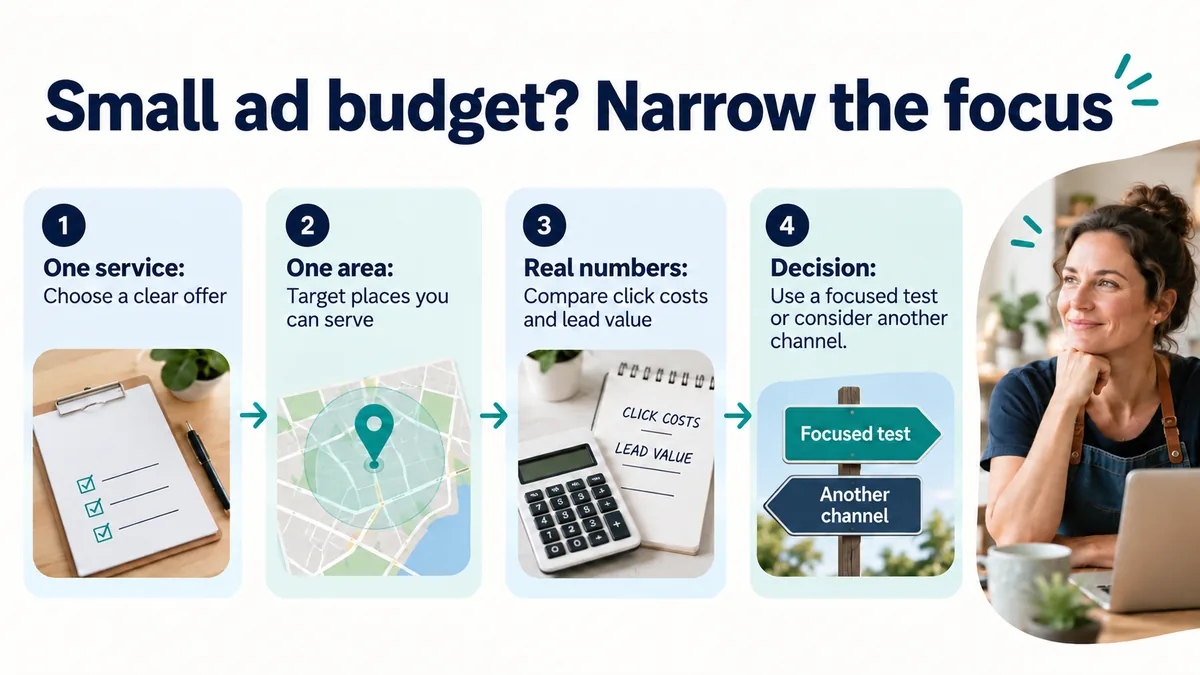
If $10/day is genuinely your ceiling right now, it's worth asking whether paid search is the highest-leverage place to put it at all. Google Ads is a rented-visibility channel, spend stops, visibility stops. Local SEO and Google Business Profile optimisation are slower to build but compound over time, and for many local service categories they can return more qualified enquiry volume per dollar than an under-funded ads account, particularly once you're already visible organically for your core services. That's not a universal rule, competitive, high-intent categories (emergency trades, urgent legal or medical needs) often need paid visibility that organic simply can't deliver fast enough, but it's worth weighing deliberately rather than defaulting to ads because it feels like "doing something."
It's also worth separating two very different problems that both show up as "Google Ads doesn't work for me": a budget that's genuinely too small to generate enough data, versus a properly funded campaign that's converting poorly for reasons that have nothing to do with budget size, broken conversion tracking, a weak landing page, an account still stuck in Smart Bidding's learning phase, or an offer that doesn't match what the searcher actually wants. If you're already spending a reasonable amount and still seeing no results, that's a different diagnosis with a different fix, worth reading alongside this piece.
How Do You Scale Up From a Small Budget Without Wasting Money?
If $10/day is your genuine starting point rather than your permanent ceiling, the most efficient path is usually to go narrow before you go wide. Concentrate the budget on one tightly defined campaign, a single service, a single suburb or region, a short, high-intent keyword list, rather than spreading it thinly across everything you offer. Watch impression share and "limited by budget" flags in the account as an honest signal of whether the budget is genuinely constraining performance. As conversions accumulate and cost-per-lead becomes clearer, graduate the budget in deliberate steps rather than large jumps, so you can attribute performance changes to the right cause.

At some point, most business owners running this kind of campaign hit a genuine decision point: keep managing it themselves as the account grows more complex, or bring in someone who manages Google Ads accounts full-time. That's a real trade-off between time, learning curve and opportunity cost rather than an obvious answer either way, worth thinking through properly rather than defaulting on instinct.
Frequently Asked Questions
Can I actually run Google Ads for $10 a day in Australia?
Yes, technically, Google Ads has no fixed minimum daily budget, and $10/day is a valid setting. Whether it's effective depends entirely on your industry's typical cost-per-click: it can work reasonably well in low-CPC retail categories, and struggles in higher-CPC categories like trades, legal or finance, where it may buy only a handful of clicks a day.
What's the minimum budget Google recommends for Google Ads?
Google doesn't publish a universal minimum daily or monthly budget. Its own guidance instead points to data volume: it recommends judging Smart Bidding performance over periods with at least 30 conversions a month (50 for Target ROAS), which indirectly implies a budget large enough to generate that many conversions within a reasonable timeframe for your industry and conversion rate.
Will Google Ads actually spend more than my set daily budget?
On individual days, yes, Google Ads can spend up to roughly double your average daily budget when it detects higher demand, to capture strong days of traffic. It balances this out over the month, and your total monthly charge is capped at 30.4 times your average daily budget, so you'll never be billed more than that hard ceiling.
How much should a small business realistically budget for Google Ads in 2026?
It depends heavily on your industry's cost-per-click and how many clicks you need to generate enough conversions for Smart Bidding to optimise properly, commonly cited Australian small-business guidance suggests budgeting for at least 15 to 20 clicks a day as a starting point, which translates to anywhere from a few hundred to several thousand dollars a month depending on your category's typical CPC.
Would $10 a day be better spent on Meta/Facebook Ads instead?
Not automatically, the same underlying issue (limited budget limits data, and data is what makes automated bidding work) applies across platforms, not just Google Ads. The right channel depends more on where your customers are actively searching with intent (favouring Google Ads) versus where they can be reached and influenced while browsing (favouring Meta), rather than which platform happens to be cheaper per click on paper.
How long before I'll know if my Google Ads budget is actually working?
Google's own guidance points to at least a month of data with a meaningful conversion count (30+, or 50+ for Target ROAS) before drawing firm conclusions about a bidding strategy's performance. On a very small budget in a higher-CPC category, reaching that volume can take considerably longer than a month, which is itself useful information about whether the budget matches the category.
Ready to Find Out What Your Budget Can Actually Do?
If you're weighing up whether $10 a day, or any budget, makes sense for your business, the honest answer depends on your specific industry, location and competition, not a generic rule of thumb. OZ Media Digital's Google Ads management service is built around setting realistic budgets from day one, based on real auction data for your category rather than guesswork, with transparent tiers and suggested ad-spend ranges so you know what you're actually working with before you commit. If you're not sure which tier, or whether paid search is even the right first move, fits your situation, our full service packages lay out the options side by side. Book a free consultation and we'll give you a straight answer on what your budget can realistically achieve, before you spend a dollar.
Sources and References
- Google Ads Help, About spending limits, accessed 2026-09-28. Primary source for the 2x daily / 30.4x monthly budget mechanics.
- Google Ads Help, About Smart Bidding, accessed 2026-09-28. Primary source for the 30-conversion (50 for Target ROAS) monthly data benchmark.
- WordStream, 2026 Google Ads Benchmarks, data window April 2025 to March 2026, accessed 2026-09-28. Global/US-weighted CPC and conversion-rate data by industry, explicitly flagged in this article as not Australia-specific.
- 20 Minute Marketing, How Much Do Google Ads Cost in Australia? (2026 Benchmarks), accessed 2026-09-28. Australia-specific CPC ranges by industry and small-business budget guidance.
- OZ Media Digital, Google Ads management service page, accessed 2026-09-28. Live pricing tiers and suggested ad-spend ranges, used as one real-world Australian data point.
All figures current as of the access dates above. Google Ads auction dynamics, CPCs and platform features change regularly, readers should verify current costs for their own keywords and location directly in Google Ads before budgeting.