 OZ Media Digital


Most Australian small businesses should budget somewhere between 5% and 12% of revenue for marketing, with digital channels taking the majority share of that figure for almost every service business. Where you sit in that range depends on how established you are, how competitive your market is, and whether you're trying to hold steady or grow, a five-year-old plumbing business defending its patch spends differently to a new clinic trying to fill its first twelve months of bookings. The bigger mistake isn't picking the wrong percentage, though. It's setting a number with no plan for where it goes, then judging the whole exercise a failure when nothing changes in month one.
The short version:
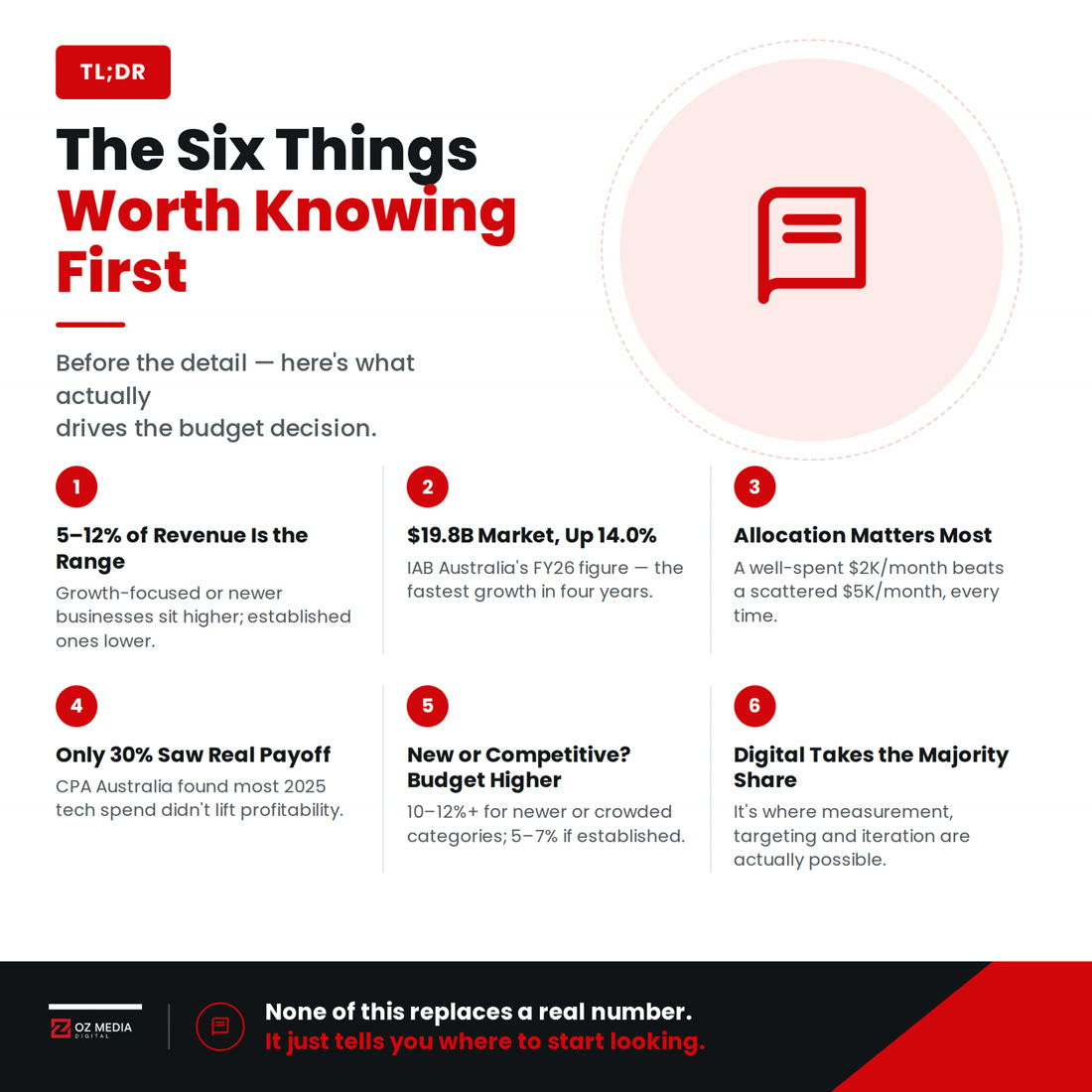
- 5 to 12% of revenue is the standard planning range for small business marketing spend, with growth-focused or newer businesses sitting at the higher end and established businesses defending market share sitting lower. This is a widely used planning benchmark, not a government-mandated figure, treat it as a starting point, not a rule.
- Australia's digital advertising market hit $19.8 billion in FY26, up 14.0% year-on-year (IAB Australia, released 31 August 2026), the fastest growth in four years, which tells you where competitors are already putting their budgets.
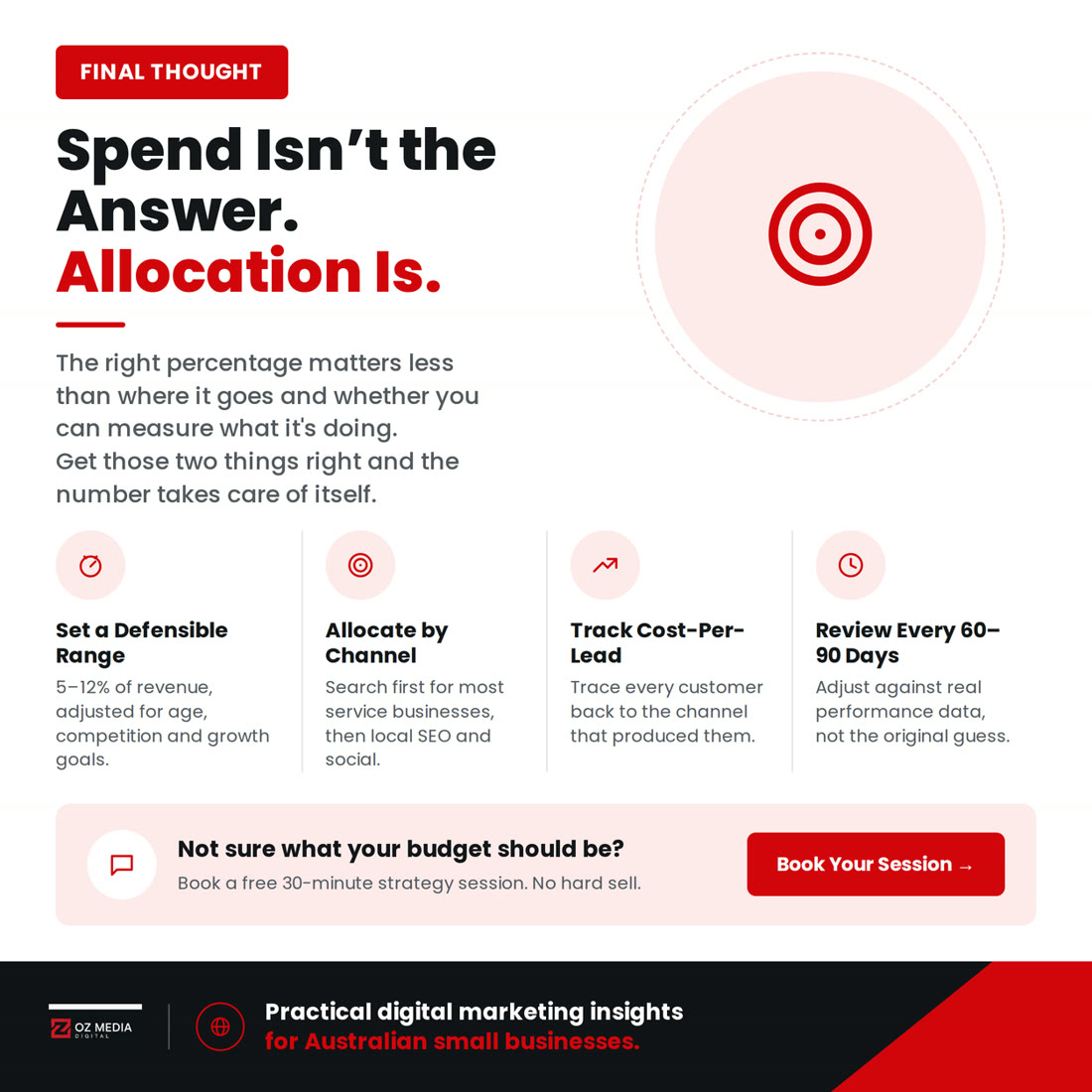
- Budget allocation matters more than the total figure. A business spending $2,000/month well (clear channel focus, tracked conversions, a follow-up process) will consistently outperform one spending $5,000/month scattered across five channels with no measurement.
- Only 30% of Australian small businesses said their 2025 technology investment actually improved profitability (CPA Australia, Asia-Pacific Small Business Survey 2025 to 2026), a reminder that spend without a plan is common, and it's exactly what separates marketing that pays for itself from marketing that doesn't.
- New businesses and businesses in competitive categories should budget toward the top of the range (10 to 12%+); established businesses with strong repeat/referral revenue can often sustain growth at 5 to 7%.
- Digital should take the majority of a service business's budget in 2026, not because print and radio don't work at all, but because digital is where measurement, targeting and iteration are actually possible.
What percentage of revenue should you actually budget?
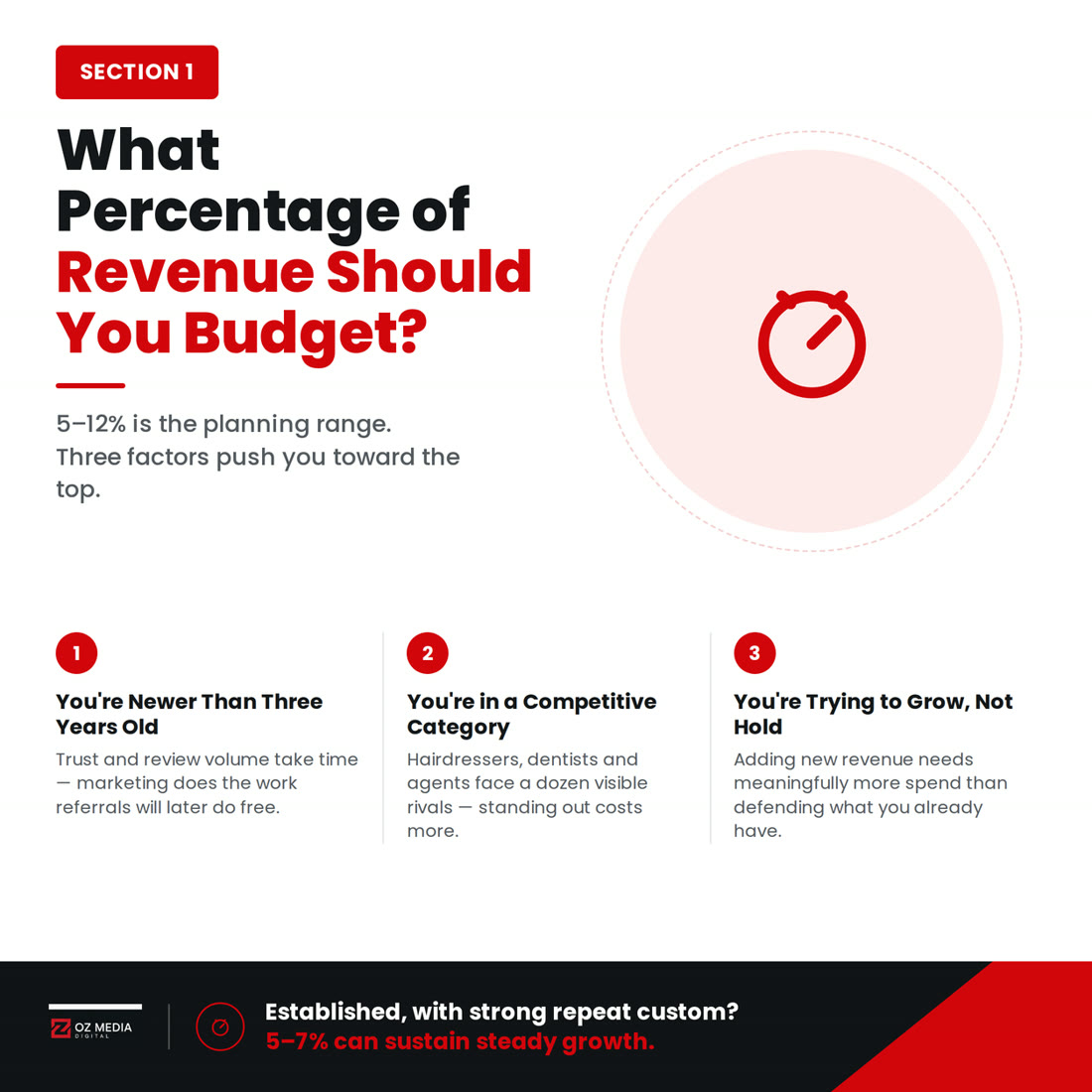
The most commonly cited planning range, 5% to 12% of gross revenue, comes from small business advisory research in the US (the Small Business Administration and marketing associations have published variations of this figure for years) and it's become the de facto industry rule of thumb in Australia too, repeated by agencies and business advisors because nothing more specific and authoritative has replaced it. There's no ATO or ASIC guideline that sets a number for you, and there shouldn't be, the right figure depends entirely on your situation, not a formula.
A few things reliably push a business toward the top of that range:
You're newer than three years old. Brand awareness, trust signals and review volume all take time to build, and until they exist, marketing has to do more of the work that referrals and reputation will eventually do for free.
You're in a genuinely competitive local category. Hairdressers, dentists, physiotherapists and real estate agents in most Australian suburbs are competing with a dozen or more visible alternatives. Standing out costs more than it does in a category with three competitors.
You're trying to grow, not hold steady. Defending existing revenue and market share needs meaningfully less spend than adding new revenue on top of it, a distinction worth being explicit about before you set a number.
Conversely, an established service business with strong repeat custom and a healthy referral pipeline can often sustain itself, and even grow modestly, at 5 to 7% of revenue, because a meaningful share of new business is arriving through channels that don't cost anything per lead.
Should the budget be revenue-based, or should you work backwards from what you need?
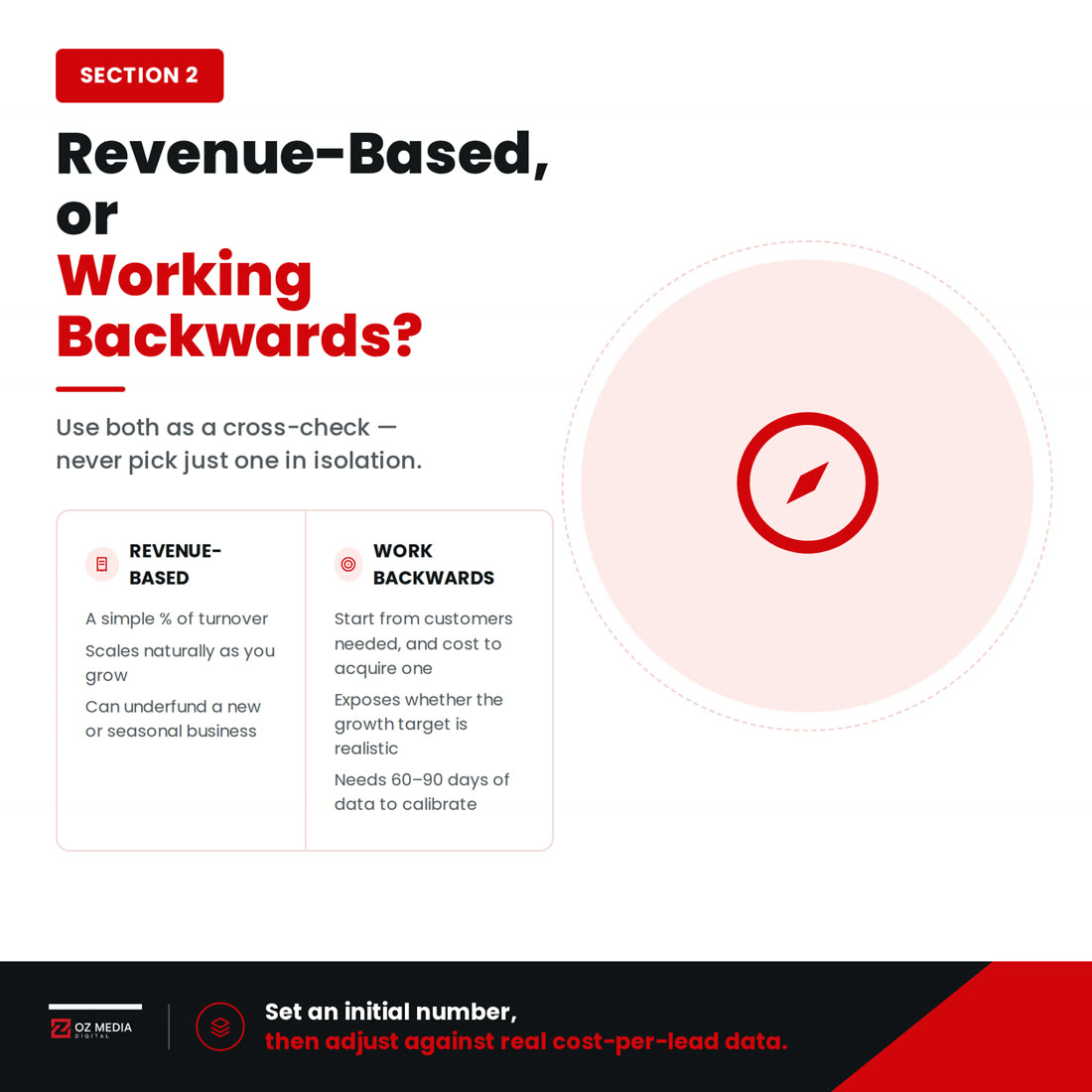
Both, ideally, used as a cross-check on each other rather than picked in isolation. Revenue-based budgeting (X% of turnover) is simple and scales naturally as the business grows, but it can leave a genuinely new or seasonal business underfunded exactly when it needs visibility most, since a percentage of low or early-stage revenue is often too small to do anything meaningful.

The alternative is working backwards from a target: how many new customers do you need this year, what's a realistic cost to acquire one in your category (this varies enormously, a $300 physiotherapy client and a $30,000 kitchen renovation client have wildly different acceptable acquisition costs), and what does that number add up to in total spend? If that figure comes out well above what a straight percentage-of-revenue calculation would suggest, it usually means one of two things: the growth target is genuinely ambitious and needs matching investment, or the assumed cost-per-acquisition is off and needs testing before committing a full year's budget to it.
The most reliable approach in practice: set an initial budget using the revenue-percentage range as a sense check, then adjust based on actual cost-per-lead and cost-per-customer data once campaigns have been running long enough to measure, usually 60 to 90 days for most digital channels. Setting a number and never revisiting it against real performance data is one of the more common reasons a marketing budget starts to look like a sunk cost rather than an investment.
Where should the budget actually go?
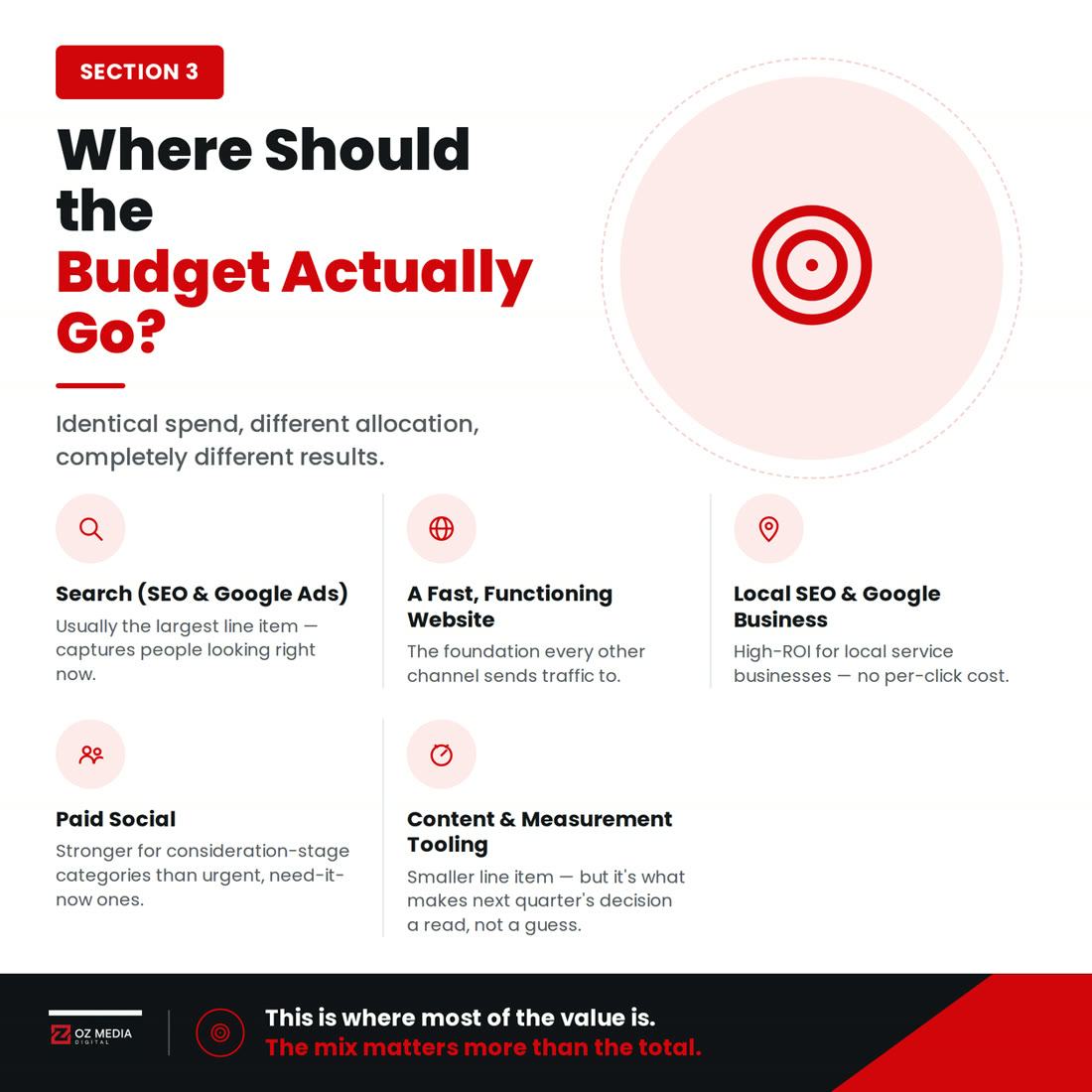
This is where most of the value in the "how much" question actually lives, because two businesses spending identical amounts can get completely different results depending on allocation. A reasonable starting split for most Australian service businesses in 2026 looks like this, though the right mix always depends on category and current visibility:

Search (SEO and Google Ads), typically the largest single line item. Search captures people actively looking for what you offer right now, which is why it tends to convert better than channels built around interruption or discovery. Google Ads costs vary enormously by industry and location, a trade business in a competitive metro suburb pays meaningfully more per click than a niche B2B service, so any fixed dollar figure quoted without context should be treated with caution.
A functioning, fast website. This isn't a separate marketing line item so much as the foundation every other channel sends traffic to, a slow, unclear or mobile-unfriendly site quietly wastes a share of whatever you spend getting people there in the first place. Our web development service builds that foundation in from the start rather than bolting it on after the fact.
Local SEO and Google Business Profile, if the business serves a physical service area, genuinely one of the higher-ROI channels for local service businesses in 2026, since it captures "near me" and local-intent searches without an ongoing per-click cost the way ads do. It's the core of our Local SEO service.
Paid social, where the audience and offer genuinely suit it, generally stronger for consideration-stage categories (home renovation, high-value professional services, anything people research before buying) than for urgent, need-it-now categories where search already dominates intent.
Content and measurement tooling, a smaller line item, but one that compounds. Tracking that actually connects a lead back to the channel that produced it is what turns next quarter's budget decision from a guess into a read of real performance.
The category-specific detail on paid search performance and ROI is covered in more depth in our guide to PPC advertising for small businesses, and the full picture of what's actually working across channels for Australian small businesses heading into 2027 is covered in our flagship guide to digital marketing priorities.
What does the current market tell you about competitive spend?
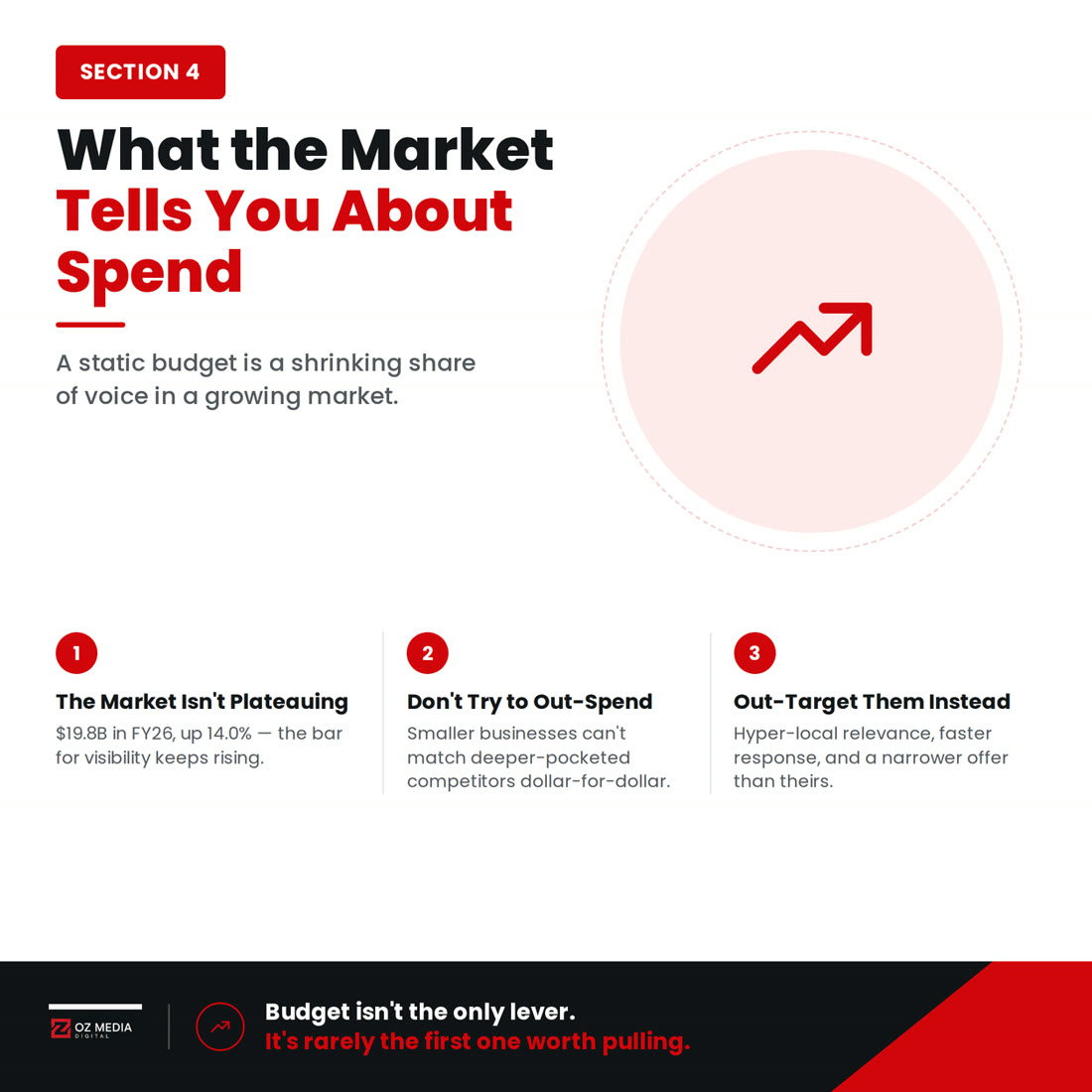
Australia's internet advertising market reached $19.8 billion in the 2026 financial year, up 14.0% on the prior year, the strongest growth in four years, according to IAB Australia's Internet Advertising Revenue Report (released 31 August 2026). That figure matters less as a number to compare yourself against and more as a signal: digital ad investment across the economy is accelerating, not plateauing, which means the bar for visibility in most categories is rising even if your own spend stays flat.
That doesn't mean matching the market's growth rate dollar-for-dollar. It means treating a static marketing budget as a slowly shrinking share of voice in a market where competitors, including ones with considerably deeper pockets, are collectively spending more each year. Smaller businesses can't out-spend larger competitors, and shouldn't try to. What consistently works instead is out-targeting them: hyper-local relevance, faster response to enquiries, and a narrower, better-defined offer than a bigger competitor's broader one. Budget matters, but it isn't the only lever, and it's rarely the first one worth pulling. Our piece on what actually grows a local business beyond the ad spend chase goes into this in more detail, it's worth reading before assuming the answer to under-performance is simply "spend more."
What's the most common budgeting mistake small businesses make?
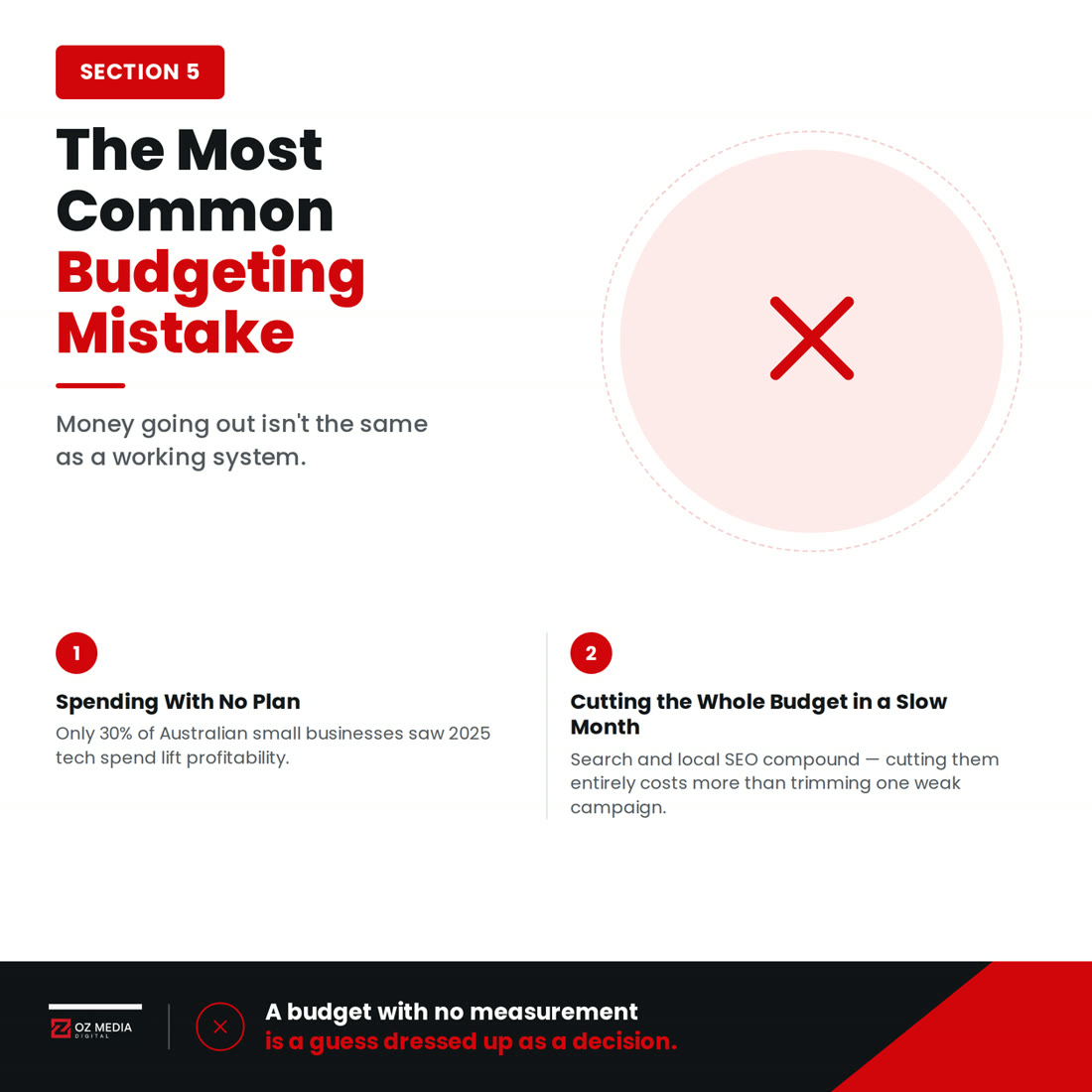
Setting a number without a plan for where it goes, then judging the whole exercise on vibes rather than data three months later. CPA Australia's most recent Asia-Pacific Small Business Survey (2025 to 2026) found only 30% of Australian small businesses said their 2025 technology investment actually improved profitability, one of the weaker results in the region, and a pattern that shows up in marketing spend just as often as it does in software and tooling. Money going out the door isn't the same as a working system, and a budget with no measurement attached to it is a guess dressed up as a decision.

A related mistake: reacting to a slow month by cutting the entire marketing budget rather than the specific underperforming line item within it. Search and local SEO in particular tend to compound, cutting them entirely during a quiet patch often costs more in lost momentum than it saves in that month's spend, whereas trimming an underperforming paid social campaign while search keeps running is a much lower-risk adjustment.
Frequently Asked Questions
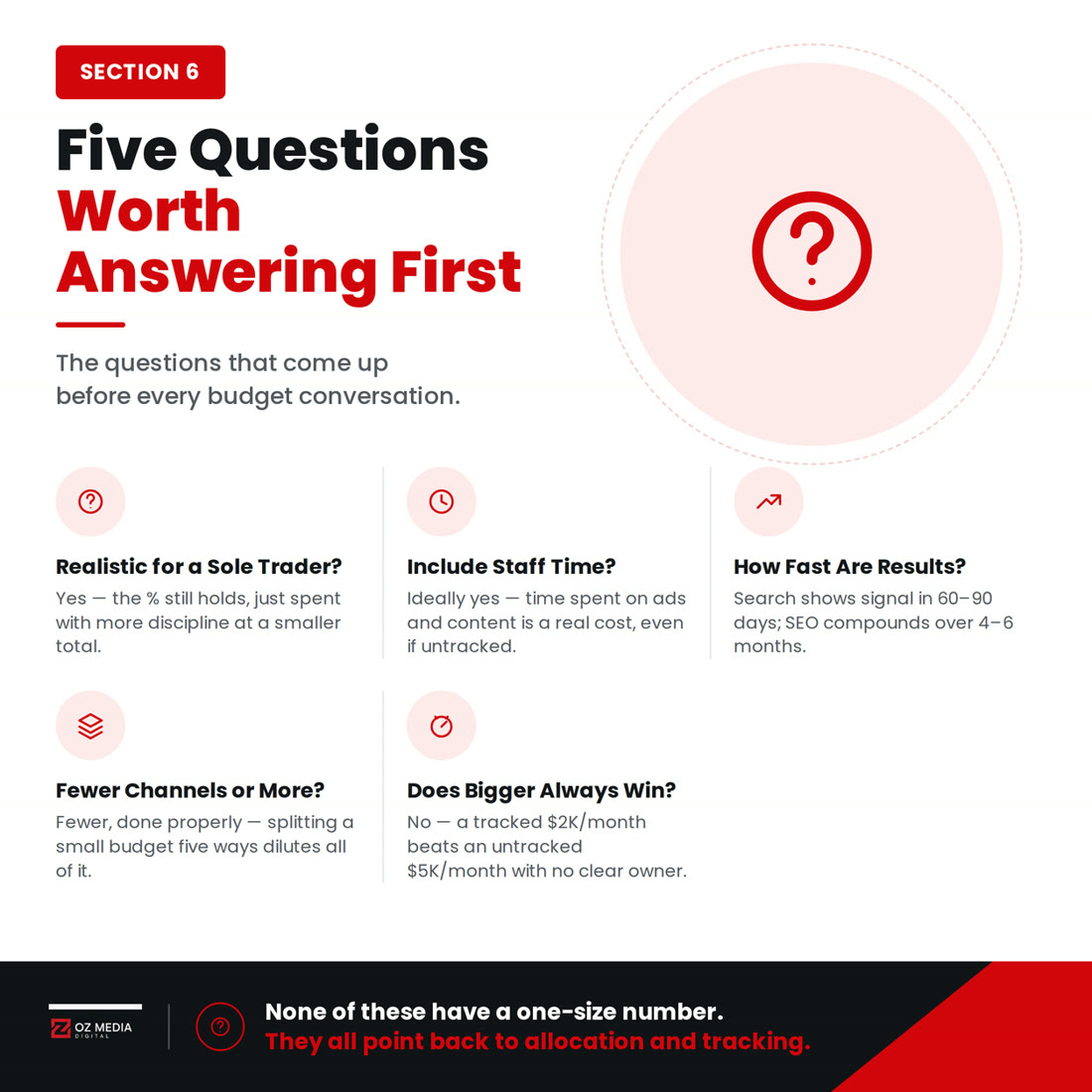
Is 5 to 12% of revenue realistic for a very small or sole-trader business?
Broadly yes, though at low revenue levels the dollar figure can be small enough that it needs supplementing with the business owner's own time on channels like Google Business Profile and organic social, which cost effort rather than cash. The percentage still holds as a planning guide; it just means a smaller total budget needs to be spent with even more discipline than a larger one.
Should the marketing budget include staff time, or only paid media and tools?
Both, ideally, even if only the cash spend is tracked formally. Time spent writing content, managing ads, responding to enquiries and maintaining a Google Business Profile is a real cost, ignoring it tends to produce an unrealistically low sense of what marketing is actually costing the business.
How quickly should a new marketing budget start showing results?
Search and paid channels typically show early signal within 60 to 90 days; SEO and content compound more slowly, usually 4 to 6 months before meaningful organic gains show up. Judging a new budget's performance inside the first month, before there's enough data to read properly, is one of the more common reasons businesses abandon channels that would have worked.
Is it better to spend less on more channels or more on fewer channels?
Fewer channels, done properly, almost always wins for small budgets. Splitting a modest budget across five channels usually means none of them gets enough spend or attention to generate a statistically meaningful result, better to dominate one or two channels well than to be thinly present everywhere.
Does a bigger budget guarantee better results?
No, allocation and measurement matter more than total spend, particularly at the small-business scale this guide is written for. A well-targeted $2,000/month campaign with clean tracking will consistently outperform an untracked $5,000/month spend split across channels with no clear owner or goal.
Where to start
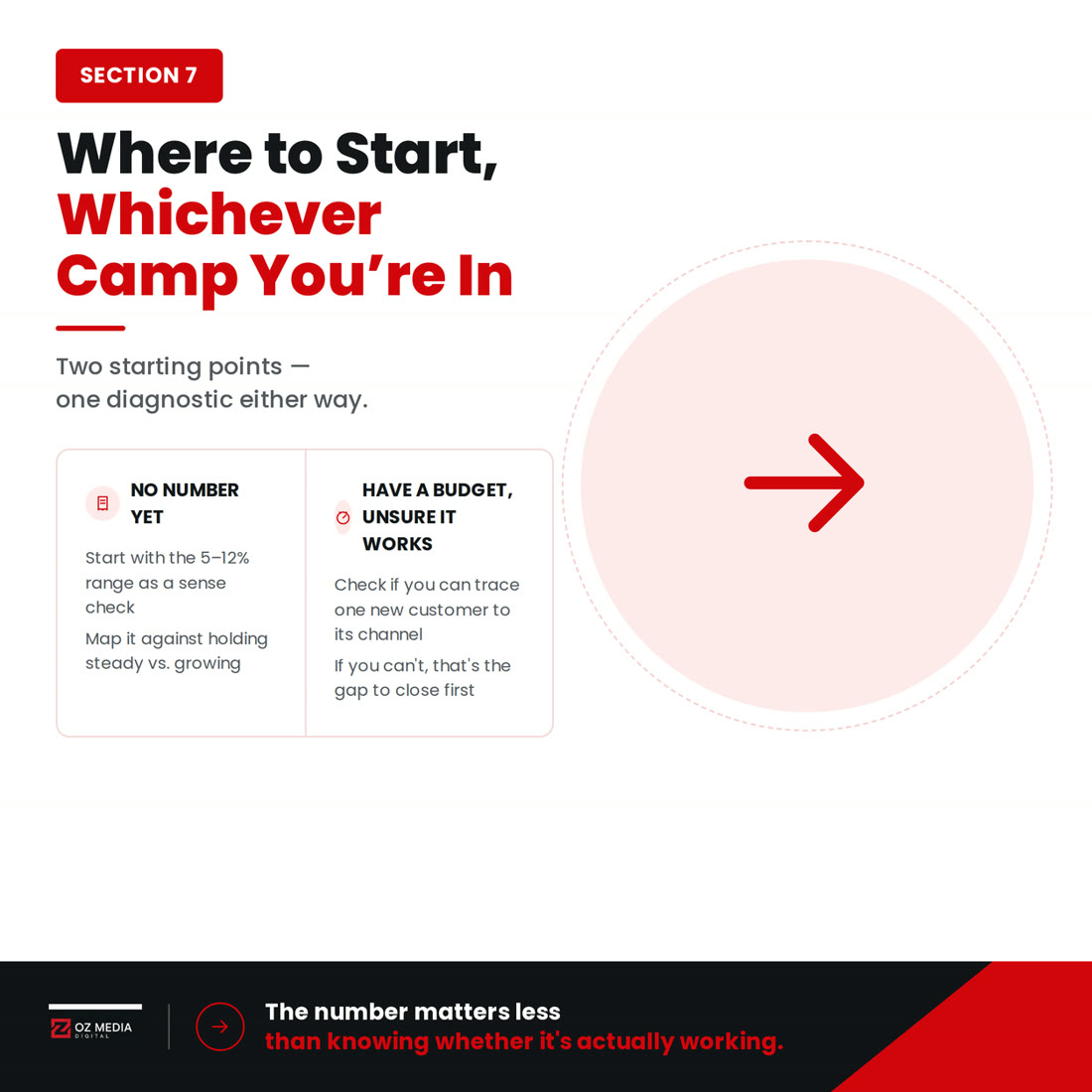
If you don't currently have a number attached to marketing at all, start with the revenue-percentage range in this guide as a sense check, then map it against what you're actually trying to achieve this year, holding steady, or genuinely growing. If you already have a budget but aren't confident it's working, the fastest diagnostic is checking whether you can currently trace a single new customer back to the specific channel that produced them; if you can't, that's the gap worth closing before adjusting the number at all.
If you'd rather have this built and managed properly, channel selection, budget allocation, and reporting that actually shows what's working, that's exactly what we do through our Google Ads management service and our broader all-in-one marketing packages for Australian small businesses. Book a free strategy session and we'll give you a straight read on what your budget should realistically be for your specific business, category and goals, no generic percentage required.