 OZ Media Digital

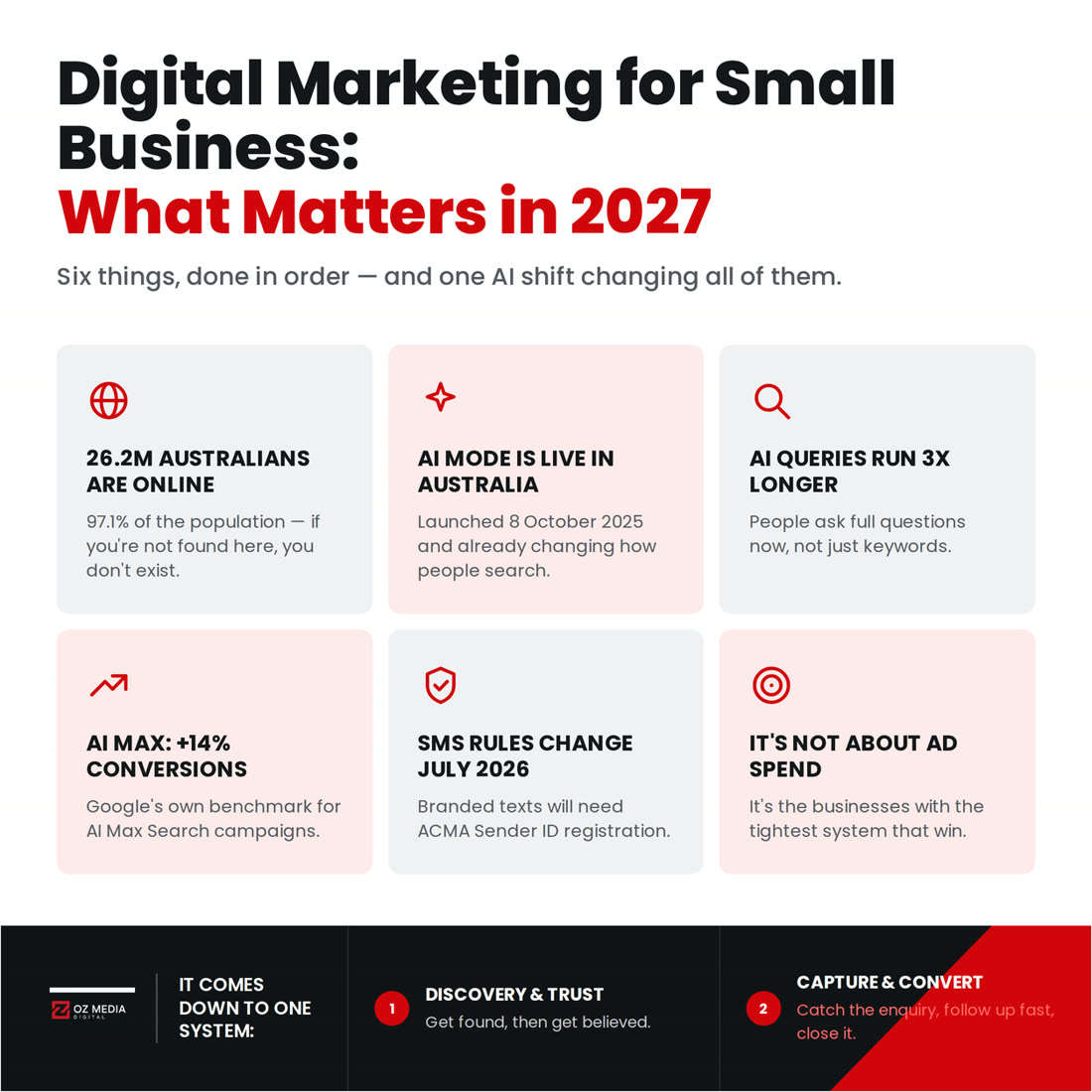
If you run a service business in Australia, a trade, a clinic, a gym, a brokerage, a salon, an agency, digital marketing in 2027 comes down to six things done in order: getting found, being trusted the moment someone lands on you, capturing the enquiry before it leaves, following up faster than your competitor, converting the conversation into a paying customer, and knowing which of those steps is actually broken. Most small businesses are still spending money on the first step alone, more ads, more posts, more "visibility", while leads leak out through the other five. That's the actual story of 2027, not another list of platform features.
This isn't a trend piece. It's the operating model behind every campaign we run at OZ Media Digital for Australian trades, health and wellness practices, property professionals, finance and consulting firms, and local hospitality businesses. Below is what's changed heading into 2027, what hasn't, and where you should actually be spending your next marketing dollar.
The short version:
- Australia now has 26.2 million internet users (97.1% of the population) and 21.0 million social media identities, so "getting online" is no longer the differentiator. Being found inside AI-generated answers and local results is (DataReportal, Digital 2026: Australia, Nov 2025).
- Google's AI Mode launched in Australia on 8 October 2025, and Google's own data shows early AI Mode queries running nearly three times longer than a typical search, meaning buying intent is now expressed in full sentences, not two-word keywords.
- Google Ads' AI Max for Search campaigns (broad match plus asset-based, keywordless targeting and automatic URL expansion) is Google's own claim of "typically 14% more conversions or conversion value at a similar CPA/ROAS" for advertisers who turn it on.
- From 1 July 2026, any organisation sending branded SMS to Australian numbers, including missed-call text-back and CRM follow-up sequences, must have its Sender ID registered with the ACMA, or the messages risk being blocked.
- Google states plainly that local ranking runs on relevance, distance and prominence, and that there's no way to request or pay for a better local ranking on Google.
- The businesses winning in 2027 aren't the ones with the biggest ad spend. They're the ones with the fastest, most complete system from first search to paid invoice, and the discipline to measure which stage of that system is actually costing them customers.
Why Is Digital Marketing Different for Small Businesses Heading Into 2027?
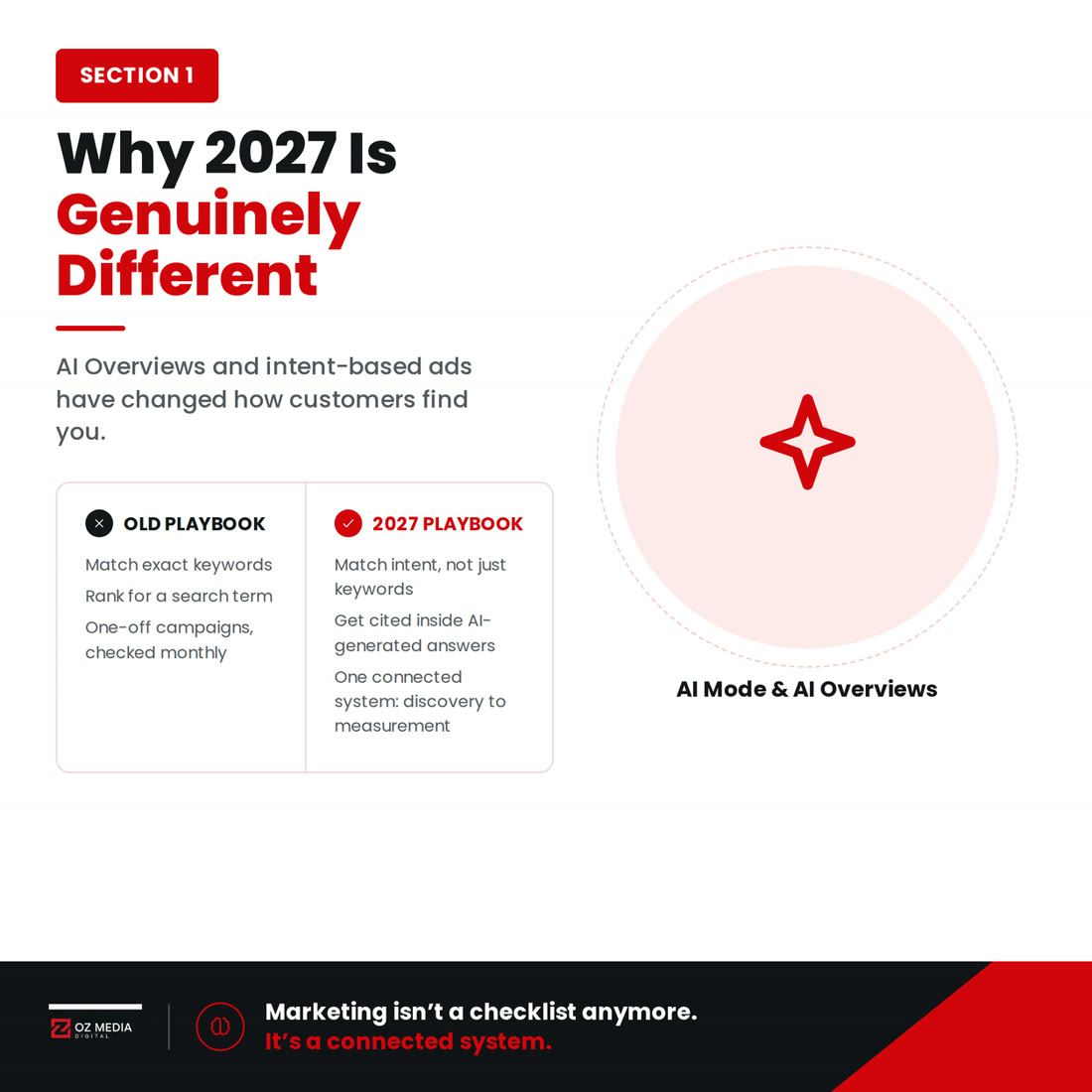
Because the sequence has changed, not just the channels. Five years ago, "digital marketing" meant a website, a Google Ads account and maybe a Facebook page, and the job was mostly about visibility: get seen, get a click, hope the phone rings. Two shifts have broken that model.
The first is AI-mediated search. Google's AI Overviews and AI Mode now sit between the searcher and the traditional ten blue links for a growing share of queries, particularly informational ones ("how much does X cost", "best Y near me", "is Z worth it"). A business that only optimises for the old-style organic result is optimising for a shrinking slice of the page. The second is that Google's own advertising products have shifted from keyword-matching to intent-matching. AI Max and Performance Max don't wait for you to guess the right keyword, they use your assets, your landing pages and your conversion data to find buying intent wherever it shows up. That's a genuine advantage for a well-run local business, and a genuine risk for one with a messy website and no conversion tracking, because the AI is now optimising against whatever signal you give it.
For an Australian service business, the practical implication is this: your marketing is no longer "advertising plus a website." It's a connected system, discovery, trust, capture, follow-up, conversion and measurement, and 2027 rewards businesses that treat it as one system rather than six separate purchases from six separate agencies.
How Do Customers Actually Discover a Small Business Now?
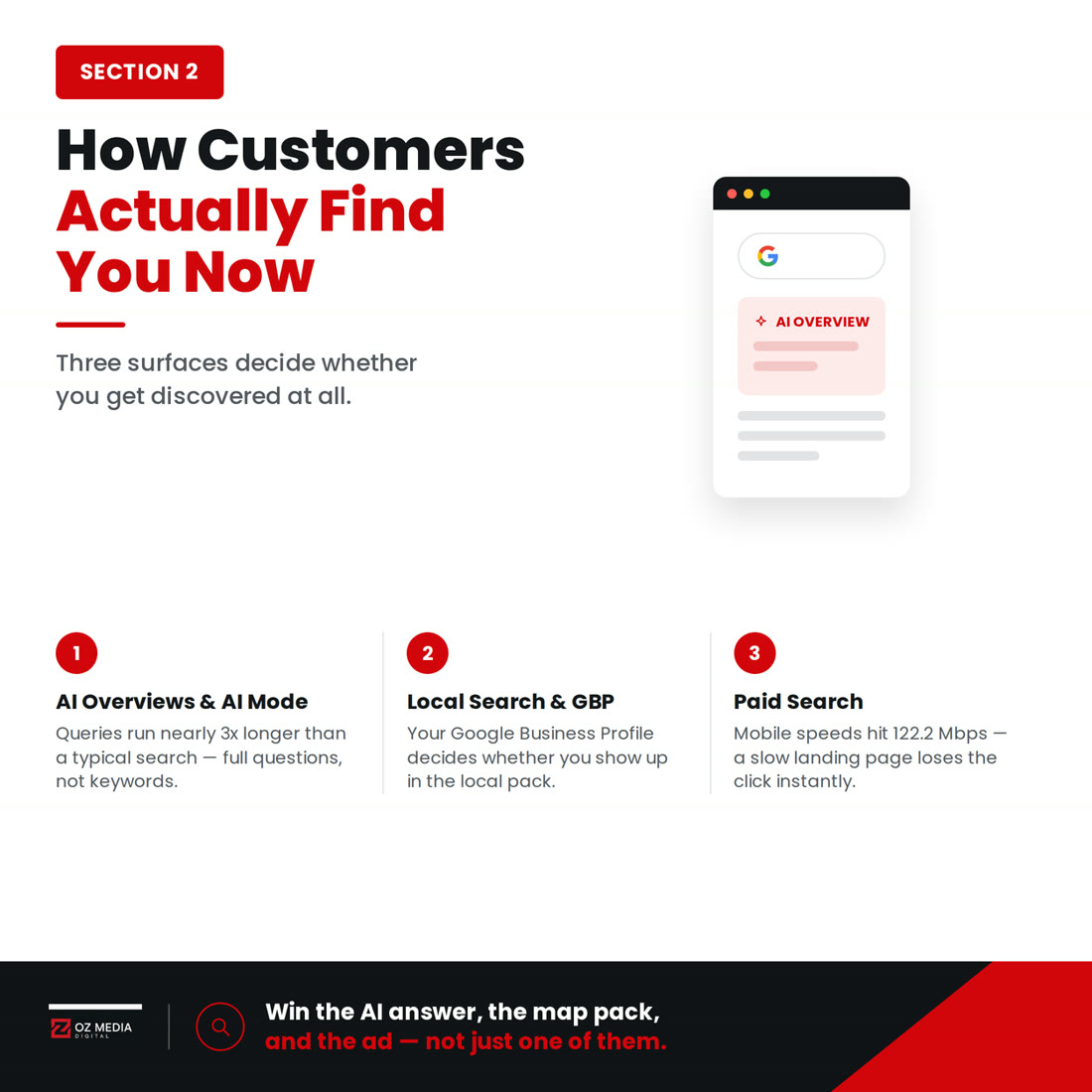
Through a mix of AI-assisted search, local search and social, often in the same session. With 26.2 million internet users and 21.0 million social media identities in a population of 27.0 million, Australians are close to universally online, so the discovery question in 2027 isn't "should we be online". It's "which of the surfaces where AI now sits between us and the customer are we actually showing up in".
Three of those surfaces matter most for a local service business.
AI Overviews and AI Mode. Google's AI Mode launched in Australia on 8 October 2025, using what Google calls "query fan-out": breaking a complex question into sub-questions and pulling from a wider set of sources than a standard search. Early adopters are typing questions nearly three times the length of traditional searches, full sentences like "which Hornsby electrician does weekend emergency callouts" rather than "electrician Hornsby". That's good news for a business with genuinely specific, well-structured content answering real customer questions, and bad news for a generic services page with no detail. We cover this shift in more depth in how local trades people can rank on Google without paying for ads.
Local search and Google Business Profile. Google is explicit that local ranking comes down to three factors, relevance (how well your profile matches the search), distance (how close you are to the searcher) and prominence (how well-known you are, including review volume and quality), and that there's no way to request or pay for a better local ranking on Google. A profile with accurate categories, complete attributes, regular photos and a steady flow of responded-to reviews is doing more for discovery than most paid campaigns. If your business relies on customers walking in or calling from nearby, local SEO is the highest-leverage channel you're probably under-investing in, and we've written specifically about the DIY-versus-hire decision for managing a Google Business Profile.
Paid search built for intent, not keywords. AI Max for Search campaigns uses broad match, asset-based targeting and keywordless technology, plus automatic final-URL expansion, to match ads to intent Google can see but a fixed keyword list can't. Google's own internal data puts the uplift at typically 14% more conversions or conversion value at a similar CPA/ROAS for advertisers who switch it on. That's a real number worth testing, but only once your landing pages, offers and tracking are solid enough for the AI to optimise toward the right outcome, not just the cheapest click. Our Google Ads management service is built around exactly that sequencing: landing pages, offers and tracking sorted before the AI is given the wheel.
Social discovery still matters, but its job has changed too. It's increasingly where trust gets built before someone searches, rather than where the first click happens. More on that below.
How Do You Earn Trust the Moment Someone Finds You?
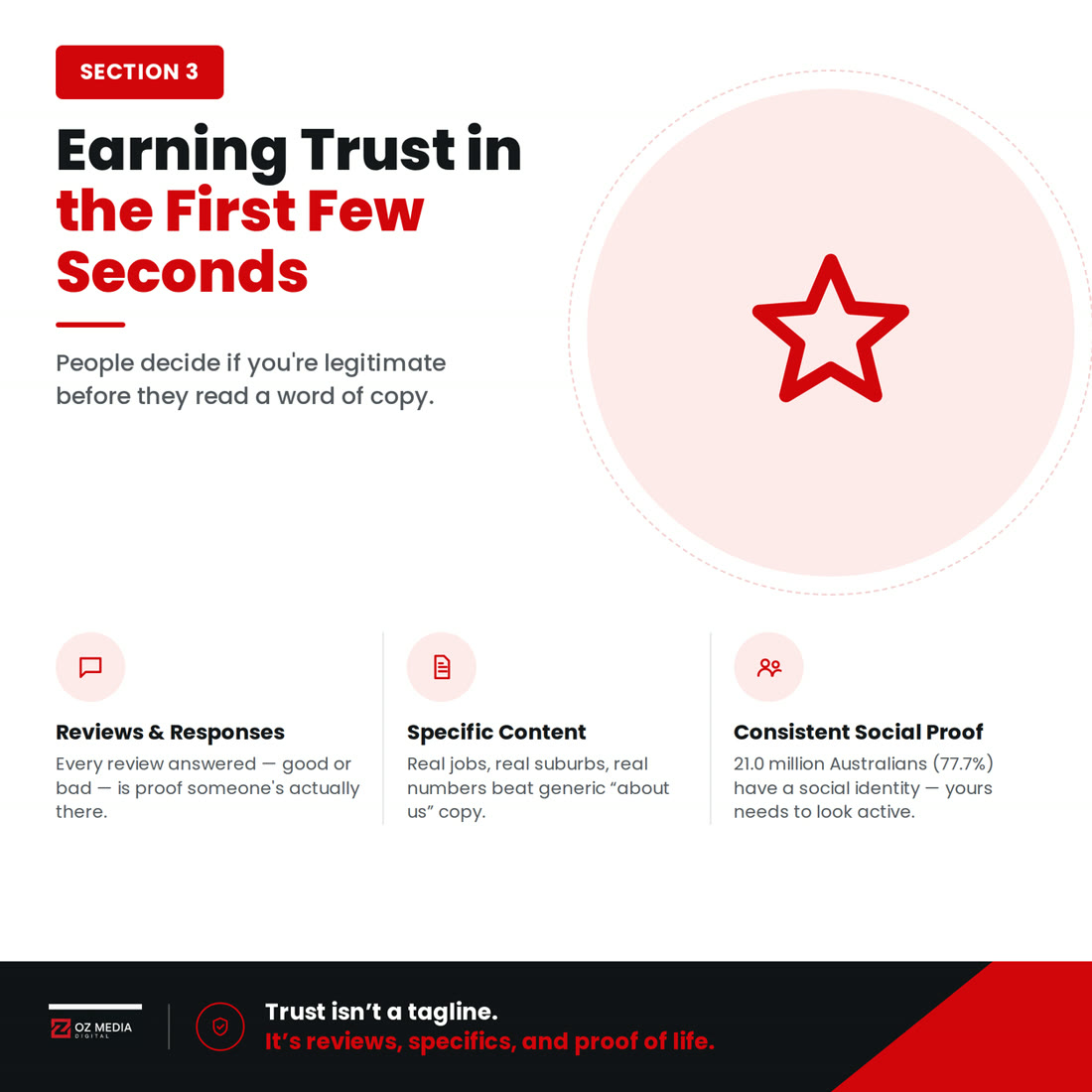
By closing the gap between what your ad or listing promised and what your website, profile or feed actually shows. Trust is the stage most small businesses skip past to get to "capture", and it's the stage AI search punishes hardest, because AI Overviews and AI Mode are actively summarising your content, your reviews and your competitors' content side by side. If a customer's AI-generated answer already tells them your competitor has more reviews or a clearer service description, you've lost the click before it happened.
Three things build trust fast in an AI-mediated search environment.
Reviews, and how you respond to them. Google explicitly states that responding to reviews shows that you value customer feedback, and that positive reviews and helpful replies can help your business stand out. This isn't just a ranking signal, it's now training data for what AI Overviews say about you. A business with 200 unanswered reviews and a business with 40 reviews that are all answered thoughtfully are not read the same way by either humans or AI summarisation.
Specific, well-structured content that answers the actual question. Because AI Mode queries run longer and more specific, generic "About Us" and "Our Services" pages don't give the AI, or the human, anything concrete to extract. A page that states your service area, your price range, your turnaround time and your point of difference in plain language performs better in both AI summaries and human decision-making than a page full of marketing adjectives. This is the same discipline behind owning a suburb-by-suburb local market rather than one generic services page trying to rank for everything.
Consistent, current social proof. With 21.0 million social media identities in Australia (77.7% of the population), your social presence is now a trust check most customers run before they enquire, even if they found you through search or a referral. A profile that hasn't posted in four months reads as a business that might not still be operating. We cover what a realistic, sustainable posting cadence looks like for a local business in our social media strategy guide. Consistency beats cleverness here, and it's one of the easier gaps to close without hiring a marketing team.

How Do You Capture the Enquiry Before It Disappears?
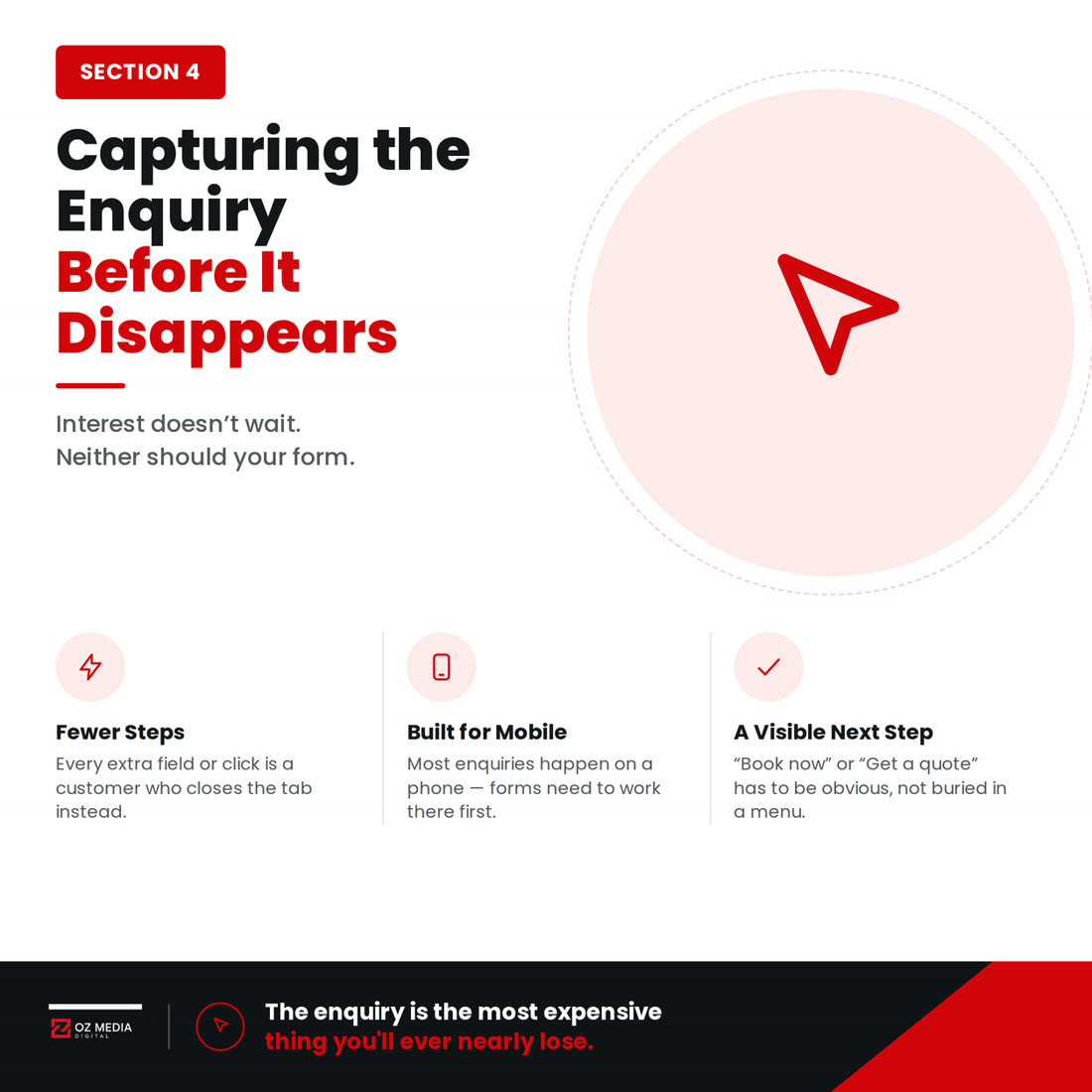
By removing every unnecessary step between "interested" and "enquired." This is the stage where the most money gets lost invisibly, not because the marketing didn't work, but because the website, form or call handling wasn't ready to catch the result.

A few checks worth running honestly on your own business right now. Does your site load fast and work properly on mobile, given the median mobile download speed in Australia is now 122.2 Mbps and customers expect near-instant pages? Is there a booking, quote-request or click-to-call option visible without scrolling, on every service page, not just the homepage? If someone lands on your site from an AI Overview citation or a Google Ads AI Max asset, do they land on a page that matches exactly what they searched for, or a generic homepage that makes them start over?
For trades and property businesses in particular, click-to-call and instant quote forms consistently outperform generic "contact us" pages because they match the urgency of the search. A well-built website foundation isn't a nice-to-have here, it's the difference between an AI Max campaign converting at a genuinely good rate and one that quietly wastes budget on traffic that arrives and leaves within seconds.
What Happens the Moment Someone Enquires?
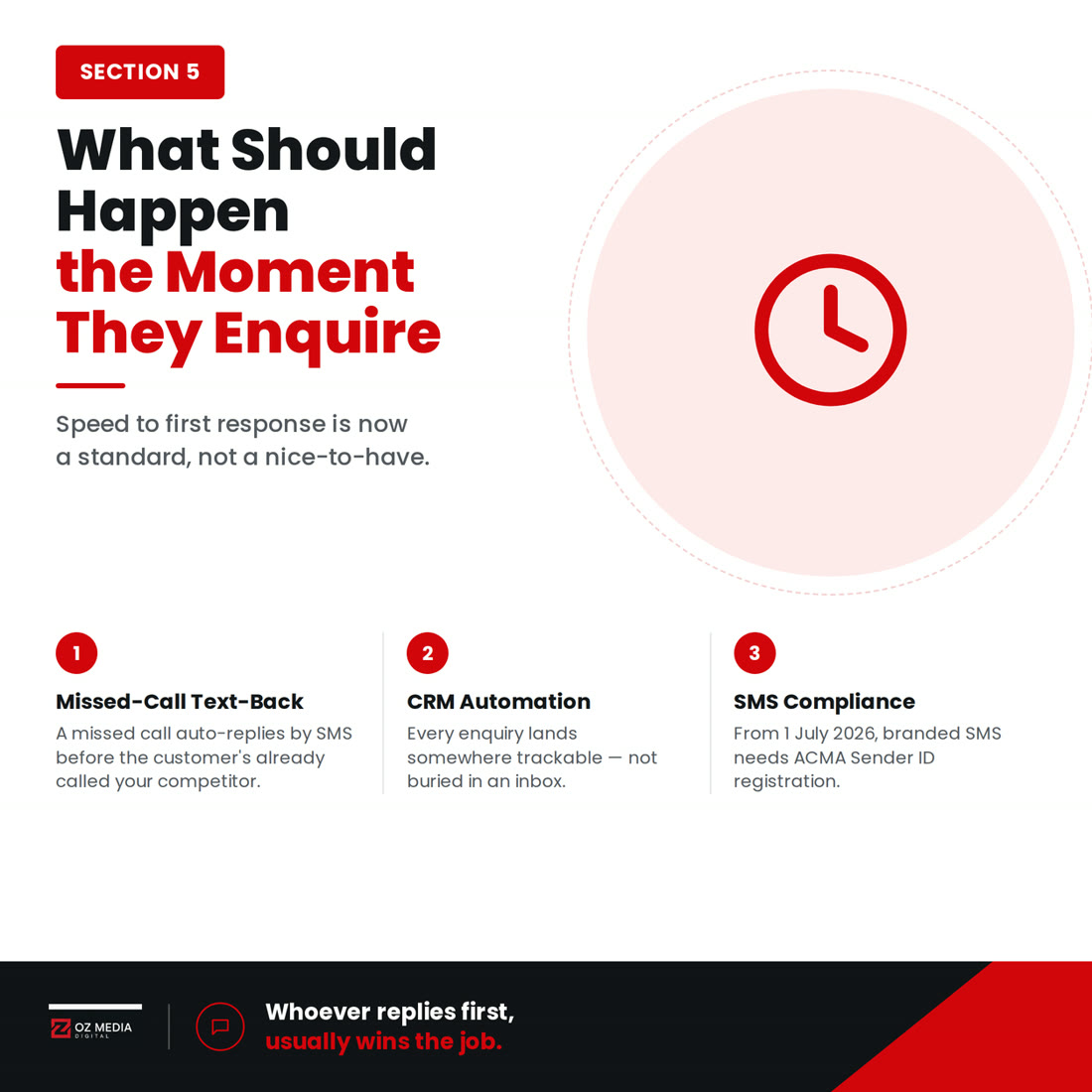
This is the stage most Australian small businesses handle worse than any other part of their marketing, and it's the one with the single highest return on fixing. A lead who fills in a form or leaves a missed call is at their most interested the moment they act, and every hour that passes before you respond is an hour your competitor has to get there first.

Two things are changing this in 2027, one operational and one regulatory.
Missed-call text-back and CRM-triggered follow-up are now standard practice, not a nice-to-have automation. A tradie, clinic or salon that automatically texts back a missed call with a booking link, and drops every enquiry into a CRM that triggers a same-day follow-up sequence, is competing on speed against businesses still checking voicemail once a day.
The compliance side has real teeth from 1 July 2026. Under the ACMA's SMS Sender ID Register, any organisation sending branded text messages to Australian numbers, including automated missed-call text-back, appointment reminders and CRM nurture sequences, needs its sender ID registered, or the messages risk being blocked outright. If your CRM or automation platform sends SMS under your business name, this is worth checking before your follow-up sequences quietly stop delivering. It's a compliance detail, but it sits directly inside your revenue pipeline: an unregistered Sender ID doesn't just risk a fine, it risks every automated follow-up message simply not arriving.
Getting this stage right is largely a system-and-automation problem rather than a creative one. The same AI tooling that helps target the right customer at the top of the funnel should also be doing the work of responding to them the moment they raise their hand, not sitting as a separate add-on nobody owns.
How Do You Turn a Responded-To Lead Into a Paying Customer?
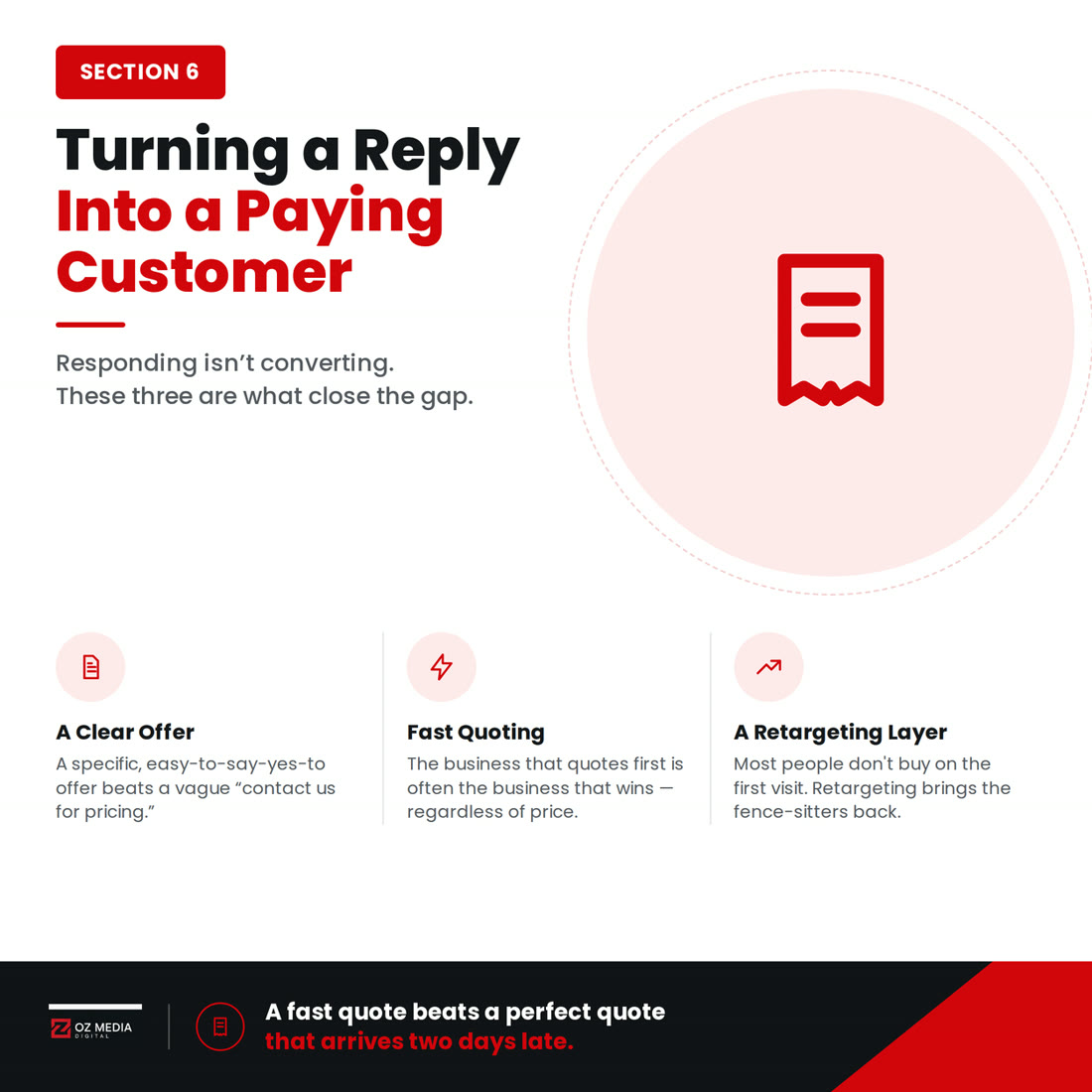
By treating the sales conversation as part of the marketing system, not a separate department's problem. Everything above this point, discovery, trust, capture, follow-up, exists to produce a conversation. What happens in that conversation determines whether the marketing spend actually pays for itself.
For service businesses, conversion usually comes down to three practical things: a clear, comparable offer (so the customer isn't left to guess at pricing or scope), a quoting or booking process that's as fast as the enquiry was, and a retargeting layer that keeps you visible to the portion of leads who don't convert on the first contact, which, realistically, is most of them. Retargeting via Google Ads and Meta isn't about "staying top of mind" as a vague brand goal; it's about being the business that's still there when a customer who compared three quotes finally decides.
We've written specifically about what a genuinely ROI-focused paid advertising approach looks like for a small business budget in PPC advertising strategies that deliver real ROI. The underlying lesson applies well beyond any one sector: a channel isn't broken just because it isn't converting; often the conversion stage behind it is.
How Do You Know Whether Any of This Is Actually Working?
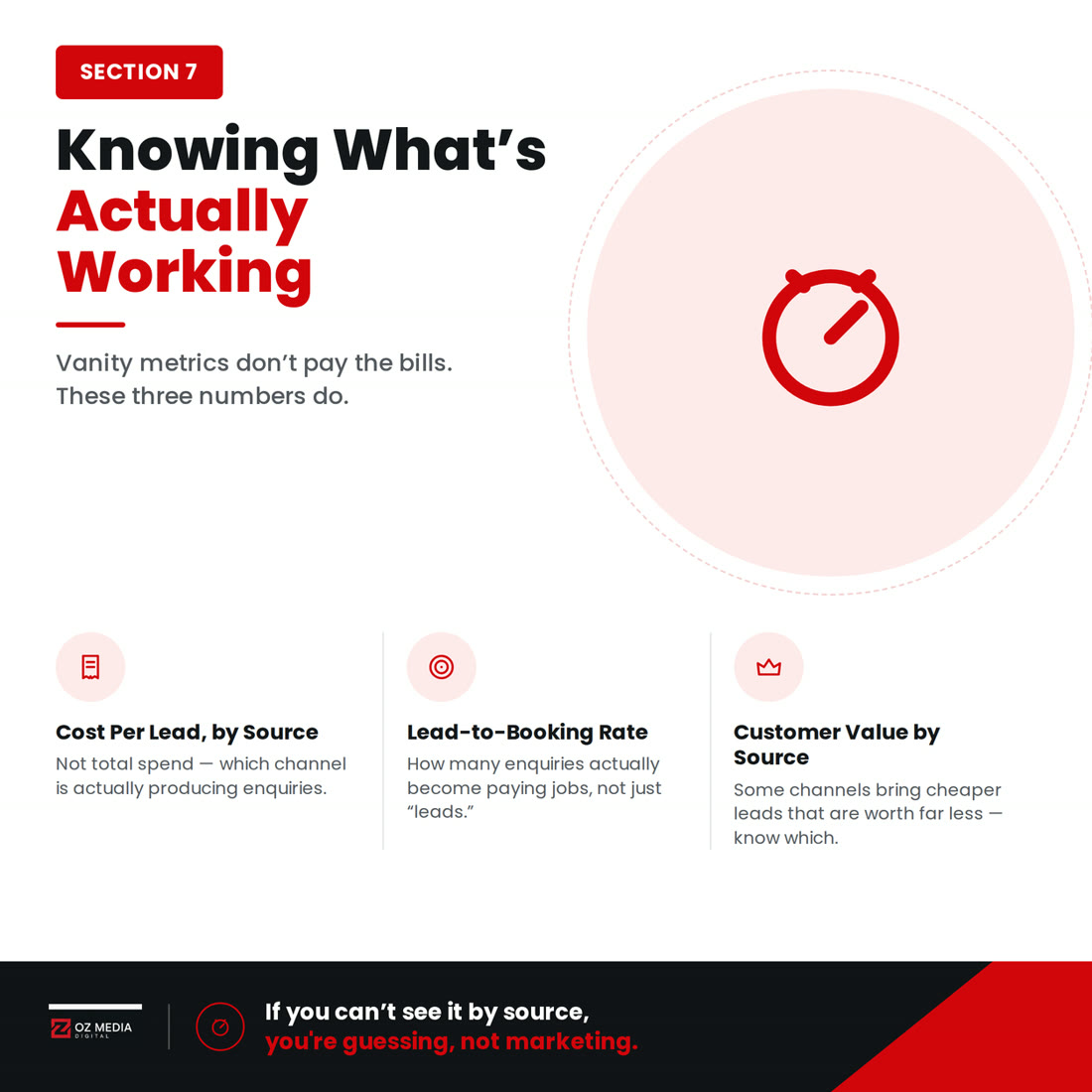
By measuring the stage, not just the channel. Most small businesses can tell you their ad spend and roughly how many leads they got. Very few can tell you their cost per lead by channel, their lead-to-customer conversion rate, or which of the six stages above is where they're actually losing the most value. That gap is the single biggest reason marketing budgets get cut in a downturn, not because marketing stopped working, but because nobody could prove which part of it was.

A workable measurement setup for a service business doesn't need to be complicated. At minimum, track cost per lead by source (Google Ads, organic/local, social, referral), lead-to-booking conversion rate, and average customer value by source, so you can see which channel produces customers worth having, not just cheap enquiries. If you're spending on AI Max or Performance Max campaigns, feed them accurate conversion data. Google's own claimed uplift only applies "at a similar CPA/ROAS", which means the AI needs a genuine conversion signal to optimise against, not a vague "form submitted" event that includes every tyre-kicker.
This is the stage where an outside set of eyes tends to pay for itself fastest, because it's hard to audit your own funnel objectively. Cash-flow-relevant numbers, not vanity metrics, are what actually tell you whether a channel is worth keeping.
What Should a Small Business Actually Prioritise in 2027?
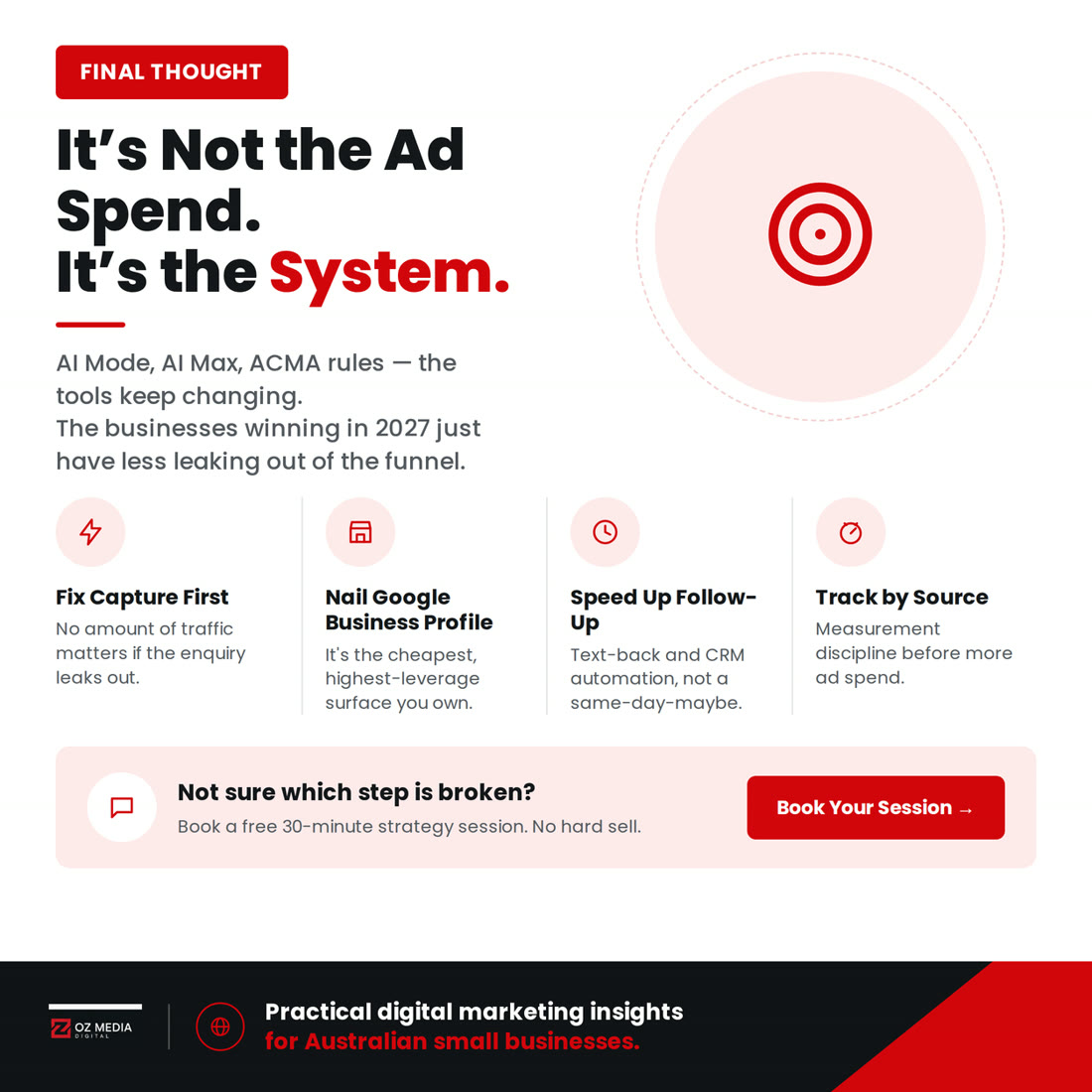
In order, if you're deciding where to spend the next dollar:
- Fix capture before you spend more on discovery. More traffic into a leaky form or a slow mobile site is wasted money, no matter how well-targeted the ad.
- Get your Google Business Profile complete, current and reviewed. It's free, it's a genuine ranking factor, and it now feeds AI Overviews as much as traditional local results.
- Build follow-up speed and compliance together. Missed-call text-back and CRM nurture sequences are now table stakes, and the ACMA's Sender ID rules mean it's worth checking your automation platform is compliant before you scale it up.
- Test AI Max or Performance Max once your tracking is genuinely accurate, not before. The uplift Google reports depends on the AI having a real conversion signal to work with.
- Measure cost per lead and lead-to-customer rate by channel, not just spend and impressions, so the next dollar goes to the stage that's actually broken.
None of this requires a marketing department. It requires treating discovery, trust, capture, follow-up, conversion and measurement as one connected system, which is the approach behind every package we offer at OZ Media Digital.
Frequently Asked Questions
Is digital marketing still worth it for a small Australian business in 2027, given how much AI has changed search?
Yes, arguably more than before, because AI search rewards specific, well-structured, genuinely helpful content and complete local profiles more than it rewards generic marketing copy. The businesses at risk aren't the ones doing digital marketing. They're the ones doing it the way it was done five years ago.
Do I need to be on every social media platform to compete in 2027?
No. With 21.0 million social media identities across a population of 27.0 million, reach isn't the constraint, consistency is. One or two platforms, posted to reliably and used to build trust before someone searches, outperform five platforms updated occasionally.
What's the single biggest mistake small businesses make with their digital marketing budget?
Spending it all on discovery (ads, SEO, social) while the website, follow-up process or sales conversation is quietly losing most of the leads that discovery generates. Fixing capture and follow-up is almost always cheaper than buying more traffic.
Does the ACMA's SMS Sender ID Register actually affect my business if I'm not a big telco?
Yes, if you send branded text messages under your business name, including automated missed-call text-back, booking confirmations or CRM follow-up sequences. The rules took effect from 1 July 2026 and apply to any organisation sending branded SMS to Australian numbers, not just telecommunications providers.
Should I switch all my Google Ads campaigns to AI Max straight away?
Not without solid conversion tracking in place first. Google's own reported uplift, typically 14% more conversions or conversion value at a similar CPA/ROAS, is measured against advertisers who already had accurate conversion data. Turning on AI Max with poor tracking tends to optimise spend toward the wrong outcome faster, not the right one.
How do I know which stage of my marketing, discovery, trust, capture, follow-up, conversion or measurement, is actually the problem?
Track cost per lead and lead-to-customer conversion rate by source. If leads are cheap but rarely convert, the problem usually sits in trust, capture or follow-up, not in the ad spend itself. This is exactly the audit we run as the first step of most new client engagements.
If your marketing feels like six disconnected purchases rather than one system that reliably turns searches into paying customers, that's the gap worth closing first, before spending another dollar on visibility. Book a free strategy session with OZ Media Digital and we'll map your current discovery-to-measurement funnel, tell you honestly which stage is costing you the most customers, and show you what fixing it would actually look like for a business your size.
Sources and References
- DataReportal: Digital 2026: Australia (report dated 5 November 2025, data to October 2025)
- Google: Introducing AI Mode in Australia, Google Blog Australia, 8 October 2025
- Google Ads Help: About AI Max for Search campaigns
- Google Ads Help: New features & announcements (Google Marketing Live 2026, 20 May 2026)
- Australian Communications and Media Authority (ACMA): SMS Sender ID Register
- Google Business Profile Help: Tips to improve your local ranking on Google