OZ Media Digital
Most small businesses get Christmas marketing wrong by treating it as a single seasonal campaign bolted on in late November, rather than a sequence of decisions (timing, messaging, trading-hours communication, cash flow and follow-up) that has to be made correctly in order, not just executed with a bit more energy than usual. The single biggest failure point isn't a bad ad or a weak discount; it's starting the planning too late to do any of the rest properly.
TL;DR: Where Christmas Marketing Actually Goes Wrong
- Starting the thinking, not just the posting, too late: by the time most owners "do" Christmas marketing, the planning window for trading hours, stock, staffing and ad creative has already closed.
- Copying retail tactics into a service business: discount-led, one-off sales messaging doesn't fit a trade, clinic, salon or consultancy the way it fits a shop.
- Making discount or availability claims that don't hold up: the Australian Consumer Law applies at Christmas exactly as it does in July, and the ACCC checks.
- Treating trading-hours communication as an afterthought: customers don't guess your hours; they Google them, and a wrong listing costs the booking.
- Planning the marketing spend without planning the cash flow around it: December and January are when a lot of businesses actually run into trouble, not just when they're busiest.
- Trying to run it all personally with no system for follow-up: the owner who does everything is also the owner who drops every enquiry that comes in after 6pm on 23 December.
Mistake 1: Treating December as the Start of Christmas Marketing, Not the Deadline

By the time "do some Christmas marketing" appears on a small business owner's to-do list, usually in the first week of December, most of the decisions that actually determine whether the campaign works have already needed to be made. Ad creative needs briefing and building time. Google Business Profile holiday hours need updating before customers start searching, not after they've already called a competitor who answered. Stock, staffing rosters and appointment calendars need to reflect demand that's been building since October, when Australian shoppers were already deep into pre-Christmas research and buying.
This isn't an argument for panic-starting earlier out of anxiety. It's a sequencing problem: timing, messaging and trading-hours planning each depend on the one before it, and none of them can be rushed in the same week. A business that starts thinking about Christmas marketing in early December has, in practice, already skipped the research-and-decision window and gone straight to execution, which is why so much "Christmas marketing" ends up being a single boosted Facebook post and a sale banner slapped on the homepage, rather than anything that was actually planned. It's the same pattern behind most of the recurring errors in our digital marketing mistakes guide for service businesses: the work that would have fixed the problem was skippable right up until it suddenly wasn't.
Mistake 2: Running a Retail Playbook When You're Not a Retailer

A huge share of generic "Christmas marketing tips" content is written for product-based retail: gift guides, site-wide sales, shipping-cutoff countdowns. None of that maps cleanly onto a plumber, a physio, an accountant, a hairdresser or a financial adviser, and businesses that borrow the retail playbook wholesale end up running a percentage-off sale on a service that nobody buys as a Christmas gift, while missing the angles that actually work for them: end-of-year servicing before the Christmas shutdown, "book now before we close for summer" urgency, gift vouchers for genuinely giftable services (massage, grooming, detailing, coaching), or simply a well-timed thank-you and referral push while customers are in a generous, reflective mood.
The fix isn't to skip Christmas marketing because "we're not really a Christmas business": it's to translate the season's psychology (urgency, gratitude, a natural pause point before a new year) into something that fits a service business's actual sales cycle, rather than importing a sale banner that was built for a shopfront. We cover exactly what that translation looks like, campaign element by campaign element, in what makes a holiday marketing campaign actually work for a local service business.
Mistake 3: Making a Discount or Availability Claim You Can't Back Up
The Australian Competition and Consumer Commission has been explicit that Christmas and Black Friday-period sales advertising gets scrutinised like any other advertising, and in a media release dated 17 December 2024, it set out exactly what it's been checking for: "was/now" pricing where the "was" price wasn't a genuine recent price, "up to X% off" claims where only a handful of products actually qualify, recommended-retail-price comparisons that don't reflect what the item actually sold for, and store-wide or site-wide claims buried under exclusions in the fine print. The ACCC has already asked a number of retailers to justify their advertising claims directly, and its own guidance is blunt: businesses need to be able to back up every number they put in an ad, not just the one that sounds best.
For a service business, this usually shows up in smaller ways than a national retailer's sitewide sale: "20% off all bookings this month" when half the calendar is already full at full price, or "limited Christmas appointments available" when there's actually plenty of capacity. Both are the same category of problem the ACCC is checking for. The safest Christmas offer is a specific, genuine one: a real discount on a real, named service, available to everyone the ad says it's available to, for the dates the ad says it's available.
Mistake 4: Letting Customers Find Out Your Holiday Hours by Calling and Getting No Answer

Christmas and New Year trading-hours restrictions in Australia mainly target large retailers (supermarkets, department stores and discount department stores), not small operators, according to the National Retail Association's Christmas and New Year factsheet (updated 4 November 2025). Most small businesses can legally set their own hours over the period. The mistake isn't a legal one; it's a communication one. Customers don't ring to ask if you're open on Boxing Day or between Christmas and New Year, they Google it, check your Google Business Profile, and book somewhere else within seconds if the information isn't there or is wrong.
Every business that's closing for any stretch over Christmas and New Year should have updated, accurate holiday hours live on its Google Business Profile, website and booking system well before the shutdown starts, not retrofitted after the first confused customer calls. This is a five-minute task that gets skipped almost every year because it isn't glamorous, and it directly costs bookings that would otherwise have been made with a bit of notice.
Mistake 5: Planning the Christmas Marketing Budget Without Planning the Christmas Cash Flow
This is the mistake that doesn't look like a marketing mistake until it's too late. December's trading surge and the January slowdown that follows it are precisely the conditions that put pressure on small business cash flow, and the data backs this up at a structural level, not just anecdotally. ASIC's insolvency figures for FY2025-26, reported by Accountants Daily, show the December quarter 2025 was the single worst quarter of the year for company insolvencies, with 3,856 companies entering external administration, more than a third of the entire year's total of 14,152, concentrated in one quarter. Separately, AMP Bank's "Go" survey of 2,000 Australian sole traders and small business owners (released 19 January 2026, fielded in January 2025) found seven in ten worry about cash flow and six in ten worry specifically about being able to pay bills, with 40% saying demand for their core product or service is unpredictable.
The marketing version of this mistake is spending the Christmas ad budget as if it's separate from everything else happening in the business at the same time: wages running through the shutdown period, suppliers wanting payment before their own break, and a predictable quiet patch in January once the rush ends. A Christmas campaign that generates a spike in bookings but leaves no plan for collecting payment, delivering the work, and surviving the quieter weeks that follow isn't actually a win. The fix is simple and rarely done: decide the marketing spend and the cash flow plan for November through February in the same conversation, not two separate ones.
Mistake 6: The Owner Tries to Run the Whole Campaign Personally, With No System Behind It

Christmas is the exact period when small business owners are least able to personally handle every enquiry, every social post, and every follow-up message, and it's also when they most often try to anyway. AMP Bank's January 2026 release found 90% of small business owners are preoccupied with work outside normal hours over summer, a third think about work constantly, and 43% say they spend too much time on financial administration alone, with over half spending more than six hours a week on it. Layer a Christmas marketing push on top of that workload with no system to catch enquiries that come in after hours, and the predictable result is leads that arrive and simply sit unanswered until the business reopens in January, by which point the customer has usually gone elsewhere.
This is where the mistake compounds: the business runs the campaign, generates genuine interest, and then loses a chunk of it to slow response, not bad marketing. Our own data on this is unambiguous outside the Christmas period too: see how fast you should respond to leads, and the problem only gets worse when the enquiry lands at 11pm on 23 December with the business closed until January. A booking form that works around the clock, an automated acknowledgement that goes out the moment someone enquires, or a simple AI-handled first response that gets a real answer to the customer before the business reopens, all close this gap without needing the owner to be glued to their phone over the break.
Mistake 7: No Plan for What Happens After Christmas
A Christmas campaign that ends when the discount ends is a wasted half of its own value. The enquiries, website visits and social engagement a Christmas push generates are a list of people who were interested in the business recently, and most of them never hear from the business again once January arrives, because nobody built a follow-up step into the campaign from the start. The fix costs nothing extra in ad spend: a simple "thanks for your interest, here's what's on in the new year" sequence to everyone who engaged, sent in the first two weeks of January while the business is still front-of-mind, captures a second wave of bookings from a list that's already been paid for once. This is the same logic covered in what marketing automation and nurture sequences actually do for a small business: a Christmas campaign without a follow-up sequence is half a campaign.
How OZ Media Approaches This Differently
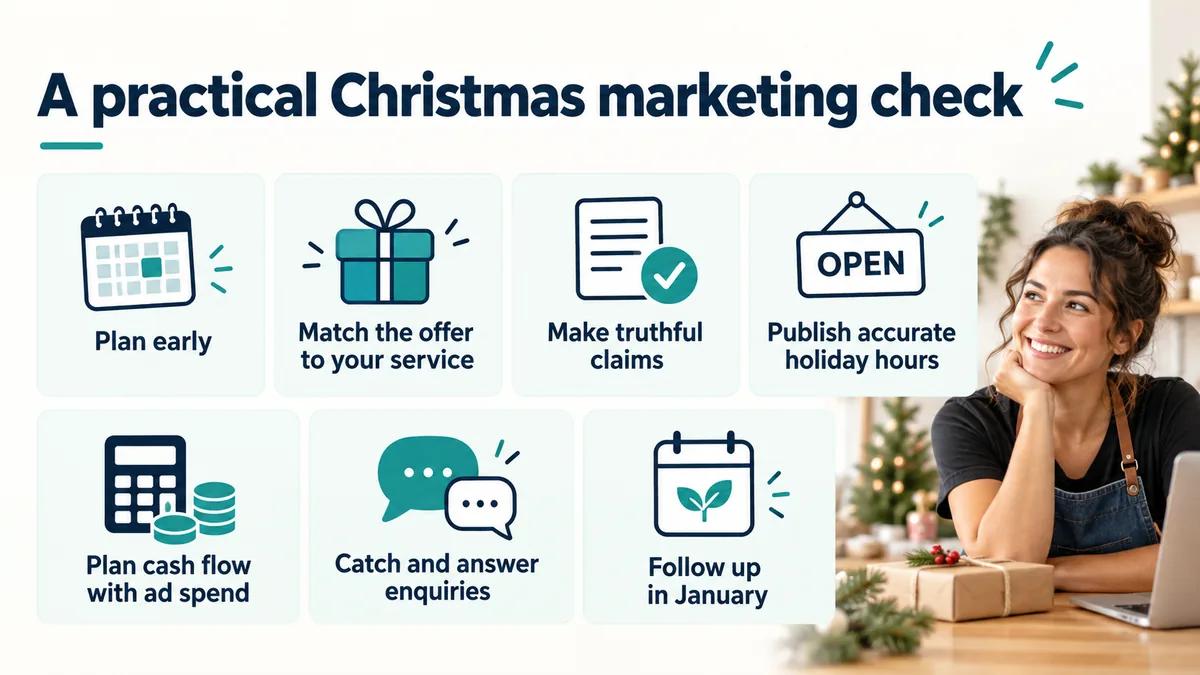
A Christmas marketing plan only works if it's sequenced: timing, offer, trading-hours communication, cash flow and follow-up decided together, not bolted on in whatever order the to-do list gets tackled. We build and run this end to end for Australian service businesses: campaign planning and content through social media management, and automated enquiry handling and follow-up sequences through AI-powered marketing automation, so the leads a Christmas campaign generates get answered and followed up whether or not the owner is at their desk.
If your Christmas marketing has historically been a last-minute scramble, book a free session and we'll help you sequence this year's properly, before December runs out of runway.
Frequently Asked Questions
Is it too late to do Christmas marketing if I haven't started by early December?
No, but the type of campaign that's still realistic changes. Full-funnel campaigns with new creative, stock planning and staged offers need lead time that's already gone by early December; what's still genuinely effective is a focused push on your existing audience, email, SMS, social and Google Business Profile updates, plus making sure your holiday hours, booking availability and contact details are accurate everywhere a customer might check them.
Do I need to run a discount to make Christmas marketing work?
No. A discount is one lever among several, urgency ("book before we close for the break"), gratitude (a thank-you offer to existing customers), and gifting (vouchers for genuinely giftable services) often convert better for service businesses than a straight percentage-off, and they carry none of the Australian Consumer Law risk that comes with a "was/now" or "up to X% off" claim you can't fully substantiate.
What do I actually need to do about holiday trading hours?
Confirm your actual opening hours and any public-holiday restrictions that apply to your business type and state (most small businesses have few or none, unlike large retailers), then update your Google Business Profile, website and booking system with the correct dates well before the break starts, not after the first customer calls and gets no answer.
How do I stop Christmas marketing from wrecking my cash flow instead of helping it?
Decide your Christmas marketing spend and your cash flow plan for the surrounding months at the same time, not separately. Factor in wages and supplier payments that still fall due over the shutdown, and the realistic chance of a quieter January once the rush ends, before committing ad spend to generate a short-term spike you then can't comfortably service.
Should a service business (not a retailer) even bother with Christmas marketing?
Yes, but not with a retail-style sale. Trades, health and wellness providers, finance and property professionals and local consultancies all have a natural "before we close" or "before the year ends" angle that fits their actual sales cycle, end-of-year servicing, pre-shutdown bookings, giftable vouchers where relevant, and a thank-you-and-referral push, which converts better than an imported retail discount campaign.
What's the single most common mistake small businesses make with Christmas marketing?
Starting the planning in December instead of October or November. Every other mistake on this list, rushed messaging, missing trading-hours updates, no cash flow plan, no follow-up system, is a downstream consequence of starting the sequence too late to do each step properly.
Prices, figures and guidance in this article reflect the sources cited below at the time of writing, and are general information rather than a guarantee of results for your business.
Sources and References
- ACCC, ACCC sweep finds concerning Black Friday sales advertising, 17 December 2024
- National Retail Association, Christmas and New Year Factsheet 2025-26, updated 4 November 2025
- Accountants Daily, Company insolvencies climb to 14,152 for FY2025-26 (ASIC-sourced data)
- AMP Bank, Small business owners "always on" while much of Australia enjoys the summer holidays, 19 January 2026
Figures above reflect the sources cited and general market conditions at the time of writing and can change; check the original source for current detail before relying on a specific figure.