 OZ Media Digital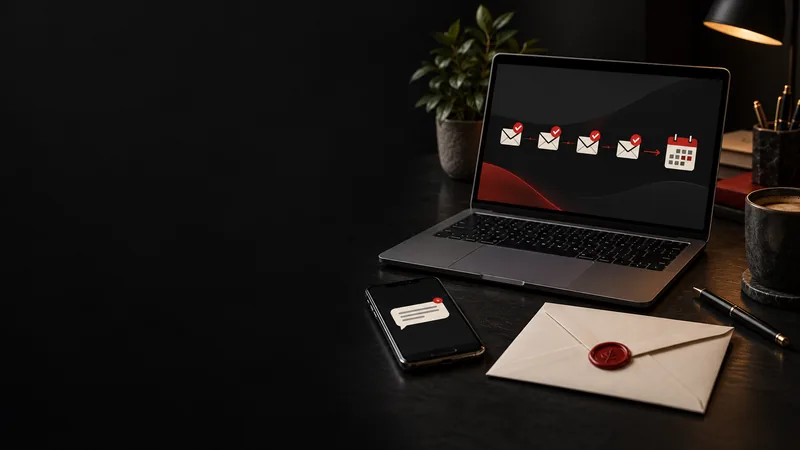
Marketing automation is software that sends the right email, SMS or task at the right moment without you doing it manually, and a nurture sequence is the specific chain of automated follow-ups that keeps a lead warm until they're ready to buy. If your current follow-up process is "I'll get to it when I remember," the honest answer is yes, you need at least a basic version of this. Most small businesses lose leads not because their marketing isn't working, but because nobody follows up on it consistently.
This isn't about turning your business into a call centre with robots. It's about the unglamorous, high-leverage work of not letting a warm inquiry go cold because you were on a job site, in a client meeting, or simply flat out.
TL;DR
- Marketing automation handles repetitive follow-up (email, SMS, task reminders) automatically, based on triggers like a form submission or an unanswered quote.
- A nurture sequence is a set series of automated touches, typically 4 to 8 messages over 2 to 6 weeks, aimed at leads who aren't ready to buy today.
- Industry-reported figures suggest nurtured leads convert from marketing-qualified to sales-qualified at roughly three times the rate of leads left to follow up manually, though these are global benchmarks, not guarantees for any single business.
- You need a CRM or equivalent contact system before automation is worth building, automation without a place to track who's in which sequence just creates a different kind of chaos.
- Australian businesses must still comply with the Spam Act 2003 (consent, identification, unsubscribe) even when messages are sent automatically, this isn't optional because a machine is sending it.
- A basic, well-built nurture sequence for a local service business can realistically be set up in 1 to 3 weeks and cost under $1,500 in one-off setup plus a modest monthly platform fee.
What Is Marketing Automation, in Plain Terms?
Strip away the software marketing and marketing automation is three things working together: a trigger, a rule, and an action. Someone fills out a quote form (trigger). Three days pass with no reply from them (rule). The system sends a follow-up email and creates a task for someone to call them (action).
That's it. It's not artificial intelligence guessing what to say, most small business automation is simple, rules-based sequencing. The "smart" part is that it runs whether or not anyone in your business remembers to do it, at 11pm on a Sunday or during your busiest week of the year.
For Australian small businesses, this typically covers:
- Automated email or SMS sequences after a form submission, quote request, or missed call
- Task reminders for staff when a lead has gone quiet
- Simple segmentation (new lead vs. existing customer vs. past customer who hasn't booked in 12 months)
- Basic personalisation (name, service requested, suburb) inserted automatically into templates
business.gov.au's own guidance on marketing tools and software describes marketing automation software as letting a business "keep all your marketing information in one place" and "send marketing messages through multiple channels all at once", including email, social and text message, while still allowing personalisation such as automated birthday or anniversary messages.
What's a Nurture Sequence, and How Is It Different From a Single Follow-Up Email?

A single follow-up email is one message. A nurture sequence is a planned series, usually somewhere between four and eight touches spread over two to six weeks, designed to move someone from "interested but not ready" to "ready to book."
The distinction matters because most small businesses already send a follow-up. What they're missing is the sequence: the second, third and fourth touch that happens automatically if the lead still hasn't responded, each one adding a different piece of value rather than just repeating "just checking in."
A typical nurture sequence for a service business might look like:
- Day 0: Thank-you and confirmation (sent automatically the moment they enquire)
- Day 2: Answer to the most common objection or question for that service
- Day 5: A short case study or before/after relevant to what they asked about
- Day 10: A direct, low-pressure "still thinking about it?" check-in with a clear next step
- Day 18: Social proof, a review or result, not a hard sell
- Day 30: Final nudge with a genuine reason to act now (seasonal relevance, limited availability, a small incentive)
Note what this is not: it isn't six sales pitches in a row. Each message should give the reader something, an answer, a proof point, a reason to trust you, not just ask again for the sale.
This is deliberately different in scope from the first-response stage covered in our guide to building a full lead-generation system, which is about replying within minutes. A nurture sequence picks up after that first reply, for the leads who don't convert immediately, which, for most service businesses, is the majority of them.
Each message should give the reader something, an answer, a proof point, a reason to trust you, not just ask again for the sale.
Which Australian Small Businesses Actually Benefit From This?
Not every business needs the same depth of nurturing, and it's worth being honest about where the leverage actually sits.
High-value, considered-purchase services benefit most: finance and mortgage broking, property (buyers agents, conveyancing), allied health and wellness programs, consulting, and higher-ticket trades work (renovations, solar, landscaping). These have longer decision cycles, days to months, where a prospect genuinely needs several touches before committing.
Urgent, transactional services benefit less from long sequences but still need short ones: emergency plumbing, locksmiths, and similar same-day trades convert on speed, not nurturing, that's a first-response problem, not a nurture problem. But even these businesses lose quote requests that don't convert immediately (a burst pipe fixed elsewhere while they waited), and a short 2 to 3 touch sequence for "didn't book this time" leads can recover future work.
Repeat-service and membership businesses benefit from a different kind of automation: fitness studios, salons, and subscription-style services get more value from re-engagement sequences (customers who haven't booked in 60–90 days) than from new-lead nurturing alone.
If your average customer decides within the same phone call, invest your time in speed-to-lead first. If your average customer needs to think it over, compare quotes, or get sign-off from a partner, a nurture sequence is where the leads you're currently losing actually are.
How Many Leads Are You Actually Losing Without One?
It's worth being precise here rather than quoting numbers as guarantees, because they aren't. The figures below are global, vendor- and analyst-reported benchmarks, useful for understanding the scale of the gap, not a promise of what will happen to your specific business.
According to Forrester and Marketo-sourced benchmarking widely cited in the marketing automation industry, businesses using structured lead nurturing report marketing-qualified-lead to sales-qualified-lead conversion rates around 38%, compared to roughly 12% for leads that aren't nurtured, a gap of more than three times. Separately, research from the Annuitas Group (in partnership with Forrester) has reported that nurtured leads can produce substantially more sales opportunities than non-nurtured leads from the same pool, and that nurtured leads tend to make larger purchases on average than those who buy without any structured follow-up.
Nucleus Research's ongoing analysis of marketing automation deployments has previously found an average return in the order of five times the platform's cost, a figure worth treating as directional, since ROI depends heavily on how well the sequence content is actually written, not just whether automation exists.
The consistent theme across all of these third-party studies, regardless of the exact multiplier: businesses that follow up systematically outperform businesses that follow up inconsistently, by a wide margin. For a service business generating even 20–30 enquiries a month, the maths on recovering an extra 2–3 bookings from leads that would otherwise have gone cold usually justifies the setup cost within the first quarter.
What Do You Need Before You Automate Anything?

Automation without a system of record just moves the chaos somewhere new, you'll have sequences firing but no clear view of who's in which one, who replied, or who should be pulled out because they've already booked.
At minimum, you need:
- A CRM or contact system, even a simple one, that stores every lead in one place rather than scattered across a phone, email inbox, and sticky notes. If you haven't settled this question yet, that decision comes first, before automation.
- An email or SMS sending platform that supports automated sequences (most modern CRMs include this; standalone tools like Mailchimp, ActiveCampaign or Klaviyo are common alternatives for email-only setups).
- Written sequence content, the actual emails or texts, planned out in advance. This is the part businesses most often skip, then wonder why automation "doesn't work." The technology is the easy 20%; writing content that doesn't read as generic spam is the harder 80%.
- A clear exit rule, every sequence needs a trigger that stops it the moment someone books, replies, or asks to be removed. Nothing damages trust faster than getting a "still thinking about it?" email the day after you've already paid a deposit.
What Are the Compliance Rules You Can't Skip?

Automating a message doesn't automate away your legal obligations. Under the Spam Act 2003, the Australian Communications and Media Authority (ACMA) requires every commercial electronic message, email or SMS, automated or not, to meet three conditions:
- Consent: you need either express consent (the person knowingly opted in) or inferred consent (an existing business relationship where the message is relevant to it) before sending.
- Identification: the message must clearly show your business name and accurate contact details, and that identification has to remain valid for at least 30 days after sending.
- Unsubscribe: every message needs a functioning, fee-free unsubscribe option that doesn't demand extra personal details or an account, and any unsubscribe request must be honoured within 5 working days.
If your nurture sequences include SMS, this sits alongside Australia's SMS Sender ID rules that came into effect in 2026, requiring registered sender IDs for business text messages, automation platforms that send SMS on your behalf need to be configured correctly, not just switched on. We've covered this compliance change in detail in our guide to Australia's SMS sender ID rules. Building a sequence that technically works but breaches consent or identification rules isn't a shortcut worth taking; ACMA has continued to take enforcement action against businesses that get this wrong.
How Do You Know If It's Actually Working?
Vanity metrics like "emails sent" tell you nothing. Track instead:
- Open and click rates by message, to see which touches in the sequence are actually landing versus being ignored (a badly performing message 3 is worth rewriting, not deleting the whole sequence).
- Reply and booking rate per sequence, not per individual email, the sequence is the unit that should convert, even if any single message doesn't.
- Time-to-conversion, to confirm the sequence is actually shortening the gap between enquiry and booking, not just running in the background while the real conversion happens elsewhere.
- Cost per lead once automation is running, compared to your baseline, see what a good cost per lead actually looks like for Australian small business benchmarks to compare against.
- Unsubscribe and complaint rate, which tells you if the sequence is too frequent or too salesy before it becomes a compliance problem.
If you're not measuring at this level, you genuinely don't know whether the automation is earning its keep or just running unattended.
What's the Realistic Cost and Timeframe to Set This Up in 2026?
For a typical Australian local service business, a first working nurture sequence, one sequence, one service line, 5–6 messages, is realistic within 1 to 3 weeks, assuming the CRM or automation platform is already in place. Setup costs (strategy, sequence writing, and configuration) commonly land under $1,500 as a one-off for a single sequence when done properly, with most CRM/automation platforms charging somewhere between $30 and $150 a month depending on contact volume and features. That sits inside your broader marketing spend, see how much you should budget for digital marketing overall if you're planning this alongside other channels. Beyond the first sequence, expanding to multiple services or adding re-engagement sequences for past customers is incremental work, not a rebuild, which is why it's worth building the first one properly rather than rushing a generic template into place.
Frequently Asked Questions
Is marketing automation only worth it for big companies with big lists?
No, the case is arguably stronger for small businesses, because you have fewer staff hours available to chase every lead manually. A solo operator or small team benefits from automation precisely because there's no dedicated admin person to send every follow-up by hand.
Do I need a CRM before I can run nurture sequences?
Effectively, yes. You need somewhere to track who's in a sequence, who's replied, and who needs to be pulled out. Most modern CRMs include basic automation, so this is often one purchase decision rather than two, see our guide on what a CRM is and whether your business needs one.
How long should a nurture sequence actually be?
Long enough to add value across several touches, short enough that it doesn't outstay its welcome. For most considered-purchase services, 4 to 8 messages over 2 to 6 weeks is the practical range; shorter for urgent trades, longer for high-value property or finance decisions.
Is email or SMS better for nurture sequences?
Neither is universally better, they suit different moments. Email works well for longer content (case studies, detailed answers); SMS works well for short, time-sensitive nudges. Many effective sequences use both, provided each channel meets its own Spam Act consent and identification requirements.
Will automation make my messages feel robotic or spammy?
Only if the content is generic. The automation is invisible to the recipient if the writing is specific to what they actually asked about. Poorly written sequences feel robotic regardless of whether a human or a platform sent them; well-written ones don't feel automated even when they are.
What happens if a lead responds in the middle of an automated sequence?
A properly configured sequence should stop immediately once someone replies, books, or is marked as converted in the CRM, this is the "exit rule" covered above. If your platform can't do this reliably, that's a sign the setup needs revisiting before you scale it to more services.
If your current follow-up process depends on someone remembering to check a spreadsheet, you're leaving bookings on the table every month. OZ Media Digital builds nurture sequences and marketing automation setups for Australian service businesses as part of our AI marketing services, and they're included in several of our growth packages. Book a time to talk through your current follow-up process and we'll tell you honestly whether automation is your next move or whether there's a bigger gap to fix first.
Sources and References
- Business adoption of Artificial Intelligence accelerates in 2024–25, Australian Bureau of Statistics, published 25 June 2026
- Digital tools for business, marketing tools and software guide, business.gov.au, last updated 14 August 2025
- Avoid sending spam, Australian Communications and Media Authority (ACMA)
- Forrester/Marketo-sourced lead nurturing benchmarks (MQL-to-SQL conversion comparison) and Annuitas Group research on nurtured vs. non-nurtured lead outcomes, as compiled and cited in industry statistics roundups current to 2026
- Nucleus Research, marketing automation ROI analysis, as cited in industry statistics roundups current to 2026
Third-party ROI and conversion statistics above are global industry benchmarks reported by named research firms, not measured outcomes for any specific business, and are presented as context rather than a guarantee of results.