OZ Media Digital
Early October, roughly ten to eleven weeks before Christmas Day, is when most Australian small businesses should start their Christmas marketing in 2026. That doesn't mean discounting in October. It means your list-building, content, creative and tracking should all be live and working by then, so you're ready to spend hard the moment Click Frenzy opens on 10 November and Black Friday hits on 27 November. Businesses that wait until December are competing for attention, and paying more for it, in the most crowded six weeks of the Australian retail calendar.
TL;DR
- 32% of Australians already start their Christmas shopping before October, but 62% think it's too early for retailers to put Christmas stock on display before then (Bazaarvoice, 2024). The fix is starting your marketing groundwork in October, not your discount messaging.
- November is the single biggest month for Christmas-period spending, accounting for 28% of sales, driven by Click Frenzy (10 to 12 November 2026) and the Black Friday to Cyber Monday stretch (27 to 30 November 2026).
- Deloitte's 2025 Australian retailer survey found businesses now expect half of all holiday revenue to land during Click Frenzy, Black Friday and Cyber Monday combined, the most concentrated this window has been since the survey began.
- The Australian Retailers Association forecasts $69.8 billion in national Christmas-period spending, and ANZ data shows a further $5.1 billion moves through the economy in the shutdown week between Christmas and New Year. So your marketing shouldn't stop on 25 December.
- Businesses that do their account setup, audience building and creative testing in October go into the highest-competition week of the year with momentum already built, instead of starting cold once everyone else has too.
When Do Australians Actually Start Shopping for Christmas?

Later than most business owners assume, but earlier than most business owners act. Bazaarvoice's Australian Holiday Shopping Season Behaviour Report found that 32% of Australians begin their Christmas shopping before October, and a further 68% shop between October and December, with November alone accounting for 28% of the total (October 19%, December 21%).
Here's the part that trips businesses up: the same report found 62% of Australian shoppers feel it's premature for retailers to have Christmas stock and displays out before October. Shoppers are quietly thinking about Christmas well before they want to be sold to about it. That's precisely the gap small businesses should be filling in October: useful content, gift guides, early-bird lists and "get in before we're fully booked" messaging, without the hard-sell Christmas branding that a third of the audience will find grating a month out from the main event.
For a service business (a tradie, a clinic, a salon, a financial adviser), this timing question looks slightly different again. You're not managing shelf stock; you're managing a finite number of appointment slots before your Christmas close-down. The "too early" objection barely applies, because "book your pre-Christmas service now, we're taking limited appointments" is useful information in October, not an unwanted sales pitch.
What Are the Key 2026 Shopping Dates You Need to Plan Around?
Every Australian small business running Christmas marketing in 2026 should have these dates locked into a calendar now, not discovered in the week they happen:
| Event | 2026 date | Why it matters |
|---|---|---|
| Click Frenzy (main event) | 10 to 12 November | Australia's own multi-retailer sale event; the unofficial opening of peak season |
| Black Friday | 27 November | The single biggest discount day of the year by ad competition |
| Small Business Saturday | 28 November | A deliberate counter-programming day for local and independent businesses |
| Cyber Monday | 30 November | Captures shoppers who held off on Black Friday, especially for online purchases |
| Christmas Day | 25 December | N/A |
| Boxing Day | 26 December | Historically Australia's single biggest retail trading day |
| Christmas/New Year shutdown | 21 December to 5 January | ANZ-tracked spending period worth $5.1 billion nationally in the most recent year measured |
The Victorian Government's own small business guidance (business.vic.gov.au, updated February 2026) notes that Black Friday discounting now effectively starts before the official date, with retailers extending the promotional window across most of the preceding week. Several industry calendars put the practical "Black Friday week" starting as early as 23 November, with the deepest discounts landing 26 to 30 November. Treat 27 November as the peak, not the start.
So What Should a Small Business Actually Be Doing in October?
October is groundwork, not sales, month. Four things belong on your to-do list before Melbourne Cup weekend:
Audit your online presence. Update your Google Business Profile with holiday trading hours the moment you know them (Google surfaces these in local search and Maps results, and a wrong closing date is a fast way to lose a last-minute customer to a competitor). Check your website loads properly on mobile, since most last-minute browsing happens on phones.
Build and segment your list. October is when you should be collecting email addresses and phone numbers through gift guides, competitions, early-access offers or simple "be the first to know" sign-ups, not December, when everyone else is also fighting for inbox space. Segmenting now (existing customers vs new leads, past buyers by category) means your December sends can be targeted instead of generic.
Set your budget and campaign structure. Decide what you're actually spending on paid advertising across November and December before the auction gets expensive, and build your campaign structure, audiences and creative variations in October so your ad accounts aren't starting cold in the highest-competition week of the year. We've written separately about how much Australian small businesses should actually budget for digital marketing, which is worth reading before you lock in a holiday-specific number.
Create content that answers questions, not content that sells. Gift guides, "last order dates for Christmas delivery," service-availability posts, and behind-the-scenes content all perform better in October than straight promotional posts, and they're exactly the kind of content most likely to get organic reach precisely because it isn't a hard sell.
How Should Marketing Intensity Escalate From October Through to the New Year?

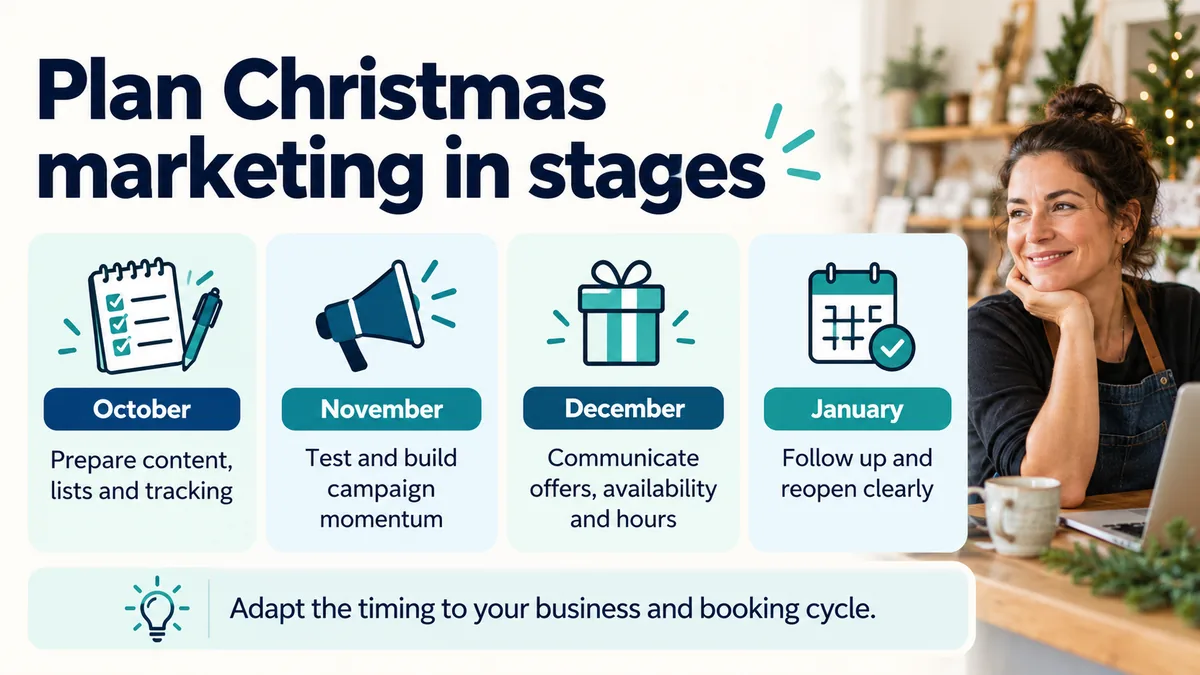
Think of it as four phases, not one campaign:
Phase 1 (October): Build. List-building, content, campaign setup, audience creation, Google Business Profile and website housekeeping. Low spend, high groundwork.
Phase 2 (Early-to-mid November): Warm up. Soft-launch gift guides and early offers ahead of Click Frenzy (10 to 12 November). This is also when you turn paid campaigns on at a moderate budget, so Google and Meta's algorithms have real performance data to optimise against before the big spend hits.
Phase 3 (Late November): Peak. Black Friday (27 November) through Cyber Monday (30 November) is when the bulk of your paid budget should be live and your creative should already be proven, not freshly uploaded. This is genuinely the most expensive advertising week of the Australian year by competitive pressure. Deloitte's research shows retailers now expect half of total holiday revenue inside this single window, which means half the industry's holiday ad spend is concentrated here too.
Phase 4 (December through early January): Convert and don't go dark. December still delivers 21% of the Christmas shopping period's sales (Bazaarvoice), and ANZ's own tracking shows $5.1 billion in spending during the shutdown week between Christmas and New Year alone. A lot of small businesses switch off marketing on 25 December, assuming everyone's on leave. The data says otherwise. If you trade through January, keep showing up.
If you want a sense of how long it generally takes for a new marketing effort to start producing results outside of the seasonal spike, our piece on realistic digital marketing timelines for small businesses is a useful cross-check. Christmas campaigns compress that timeline because of seasonal intent, but they don't eliminate the need for a working, tested campaign going in.
Does This Apply to Service Businesses, Not Just Retail?

Yes, with the framing adjusted. Most of the data above comes from retail-spending surveys, but the timing logic holds for service businesses too: trades, health and allied health, property, finance, wellness and hospitality all see a version of the same November-December intensity, just expressed differently:
- Trades and home services typically see a rush of "get this done before Christmas" enquiries in October and November, followed by a scramble for January bookings once people are back from holidays. Marketing availability and encouraging early bookings in October captures work you'd otherwise lose to a competitor who happened to post first.
- Health, allied health and wellness businesses often see a pre-Christmas lull as people get busy, followed by a January surge of "new year, new habits" enquiries. October/November is the right time to market gift vouchers and encourage bookings before the Christmas break, with a second campaign ready to go for the January rebound.
- Finance and property professionals can use November/December content around end-of-financial-year-adjacent planning, timing advice for property settlements around the shutdown period, or simply staying visible while competitors go quiet.
- Hospitality and events businesses are the exception to "start in October": for Christmas function and event bookings specifically, the planning window is often July to September, since corporate Christmas party bookings lock in months ahead.
What's the Biggest Mistake Businesses Make With Christmas Marketing Timing?
Two mistakes show up constantly, at opposite ends of the calendar.
Starting too late. A business that begins Christmas marketing in the first week of December is trying to build an audience, test creative and find its advertising footing during the single most expensive, most competitive advertising week of the Australian year. There's no "learning period" left, and no list to call on.
Starting too hard, too early. The flip side is just as damaging: full-throttle "Christmas Sale!" messaging in early October, which Bazaarvoice's research shows the majority of the Australian shopping public (62%) finds premature. The fix isn't to wait. It's to change what you're saying in October. Useful, non-discount content in October; offer-led, discount-driven content from Click Frenzy onward.
A third, quieter mistake: assuming the campaign ends on Christmas Day. The data above shows meaningful spending continues straight through the shutdown period into early January. A business that goes completely dark on 25 December is choosing to miss it.
How Does This Change the Way You Should Think About Ad Budget?

Lock in your Christmas-specific ad budget and campaign structure in October, before the auction gets more expensive. With Deloitte's research showing retailers expect half of all holiday revenue to land inside the single Click Frenzy, Black Friday and Cyber Monday window, that's also the week when every other Australian business selling anything remotely similar is bidding for the same audience at the same time. Businesses that have already built and tested their campaigns in October are optimising from a position of real data when that window opens; businesses starting cold in late November are paying tuition fees in the form of a more expensive, less efficient learning period, at the worst possible time to be paying them.
This is also where automated follow-up earns its keep over the holiday period specifically: enquiry volume spikes, staff availability often doesn't, and a lead that doesn't get a response within minutes during your busiest trading weeks is a lead a competitor picks up instead. We've covered this in more depth in our piece on marketing automation and nurture sequences for small businesses, which is worth setting up before November, not during it.
If you're still deciding where to actually spend the budget once it's set, our guide to which marketing channels small businesses should use in 2026 is a reasonable starting point for the channel mix question specifically.
FAQ
When should a small business start Christmas marketing in Australia?
Early October, for most businesses, about ten to eleven weeks before Christmas Day. That's enough time to build your email/SMS list, set up and test paid campaigns, and publish useful (not hard-sell) content before the Click Frenzy and Black Friday-Cyber Monday peak in November.
Is it too early to start Christmas marketing in October?
For discount-led, "Christmas Sale now on" messaging, yes: 62% of Australian shoppers surveyed by Bazaarvoice think retailer Christmas displays before October are premature. For list-building, gift guides, availability notices and general content, October is the right time, not too early.
What are the biggest Australian shopping dates in 2026?
Click Frenzy (10 to 12 November), Black Friday (27 November), Small Business Saturday (28 November), Cyber Monday (30 November), Christmas Day (25 December) and Boxing Day (26 December), followed by a shutdown trading period running through to early January.
Does Christmas marketing timing apply to service businesses, not just retailers?
Yes. Trades and home services typically see a pre-Christmas rush of enquiries in October/November; health and wellness businesses often see a lull before Christmas and a surge in January; finance and property professionals can stay visible while competitors go quiet. The exception is hospitality and events, where Christmas function bookings are often locked in by July to September.
Should marketing stop on Christmas Day?
No. ANZ data shows $5.1 billion in spending moves through the Australian economy during the Christmas-New Year shutdown period alone, and Bazaarvoice's research shows December still accounts for 21% of total Christmas-period shopping activity. Businesses that go completely dark on 25 December are leaving that activity to competitors who don't.
How much should I budget for Christmas marketing, and when should I lock it in?
That depends on your industry, margins and existing baseline spend, see our broader guide on how much Australian small businesses should spend on digital marketing. The timing principle that applies regardless of amount: decide the number and build the campaign structure in October, so your accounts have real performance data behind them before the most competitive advertising week of the year begins in late November.
Getting Your Timing Right Matters More Than Getting Your Discount Right
Most small businesses spend far more energy deciding what percentage off to offer than deciding when to start talking about it at all, and the data above suggests that's backwards. The businesses that win the Christmas trading period aren't necessarily the ones with the deepest discounts; they're the ones who built their list, tested their creative and set their budget before the rest of the market turned its attention to the same six-week window everyone else is fighting over.
If you want help building and running paid campaigns across Google and Meta for the Click Frenzy-to-Christmas period, that's exactly what our Google Ads management and social media marketing services are built for, and with October already underway, the practical window to set this up properly before November is closing. Book a free 30-minute session and we'll map out a Christmas timeline specific to your business.
Prices, figures and guidance in this article reflect the sources cited below at the time of writing, and are general information rather than a guarantee of results for your business.
Sources and References
- Bazaarvoice, Australian Holiday Shopping Season Behaviour Report, via B&T, 10 July 2024
- Deloitte Australia, "From Black Friday to Boxing Day: Optimism Returns", 18 September 2025
- Australian Retailers Association, "Countdown to Christmas as Retailers Race to 25 December", 20 December 2024
- ANZ, Media release on the 2025 Christmas "shutdown" spending forecast, 17 December 2025
- Business Victoria, 2026 Small Business Guide to Online Shopping Days, updated 25 February 2026
- ShopBack Australia, Black Friday 2026 Sale Calendar, accessed 7 October 2026
Figures above reflect the sources cited and general market conditions at the time of writing and can change; check the original source for current detail before relying on a specific figure.