
If you have only got one marketing dollar to spend right now, put it where buyers already are: a tight Google Business Profile plus Local SEO basics for free discovery, and Google Ads for anyone who needs leads inside the next 30 to 60 days. Social media builds familiarity over months, not sales this week, and "AI search optimisation" is not really a separate channel yet, it rides on the same SEO fundamentals you should already be doing. The right first investment depends on two things: how fast you need results, and how much you can afford to spend while you wait for the slower, cheaper channels to kick in.
In short:
- Fastest path to leads: Google Ads targeted at high-intent search terms, paired with a properly optimised Google Business Profile, both capture people actively looking to buy right now.
- Cheapest path to the same buyers: Local SEO and on-page content do the same intent-capture job as Google Ads, just slower, think months, not days, and without the ongoing media spend.
- Search still dominates Australian ad budgets for a reason. It was the single largest category of digital ad spend in the country in FY26, according to IAB Australia's Internet Advertising Expenditure Report.
- Social media is a trust-and-familiarity layer, not a lead-generation engine, for most local service businesses, unless you are running genuinely targeted paid social, not just posting and hoping.
- AI Overviews and AI Mode use the same eligibility rules as standard Google Search, per Google's own Search Central guidance, so there is no separate "AI search budget line" to create; solid SEO already covers it.
What Should a Small Business Invest in First: SEO, Google Ads, Social Media or AI Search?
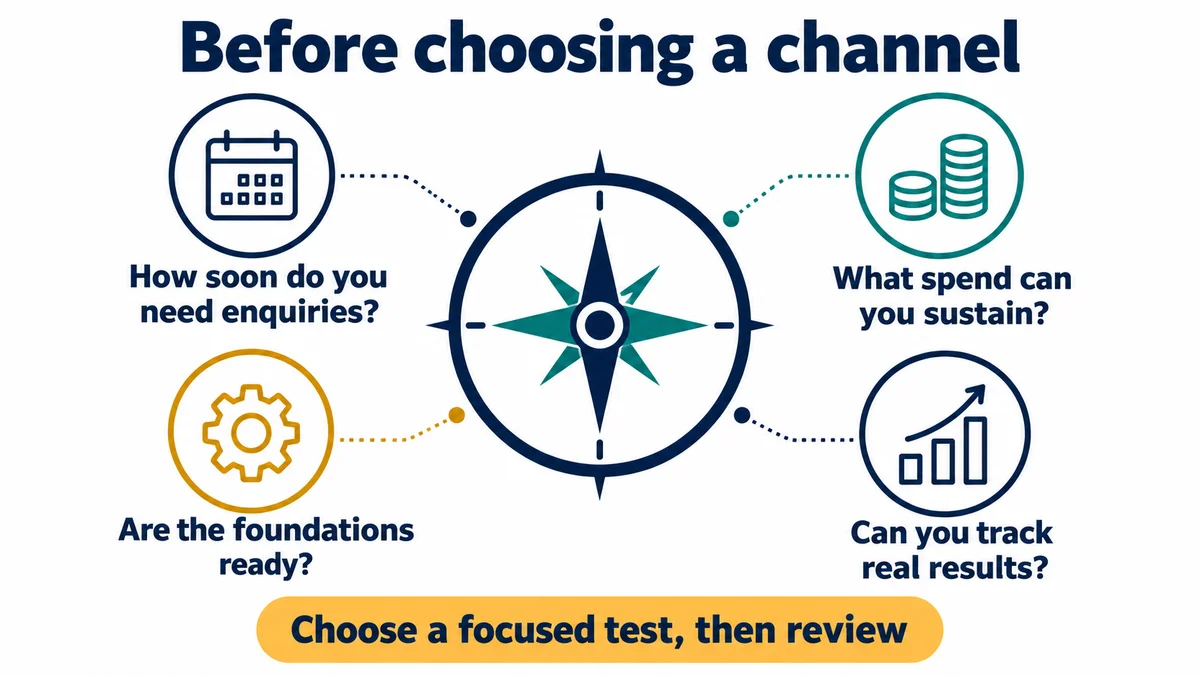
There is no universal answer, and any agency that gives you one without asking about your budget, timeline and existing foundations is guessing. What actually decides the order is two variables.
Time horizon. If you need the phone to ring this month, you need a channel that captures people who are already searching with buying intent, that is Google Ads, full stop. If you can wait three to twelve months for compounding results, SEO becomes genuinely competitive on cost per lead.
Budget tolerance for ongoing spend versus upfront effort. Google Ads needs real, continuous media spend from day one, cut the budget and the leads stop the same week. SEO needs upfront and ongoing effort (content, technical fixes, reviews, links) but the traffic does not disappear the moment you stop paying for a single click.
Most Australian small businesses asking this question are exactly the audience this trade-off matters most for. The Australian Bureau of Statistics counted 2,814,778 actively trading businesses at 30 June 2026, and businesses with fewer than 20 employees made up roughly 97% of that total, 2,741,087 of 2,814,778, meaning the overwhelming majority of Australian businesses, including the one reading this, are making exactly this budget-versus-time call with genuinely limited marketing resources, not an unlimited enterprise media budget.
The practical sequence for most service businesses: foundations first, website, Google Business Profile, review generation, all low-cost, high-leverage, then whichever of Google Ads or SEO matches your urgency, then layer in social media and broader content once the first channel is converting reliably. Treat "AI search" as something you get automatically from doing SEO properly, not a fifth line item.
Why Does Google Ads Usually Win the "What First" Argument?
Because it is the only channel on this list that reliably converts cold attention into a booked job inside the same week, and the Australian ad market's own spending patterns back that up. Search was the single largest category of internet advertising in Australia in FY26, worth $8.6 billion of the $19.8 billion total digital ad spend tracked by IAB Australia, a 43% share, and a financial-year record for the category.1 That is not a coincidence. Search is where intent concentrates: someone typing "emergency plumber near me" or "dentist taking new patients Hornsby" has already decided to buy something, they just need to pick who from.
Google Ads' real advantage is speed, not cheapness. You can be showing ads to people actively searching for what you sell within a day of campaign approval. The trade-off is that leads stop the moment the budget stops, and a poorly structured account, wrong match types, no negative keywords, Smart Bidding switched on before there is enough conversion data to optimise against, burns money fast without producing bookings. This is exactly where the set-it-and-forget-it automation pitch common in Google's current AI Max and Performance Max tooling needs human oversight, not blind trust, we cover that in detail in our guide to Google Ads in the AI era.
Who should start here: any service business where a single job is worth enough to justify a cost per click, trades, allied health, finance, property services, anything with a clear "I need this fixed, booked, handled now" moment. If your average job value is low and your margins are thin, Google Ads can still work, but you need tighter targeting and faster follow-up to make the maths stack up, see our guide on how fast you should respond to a new lead, since a slow callback undoes everything a well-run campaign just paid for.
When Is SEO the Better First Investment?

When you genuinely cannot commit to ongoing media spend but can commit time, or when your sales cycle is long enough that a slower-building channel still gets there before the decision is made. SEO and Local SEO are doing the same intent-capture job as Google Ads, getting you in front of people who are already searching, they are just doing it without a daily media bill attached.
The catch is time. SEO results compound rather than switch on. A newly optimised Google Business Profile can start generating map-pack visibility within weeks; ranking competitively for a commercial search term usually takes months of consistent content, technical hygiene and genuine reviews, not days. We have covered the realistic timeline in detail elsewhere, including the stages most businesses underestimate, read how long digital marketing actually takes to generate leads before you commit to this as your primary channel if you need results fast.
Is SEO still worth the wait given how much search behaviour has changed? Yes, and it is arguably more important now than it was a few years ago, not less, because of how AI-generated answers actually work. We go into this in full in Is SEO Still Worth It in the Age of AI Search?, but the short version is: AI Overviews and AI Mode are built on top of standard Search indexing, not a separate system, so a site with weak SEO fundamentals has nothing for either Google's classic results or its AI features to draw from.
Practical starting point if SEO is your pick: Google Business Profile optimisation and review generation first, cheapest, fastest-moving part of local SEO, then on-page content targeting the specific questions your customers are actually typing into Google, then the slower technical and authority-building work. Do not try to do all of it at once with a limited budget, sequence it.
Where Does Social Media Actually Fit?
As a trust-building and retention layer that most service businesses invest in too early and expect too much from. Organic social media reach in Australia is substantial, DataReportal's Digital 2026: Australia report counted 21.0 million social media user identities nationally as of October 2025, equal to 77.7% of the population, with Facebook reaching 17.7 million and Instagram 15.2 million of the eligible audience.2 Those are genuinely large numbers. The problem is that reach is not intent: someone scrolling Instagram on their lunch break is not in the same buying mindset as someone typing a search query, and organic reach on most platforms has been in long-term decline regardless of how good your content is, because that is how the algorithms are designed to work.
Where social media genuinely earns its place: building recognition and trust with people who have already found you some other way, so they book with confidence rather than needing convincing, nurturing an existing customer base for repeat business and referrals, and, when run as paid social with real audience targeting, not boosted posts, reaching cold audiences with enough frequency and consistency to eventually convert. Treat it as the second or third channel you properly invest in, not the first, unless your business genuinely sells on visual appeal and impulse, hospitality, beauty, some retail-adjacent services, where social can realistically drive direct bookings faster. Our 2026 social media strategy guide breaks down which platforms are actually worth a service business's time versus which ones are mostly vanity reach.
Should You Be Optimising for "AI Search" as Its Own Channel?
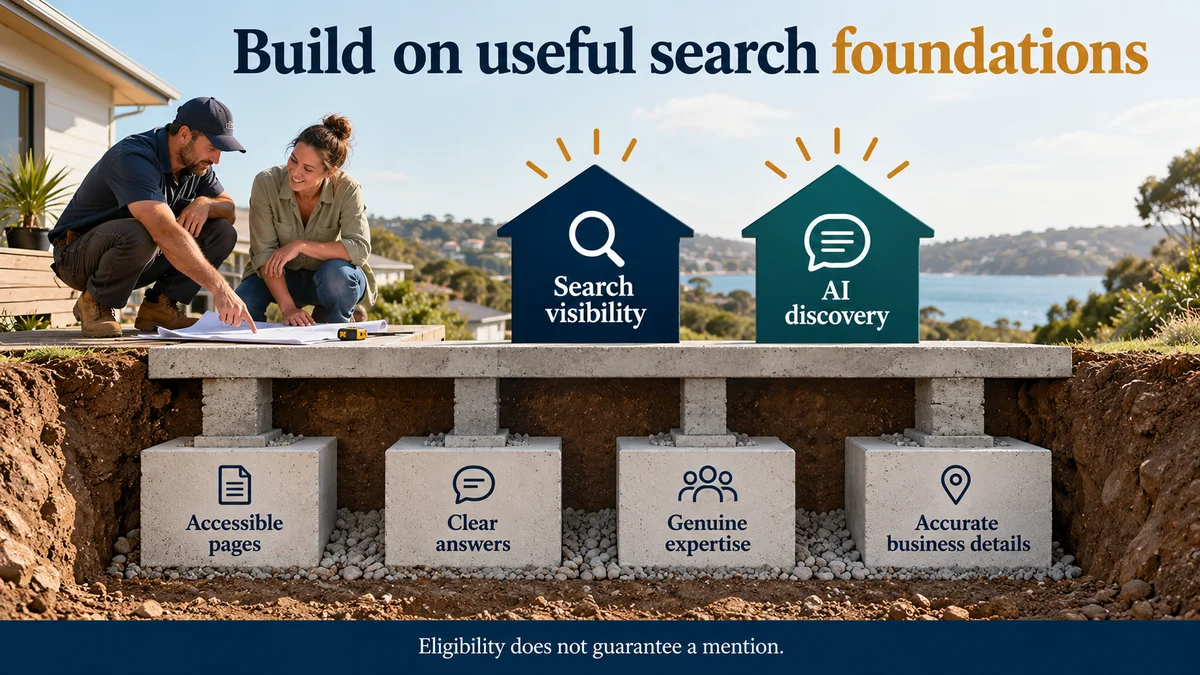
No, and treating it as a separate line item is the most common new mistake we are seeing small businesses make heading into 2027. Google's own Search Central documentation is explicit on this: AI Overviews and AI Mode have "no additional technical requirements" beyond standard Search eligibility.3 A page qualifies to be cited as a supporting link in these AI features the same way it qualifies for a normal search result, it needs to be indexed, crawlable, and eligible to appear with a standard snippet. Google states you do not need special schema markup, new machine-readable files, or any AI-specific technical work to be eligible.
What this means practically: if your SEO fundamentals are solid, clear, well-structured content that directly answers the questions customers are actually asking, genuine expertise demonstrated in the text, a technically healthy site, current Google Business Profile information, you are already doing what AI search optimisation actually requires. The genuinely new skill is being mentioned by name in AI-generated answers from tools like ChatGPT, which draws on a wider mix of sources than Google's own index. We cover that specific discipline, sometimes called answer engine optimisation, in how to get your business mentioned by ChatGPT and other AI tools, but it is a refinement you layer onto working SEO, not a replacement starting point.
What Does a Smart Investment Sequence Actually Look Like?

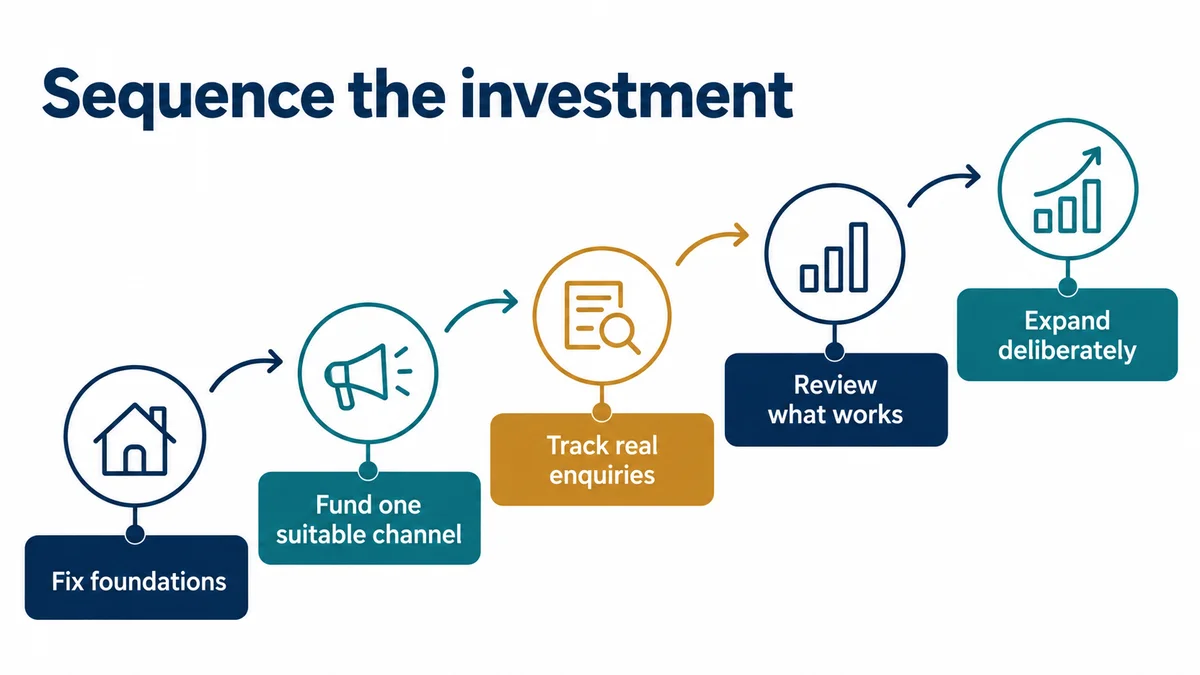
For most Australian service businesses asking this question, the realistic sequence is:
- Foundations (week one, low cost). Claim and fully optimise your Google Business Profile, fix any glaring website issues (mobile speed, a working enquiry form, clear services and pricing signals), and start actively generating Google reviews.
- Pick one channel to properly fund, not two half-funded ones. If you need leads inside 60 days and can sustain ongoing ad spend, that is Google Ads. If you cannot sustain media spend but can commit time, that is SEO and content.
- Measure before you expand. Do not add a second channel until the first one is producing a measurable, trackable cost per lead you understand. Running Google Ads and content marketing and social media all at once on a stretched budget usually means all three are underfunded and none of them get a fair test.
- Layer in social media and retargeting once channel one is converting. This is where you build the trust and repeat-business layer on top of a working lead source, rather than hoping social does the whole job alone.
- Let AI search visibility follow from solid SEO, do not chase it separately.
If you are not sure which of your current channels is actually working, that is a measurement problem before it is a channel-selection problem, see our breakdown of how to build a digital marketing system that generates qualified leads for the full funnel view, from first search through to booked job.
Every business on this list, trades, health, property, finance, hospitality, local professional services, is solving the same underlying problem with different urgency and budget constraints: getting in front of people who are already looking for what they sell, before a competitor does. Google Ads and Local SEO do that job directly. Social media and AI search visibility matter, but they are the compounding layer you add once the first channel is actually converting, not the place to start when budget is tight. If you want a straight answer on which of these fits your specific business, budget and timeline, not a generic framework, book a free strategy session with OZ Media Digital, or see our full range of local SEO services and Google Ads management if you already know which channel you are backing first. We also help businesses layer AI-ready marketing systems on top of a working foundation once it is time to expand.
FAQ
Is Google Ads better than SEO for a small business?
Neither is universally better. Google Ads is faster, producing leads within days but dependent on continuous spend. SEO is cheaper over time but slower to build, typically taking months. The right choice depends on how urgently leads are needed and how much ongoing budget can be sustained.
How much should a small business budget for its first digital marketing channel?
There is no single figure that fits every industry or job value. A business with a higher average job value can sustain a higher cost per click than one with a low average job value. Budget enough to gather several weeks of genuine conversion data before judging results.
Does social media actually generate leads for local service businesses?
Rarely on its own for most trades, health and professional services. It works best as a trust-building layer for people who have already found the business some other way, and as a targeted paid channel rather than organic posting alone.
Do I need to do anything different to appear in Google's AI Overviews or AI Mode?
No separate technical work is required. Google's own Search Central guidance confirms AI Overviews and AI Mode use the same eligibility rules as standard Search. Solid SEO fundamentals are what make a page eligible for both classic results and AI features.
Can I run Google Ads and SEO at the same time?
Yes, and many service businesses eventually run both. If budget is genuinely limited, fully funding one channel usually outperforms thinly spreading a small budget across two.
What should come after my first marketing channel is working?
Measurement discipline and a second channel, usually social media or retargeting for trust-building and repeat business, added once the cost per lead on the first channel is understood.