
Google Business Profile optimisation means making every section of your free listing, category, attributes, photos, products, posts, Q&A and business information, as complete and accurate as possible, because Google ranks local results on relevance, distance and prominence, and a thin or incomplete profile loses on all three. Most Australian service businesses verify their profile once, add a logo, and never touch it again. That is the gap this article closes.

TL;DR, what actually moves a Google Business Profile:
- Your primary category is the single highest-weighted factor in Google's own local algorithm research, more important than reviews, posts, or how recently you updated anything.
- Completeness beats polish. Google's own guidance says businesses with complete, accurate information are more likely to appear in local search results, hours, address, attributes and categories matter more than how good your photos look.
- Distance still matters even with a perfect profile. A business 400 metres from the searcher with a decent profile can outrank a flawless profile 8km away for the exact same search.
- Attributes, products and Q&A are the most commonly skipped sections, and they are free, fast to fill in, and directly tied to the relevance half of Google's ranking formula.
- Posts and photos do not rank you on their own, but they influence whether someone who finds you actually clicks through, calls, or keeps scrolling.
What Does "Optimising" a Google Business Profile Actually Mean?
It means filling in every section Google offers, keeping it accurate as your business changes, and giving Google enough signal to understand exactly what you do and where. Google's own Business Profile Help page states local search results are "mainly based on relevance, distance, and popularity," Google's own term, elsewhere called prominence.1 Optimisation is the work of improving your business's standing on the two of those three factors you can actually control: relevance and prominence. Distance is fixed by your physical address or service area, you cannot move your business to rank better, but you can make sure Google has an accurate address or service-area radius to judge that distance from in the first place.
Most businesses treat the profile as a one-time setup task: claim it, verify it, add a phone number, done. Google's guidance is explicit that this is not enough, complete and accurate information is what "more likely to show up in local search results" is built on, not a one-off verification tick.
What's the Single Biggest Ranking Factor Most Businesses Get Wrong?
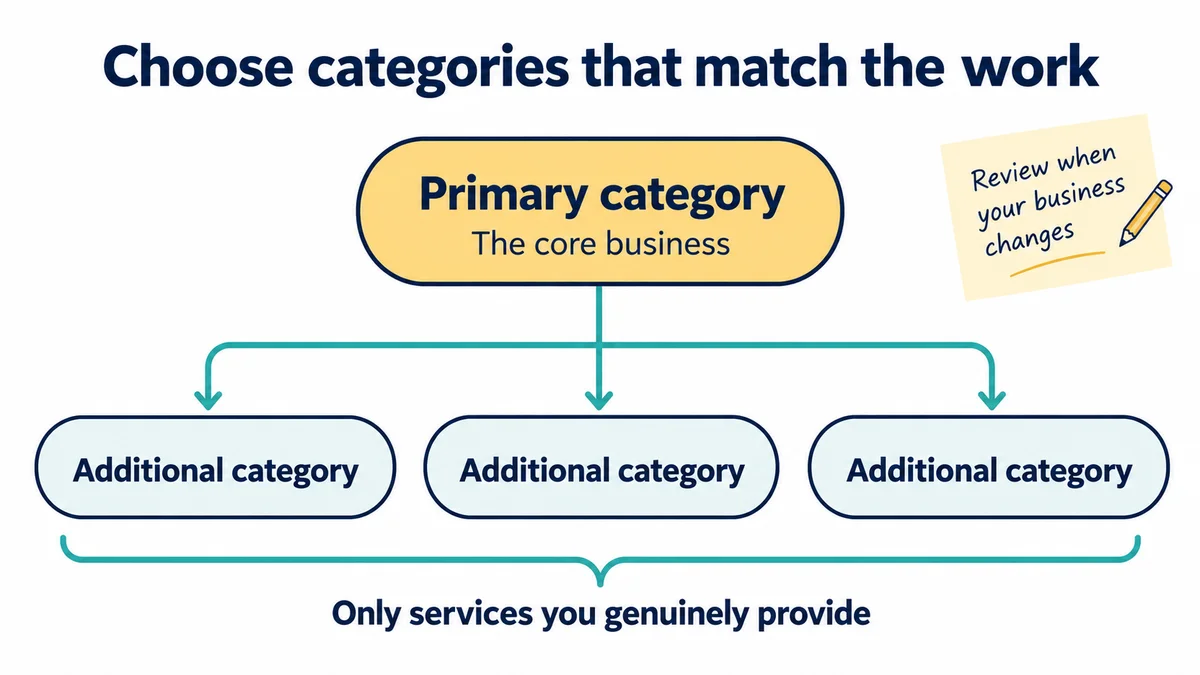
Your primary category. Whitespark's 2026 Local Search Ranking Factors survey, an annual poll of local SEO practitioners published 6 November 2025, ranked "Primary GBP Category" as the single highest-weighted individual local pack ranking factor for 2026, ahead of proximity to the searcher, keywords in the business title, and the quantity of Google reviews with text.2
This matters because most businesses pick their primary category once, during setup, and never revisit it. A plumber who registered under "Plumber" five years ago but now does more emergency callouts than new installs, or a physiotherapist registered as "Physical therapist" when "Sports medicine clinic" is available and more specific, is leaving relevance signal on the table every single day that category sits unreviewed. Google allows one primary category and up to nine additional categories, Whitespark's survey ranks "Additional GBP Categories" in its top 10 factors as well, so the secondary categories are not decoration, they are genuine ranking signal.
The fix takes five minutes: open your Business Profile, check whether your primary category is still the single most accurate description of what brings in the most revenue today, and add every genuinely relevant secondary category Google offers, not categories you wish applied, ones that actually describe a service you deliver.
Do Attributes, Products and Q&A Actually Matter, or Are They Just Extra Clutter?

They matter, and they are the most commonly skipped sections on an Australian small business profile. Attributes are the small tags Google shows under your profile, wheelchair accessible, free Wi-Fi, online appointments, women-owned, LGBTQ+ friendly, and dozens more depending on your category. Google's own guidance lists attributes alongside business category and hours as part of the complete and accurate info that improves local visibility. They cost nothing, take seconds to tick, and directly answer questions a searcher is often filtering by before they even click through.
Products work the same way for any service business that sells anything discrete, a tradesperson selling hot water system units, a salon selling retail haircare, a gym selling memberships as line items. Google's guidance notes products can appear directly in local search results, letting a customer see what is available before they ever visit your website. For a service business, this is frequently the fastest win on the whole list, because almost nobody fills it in.
Q&A is the section Google shows directly on your profile where anyone, not just you, can ask a question, and anyone, including other customers, can answer it. Left unmanaged, this becomes a liability: a competitor, a disgruntled ex-customer, or a confused searcher can post a question that sits there unanswered, or worse, gets answered incorrectly by someone who is not you. The fix is proactive: seed your own profile's Q&A with the five questions customers actually ask most ("do you offer emergency callouts," "do you service [suburb]," "what's your call-out fee") and answer them yourself, in your own voice, before anyone else does.
How Much Do Photos Actually Influence Ranking?

Less than most business owners assume, and more than most businesses invest in. Google's own guidance frames photos and videos as a way to "show off what you have to offer and tell your business's story," note this is framed as a discovery and trust signal for the person looking, not stated by Google as a direct ranking input the way category and completeness are. What photos actually do is influence the next step after someone finds you: whether they click through to your profile, call, or keep scrolling to the next listing in the pack.
A profile with zero photos, or only a stock logo, reads as abandoned to anyone comparing three or four local businesses side by side in the map pack. A profile with recent, specific, real photos, your actual van, your actual shopfront, your actual completed jobs, reads as active and current, which matters because Whitespark's 2026 survey also flags recency and freshness signals as a rising factor group, even where the exact mechanism is not published by Google. The practical rule: add photos regularly, make them specific to your business rather than generic, and never let the photo count sit at zero.
Does Posting Regularly Actually Help My Ranking, or Is It Just for Show?

Posting is not confirmed by Google as a direct ranking factor, but it is one of the clearest signals of an active, maintained profile, and an inactive profile is a weaker candidate on the prominence side of Google's own ranking formula, which is explicitly built in part from signals about how well-known and well-reviewed a business is. A profile that has not posted, updated hours, or added a photo in eight months looks different to Google's systems than one that is actively maintained, even if Google does not publish exactly how that difference is weighted.
The more immediate benefit is for the human reading your profile, not the algorithm ranking it. A post about a completed job, a seasonal service reminder, or a short note about extended hours over a public holiday period gives a searcher comparing you against two competitors a reason to pick the business that looks awake. Treat posts as a low-effort trust signal, not a ranking lever you can pull on its own.
What's the Realistic Order to Tackle All of This In?
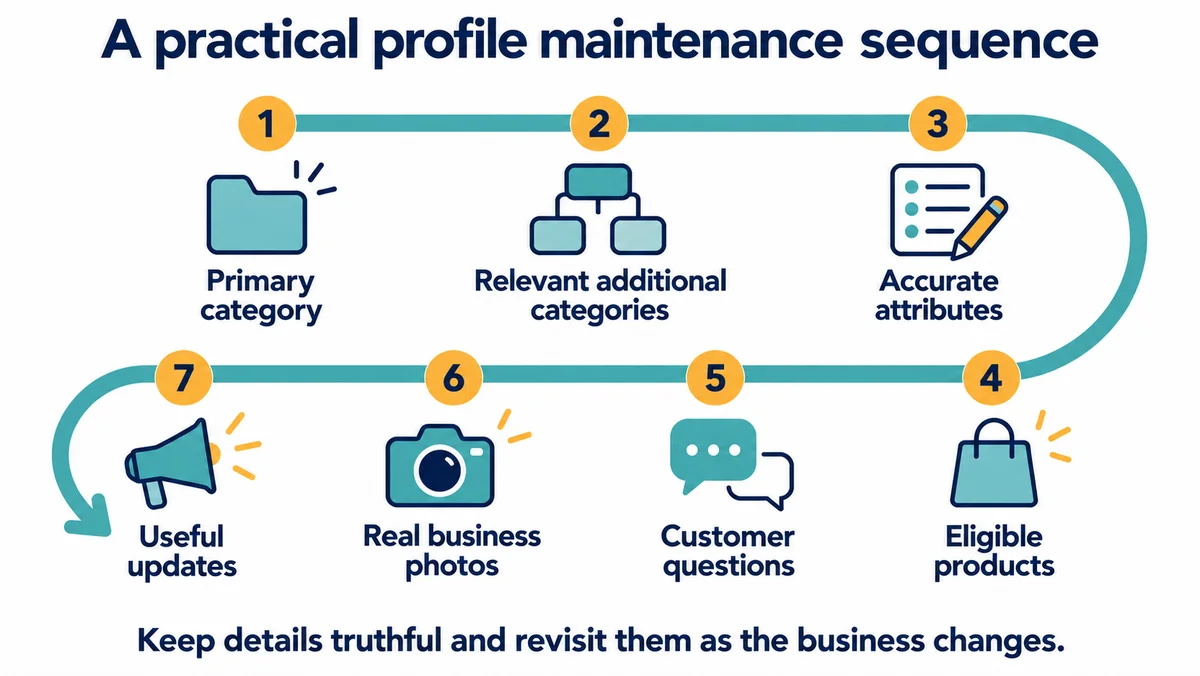
Do not try to do all seven sections in one afternoon and then abandon the profile again for a year, that is the exact pattern that got most Australian profiles into their current half-finished state. A sensible sequence:
- Fix the primary category first. This is the single highest-weighted factor per Whitespark's 2026 survey, and it is a five-minute check.
- Add every genuinely relevant secondary category. Still category work, still fast, still high-leverage.
- Fill in attributes completely. Every tag that genuinely applies, no exceptions, this costs nothing and directly supports relevance.
- Add products if you have anything sellable as a discrete line item. Most businesses in this category have never touched this tab.
- Seed your own Q&A with the five questions you are asked most, answered in your own words.
- Build a photo habit. Even four or five real photos added per month beats forty uploaded once and never touched again.
- Post something at least monthly. A completed job, a seasonal note, an hours change. Consistency matters more than frequency.
This is genuinely different work from deciding whether to manage a profile yourself or hire it out, we have covered that decision, including realistic Australian pricing for professional management, in Do I Really Need to Hire Someone to Manage My Google Business Profile? The checklist above is what "doing it properly" actually contains, whichever option you choose.
How Does This Fit With the Rest of Local Search, Beyond the Profile Itself?
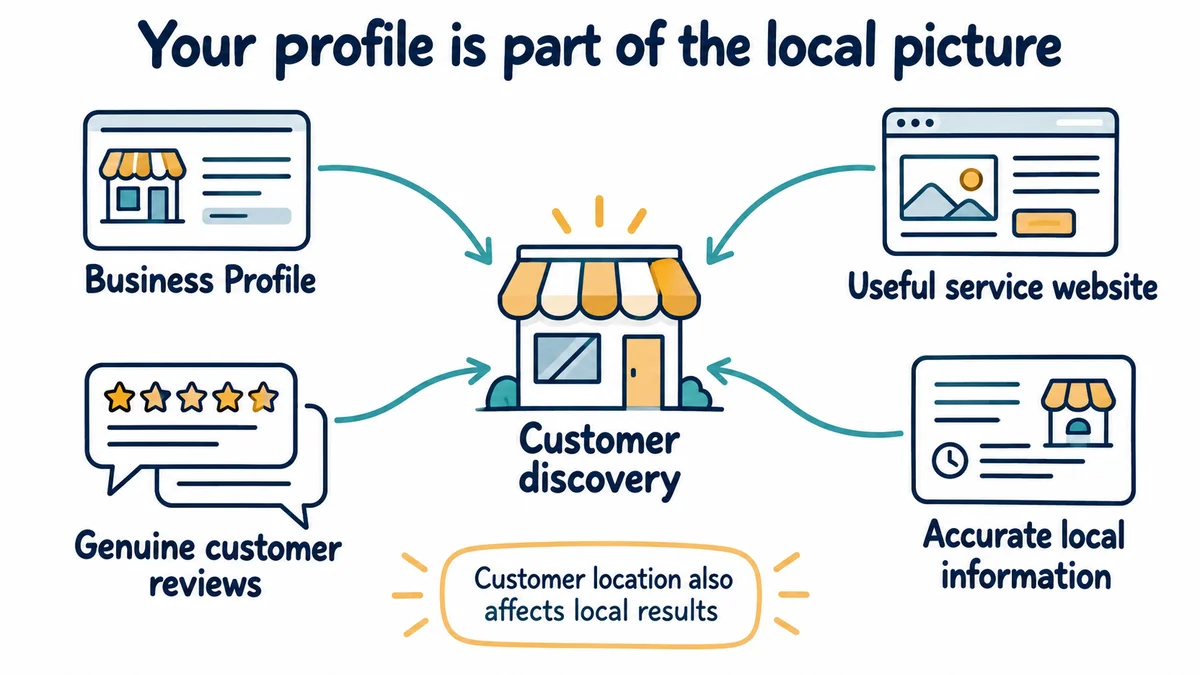
A fully optimised Google Business Profile is one input into local visibility, not the whole system. Distance is the factor Google weighs that your profile alone cannot fix, a business genuinely closer to the searcher starts with an advantage no amount of category tidying overcomes on its own, which is why service-area businesses need a deliberate suburb-level content strategy alongside profile work, not instead of it. We have mapped that broader approach in The Suburb SEO Strategy: How Small Businesses Can Own Their Local Market, and the full picture of how customers actually find local businesses now, profile, Maps, reviews and AI search combined, is covered in How Customers Find Local Businesses Now: Google Search, Maps, Reviews and AI.
If budget for paid visibility is not there yet, profile optimisation is also one of the few genuinely free levers available, see How Local Trades People Can Rank on Google Without Paying for Ads for how this fits into a no-ad-spend local strategy. A fully optimised profile only helps if the details on it actually match your website and other directories, see why consistent business information matters for the audit process.
A Google Business Profile that is genuinely optimised, not just verified and left alone, is one of the highest-leverage, lowest-cost things a local service business can do, and most businesses we review have never touched more than three of the seven sections covered above. At OZ Media Digital, profile optimisation is a standard part of our Local SEO & AI SEO service: we audit every section against what is actually missing, not a generic template, and fold it into the broader local visibility work covered by our full marketing services. Book a free session and we will run a free audit of your current profile against this exact checklist.
FAQ
How long does it take to fully optimise a Google Business Profile?
The core checklist, category, attributes, products, Q&A, takes under an hour for most businesses once you sit down and do it properly. Building the ongoing habit of photos and monthly posts is the part that takes discipline, not time.
Does changing my primary category hurt my existing ranking?
Not if the new category is genuinely more accurate. Google's ranking is based on relevance to the search, so correcting a category that no longer matches your main service should improve relevance, not damage it. The risk is picking a category that sounds more impressive but is less accurate, Google penalises mismatch, not correction.
Do I need a physical address to rank well locally?
No, but it changes how you are evaluated. Service-area businesses without a public-facing address can still rank, using their declared service area instead of a storefront address, Whitespark's 2026 survey ranks having a genuine, non-virtual physical address as a stronger factor than a service-area-only setup, so businesses with a real premises still have an edge where one exists.
Can I lose my Google Business Profile ranking by doing nothing?
Not instantly, but an unmaintained profile falls behind as competitors keep theirs current. Google's own framing of prominence and relevance rewards an actively maintained listing over a static one, and a profile untouched for a year is a weaker candidate every time a competitor fills in a section yours is still missing.
Is there any way to pay Google for a better local ranking?
No. Google's own help documentation states plainly that there is no way to request or pay for a better local ranking on Google. Paid Google Ads can appear alongside organic local results, but that is a separate placement, not an improvement to your organic Business Profile ranking.
Should I optimise the profile myself or get help?
Either works, this article is the checklist either option needs to actually cover. If you want the full breakdown of cost and effort for DIY versus professional management specifically, see Do I Really Need to Hire Someone to Manage My Google Business Profile?