 OZ Media Digital
Most Australian customers don't "look for" your business anymore. They ask Google a question, glance at three results with stars next to them, and pick one before they've spent thirty seconds on it. Search still starts the journey (46% of all Google searches carry local intent), but Google Maps, star ratings and, increasingly, AI-generated answers now do the filtering that used to happen on your website. If you're not visible in those three places, you're not in the conversation, no matter how good your actual service is.
This guide breaks down exactly how local discovery works in Australia right now: where people actually look first, how much reviews really move the needle, what AI Overviews and AI Mode are doing to local search, and what Google is actually ranking on in the Maps pack today. Then it turns that into a plain checklist for what to fix first. It's the local-search half of the wider system we mapped out in digital marketing for Australian small businesses in 2027, the discovery stage most small businesses under-invest in relative to ads or social.
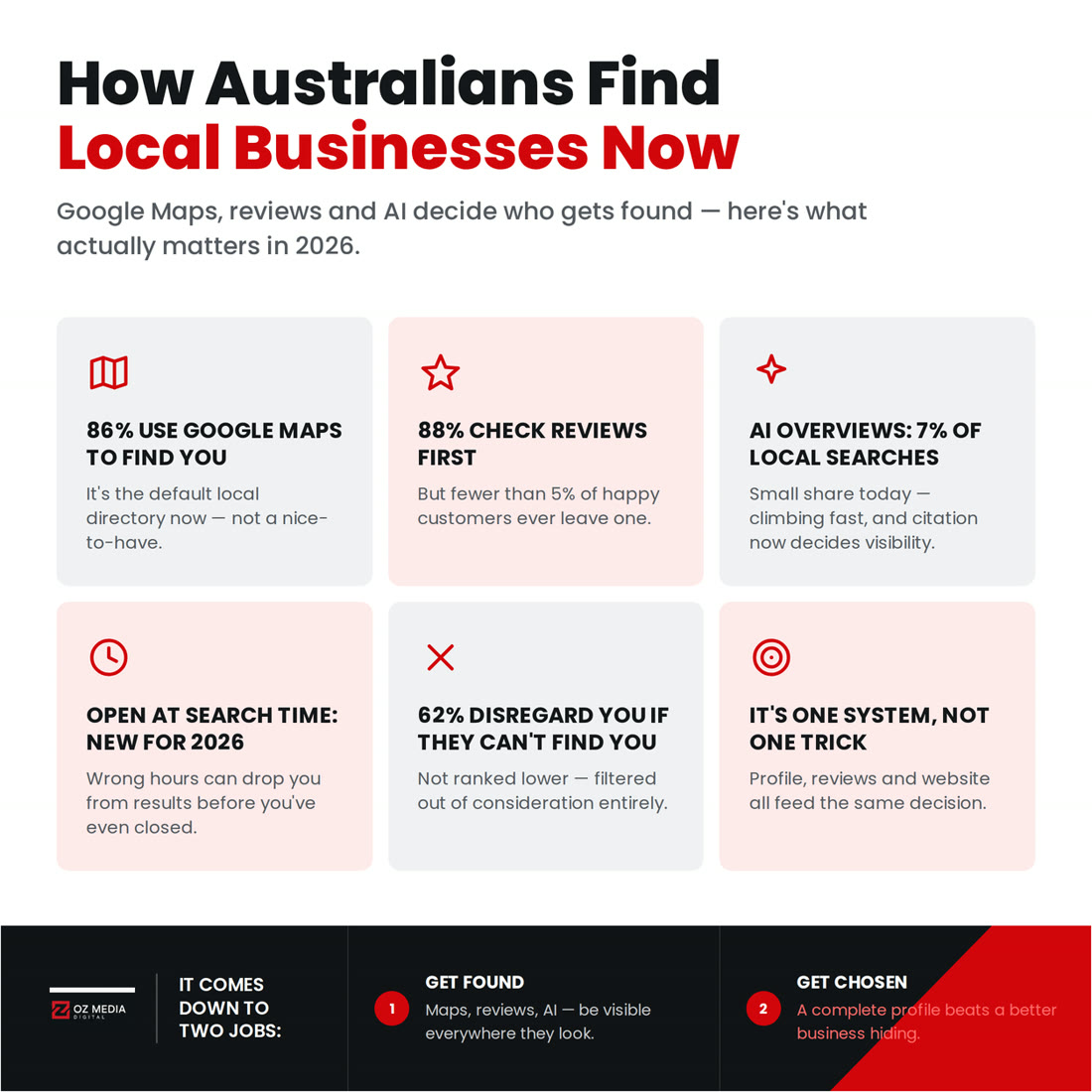
The short version:
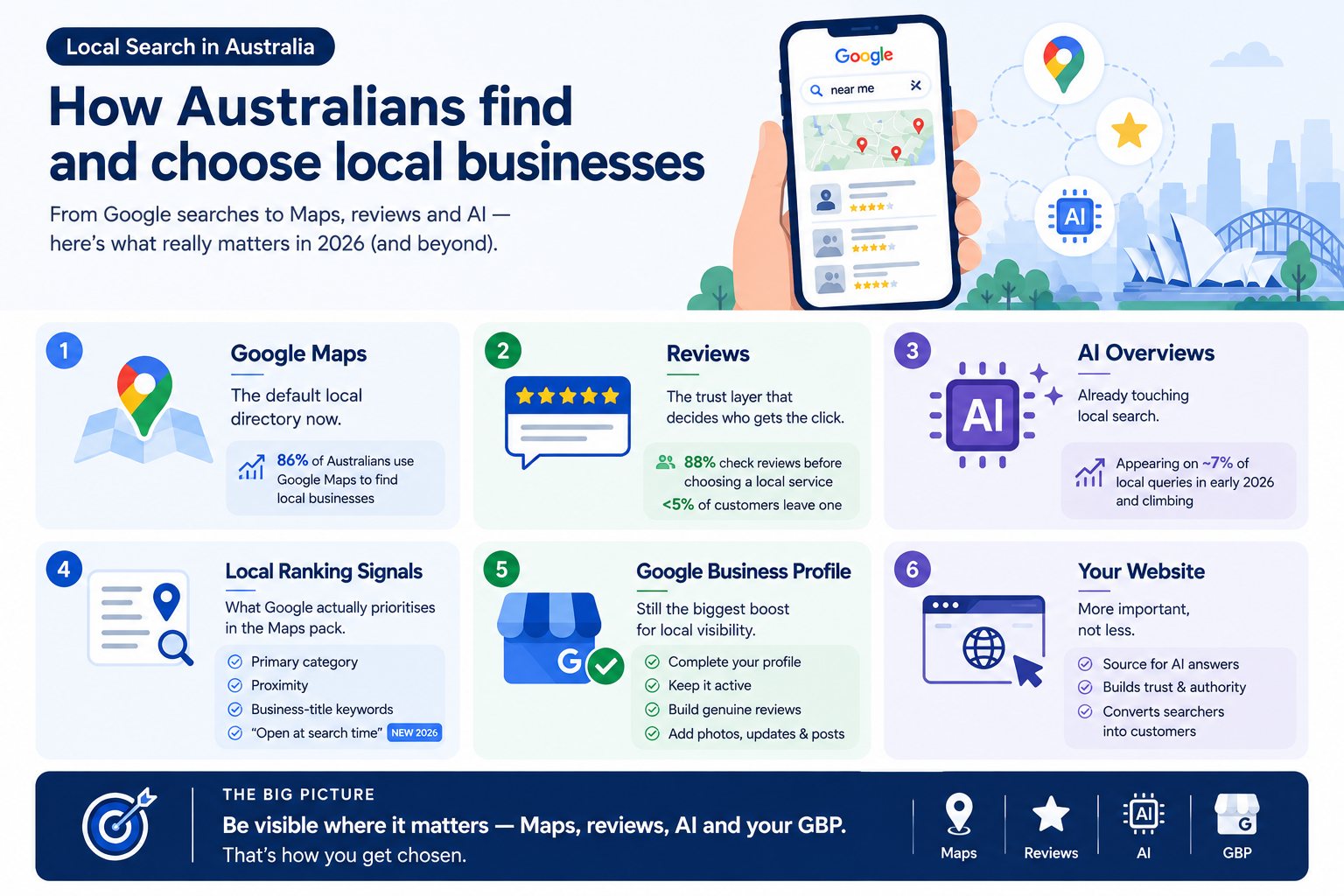
- Google Maps is the default local directory now. 86% of Australian consumers use it to find local businesses, and "near me" mobile searches have grown 136% year on year.
- Reviews are the trust layer that decides who gets the click. 88% of customers check reviews before choosing a local service, but fewer than 5% of customers ever leave one, which means most businesses are being judged on reviews from a small, self-selected minority.
- AI Overviews are already touching local search. They appear on roughly 7% of local queries in early 2026 and climbing, favouring businesses with consistent, well-structured information over businesses that merely rank.
- Google's local ranking signals shifted for 2026. Primary category, proximity and business-title keywords still dominate, but "open at search time" is a new, sharp-edged factor: Google will drop a closed business from results before it even shuts.
- A complete, active Google Business Profile plus a genuine review pipeline still beats almost everything else a small service business can do for local visibility, and it's also the foundation AI search tools pull from.
- A website matters more, not less, in the AI-search era. It's the source AI Overviews and AI Mode cite when they answer local questions, not a channel they're replacing.
Where Do People Actually Look First: Google, Maps, or Something Else?
For a service business (tradie, clinic, salon, accountant, gym) the honest answer is that Google Search and Google Maps are functionally the same discovery surface now, and between them they carry the overwhelming majority of local intent.
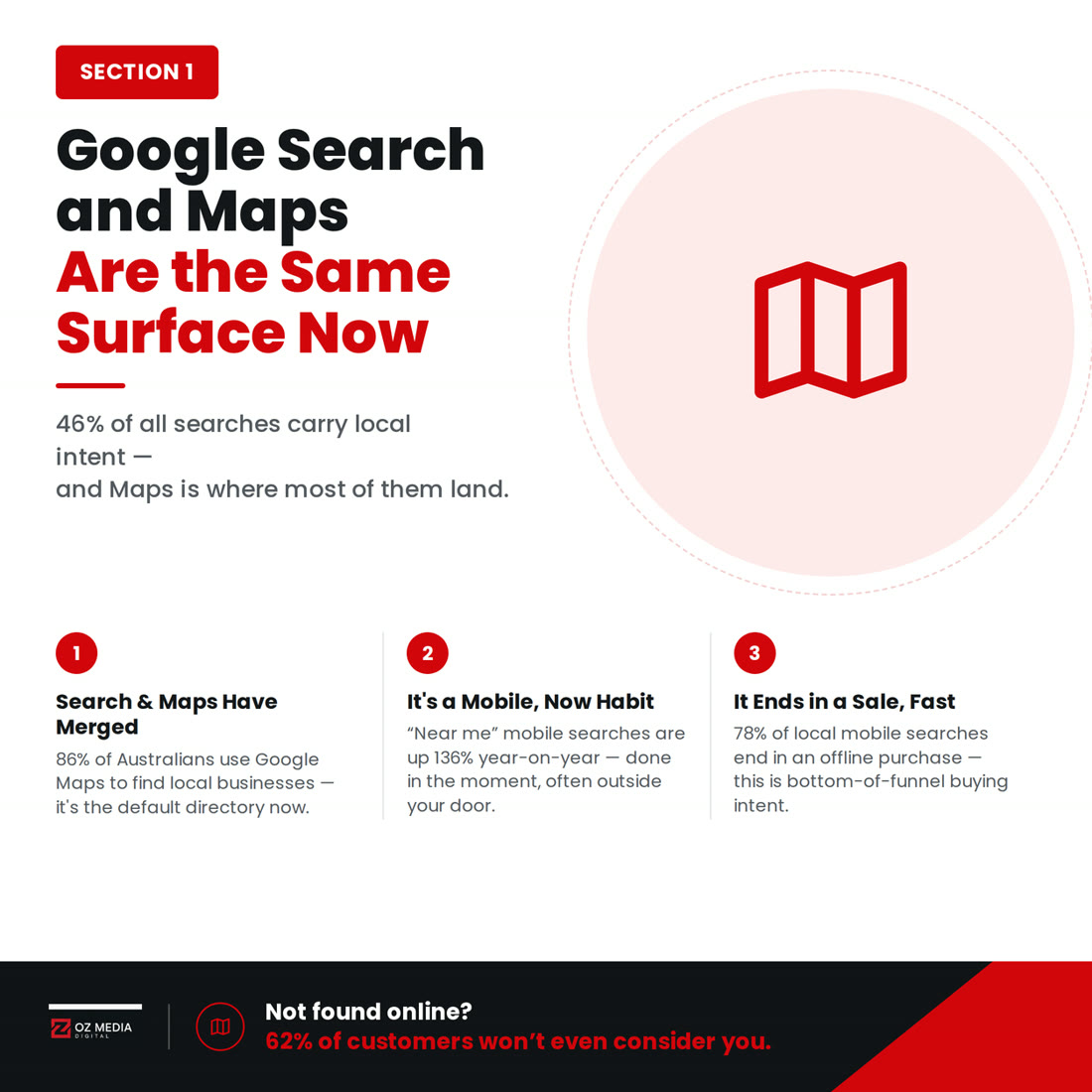
Local intent itself is enormous. Roughly 46% of all Google searches (an estimated 1.6 billion of Google's 3.5 billion daily searches) carry a local signal, whether that's an explicit "near me" or an implicit one Google infers from the searcher's location. Ninety-seven per cent of people say they've searched online specifically to find a local business, and close to a third search for one at least once a week.
Two things have changed the shape of that behaviour in the last two years. First, mobile "near me" searches have grown 136% year on year. This is now overwhelmingly a phone habit, done in the moment, often standing outside or already in the car. Second, the local pack (the map with three pinned businesses that sits above the organic results) has become the primary decision surface for a huge share of those searches: 86% of Australians use Google Maps specifically to find local businesses, and 68% of smartphone users default to it over any other map or directory app.
The commercial weight behind this is what makes it worth taking seriously rather than treating as a vanity channel. Seventy-eight per cent of local searches on mobile end in an offline purchase, and more than half of all "near me" searches result in a store or premises visit within a short window. This isn't top-of-funnel browsing. It's bottom-of-funnel buying intent, arriving through a channel most small businesses under-invest in relative to their website or their ad spend.
The flip side is blunt: 62% of consumers say they'll disregard a business entirely if they can't find it online. Not "rank it lower". Disregard it. If your Google Business Profile is thin, outdated, or missing, you're not losing a ranking position. You're being filtered out of consideration before the customer has even seen your name.
How Much Do Reviews Actually Influence Who Gets Chosen?
More than most business owners want to believe, and the mechanism matters as much as the headline number.
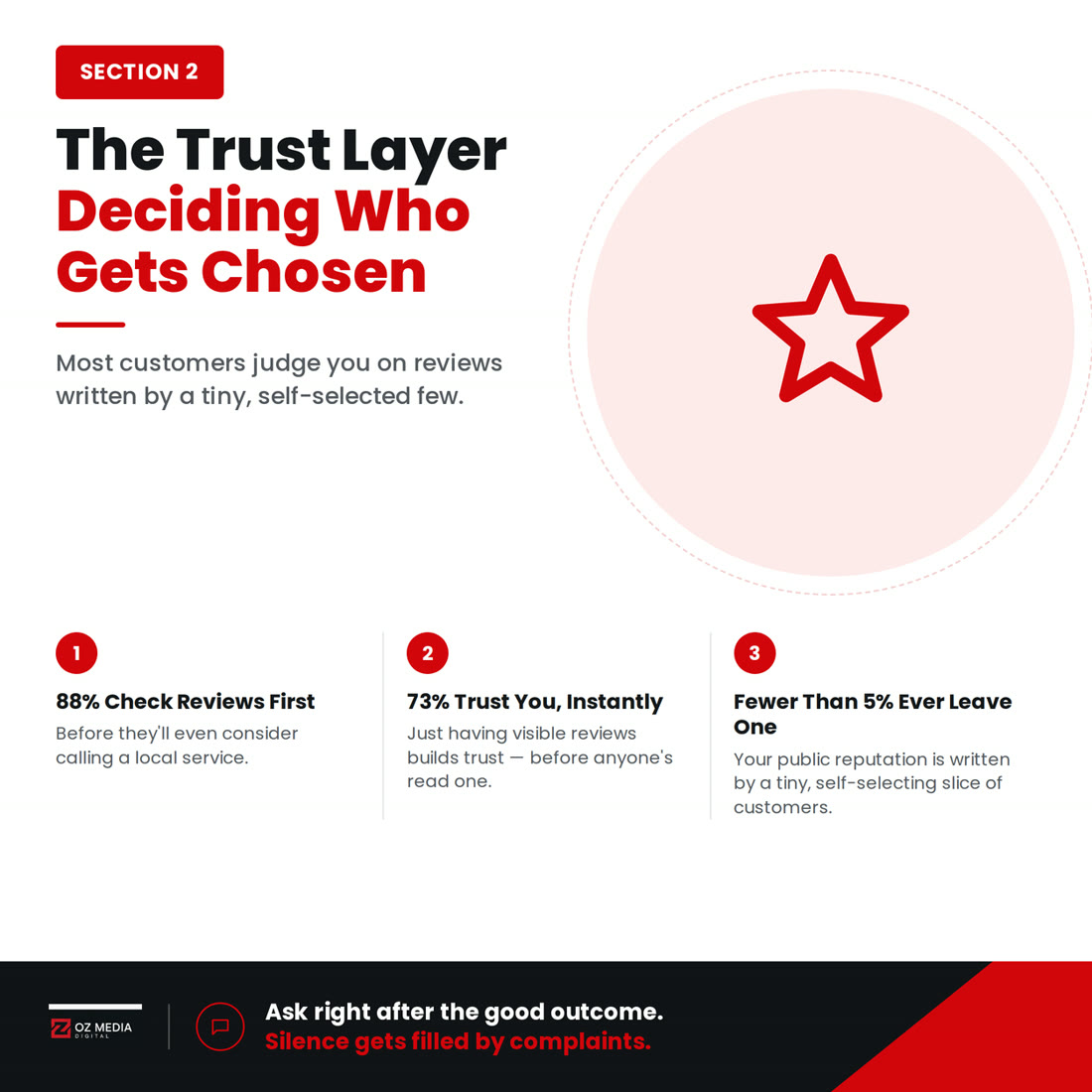
Eighty-eight per cent of potential customers say they look for online reviews before choosing a local service, and 73% say they trust a business more once it has visible reviews, full stop, before they've read a single one. That's the trust threshold: a business with a handful of average reviews at 4.2 stars generally beats a business with zero reviews and no signal at all, even if the zero-review business is objectively better.
Here's the part that changes how you should think about your review strategy: fewer than 5% of customers who could leave a review actually do. That means your public review profile (the thing shaping first impressions for the other 95% of prospective customers) is being written by a small, self-selecting group, usually skewed toward people who had either an unusually good or unusually bad experience. If you're not actively asking satisfied customers to review you, you're leaving that narrative to chance, and chance tends to over-represent complaints.
Practically, this means review generation isn't a "nice to have" bolted onto customer service. It's a discovery-channel input with a direct line to whether you show up in the local pack at all, since review count and review recency are both live ranking signals Google uses for local search. A simple, consistent ask, timed right after a good outcome and made easy with a direct link, will outperform an occasional reminder email every time.
What's Changed With AI Overviews and AI Mode for Local Search?
This is the part most local SEO advice hasn't caught up with yet, so it's worth being precise about what's actually happening rather than what's being predicted.
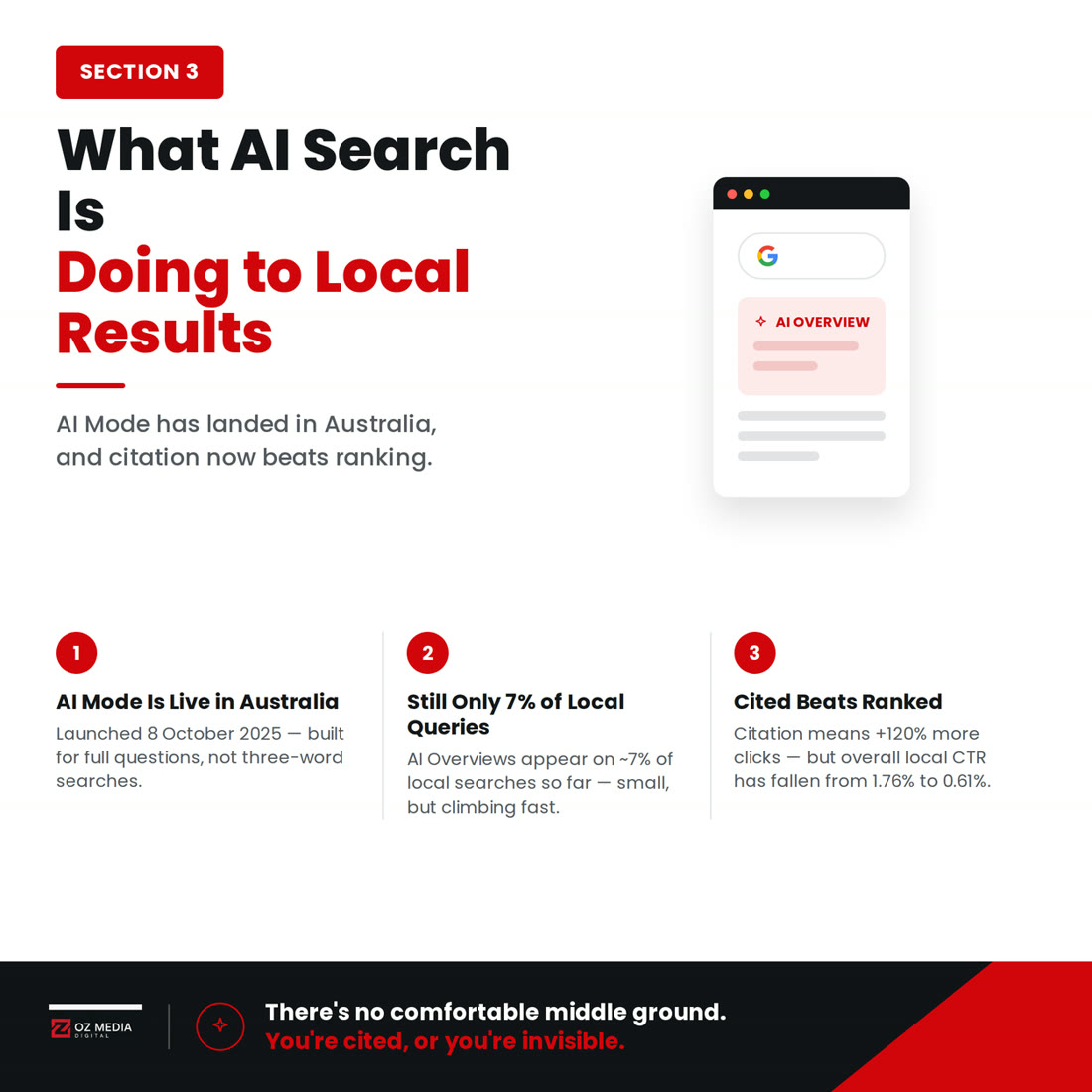
Google rolled out AI Mode in Australia on 8 October 2025. It's the company's most conversational search experience, built to handle longer, multi-part questions ("best-rated licensed electrician near me who does emergency callouts on weekends") rather than the three-word queries search has trained us to type. Early testers were asking questions nearly three times the length of a typical search. AI Mode works by breaking a question into sub-topics and running a "query fan-out" across the web and Google's Knowledge Graph to assemble an answer, rather than returning ten blue links for the user to sort through themselves.
AI Overviews (the AI-generated summary that now sits above traditional results on many searches) are a separate but related feature, and the local-search numbers on it are still modest but moving fast. As of early 2026, AI Overviews appear on roughly 48% of all tracked search queries overall, but only around 7% of local searches specifically. That 7% figure matters for two reasons: it tells you local search has been comparatively insulated from the AI disruption hitting informational content, but it also tells you the trend is upward, not flat. Local is simply a later wave, not an exempt one.
What does change when AI Overviews do appear on a local-flavoured query is the mechanics of visibility. Being cited inside an AI Overview correlates with roughly 120% more organic clicks per impression than not being cited. But the overall organic click-through rate on queries where an AI Overview appears has fallen sharply, from around 1.76% to 0.61%. In plain terms, getting cited is now worth more, and not getting cited is now worth a lot less. There's no comfortable middle ground of "ranking reasonably well" the way there used to be.
The practical implication for a local service business is that the inputs to AI visibility and the inputs to traditional local ranking have converged rather than diverged. Whitespark's 2026 local ranking factors survey (the closest thing local SEO has to an industry consensus benchmark, based on 47 practitioners scoring 187 factors) found that citation consistency, your business name, address and phone number matching everywhere it appears online, has become one of the strongest signals for AI-driven visibility specifically, even as its weight in traditional Maps ranking has softened. The report's authors put it plainly: "mentions are the new links" for AI search. A website with clear, structured, locally specific content, real answers to real customer questions rather than thin service-area pages, is also what AI Overviews and AI Mode actually pull from and cite. Your website isn't being made obsolete by AI search. It's becoming the raw material AI search reads out loud.
What Does Google Actually Rank on in the Local Pack and Maps Right Now?
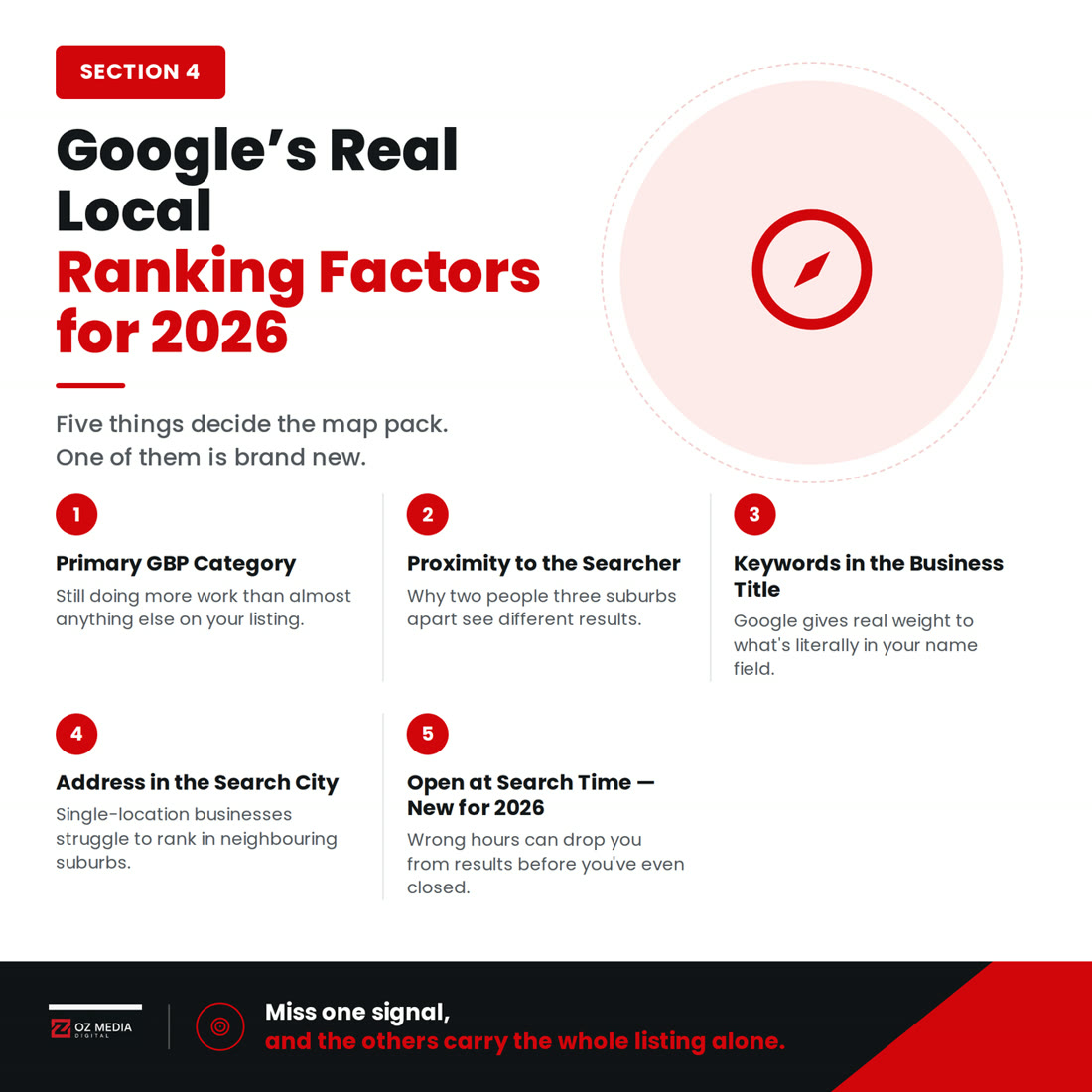
Skip the folklore and work from what's currently measured. Whitespark's November 2025 report, the most current large-scale survey of local ranking factors available, puts these five at the top for local pack and Maps visibility in 2026.
- Primary Google Business Profile category. The single category you choose when you first set up (or later edit) your listing is still doing more work than almost anything else. Wrong or overly broad category choice is one of the most common, and most fixable, mistakes small businesses make.
- Proximity to the searcher. You can't move your premises to win this one, but it does explain why a customer three suburbs away sees different results to a customer next door, and why "near me" phrasing behaves differently to a suburb-named search.
- Keywords in the business title. Google gives real weight to what's literally in your business name field. That's also why you'll see competitors stuffing service and suburb keywords into their listed name (against Google's own guidelines, and a reportable violation, but common enough that it's worth knowing about if you're being consistently outranked by a business with a keyword-stuffed name).
- Address in the search city. Straightforward, but it's the reason single-location businesses genuinely struggle to rank in a neighbouring suburb they service but aren't based in. A service-area setting helps, but it doesn't fully close this gap.
- Business open at search time (new for 2026). This is the sharpest change in this year's report. Google increasingly treats "is this business open right now" as a hard filter, not just a nice-to-show detail. That means a business with outdated or missing hours can effectively disappear from results before it's even closed for the day. If your Google Business Profile hours aren't accurate, including public holiday hours, you are actively losing visibility during exactly the windows when someone is most ready to call.
Two other factors are worth calling out because they moved noticeably in this year's data: review signals (volume, recency and rating) and behavioural signals (click-through and engagement with your listing) both increased in importance, while GBP Services, the specific list of services you can add to your profile, jumped in as a new factor entirely. That reinforces that a profile listing "Electrician" with nothing else filled in is leaving ranking signal on the table.
What Should a Local Service Business Actually Do About This?
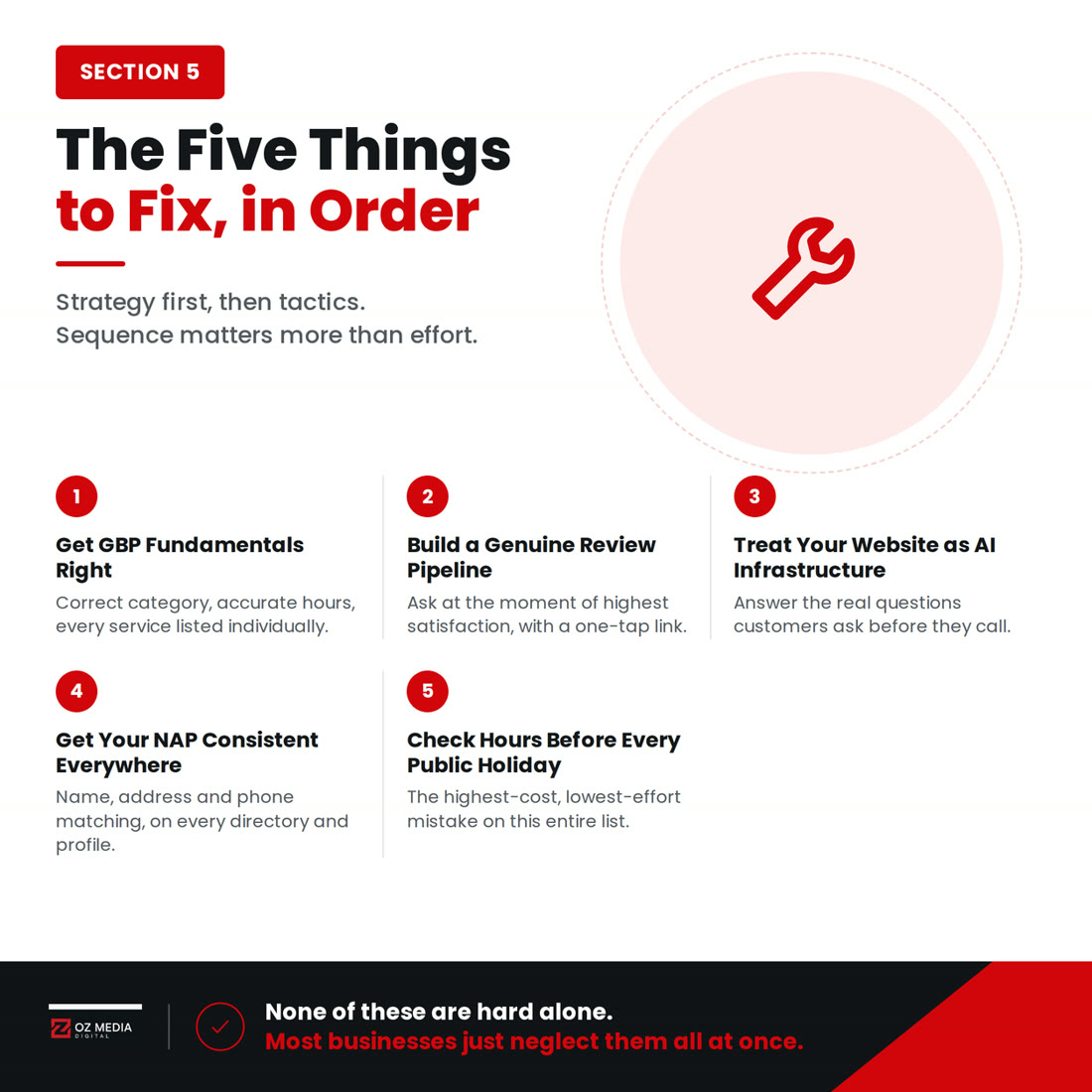
Strategy first, then tactics, in this order, because doing them out of sequence wastes effort.
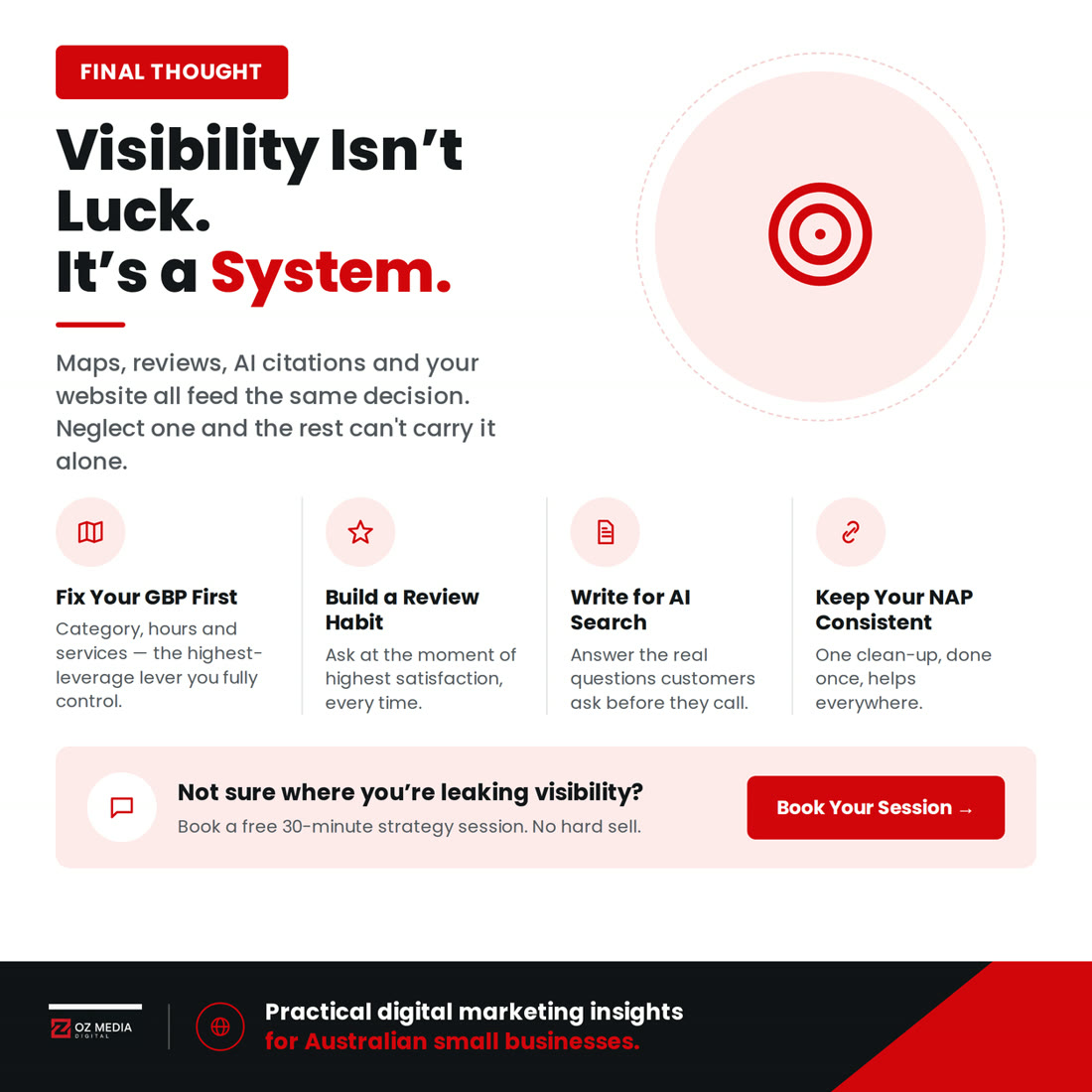
1. Get the Google Business Profile fundamentals genuinely right, not just filled in. Correct primary category (and relevant secondary categories), complete and accurate opening hours including public holidays, every service you offer listed individually rather than implied by your category, a business name field that matches your actual legal or trading name (no keyword stuffing, it's against Google's guidelines and increasingly the kind of manipulation Google is getting better at catching), and photos updated regularly enough that Google can see the listing is actively managed.
2. Build a genuine review pipeline, not an occasional reminder. Ask at the moment of highest satisfaction (right after the job's done, the appointment's finished, the result's landed) with a direct link that takes one tap to complete. Respond to every review, good and bad. Response behaviour is itself a signal, and it's also the first thing a prospective customer reads when they're deciding whether the 3-star review from 2024 still applies to how you operate today. If managing this properly feels like one more job you don't have time for, our guide on whether to DIY or hire out your Google Business Profile walks through the real trade-offs.
3. Treat your website as AI-search infrastructure, not just a brochure. Write pages that actually answer the specific questions your customers ask before they call: service-and-suburb combinations, pricing ranges, what's included, how emergency callouts work, in plain, structured language. This is exactly the content AI Overviews and AI Mode draw from and cite, and it's also what ranks for the long-tail, high-intent searches your competitors are ignoring because they're all fighting over the same three head terms.
4. Get your NAP (name, address, phone) consistent everywhere. Every directory, every social profile, every mention should match your Google Business Profile exactly. This has become more valuable for AI visibility even as it's become less decisive for traditional Maps ranking. Worth fixing regardless, because it's a one-off clean-up rather than an ongoing effort, and it's also where a suburb-level SEO strategy pays off, since consistent NAP data is what lets Google trust you across multiple service areas.
5. Check your hours before every public holiday, not after. Given how much weight "open at search time" now carries, an outdated holiday-hours field is one of the highest-cost, lowest-effort mistakes on this entire list.
Does This Play Out the Same Way Across Trades, Health, Finance and Professional Services?
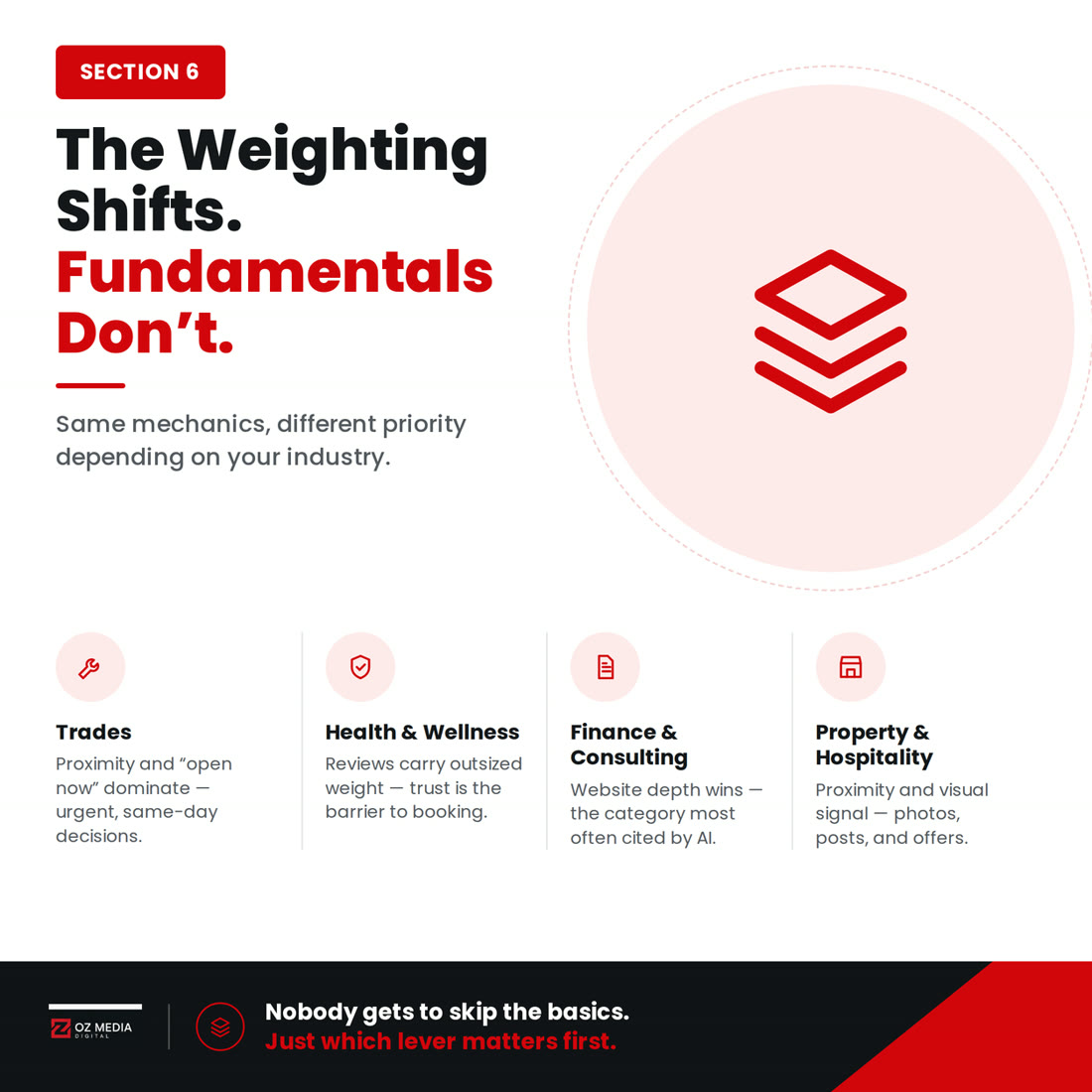
The mechanics are identical (Google Business Profile fundamentals, review volume and recency, website content depth), but the weight each one carries shifts by industry, and it's worth knowing which lever matters most for your category before you spend time on the wrong one.
Trades (electricians, plumbers, builders, landscapers): proximity and "open at search time" dominate, because these are urgent, local, often same-day decisions. A tradie with accurate hours and a fast-responding profile will regularly out-rank a bigger competitor with a neglected one. Service-area settings and individually listed services (emergency callouts, specific certifications) matter more here than almost any other category. We've covered this in more depth in how local trades people can rank on Google without paying for ads.
Health and wellness (physios, dentists, gyms, allied health): reviews carry disproportionate weight, because trust is the primary barrier to booking with someone you haven't met before. Recency matters even more than usual. A five-year-old five-star review does very little for a prospective patient deciding today, and AHPRA advertising guidelines mean testimonial-style content needs careful handling on the website itself, which makes the Google Business Profile review channel even more important as the main visible trust signal.
Finance and consulting (accountants, brokers, advisers): website content depth and structured, question-answering pages carry more weight here than in most categories, because these are higher-consideration decisions researched over days or weeks rather than resolved in a single "near me" search. This is also the category most likely to be cited inside an AI Overview or AI Mode answer, since those systems favour clear, specific, well-sourced explanations over generic service pages.
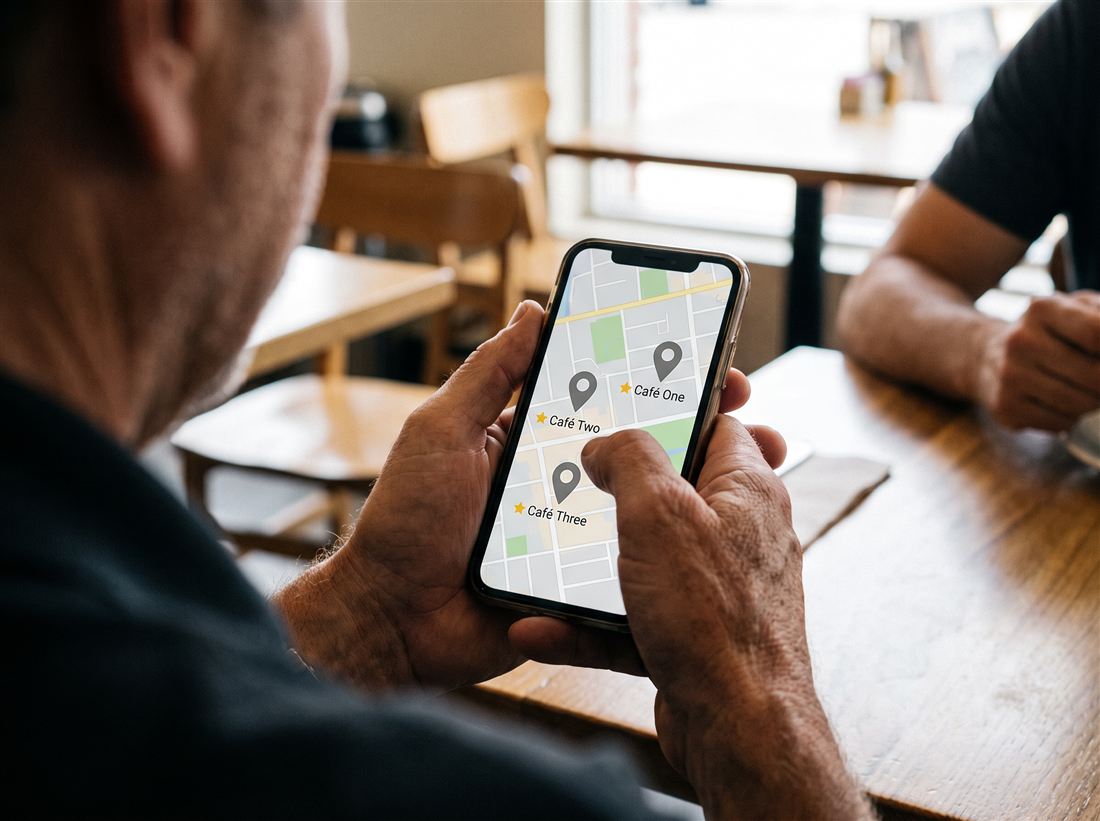
Property and hospitality: proximity and visual signal (photos, Google Posts, up-to-date offers) both matter heavily, since these categories are often browsed rather than urgently searched. Someone comparing three cafés or three property managers is more likely to scroll and compare than pick the first result outright.
The common thread across all of them: nobody gets to skip the fundamentals. The weighting shifts; the requirement to have a complete, accurate, actively managed profile and a genuine review pipeline doesn't.

Where Do Most Local Businesses Actually Get This Wrong?
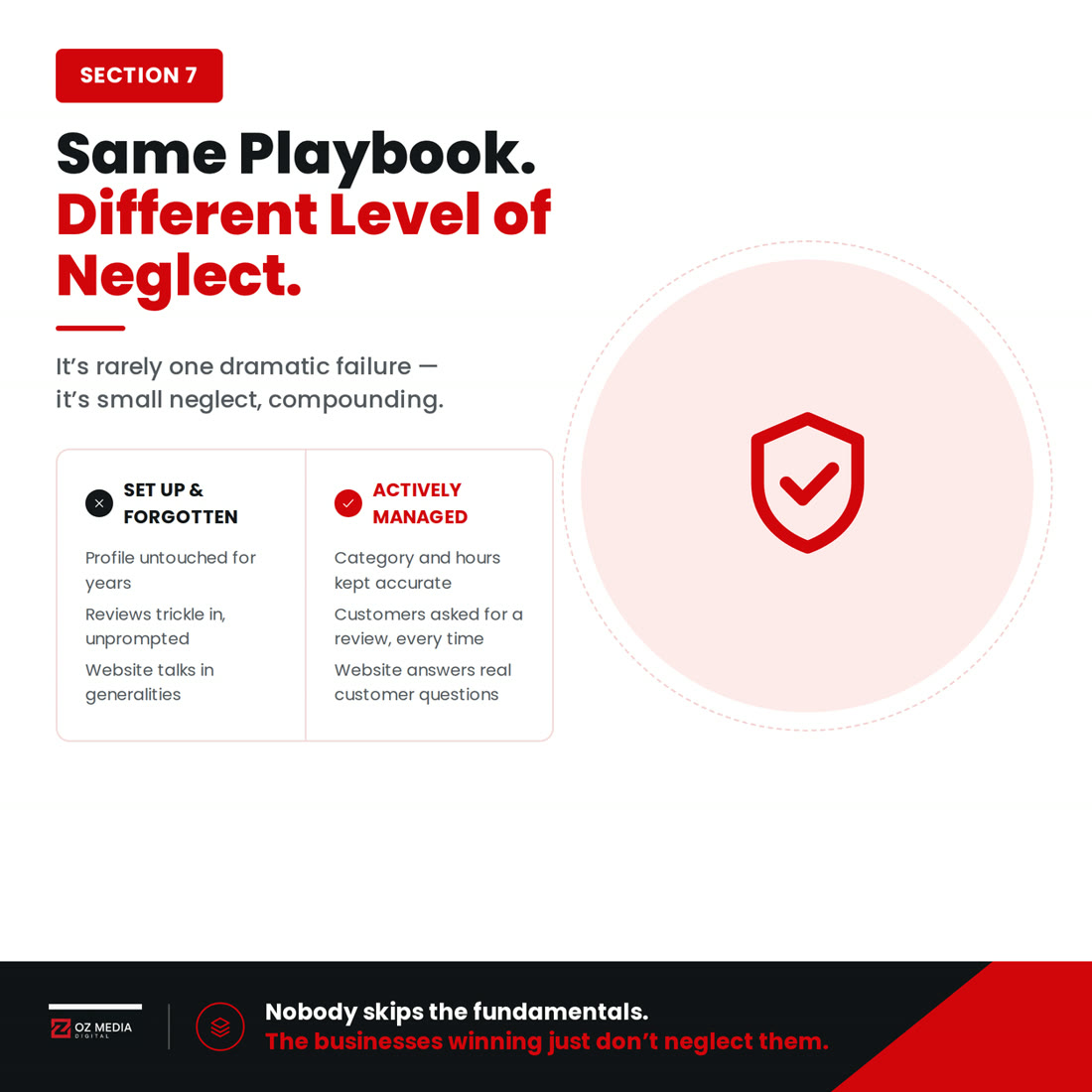
In our experience running this for service businesses, it's rarely a single dramatic failure. It's the accumulation of small neglect. A profile set up once, three years ago, and never touched again. A category chosen because it was the closest match at 2pm on a Tuesday, never revisited. Reviews that trickle in unprompted, mostly from people who had a complaint. A website that talks about the business in general terms instead of answering the fifteen actual questions customers ask on the phone every week.
None of those are hard to fix individually. The businesses that win the local pack consistently aren't doing anything mysterious. They're just not neglecting the profile, the reviews and the website content at the same time everyone else is.
Frequently Asked Questions
Do I still need a website if I have a good Google Business Profile?
Yes, more than before, not less. Your Google Business Profile is where customers make the split-second decision to consider you. Your website is where they verify that decision, and where AI Overviews and AI Mode pull the detailed answers they cite. A strong profile with no website behind it is now a bigger gap than it was two years ago, not a smaller one.
How many reviews do I need before I start ranking well locally?
There's no fixed threshold Google publishes, but review volume, recency and rating are all live ranking signals, and businesses with a steady trickle of recent reviews consistently outperform businesses with a large but stale review count from years ago. Recency matters as much as total volume. A business with 20 reviews in the last six months will often out-rank one with 80 reviews, none in the last year.
Is optimising for Google Maps different from optimising my website for SEO?
They overlap but aren't identical. Maps and local-pack visibility lean heavily on your Google Business Profile setup (category, hours, services, reviews, proximity), while broader organic SEO leans on your website's content, structure and authority. You need both. A perfect Google Business Profile with a thin website will plateau, and a great website with a neglected profile will lose the local pack to a weaker competitor with a better-managed listing.
Will AI Overviews eventually replace my Google Business listing?
Unlikely, and not what current data shows. AI Overviews currently appear on only around 7% of local searches, and when they do, they're typically pulling information from, and citing, well-maintained Google Business Profiles and websites rather than bypassing them. The businesses AI search favours are the same ones that were already doing local SEO fundamentals properly. It's raising the cost of not doing them, not replacing the need to.
How long does it typically take to see movement in the local pack after fixing these issues?
It varies with competition and how neglected the starting point was, but Google Business Profile changes (category, services, hours) typically show some effect within a few weeks, while review-driven improvements build more gradually over a few months as volume and recency accumulate. Website content changes for AI-search visibility tend to take longer to show up, since they depend on Google and other AI systems re-crawling and re-evaluating the page.
Should I respond to negative reviews, or leave them alone?
Always respond: professionally, briefly, and without getting defensive. A calm, specific response to a negative review often does more to build trust with the next prospective customer reading it than the negative review itself does to damage you. An unanswered bad review reads as neglect; an answered one reads as a business that takes accountability.
Where to Start
If you've read this far and recognised your own Google Business Profile in the "set up once and forgotten" description above, that's the highest-leverage place to start. It's the one part of this system entirely within your control, and it touches every other channel downstream, including your ads and your website's local relevance.
At OZ Media Digital, our local SEO service is built specifically around this: fixing the profile fundamentals, building a genuine review pipeline, and making sure your website is actually answering the questions AI search and human searchers are both asking. If you want a straight assessment of where you're currently losing visibility, an actual look at your listing and your market rather than a generic audit template, book a time to talk it through. If you'd rather see how local search fits into a broader plan, our growth packages and the Smart Growth Digital Mastery programme cover this alongside the rest of the funnel, or start with the full services overview.
Sources and References
- Whitespark: 2026 Local Search Ranking Factors (survey of 47 local SEO practitioners scoring 187 ranking factors, published 6 November 2025)
- Google: Search: Introducing AI Mode in Australia, official Google blog (Australia), 8 October 2025
- Safari Digital: 21 Local SEO Statistics That Matter in 2026 (Australian consumer local-search behaviour benchmarking)
- Digital Information World: How Google's AI Overviews Are Changing Local Search for Small Businesses in 2026, June 2026