

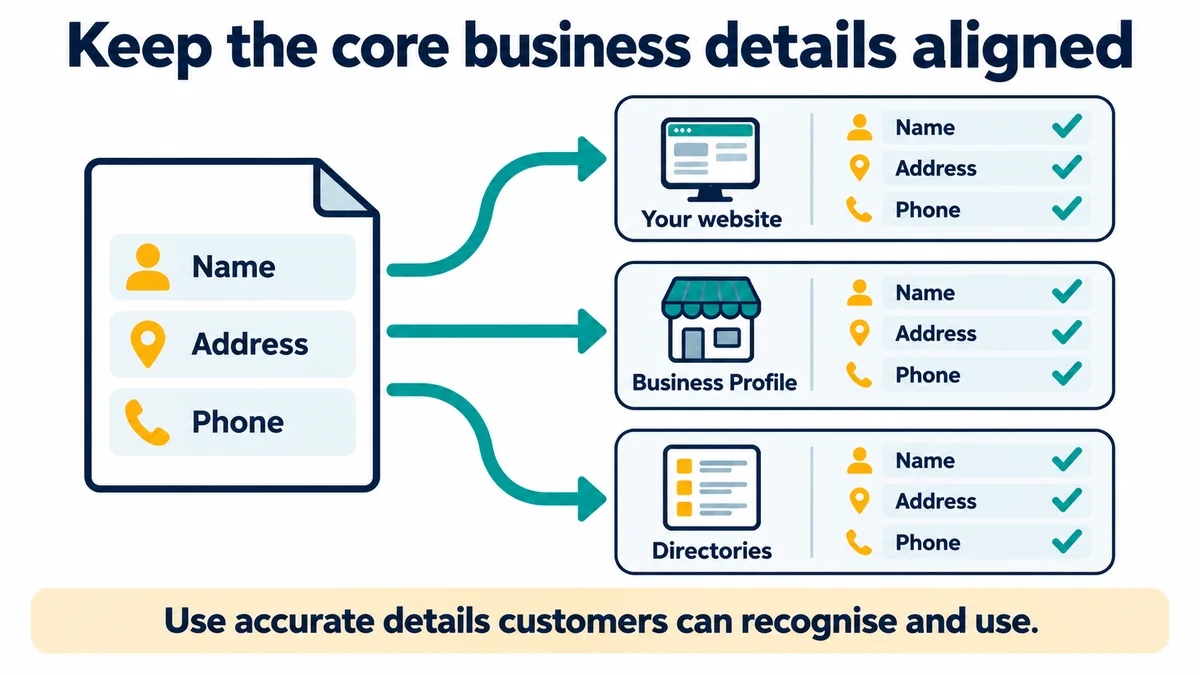
If your business name, address or phone number is listed differently on your website, your Google Business Profile and directories like True Local or Yellow Pages, it is actively working against your local search rankings, and confusing the customers who do find you. This mismatch has a name in the SEO industry: "NAP consistency" (Name, Address, Phone), and getting it right is one of the cheapest, least technical fixes available to a small business, yet one of the most commonly ignored.
TL;DR:
- NAP consistency means your business Name, Address and Phone number match exactly, everywhere they appear online, your website, Google Business Profile, Bing Places, Apple Maps and every directory you are listed on.
- Whitespark's 2026 Local Search Ranking Factors survey (47 local search experts, published 6 November 2025) ranks "HTML NAP Matching GBP NAP" the 15th most important factor out of 187 for local pack rankings, and citation consistency across primary search engines at 28th.
- Inconsistency does not just cost rankings, it costs trust. BrightLocal's Local Business Discovery & Trust Report found 62% of consumers say they would avoid a business with incorrect information listed online.
- Duplicate Google Business Profile listings are a common, specific cause. Google states a duplicate profile will not show on Google Search or Maps at all, which can mean your "real" listing is competing against a dead one.
- The fix is mostly a one-off audit, not an ongoing cost. Once your core details are corrected everywhere, maintenance is just checking in a few times a year.
- Citations are becoming more relevant again for AI search, not less, Whitespark's 2026 data found 3 of the top 5 ranking factors for AI search visibility are citation-related.
What Is NAP Consistency, and Why Does It Matter for Local SEO?

NAP stands for Name, Address, Phone, the three core pieces of identifying information that appear on your website, your Google Business Profile, and every third-party directory or citation source your business is listed on. "Consistency" means these details match exactly, character for character, everywhere they appear: the same formatting of your street address, the same phone number, not a tracking number on one platform and your direct line on another, and the same version of your business name.
Search engines use these citations, mentions of your business details across the web, as a trust signal. When your NAP details match consistently across many sources, it reinforces to Google, Bing and Apple that your business is real, stable and accurately represented. When they do not match, it introduces doubt about which version is correct, and in the worst cases, search engines may simply trust a different, inconsistent listing over your own.
How Does Inconsistent Business Information Actually Hurt Your Rankings?

Two separate mechanisms are at work, and most small businesses only think about one of them.
The ranking-signal mechanism is what Whitespark's 2026 Local Search Ranking Factors survey, a widely cited annual industry study based on scoring from 47 local search experts, published 6 November 2025, actually measures.1 The survey ranks "HTML NAP Matching GBP NAP," your website's listed details matching your Google Business Profile exactly, as the 15th most important ranking factor out of 187 scored factors for local pack and Maps visibility, with "Consistency of Citations on Primary Search Engines" (Google, Bing, Apple Maps) at 28th, and consistency across well-known directories like Yellow Pages and Yelp sitting further down the list but still measured as a real, scored factor. These are not the single biggest ranking levers available to a small business, content quality and review signals typically score higher, but they are free to fix and compound with everything else you are doing.
The trust and conversion mechanism matters just as much and is easier to underestimate. BrightLocal's Local Business Discovery & Trust Report found that 62% of consumers say they would actively avoid a business that has incorrect information listed online.2 A customer who calls a disconnected number, drives to an old address, or finds conflicting opening hours between your website and your Google listing does not file a complaint, they just go to the next business in the results instead.
Where Do Businesses Typically Have Inconsistent NAP Information?
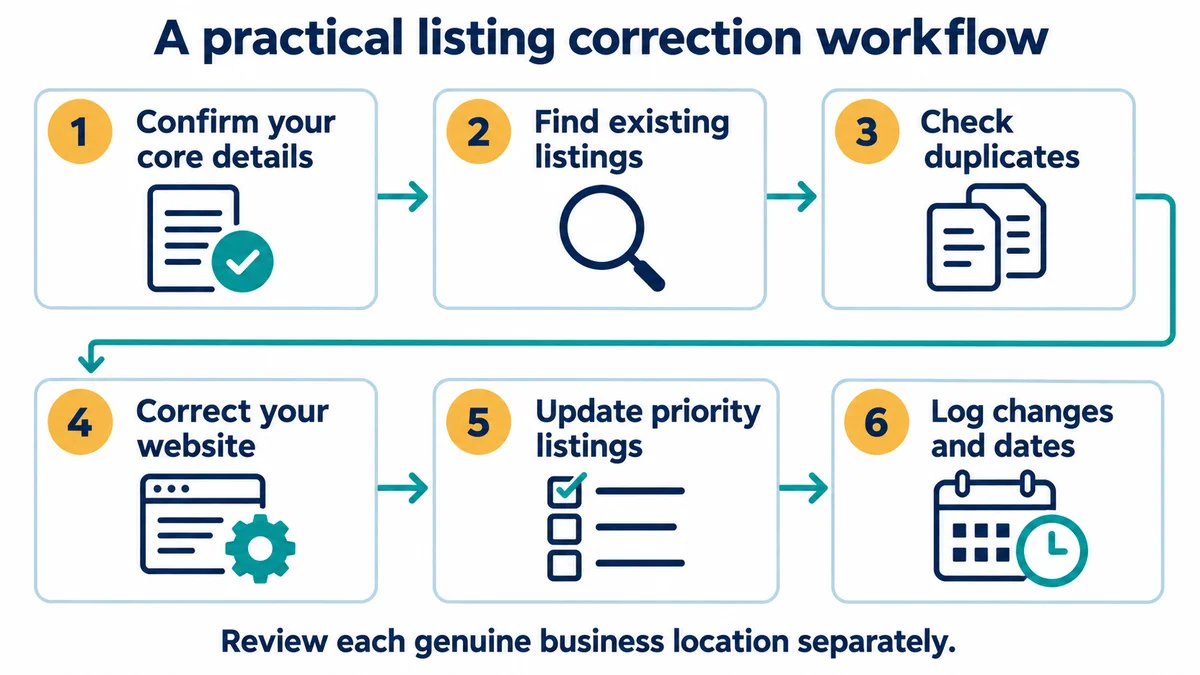
The most common sources of inconsistency, roughly in order of how often they show up during an audit:
Old addresses that were never updated. A business that moved premises two years ago but never corrected its listing on three or four directories it signed up for early on and forgot about.
Multiple phone number formats. (02) 9123 4567, 02 9123 4567 and +61 2 9123 4567 are the same number to a human, but inconsistent formatting across listings is exactly the kind of mismatch citation-consistency scoring picks up on, the fix is not to panic about formatting, but to pick one format and use it everywhere going forward.
Tracking or call-forwarding numbers used inconsistently. If you use a call-tracking number on your Google Ads campaigns but your organic listings show your direct line, that is an intentional, legitimate difference, but it should be deliberate and documented, not an accident of which freelancer set up which platform.
Business name variations. "Smith Plumbing," "Smith Plumbing Pty Ltd," and "Smith Plumbing & Gas" might all be technically correct, but using different versions across different platforms dilutes the consistency signal.
Duplicate Google Business Profile listings. This is the single most damaging and most common specific issue. It typically happens when a business is claimed and set up twice, once by the original owner, once later by a well-meaning employee or an agency who did not check for an existing listing first, or when a listing gets auto-generated by Google from a different data source entirely. Google's own guidance is direct about the consequence: a duplicate profile will not show on Google Search or Maps at all. If your "real," actively managed listing is the duplicate, or vice versa, you can be doing everything right on one profile while the version search engines are actually surfacing sits unmanaged and inaccurate. Getting the profile itself genuinely optimised, not just duplicate-free, is its own checklist, which we cover in full in Google Business Profile Optimisation: What Actually Matters for Local Service Businesses?
How Do You Find and Fix Inconsistent Listings?
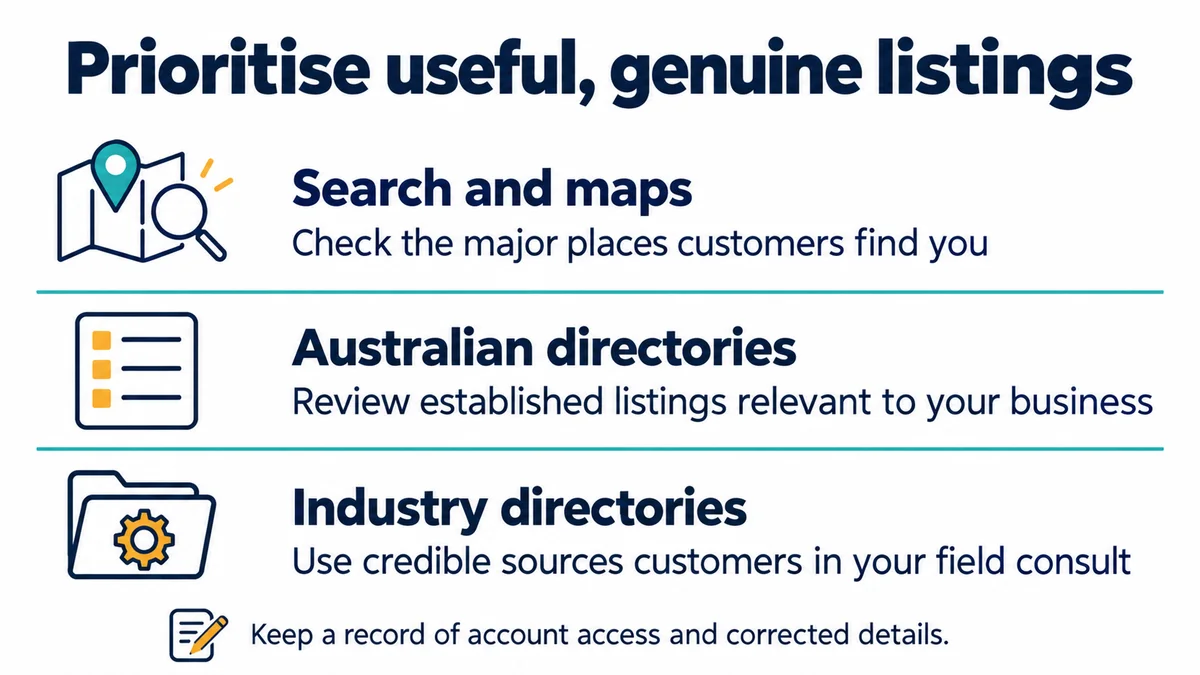
A practical, one-off audit process:
- Pick your canonical details first. Decide the exact, final version of your business name, full address (including suite or unit numbering) and phone number format you will use everywhere, before you start correcting anything.
- Search your business name and old addresses directly in Google, including with "site:" searches on major directories, to surface listings you may have forgotten existed.
- Check for duplicate Google Business Profile listings specifically. Search your business name and category in Google Maps and look for more than one pin. If you find a duplicate, Google's support process lets you report or request merging of duplicate listings directly through Google Business Profile.
- Correct your website first. Your own site is the one source you fully control, and it is a reasonable reference point for everything else.
- Work through major directories systematically rather than randomly, prioritise your Google Business Profile, Bing Places and Apple Maps first, these feed many smaller directories automatically, then Australian-specific directories.
- Document what you have corrected and when, so a future audit, or a new staff member or agency taking over your marketing, is not starting from zero.
For most small businesses this is a single afternoon's work, not a multi-week project, the time cost is almost always smaller than business owners expect once they have picked their canonical details and stopped second-guessing formatting choices. If you manage more than one location, treat each premises as its own separate audit: a shared head-office phone number listed against three different branch addresses is one of the most common multi-location NAP problems, and it actively confuses which branch a customer should actually contact.
Which Australian Directories Actually Matter for Citations?
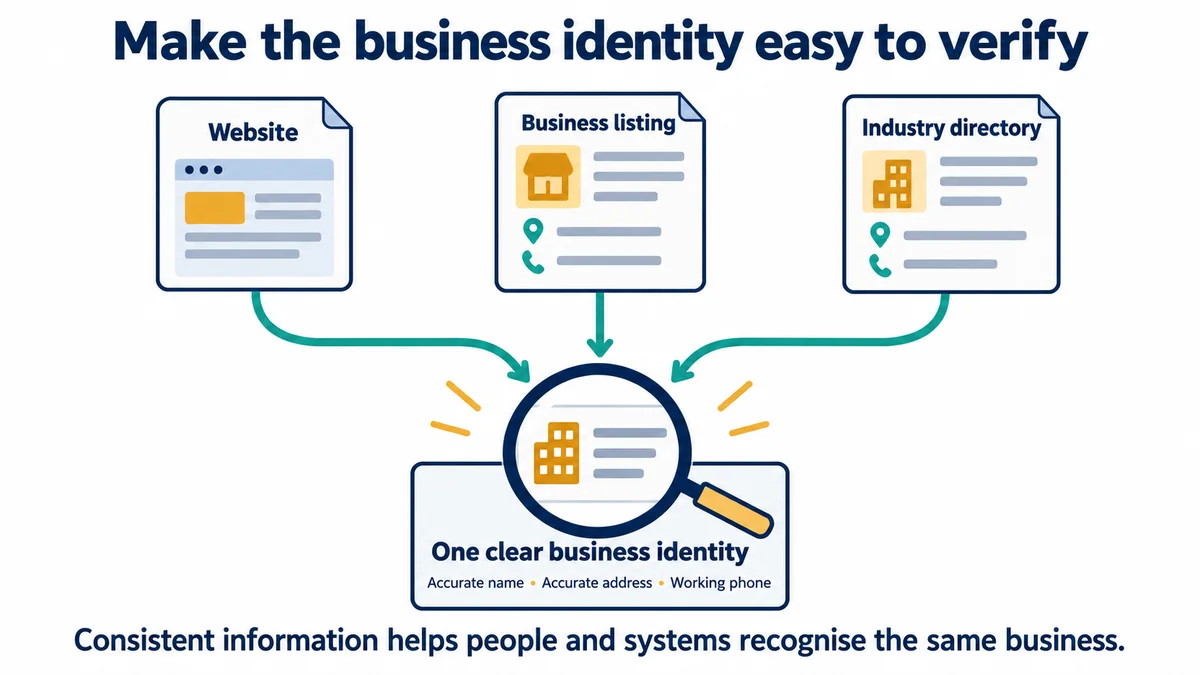
Not every directory is worth the time to fix. Focus on directories with genuine domain authority and real traffic rather than low-quality listing sites that exist purely to sell citation-building services. For an Australian small business, the practical priority list is: your Google Business Profile (by far the most important), Bing Places, Apple Business Connect, and then Australian-specific directories including True Local, Localsearch and Yellow Pages Australia, alongside relevant industry-specific directories where they exist (Health Direct for allied health, for example). Each listing typically takes 15 to 20 minutes to claim and correct, a modest, one-off time cost for a signal that compounds for as long as the listing exists.
Does NAP Consistency Matter for AI Search Too?
Yes, and arguably it is becoming more relevant, not less. Citation-based signals had been gradually declining in weight within traditional local-pack ranking factors over the past decade, according to Whitespark's own year-on-year tracking, but the 2026 survey specifically flags a renewed role for citations in AI-driven search results, reporting that three of the top five ranking factors for AI search visibility are citation-related. The practical implication is the same whether you are thinking about classic Google Maps rankings or an AI system assembling an answer about local businesses: consistent, verifiable information across multiple independent sources is what both systems use to decide your business is real and worth surfacing.
How Do You Maintain Consistency Going Forward?

Once the initial audit is done, maintenance is light, but it needs to be deliberate, not assumed. Whenever you change your phone number, move premises, or update your business name or structure, build "update every major listing" into that process as a standing checklist item, not an afterthought you remember three months later. A light annual check, searching your business name and spot-checking your top five to ten listings, catches drift before it compounds. If you have recently had an agency, freelancer or in-house team member set up new listings or Google Ads tracking numbers, specifically check those did not accidentally create a new, inconsistent version of your details.
It is also worth building this into any website redesign or rebrand project specifically. A new website launch is one of the most common moments a business's listed address format quietly changes (a new web developer reformatting "Suite 4, 12 Smith Street" to "4/12 Smith Street," for instance) without anyone treating it as a citation-consistency issue. Flag your canonical NAP format to any developer or designer before a rebuild starts, rather than discovering the mismatch during a later audit.
Consistent business information is one of the few local SEO fixes that is genuinely a one-off project rather than an ongoing cost, which makes it one of the easiest wins available if it has been neglected. It will not single-handedly fix a weak local SEO strategy, but it removes a real, measurable drag on your visibility for very little effort. If you want a proper audit of where your business details are inconsistent, and a broader local SEO strategy that goes beyond fixing listings, OZ Media Digital's Local SEO & AI SEO services cover exactly this kind of technical groundwork alongside the content and review strategy that drives actual rankings. Book a free session and we will run the audit for you.
FAQ
What exactly counts as "NAP" in local SEO?
NAP stands for Name, Address, Phone, the three core identifying details search engines use to match your website, Google Business Profile and third-party directory listings together as the same, trustworthy business.
Does a minor formatting difference, like "(02)" vs "02", actually hurt my rankings?
On its own, probably not meaningfully, but it is still worth standardising, because formatting inconsistency is exactly the kind of signal citation-consistency scoring can pick up on, and it compounds with every other inconsistency across your listings.
How do I know if I have a duplicate Google Business Profile listing?
Search your business name and category directly in Google Maps and look for more than one result pin for the same physical location. Google's own guidance confirms a duplicate profile will not show on Google Search or Maps, so finding and merging or removing it matters.
Is it worth paying for a citation-building service?
For most small businesses, a one-off manual audit and correction across the dozen or so directories that genuinely matter is manageable without paid tools. A citation-building service becomes more worthwhile for multi-location businesses or franchises managing dozens of listings at scale.
Does NAP consistency matter if I only get customers through word of mouth?
It still matters for anyone finding you through Google Search, Maps or an AI assistant, which, for most service businesses, is a meaningful share of new enquiries even alongside referral business. It also protects existing customers from the frustration of calling a disconnected number or driving to a wrong address.
How often should I re-check my listings for consistency?
Once a year is a reasonable baseline for a stable business, and immediately after any change to your name, address, phone number or business structure, do not wait for the annual check if something's actually changed.