OZ Media Digital
Short-form video of real people doing real things beats polished sales posts over the Christmas period, and it isn't close. Content that starts in November and treats December as a sequence of specific dates, not one long "Merry Christmas, shop with us" message, consistently outperforms content that waits until the second week of December to start. For Australian service businesses without physical gifts to sell, the content that works is less about selling and more about staying visible, human and easy to book while everyone else goes quiet.
The rest of this guide breaks down what that actually looks like by content type, platform and week, using current Australian data rather than generic "post more at Christmas" advice.
TL;DR
- Short-form video wins. Meta's own Australian research found 74% of Instagram users bought something after watching a Reel, and 86% followed a business they discovered through one (Meta Australia, "Shift to Short," 2023).
- Start in November, not December. Research timing should follow the shopping calendar, not the modern calendar, see When Should Small Businesses Start Their Christmas Marketing? for the week-by-week schedule this article builds on.
- Behind-the-scenes content earns more trust than sales posts, especially for trades, health, finance, property and wellness businesses that don't have a "gift" to promote.
- Posting frequency should rise and fall with the calendar, not stay flat, see How Do You Avoid Overwhelming Your Customers with Christmas Marketing? for where the line sits.
- Know who's actually on each platform before you commit to it. TikTok removed roughly 4.7 million under-16 Australian accounts in December 2025, changing the platform's real local audience.
What Type of Content Actually Gets Engagement During the Christmas Period?
Four content types consistently perform better than generic promotional posts over the Australian festive season: short-form video, behind-the-scenes content, gift and deal-finding content, and genuinely useful "how this affects you" content tied to specific dates.

Short-form video is the clearest standout. Across TikTok, Instagram Reels and YouTube Shorts, video consistently earns more reach and more action than static photos or text posts, because the algorithms on all three platforms are built to push video to new audiences, not just existing followers. Meta's Australian "Shift to Short" research found that 74% of Australian Instagram users had purchased something after watching a Reel, 86% had followed a business after discovering it through one, 60% had messaged a business directly after watching, and 95% had shared a Reel with family or friends (Meta Australia, 2023). That's a far wider set of actions than "like and scroll past."
Behind-the-scenes content (decorating the shop, the team's last trading day before the break, a tradie wrapping up final jobs before Christmas) tends to outperform anything that reads like an ad, because it's the one kind of content a competitor's paid campaign can't easily copy. It's also the easiest content type for a service business with no physical product to produce convincingly, which matters because most of OZ Media's clients sell a service, not a gift.
Gift and deal-finding content matters most for retail and hospitality, but it's broader than product photography. Oxford Economics research commissioned by TikTok (FY23, published 2024) found that 38% of Australian TikTok users buy a product recommended to them on the platform at least once a month, roughly 3.2 million people, and 41% have visited a recommended restaurant or shop. A separate survey by marketing agency MGH (reported November 2024) found 55% of respondents discovered gift ideas while scrolling TikTok, and 39% actively searched the platform for gift ideas rather than finding them by chance.
Dated, specific content ("last day to order before Christmas," "we're closed December 25 to January 2," "book your pre-Christmas service now, we're fully booked from December 15") performs well because it answers a real, time-sensitive question. This is the single easiest win most small businesses skip: posting your actual trading hours and cut-off dates as content, not just as a Google Business Profile update.
Does Short-Form Video Really Outperform Photos and Text Posts at Christmas?
Yes, on the evidence available, though the gap is more about actions taken than raw engagement rate. Global engagement-rate benchmarks from Socialinsider (2026) put TikTok at 2.60% engagement by followers and Instagram Reels at 0.48%, both measured as engagements divided by followers, useful for tracking your own trend over time, but not Australia-specific and not dramatically higher than photo posts on their own. The real difference shows up in what people do next: Meta's Australian Reels research (2023) found viewers were more likely to follow, message and buy after watching a Reel than after seeing a static post, and TikTok's Oxford Economics data (2024) shows a meaningful share of Australian users treat the platform as a genuine product-discovery tool, not just entertainment.
One caution worth flagging honestly: most of the audience data behind these figures predates December 2025, when roughly 4.7 million under-16 accounts were removed from TikTok in Australia following new age-verification requirements. Treat pre-December-2025 TikTok audience figures as a ceiling on the platform's reach, not a current number, the adult, purchasing-age audience is likely a smaller slice of that total than older research suggests.
Which Social Platforms Should an Australian Small Business Actually Use Over the Festive Period?
The platform mix should match where your actual customers are, not where competitors post the most. As of the most recent full national snapshot (DataReportal's Digital 2026: Australia report, data to October 2025, published November 2025), Australia has 21.0 million social media user identities, 77.7% of the population, with Facebook reaching an estimated 17.7 million people by ad audience, Instagram 15.2 million, and TikTok 10.9 million adults (51.2% of the adult population).
For most OZ Media clients (trades, health and allied health, property, finance, wellness and local professional services), that points to a simple default: Facebook and Instagram for reach and trust-building (reviews, local community visibility, behind-the-scenes), short-form video on Instagram Reels or TikTok for discovery, and Google Business Profile posts for the people already searching with buying intent. LinkedIn is worth a Christmas mention only for B2B service businesses, a "thank you for the year, here's when we're back" post to clients and referral partners is a genuinely useful, low-effort addition, not a core channel.
Don't spread Christmas content across every platform evenly. Pick the one or two platforms where your actual customers already follow you, and put the behind-the-scenes and video effort there, a thin, spread-everywhere content plan performs worse than a concentrated one, and it costs more of your or your team's time to produce.
What Should Service Businesses Post If They Don't Have "Gifts" to Sell?
This is the question most Christmas marketing advice skips, because most of it is written for retail. If you're a plumber, physio, mortgage broker, accountant, buyers agent or hairdresser, "gift guide" content doesn't apply to you, but five other content types do, and they tend to outperform forced retail-style posts for service businesses specifically:

- Trading hours and cut-off dates as standalone posts, not buried in a caption. "Last bookings before Christmas: December 19" earns saves and shares because it answers a real logistics question.
- Team and client appreciation content. A short video thanking the team or recapping the year's work earns goodwill that outlasts the season, and it's content a competitor genuinely can't copy.
- Seasonal relevance tied to your trade. An electrician posting about fire-safety checks before everyone plugs in Christmas lights, a plumber reminding people to check for leaks before hosting, a financial adviser posting about EOFY-adjacent planning timed around the break. This is useful content that happens to be seasonal, not a sales pitch dressed as a greeting card.
- Local community and charity tie-ins. Sponsoring a local event, donating to a local charity drive, is genuinely shareable content and reinforces the "local business" positioning that drives referrals the rest of the year.
- A short "see you in 2027" or year-in-review post. Low production effort, genuinely good engagement, and a natural moment to say thank you to the people who kept the business running.

When Should Christmas Content Start, and How Should the Rhythm Change Week by Week?
Research timing should follow the shopping calendar, not December 1. GoDaddy-commissioned research (reported via Mediaweek, November 2024) found 55% of surveyed shoppers aim to finish festive gift shopping before December even starts, and a separate MGH survey (reported November 2024) found 21% of shoppers do most of their gift buying on Black Friday specifically, rising to 32% among 18 to 24 year-olds. If your content plan starts in the second week of December, you've already missed the audience most inclined to act early.
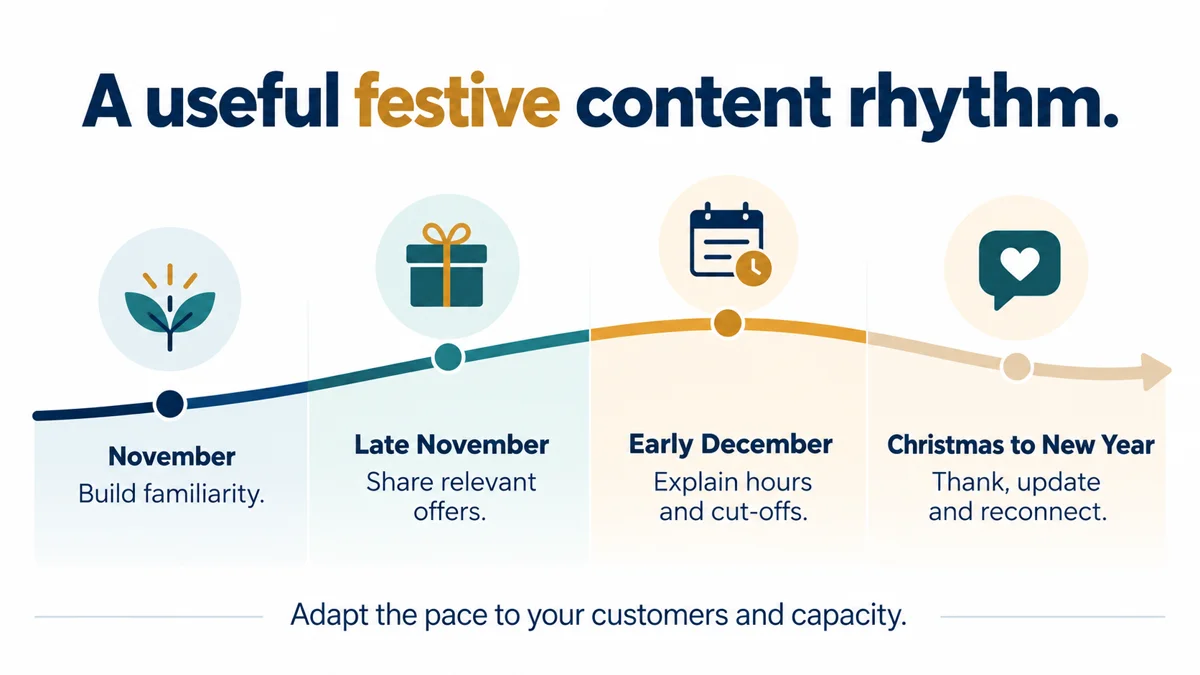
A practical rhythm most OZ Media clients can sustain: light, regular content through November building anticipation and flagging cut-off dates; a step-up in frequency and video content from late November through Black Friday/Cyber Monday if relevant to your business; a steady, specific-date-driven rhythm through the first three weeks of December (cut-offs, last bookings, trading hours); and a lighter, more personal tone from Christmas Eve through the New Year, when most people are offline and heavy promotional content reads tone-deaf. The full week-by-week version of this schedule, including why "too early" is rarely the actual risk, is covered in When Should Small Businesses Start Their Christmas Marketing? A 2026 Timing Guide.
If you want a simple framework for deciding the mix of content within that schedule rather than just the timing, the 3-3-3 rule (three post types in rotation) is a practical starting point, see The 3-3-3 Rule and the 40-40-20 Rule Explained for how to apply it specifically to a Christmas content calendar.
How Do You Avoid Posting Too Much, or Too Little, Over the Christmas Period?
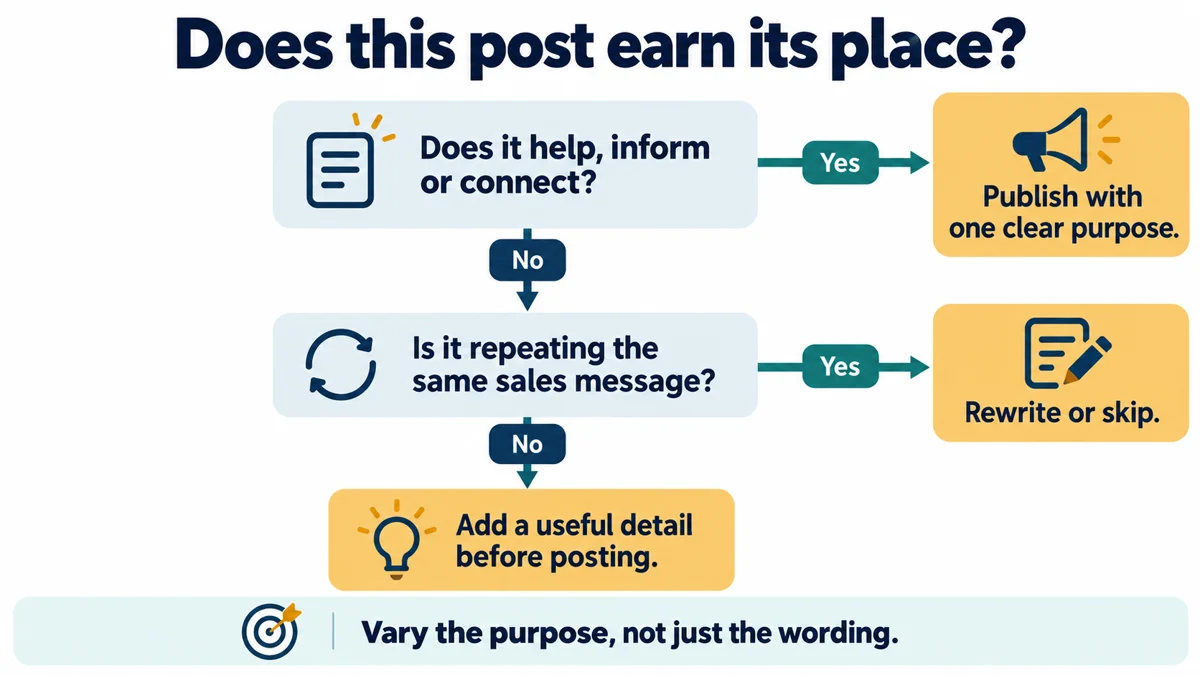
Both failure modes are common, and they're easier to avoid than most owners expect once you separate "frequency" from "repetition." Posting daily isn't the problem if every post earns its place, a cut-off date, a genuine behind-the-scenes moment, a useful seasonal reminder. The actual complaint customers raise is repetition: the same sales message reworded five times in two weeks reads as noise, even at a moderate posting frequency. This is covered in detail, including the specific signs you've crossed the line, in How Do You Avoid Overwhelming Your Customers with Christmas Marketing?, the short version is that variety of content type matters more than raw post count.
Should AI Tools Be Used to Create Christmas Social Content?
Used well, yes, as a drafting and production-speed tool, not a replacement for the authentic, behind-the-scenes content that performs best. GoDaddy's November 2024 research found 38% of Australian entrepreneurs already use AI for marketing tasks such as creating social content, and 33% use AI to support the business more broadly. For a small business trying to sustain daily posting through a busy trading season, AI tools can genuinely help with first-draft captions, content calendars and repurposing one piece of video into several platform-sized cuts.

Where it goes wrong is when AI-generated imagery or AI-written captions replace the real behind-the-scenes footage that's driving the engagement in the first place, a generic AI-generated "Christmas shop" image will always underperform a genuine phone video of your actual shop, because the whole advantage of behind-the-scenes content is that it's unmistakably real. Use AI to move faster on the planning and editing side; keep the actual content human.
What's the Best Time to Post on Social Media During the Christmas Period in Australia?
General Australian posting-time data still applies as a baseline, with festive-specific adjustments layered on top. Sprout Social's Australia-specific analysis (published 31 March 2026, based on more than 68 million Australian brand engagements) found Thursday is the single best-performing day across most networks, with weekday mornings (roughly 8 to 10am) and evenings (roughly 5 to 11pm) as the strongest windows overall. Platform specifics: Facebook performs best on Tuesday evenings (4 to 9pm), Instagram on Monday and Thursday evenings (5 to 10pm), and TikTok across a spread of windows including 8 to 11am and late evenings.
During the festive period specifically, two adjustments are worth making. First, shift some content earlier in the day in the final fortnight before Christmas, people are checking phones during work breaks and commutes while juggling end-of-year logistics, and evening engagement can dip as social plans fill the calendar. Second, don't assume Christmas Day and Boxing Day are dead zones, people are on their phones throughout the break, just less receptive to hard sales content and more receptive to genuine, low-pressure posts.
Christmas Social Media Content, the OZ Media Way
The businesses that do well on social media at Christmas aren't the ones posting the most, they're the ones posting the most honestly. A short, real video of your actual shop or team beats a stock-photo gift guide every time, and a clear cut-off date post earns more bookings than another "Merry Christmas from the team" graphic. If you'd rather hand the planning, content calendar and video editing over to someone who does this daily, that's exactly what our social media marketing service is built for, and if you want AI genuinely speeding up your content production without losing the authentic feel that actually performs, our AI marketing service can show you where it helps and where it doesn't. If you're also weighing up which platform deserves most of your attention, our platform-by-platform social media guide is a useful cross-check.
Not sure where your Christmas content plan has gaps? Book a free session and we'll map out what's actually worth posting between now and New Year.
FAQ
How many times a week should a small business post on social media over Christmas?
There's no universal number, what matters more than frequency is that every post earns its place. Most OZ Media clients do well posting three to five times a week through November, stepping up to most weekdays through the first three weeks of December around genuine content (cut-off dates, behind-the-scenes, team updates), then easing off over the Christmas-New Year break itself.
Do I need a different TikTok strategy now that under-16 accounts have been removed?
Worth reviewing, not panicking over. Roughly 4.7 million under-16 Australian accounts were removed from TikTok in December 2025. If your business targets an adult, purchasing-age audience, which most trades, health, finance and professional services do, the practical impact is limited. If your content strategy was built around broad reach numbers from before December 2025, treat those figures as a ceiling rather than a current state.
What's the best day to post Christmas content on Facebook and Instagram in Australia?
Based on Sprout Social's 2026 Australian engagement data, Thursday performs best overall, with Tuesday evenings strongest specifically on Facebook and Monday/Thursday evenings strongest on Instagram. Treat this as a starting point and check your own page's insights once you have a few weeks of festive-period data.
Should I pay to boost Christmas posts, or is organic content enough?
For most small businesses, a mix works best: let organic behind-the-scenes and video content build trust and reach for free, then put a small, targeted budget behind your highest-performing post or a specific offer with a clear cut-off date. Boosting a weak post rarely fixes it, boosting genuinely strong content extends its reach.
Is it worth creating separate content for Boxing Day and New Year, or should I just focus on Christmas?
Yes, worth separating. Boxing Day audiences are often still in shopping or deal-seeking mode, while New Year content tends to perform better with a lighter, reflective or planning-focused tone (year-in-review, "here's what's coming in 2027"). Treating all three as one undifferentiated festive message misses genuinely different audience moods.
What if my business doesn't sell physical gifts, should I even bother with Christmas content?
Yes. Service businesses that skip Christmas content entirely miss an easy, low-cost opportunity to stay visible while competitors go quiet. Trading hours, cut-off dates, team appreciation and seasonal-relevance content (safety reminders, EOFY-adjacent planning, local community involvement) all perform well without needing a single product photo.
Prices, figures and guidance in this article reflect the sources cited below at the time of writing, and are general information rather than a guarantee of results for your business.
Sources and References
- Meta Australia, "Shift to Short" Reels research (2023), as reported via industry coverage of Meta's Australian short-form video research
- Oxford Economics, The Economic Impact of TikTok in Australia (FY23), commissioned by TikTok, published 2024
- Bill Hartzer, TikTok Influences Holiday Shopping: What 69% of Shoppers Say They Need to See First, citing MGH survey data, published 22 November 2024
- Mediaweek, GoDaddy: Australians Willing to Spend Big With Small Businesses, published 19 November 2024
- DataReportal, Digital 2026: Australia, data as of October 2025, published 5 November 2025
- Sprout Social, Best Times to Post on Social Media in Australia, published 31 March 2026, based on 68+ million Australian brand engagements
- Vidico, Short-Form Video Statistics Australia, including Socialinsider 2026 engagement benchmarks and the December 2025 TikTok under-16 account removal figures
Figures above reflect the sources cited and general market conditions at the time of writing and can change; check the original source for current detail before relying on a specific figure.