 OZ Media Digital
An "AI employee" typically costs somewhere between $150 and $1,800 a month for an Australian small business, depending on whether you're buying a self-service chatbot subscription or a fully managed, done-for-you setup handling calls, messages and follow-up. On top of that, expect a one-off setup fee (often $500–$2,500) and usage overages once you exceed your plan's included call minutes or conversation volume. The cheapest plans handle simple, repetitive tasks well; they won't replace a skilled staff member doing complex, judgement-based work, and nobody selling you one should tell you otherwise.
TL;DR
- DIY AI tools (chatbot builders, workflow platforms) run roughly $20–$500 a month in subscription fees, but you configure and maintain them yourself.
- Managed "AI employee" services, AI receptionists, automated follow-up systems, AI-powered inboxes, typically cost $150–$1,800 a month in Australia, plus a one-off setup fee.
- Agency-built AI agent systems with ongoing management run $1,000–$5,000+ a month, often with a $5,000–$25,000 implementation project upfront.
- A human employee costs far more than their wage. Superannuation is 12% on top of base pay from 1 July 2025, and total employment costs in Australia typically land at 1.25–1.4 times base salary once you add leave, insurance, equipment and management time.
- The National Minimum Wage is $26.44 an hour ($1,004.90 a week for a 38-hour week) as of 1 July 2026, that's your floor, not your real cost, once on-costs are added.
- Don't chase the cheapest plan blind. Usage overages, per-minute voice charges and per-resolution fees can turn a $149 subscription into a $600 bill in a busy month.
What Do People Actually Mean by "AI Employee"?
There's no formal definition, and that's part of the confusion. "AI employee" is a marketing term, not a job title, it covers everything from a simple website chatbot to a fully autonomous voice agent that answers your phones, books appointments and follows up on missed calls without a human touching it.

In practice, when Australian small businesses talk about an "AI employee," they usually mean one of three things:
- An AI receptionist or voice agent, answers calls, handles bookings, sends text-backs for missed calls.
- An AI-powered follow-up and nurture system, automatically messages leads, chases quotes, requests reviews, and keeps a pipeline moving without a human typing every message.
- A conversational AI agent embedded in a platform, a chatbot on your website or in your CRM that answers questions, qualifies leads, or triages support tickets.
All three get marketed as "AI employees" because the pitch is the same: work that used to require a person now happens automatically. The pricing models, however, are genuinely different, which is why "how much does an AI employee cost" doesn't have a single answer, it depends entirely on which of these three you're actually buying.
Which “AI employee” do you actually mean?
InteractiveThe pricing models differ by type. Pick one to see what it does and what it typically costs.
Answers calls, handles bookings and sends text-backs for missed calls.
- Managed pricing: entry plans around $149 a month (about 250 minutes included), core plans $199 to $399, premium tiers $499 to $1,800.
- One-off setup is typically $500 to $2,500.
- Overages are often $0.50 to $2.00 per extra voice minute and about $0.10 per SMS.
Automatically messages leads, chases quotes, requests reviews and keeps a pipeline moving without a person typing every message.
- Usually sold as a managed service in the same $150 to $1,800 a month band.
- Setup depends on how much it must connect to your CRM, booking system or phone lines.
- Watch for what is excluded from the base fee.
A chatbot on your website or in your CRM that answers questions, qualifies leads or triages support.
- DIY builders run roughly $20 to $500 a month, but you configure and maintain them.
- Agency-built agents run $1,000 to $5,000+ a month, often after a $5,000 to $25,000 implementation.
- Some support platforms charge about $1 to $2 per resolved conversation instead.
Prices are the Australian and international vendor ranges cited in this article. Vendor pricing changes quickly.
How Much Does an AI Employee Cost in Australia?
Based on current Australian and international vendor pricing (checked live for this article), here's roughly what each tier costs:
Tier 1, DIY subscription tools ($20–$500/month)
Platforms like Zapier, Make, or a self-configured chatbot builder charge a base subscription plus usage (often per task or per operation). You do your own setup, prompt-writing and maintenance. Cheapest entry point, but the time cost of building and babysitting it is real, this isn't a "set and forget" option unless you or someone on your team is comfortable with the tooling.
Tier 2, Managed AI receptionist / follow-up services ($150–$1,800/month)
This is where most Australian small businesses actually land. Live Australian pricing checked for this article shows a fairly consistent pattern: entry-level plans around $149/month (roughly 250 minutes of voice/SMS included), core plans in the $199–$399 range, and premium or higher-volume tiers between $499 and $1,800/month. Setup fees typically sit between $500 and $2,500 depending on how much integration with your existing booking system, CRM or phone lines is required. Expect usage overages once you exceed the included minutes, often $0.50–$2.00 per extra voice minute and $0.10 per SMS.
OZ Media's own AI Marketing service sits in this tier: three plans from $799 to $1,799 a month plus GST, covering missed-call text-back, automated lead follow-up, AI review requests, a 24/7 website chatbot and a unified inbox for SMS, email and social, with no lock-in beyond an initial three-month commitment.
Tier 3, Agency-managed AI agent systems ($1,000–$5,000+/month)
For businesses wanting a custom-built AI agent handling more complex workflows, multi-step sales qualification, industry-specific compliance questions, integration across several systems, expect an implementation project ($5,000–$25,000 upfront) followed by an ongoing retainer of $1,000–$5,000 a month for management, monitoring and refinement. This tier makes sense once your call or conversation volume is high enough, or your workflow complex enough, that a template plan genuinely can't handle it.
Outcome-based pricing (a newer model worth knowing about)
Some platforms, particularly in customer support, now charge per resolved conversation rather than a flat subscription: think roughly $1–$2 per automated resolution. This can work out cheaper at low volume and more expensive at high volume, so it's worth modelling against your actual conversation numbers before committing, not just comparing headline rates.
The AI employee cost ladder
InteractiveTypical monthly cost by type, from DIY tools to a full-time human receptionist. Setup and implementation fees are extra.
Ranges from the vendor and industry sources listed below, checked in September 2026. Vendor pricing changes quickly, and no independent survey of AI employee pricing exists yet.
What Are You Actually Paying For?
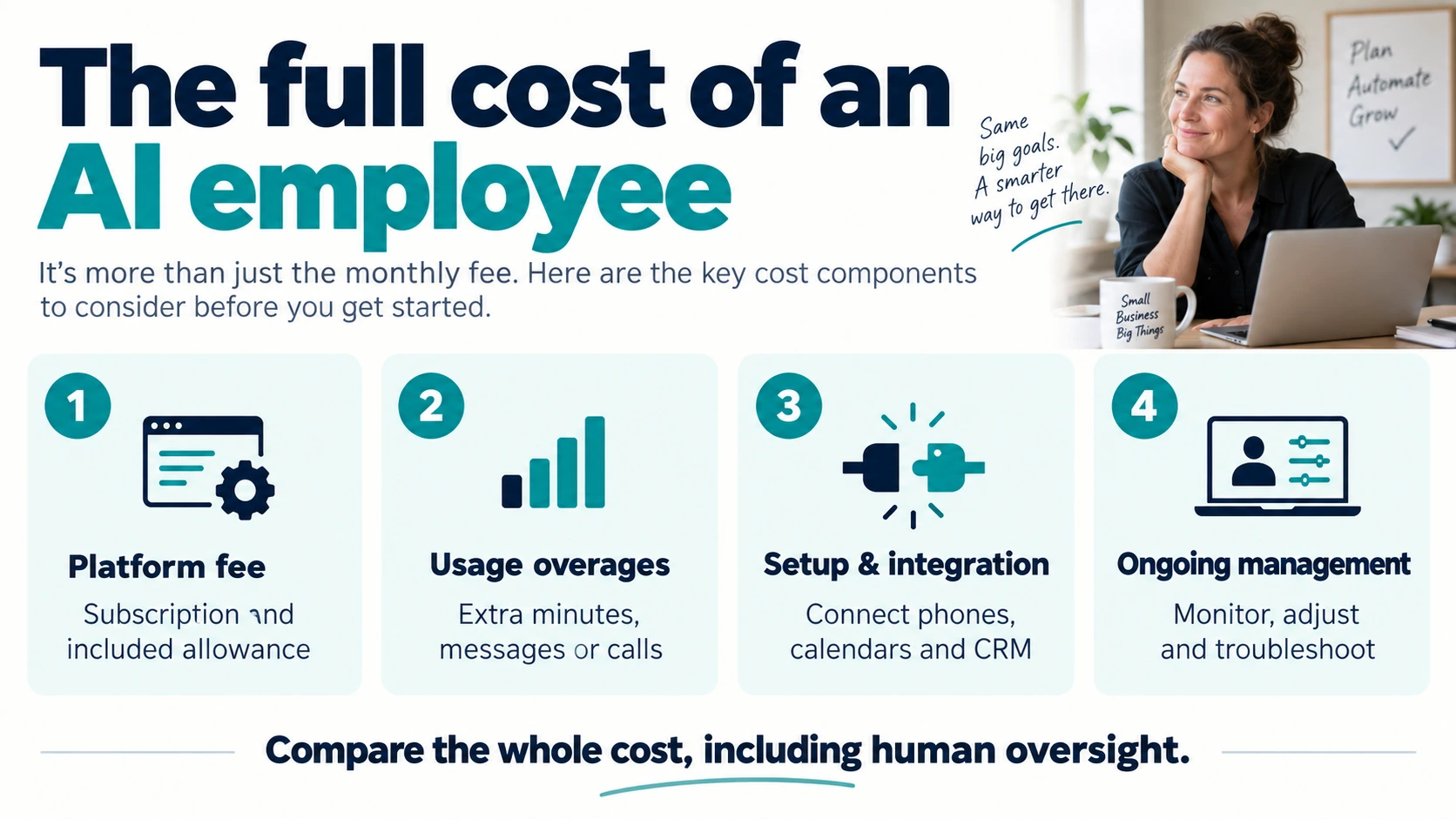
Every "AI employee" quote is really four separate cost components bundled together, and understanding them is what stops you overpaying or getting blindsided by a bill:

The platform fee. The base subscription covering software access, a set allowance of usage, and (in managed plans) a level of human oversight keeping the system running.
Usage overages. Voice minutes, SMS sent, conversations resolved, or API calls beyond your included allowance. This is the line item that catches people out, a plan that looks like $149/month can land closer to $400–$600 in a genuinely busy month if you haven't checked what happens past the included allowance.
Setup and integration. Connecting the AI system to your phone lines, booking calendar, CRM, or website isn't always included in the monthly fee. Ask specifically what setup covers before you sign, "up and running in two weeks" quotes sometimes assume you're supplying clean, ready-to-connect systems on your end.
Ongoing management. Fully managed services include monitoring, tone adjustments and troubleshooting in the fee. DIY tools don't, that work either falls to you, or you're pricing in someone's time to do it, which is a real cost even if it never appears on an invoice.
What will you really pay in a busy month?
InteractiveModel a plan’s included allowance against your actual call volume. The gap between the headline plan and the real bill is the overage.
Overage rates of about $0.50 to $2.00 per extra voice minute and entry plans of around $149 with roughly 250 minutes included are typical of Australian AI receptionist pricing cited in this article. Your provider’s terms will differ.
How Does That Compare to What a Human Employee Actually Costs?
This is the comparison every AI employee vendor wants you to make, and it's a fair one to run, as long as you use real numbers rather than the vendor's rounded-up worst case.
Start with the wage floor. As of 1 July 2026, Australia's National Minimum Wage is $26.44 an hour, or $1,004.90 a week for a 38-hour week, that's roughly $52,255 a year before any on-costs, and most receptionist or admin-support roles are paid above this floor, not at it.
Then add what the wage doesn't cover. Superannuation reached its final scheduled increase of 12% of ordinary time earnings from 1 July 2025 (the Payday Super reform also now requires super to be paid within seven days of each payday, rather than quarterly, from 1 July 2026, a cash-flow timing change worth knowing about even if it doesn't change the total). On top of super, add workers' compensation insurance (roughly 0.5–3%+ of wages depending on your state and industry classification), statutory leave entitlements (annual leave, personal leave, public holidays), and, for larger payrolls, state payroll tax above each state's threshold.
Put together, employer cost-of-employment benchmarks typically land at 1.25 to 1.4 times base salary once super, leave, insurance and on-costs are included, before you've added office space, equipment, software licences, recruitment and the management time it takes to hire, train and supervise someone.
For a full-time receptionist role specifically, Australian cost breakdowns published this year put the fully-loaded monthly cost (base salary plus super, workers' comp, leave, office space, equipment, software and recruitment/management overhead) at roughly $7,000–$8,300 a month, or $81,000–$100,000+ a year, well above the base salary figure alone. A part-time or offshore-outsourced receptionist service sits meaningfully lower than that, typically $800–$4,000 a month depending on whether it's shared or dedicated.
Where does an AI employee land against that? Realistically, for straightforward call-answering, booking and follow-up work, a managed AI service at $150–$1,800 a month is doing a genuinely different job to a full-time receptionist on $80,000+ fully loaded.
It's cheaper because it's doing less, not because it's a like-for-like replacement.
One Australian AI receptionist provider's own marketing claims an "85–90% savings" figure against a full-time equivalent; treat that as that provider's own case-study claim, not an independent benchmark, and run the comparison against your own actual call volume, complexity and current wage costs before assuming a similar number applies to your business.
What does a person really cost per month?
InteractiveSet an annual base salary and the on-cost multiplier. Employers typically pay 1.25 to 1.4 times base salary once super, leave and insurance are added. Compare that with the AI options.
The default is the National Minimum Wage ($26.44 an hour, $1,004.90 for a 38-hour week, about $52,255 a year) from 1 July 2026.
The multiplier is a benchmark range for total employment cost, not a quote. It excludes office space, equipment, recruitment and management time. An AI service is cheaper largely because it does less, not because it is a like-for-like replacement.
What Determines the Price You'll Actually Pay?
Five things move an AI employee quote up or down more than anything else:
Call or conversation volume. Included allowances (minutes, SMS, resolutions) are the first thing to check, a plan priced for 250 minutes a month will overage fast for a trades business fielding 40+ calls a day.
Task complexity. Simple answering and booking is cheap to automate well. Multi-step qualification, industry-specific compliance questions (health, finance, legal-adjacent services), or handling genuinely upset customers needs more sophisticated setup, and usually a higher tier or a human-in-the-loop fallback, both of which cost more.
Integration depth. Connecting to an existing booking system, CRM or multi-location phone setup adds to setup cost. A business running on a single, common platform (Calendly, a standard CRM) will generally set up cheaper than one running bespoke or legacy systems.
Human oversight requirements. Fully autonomous AI handling is cheaper than AI-plus-human-review, but riskier for anything where a wrong answer has real consequences (bookings, pricing quotes, medical or legal-adjacent queries). Budget for the oversight your risk tolerance actually requires, not the cheapest available tier.
Contract length and lock-in. Month-to-month plans cost more per month than annual commitments in most vendor pricing structures. Worth weighing against how confident you are the tool will still be right for you in six months, AI tooling in this space is moving fast, and today's best-fit vendor may not be next year's.
Is the Cheapest Option Always the Right Call?
No, and this is worth saying plainly, because "AI employee for $99/month" headlines are everywhere and most of them are selling you the platform fee, not the real monthly cost.

A $149/month entry plan genuinely can handle straightforward call answering and appointment booking well. What it typically can't do is complex, judgement-heavy admin, nuanced customer service recovery, or high-volume handling without racking up overage charges that erase the headline saving. The gap between "cheapest plan" and "right-fit plan" usually shows up in one of three places: overage billing once you exceed included usage, a setup fee that wasn't in the headline price, or a task genuinely too complex for that tier, forcing an upgrade or a human to step back in anyway.
The practical test: before signing, ask what happens at your actual volume (not the vendor's example), what's excluded from the base fee, and what the escalation path is when the AI can't handle something, because it will hit that point eventually, and how gracefully it fails matters as much as how well it performs on the easy calls.
How Do You Work Out If It's Actually Worth It for Your Business?
Rather than trusting a vendor's headline savings percentage, run your own numbers against four questions:

- What is this actually replacing? Missed calls that currently go to voicemail and never get returned? A part-time admin role? Overflow capacity during your busiest hours? The value proposition, and the right price tier, is completely different for each.
- What's the cost of the status quo? Missed calls that don't convert, slow follow-up that loses leads to a faster competitor, or a stretched team dropping admin tasks all have a real cost, even if it's never shown up as a line item. This is often the number that makes the comparison make sense either way.
- What volume are you actually running? Pull your real call/enquiry numbers for a typical month and a busy month, and price each tier against both, not just the vendor's example numbers.
- What's your tolerance for imperfect handling? AI systems handle the routine well and struggle with the unusual. If your business runs on a lot of unusual, judgement-heavy interactions, weight that into the decision rather than assuming automation-first is automatically cheaper once you count the fallback and correction time.
There's no single right answer here, a sole trader tradie missing calls on the tools all day has a very different calculation to a multi-location health clinic managing complex bookings. Work the numbers for your specific business before committing to a tier.
Treat any vendor's "you'll save X%" claim as a starting estimate to verify, not a guarantee to bank on.
Frequently Asked Questions
Is an AI employee cheaper than hiring a person in Australia?
For narrow, well-defined tasks, answering calls, sending follow-up messages, basic booking, usually yes, often significantly. For broader, judgement-based roles, an AI employee isn't really a comparable substitute, so the "cheaper" framing doesn't apply in the same way. Compare like-for-like tasks, not like-for-like job titles.
What's a realistic monthly budget for an AI employee for a small Australian business?
Most small businesses land in the $150–$500/month range for a managed AI receptionist or follow-up system handling moderate call volume, plus a one-off setup fee of $500–$2,500. Higher-volume or more complex businesses should budget $500–$1,800/month.
Are there hidden costs with AI employee services?
The most common ones are usage overages (extra voice minutes or SMS beyond your plan's allowance), setup/integration fees not included in the headline monthly price, and the cost of your own time monitoring and correcting the system, particularly with DIY tools.
Does an AI employee replace the need for insurance, super, or other employment on-costs?
Yes, you're not employing the AI system, so superannuation, workers' compensation, payroll tax and leave entitlements simply don't apply. That's part of the genuine cost difference, not a trick, but it also means an AI system carries none of the flexibility, judgement or relationship-building a person brings either.
Can I try an AI employee before committing to a long-term contract?
Most Australian providers now offer month-to-month plans with limited or no lock-in, often with a minimum initial term (commonly three months) rather than a full annual contract. Check the specific cancellation terms before signing, since "no lock-in" language varies in what it actually means between providers.
What tasks should I NOT hand to an AI employee yet?
Anything requiring genuine judgement calls, handling a distressed or angry customer, complex pricing negotiations, or compliance-sensitive advice (health, legal, financial specifics) is still better handled by a person, with AI supporting rather than replacing that interaction.
Where This Fits Into Your Broader Marketing Budget
An AI employee isn't a marketing spend on its own, it's infrastructure that determines whether the leads your marketing generates actually get followed up. If you're investing in Google Ads, SEO or social media marketing to generate more enquiries, a missed-call or slow-follow-up problem quietly erodes the return on that spend before you ever measure it against your cost per lead. It's worth budgeting for both together rather than treating lead generation and lead follow-up as separate line items.
If customer trust in AI-handled interactions is part of your hesitation, we've covered that specifically here, the short version is that execution quality matters far more than the fact that it's AI at all.
OZ Media's own AI Marketing service covers missed-call text-back, automated follow-up, review requests and a 24/7 website chatbot from $799/month, and it's also available as part of our bundled packages alongside SEO, ads and social media management. If you want a straight answer on whether an AI employee makes sense for your specific call volume and business type, not a generic vendor pitch, book a free 30-minute strategy session and we'll run the numbers with you.
OZ Media Digital’s AI Marketing service covers missed-call text-back, automated follow-up, review requests and a 24/7 website chatbot, alongside our bundled packages.
Sources and References
- Fair Work Ombudsman, "Minimum wage increase starts today", National Minimum Wage of $26.44/hour ($1,004.90/week, 38-hour week) effective 1 July 2026; casual rate $33.05/hour including 25% loading. Fetched live 2026-09-22.
- Fair Work Ombudsman / Fair Work Commission, Annual Wage Review 2026, confirms the 1 July 2026 increase cycle and the 4.75% award-rate increase applied to award-covered employees.
- usemultiplier.com, "Cost of Employment in Australia: Full Employer Cost Breakdown (2026)", Superannuation Guarantee at 12% of ordinary time earnings from 1 July 2025; state payroll tax rates and thresholds by state (2025/26); total cost-of-employment typically 1.25–1.4x base salary. Fetched live 2026-09-22.
- Valory AI, "AI Receptionist Cost Australia 2026: $149-$1,299/mo + Setup", Australian AI receptionist pricing tiers, setup fees, and usage overage rates, plus a competitor pricing snapshot dated 12 July 2026. Fetched live 2026-09-22. Vendor's own pricing, used as one data point among several, not the sole source.
- Amily AI, "AI Receptionist Cost Melbourne 2026", AI receptionist pricing tiers and a fully-loaded human receptionist cost breakdown ($7,000–$8,300/month). Fetched live 2026-09-22. Vendor's own pricing and comparison methodology, attributed accordingly, not adopted as an independent benchmark.
- Pickaxe, "AI Agent Pricing Models Explained (2026)", per-seat, usage-based and outcome-based AI pricing model examples (Intercom Fin AI, Zendesk AI Agents) and typical agency/consultant pricing ranges. Fetched live 2026-09-22.
- AI Employee (home.aiemployee.com), "How Much Does an AI Employee Cost? 2026 Pricing Guide", subscription tier and voice-minute overage pricing example, and a vendor-claimed savings comparison against a human receptionist. Fetched live 2026-09-22. Vendor's own marketing claim (the "85-90% savings" figure), reported here as an attributed claim, not verified independently, consistent with Cluster 9 Decision 5's no-unsubstantiated-savings-claims rule.
- OZ Media Digital, AI Marketing service page, OZ Media's own current pricing ($799–$1,799/month plus GST across three tiers) and service scope. Fetched live 2026-09-22.
No AU-government or ABS-published survey of "AI employee" market pricing specifically exists publicly as of this writing, this is a fast-moving vendor market, not yet covered by an official statistics body. Pricing ranges above are drawn from multiple live-checked vendor sources rather than a single authoritative benchmark, and are explicitly flagged as such rather than presented as settled market data.