We hear it every week from dentists, pet groomers, tradies and clinic owners across Sydney: "We don't need a website. If we needed one, we'd have one. We've been in business 15 years." It's a fair point, and for most of those 15 years, it was true. But the way Australians choose a local business has changed more in the last two years than in the previous ten. This article lays out what changed, using Australian research only, so you can decide for yourself.
Still deciding whether you need a website at all? Read Can an Australian Business Survive Without a Website? first.
You're Right, About the Past
If you've built a business on referrals, repeat customers and a solid Google Business Profile, you've done the hard part. Good service still wins. The question isn't whether you survived without a website. It's whether the next generation of customers can find you, trust you and pick you, when they're searching in a completely different way.

What We Mean by "AI Search"
AI search isn't just ChatGPT. It's the way search itself now works, including on Google, where most Australians still start. A few years ago, you typed "dentist Hornsby" and got a list of ten links. Today, more and more searches look like this:
- A full question, typed or spoken: "Which pet groomer near Asquith is good with nervous rescue dogs?"
- An answer written by AI at the top of Google in an AI Overview, or a back-and-forth conversation in Google's AI Mode
- An assistant answering on the go: Gemini, Siri or ChatGPT on a phone, or through Apple CarPlay and Android Auto in the car
- Two or three businesses named in the answer, with a link to read more
The search box looks the same. What happens after you press enter has changed. Google says its AI Mode passed 1 billion monthly users worldwide within a year of launch, with queries more than doubling every quarter. That changes what you're competing for. It's no longer a spot on page one, it's being one of the two or three businesses the AI names, and the AI can only name you if it can read enough about you to be confident.
How Australians' Search Habits Have Changed in Two Years
Australians have adopted AI faster than almost any technology before it. Telsyte's Australian Artificial Intelligence Study 2026 found 17.4 million Australians now use AI, 77% of everyone aged 16 and over. That's up by more than 6 million people in a single year, and 5.2 million use it every day.
AI is becoming the front door to search. The same study found 12% of Australians now say an AI tool is their main way of finding information online, more than double the 5% of a year earlier. YouGov's 2026 report found 36% of Australian online searchers start at least one search a day with an AI assistant, nearly six in ten among Gen Z.
Google itself has changed. AI Overviews, the AI-written summary at the top of results, rolled out in Australia in late 2024. Google's AI Mode followed on 8 October 2025, turning search into a conversation. People now type questions like "gentle dentist in Hornsby that's good with anxious kids and open Saturdays," not just "dentist Hornsby."
Many people never click past the answer. Telsyte found 81% of Australians are aware of AI summaries in search, and half say they'd often rely on the summary without clicking through to the source. Here's the point most business owners miss: if the AI answer is the new shopfront, you need to be in the answer, and the AI can only recommend what it can read and verify.

Where AI Search Gets Its Answers About Your Business
When someone asks Google AI Mode or ChatGPT for a recommendation, the AI doesn't phone around, it reads. Google describes AI Mode as breaking a question into smaller searches and running many of them at once, then pulling together web content to answer. That means it looks for detail: what services you offer, which suburbs you cover, whether you take a particular health fund, how much a full groom costs for a large dog, whether you do emergency call-outs.
A Google Business Profile gives the AI the basics: name, category, hours, reviews. A website gives it the substance:
- A page for each service, written in plain English
- The questions customers actually ask, answered
- Pricing guidance, service areas, qualifications and team bios
- Structured data that tells machines exactly what you are and where you operate
Without that, when someone asks a detailed question, the AI has nothing to quote from you. So it quotes your competitor who does.
A Google Listing Gets You Found. A Website Gets You Chosen
Even when people do find you, most check you out before they call. Research by auDA, the body that manages Australia's .au domains, found three in four Australian consumers would only buy from a business online if it has a website. Three in four are also more likely to trust an Australian business if its website ends in .au.
YouGov's 2026 research shows Australians don't blindly trust AI either. Fewer than half of AI users trust the information it gives them, and only 15% usually stop searching once they get an AI answer. They go and check. Where do they check? Your website, if you have one.
Think about the person comparing two dental practices on a Sunday night. One has a listing with photos. The other has a listing plus a website showing the dentists, the technology, gap-free check-up options and an online booking button. Who gets the booking?

Your Competitors Are Already Moving
The "most of us don't bother" argument is losing ground fast. auDA's Digital Lives of Australians 2026 report found 56% of Australian small businesses now have a dedicated website, up from 49% just a year earlier. The same report found 72% of small businesses have now used AI. Your competitors aren't just building websites, many are using AI to produce the content that AI search engines look for. Every month you wait, the gap between you and them in AI answers gets wider.
"But I've Got Facebook and Google": The Rented-Land Problem
Social media and Google Business Profile are valuable. Keep them. But you don't own either of them.
- You can't control the rules. Platforms change layouts, algorithms and features without asking you.
- You can't hold much detail. A listing can't carry ten service pages, a full FAQ or your clinical approach.
- Accounts get suspended. Listings get hijacked, merged or flagged, and getting them back can take weeks.
- You can't run serious advertising without one. Google Ads and Meta Ads perform far better when they send people to a focused page built to convert.
Your website is the one asset online that you fully own. Everything else should point back to it.

How to Future-Proof Your Business for AI Search
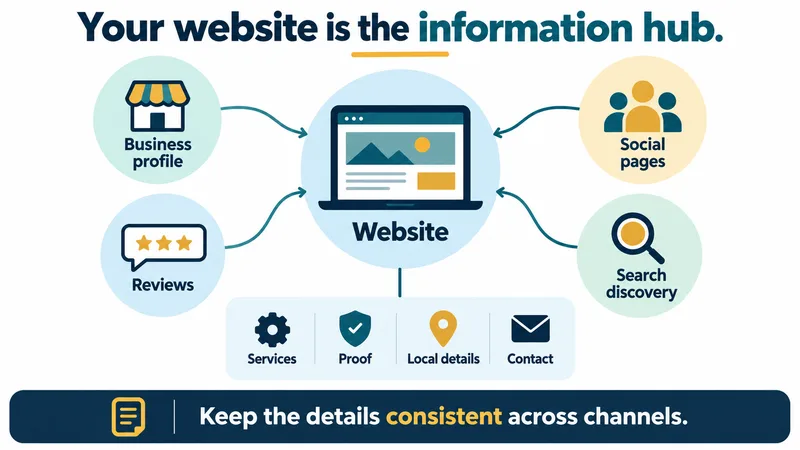
Future-proofing doesn't mean a big or expensive website. It means a website that people and AI can both read, understand and trust. Make yours the hub that your Google Business Profile, social pages and reviews all point back to, then make sure it does these jobs:
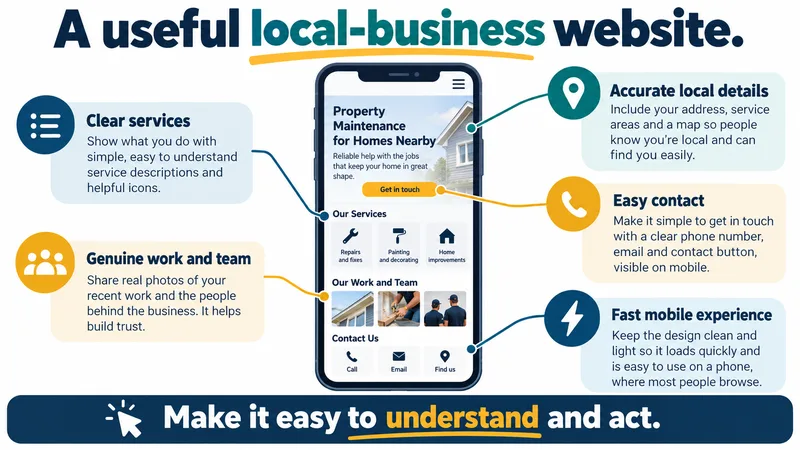
- Load fast on a phone. Most local searches happen on mobile.
- One page per core service, with the suburbs you serve named clearly
- Answer the real questions customers ask on the phone, cost, timing, what to expect
- Show proof: reviews, photos of real work, qualifications, team bios
- Make contact effortless: click-to-call, online booking or a short enquiry form
- Use a .au domain and a matching email address to signal you're local and legitimate
- Add LocalBusiness schema so search engines and AI can read your details accurately
- Match your Google Business Profile exactly: name, address, phone, hours
- Track enquiries, so you know what the site is actually earning you
- Stay compliant: for health practices like dental, website content must follow AHPRA advertising rules
The Cost of Waiting
Don't think about what a website costs. Think about what one missed customer a week costs. Work it out for your own business. Say a new client is worth $1,500 over their lifetime with you. If your missing website means just one lost enquiry a week, that's around $78,000 a year walking to the clinic or groomer down the road. Use your own numbers, most owners are surprised.
The businesses that win the next five years won't be the ones with the biggest budgets. They'll be the ones that AI, Google and customers can all read, understand and trust.
Frequently Asked Questions
What is AI search?
AI search is when a search engine or assistant writes the answer for you instead of just listing links. It includes Google's AI Overviews and AI Mode, Gemini, Siri and ChatGPT. It reads websites to build those answers.
Is a Google Business Profile enough for a small business?
It's essential, but it's not enough on its own. It helps you appear in Maps; a website gives Google, AI tools and customers the detail they need to choose you.
Will AI search replace websites?
No. AI tools build their answers from information on the web. Websites are a key source they read. Without one, you give them less to work with.
Do I need a big website?
No. A fast, focused site with clear service pages, real proof and easy contact beats a large, slow one.
Should I use a .com or .com.au domain?
For a business serving Australian customers, use .au. auDA research shows Australians trust .au businesses more.
Find Out What AI Says About Your Business
We'll ask ChatGPT and Google AI Mode the questions your customers ask about your trade and suburb, then show you exactly who gets recommended, and why. No obligation, no jargon.
At OZ Media Digital, this is exactly the kind of AI-assisted marketing we build for Australian trades, health, property and fitness businesses. If you're not sure whether your business needs a website at all yet, read Can an Australian Business Survive Without a Website? first, then book a free AI visibility check and we'll show you what AI currently says about your business.
Sources and References
- Four in five AI users now engage monthly as Australia's user base surges past 17 million, Telsyte Australian Artificial Intelligence Study 2026
- YouGov research finds 72% of Aussies use AI for search, ChannelNews, 2026
- Search at I/O 2026, Google
- Google rolls out AI Mode in Australia, AdNews, 8 October 2025
- Digital Lives of Australians 2026, auDA, July 2026
- Help your small business get ahead online with .au, auDA