
AI search optimisation is not a separate discipline from SEO, and Google says so directly. If your website already ranks well through solid, helpful, technically sound SEO, you are already doing most of what shows up in Google's AI Overviews and AI Mode. The difference that actually matters is not a new set of tricks, it is what you measure as a win once some of your audience never clicks through at all.
TL;DR:
- Google's own Search Central guidance states there are "no additional requirements" or "special optimizations" needed to appear in AI Overviews or AI Mode beyond standard, eligible, indexed content.
- AI Overviews now appear in roughly 43% of Google searches as of mid-2026, up from about 15% a year earlier, and around 68% of US Google searches ended without any click in early 2026.
- "Generative engine optimisation" (GEO) and "answer engine optimisation" (AEO) are real, growing search terms, but they describe a shift in emphasis within SEO, not a replacement for it.
- What genuinely changes: your success metrics (brand visibility and quality enquiries matter more than raw click volume), and how clearly you structure answers for extraction rather than just for ranking.
- Only about one in four Australian small businesses (26%) say they are actively optimising for AI-driven search, which is both a warning sign and a real opportunity to get ahead of competitors who are still ignoring it.
Is "AI Search Optimisation" a Real Discipline, or Just SEO With a New Name?
It is mostly SEO with a new name, and Google has said this explicitly. Google's Search Central developer documentation on AI features states plainly: "There are no additional requirements to appear in AI Overviews or AI Mode, nor other special optimizations necessary."1 The same page confirms there is no special schema.org markup, no separate machine-readable file, and no AI-specific technical checklist. Eligibility works the same way it always has: your page needs to be crawlable, indexable, and eligible to appear in Search with a normal snippet.
Google's Search Advocate John Mueller made the same point on the Search Central blog in 2025, writing that "the underpinnings of what Google has long advised carries across to these new experiences."2 His advice was to focus on visitors and provide unique, satisfying content, not to chase a separate AI ranking factor.
That said, the terms "generative engine optimisation" (GEO) and "answer engine optimisation" (AEO) are not marketing fluff invented by SEO agencies to sell a new service. They describe something real: a search result page where, more often than not, an AI-generated summary sits above the traditional blue links, pulling together an answer from several sources rather than sending the user to one page. Data from DataForSEO's keyword tracking shows "generative engine optimization" has gone from essentially zero search volume in 2023 to around 260 searches a month in Australia today, and "AI search optimisation" has climbed from near zero to roughly 110 a month over the same period, both still rising. People are searching for this term because something genuinely did change in how results are displayed, even if the underlying mechanics did not change as much as the terminology suggests.
What Actually Changed in How Australians Search?

Three things changed, and none of them are about ranking factors.
First, AI-generated summaries now appear far more often. Similarweb's 2026 Generative AI Report found that AI Overviews now appear in around 43% of Google searches, up from about 15% a year earlier, according to reporting on the data in mid-2026.3 That is close to tripling in twelve months.
Second, a lot more searches end without a click at all. Research firm SparkToro, using Similarweb clickstream data, found that 68.01% of US Google searches ended without a click between January and April 2026, up from 60.45% in 2024.4 There is no equivalent published Australian figure, but there is no reason to expect our market is meaningfully different, since Google's AI features roll out globally on broadly the same timeline.
Third, AI Mode itself is now live in Australia. Google began rolling out AI Mode locally in October 2025, about twelve months after AI Overviews first launched here5 (we have gone deeper on what AI Overviews and AI Mode specifically mean for a small business if you want the full breakdown). AI Mode goes further than AI Overviews: it can break a single question into several sub-questions and run them in the background, a technique Google calls "query fan-out," to build a more complete answer before the user sees anything. Industry reporting at the time flagged concern among Australian publishers about falling referral traffic, with Similarweb data showing referral clicks to Australian news sites down more than 5% around the AI Mode rollout. Google's counter-argument, repeated by its search teams, is that the clicks AI search features do send are higher-quality, because the user arrives with more context and a narrower intent.
For a service business, the practical read is this: your phone number and your Google Business Profile matter just as much as before, possibly more, because a shrinking share of searchers is scrolling down to the tenth blue link to find you. The battle has shifted from "can I rank on page one" to "can I be the thing that gets cited when no page gets clicked at all."
So What Should a Small Business Actually Do Differently?

Nothing structurally different from good SEO, but with sharper emphasis on four things.
Write the direct answer first, every time. AI systems extract and summarise content. A page that buries its actual answer under three paragraphs of scene-setting is harder to lift into a summary than a page that answers the question in the first two sentences. This is exactly the same advice that has always made content perform well for featured snippets, it just matters more now that more result types pull from it.
Use clear, named entities instead of pronouns when stating a fact. Write "Google's Search Console" rather than "it," and "the ATO" rather than "they." This is not a stylistic preference, it is what lets a generative system correctly attribute a fact to your business when it is deciding whether and how to cite you.
Keep your Google Business Profile, reviews, and NAP (name, address, phone) consistency tight. AI Overviews and AI Mode draw heavily on Google's Knowledge Graph and local data sources, not just web pages. A plumber with inconsistent business hours across their website, Google Business Profile, and directory listings is handing the AI system conflicting information to reconcile, and it may simply choose not to feature them at all rather than guess.
Structure content for extraction: clear headings phrased as real questions, short paragraphs, and genuine FAQ sections. This also happens to be excellent classic SEO practice. There is no trade-off here between optimising for humans, for classic Google rankings, and for AI summarisation, because the same structural clarity serves all three audiences.
What you should not do is chase AI-specific "hacks" being sold around the internet, llms.txt files, AI-only schema markup, or services promising guaranteed AI Overview placement. Google's own documentation explicitly states none of these are required, and anyone promising guaranteed AI citation placement is making a claim Google itself does not support.
Where Classic SEO and AI Search Optimisation Genuinely Diverge
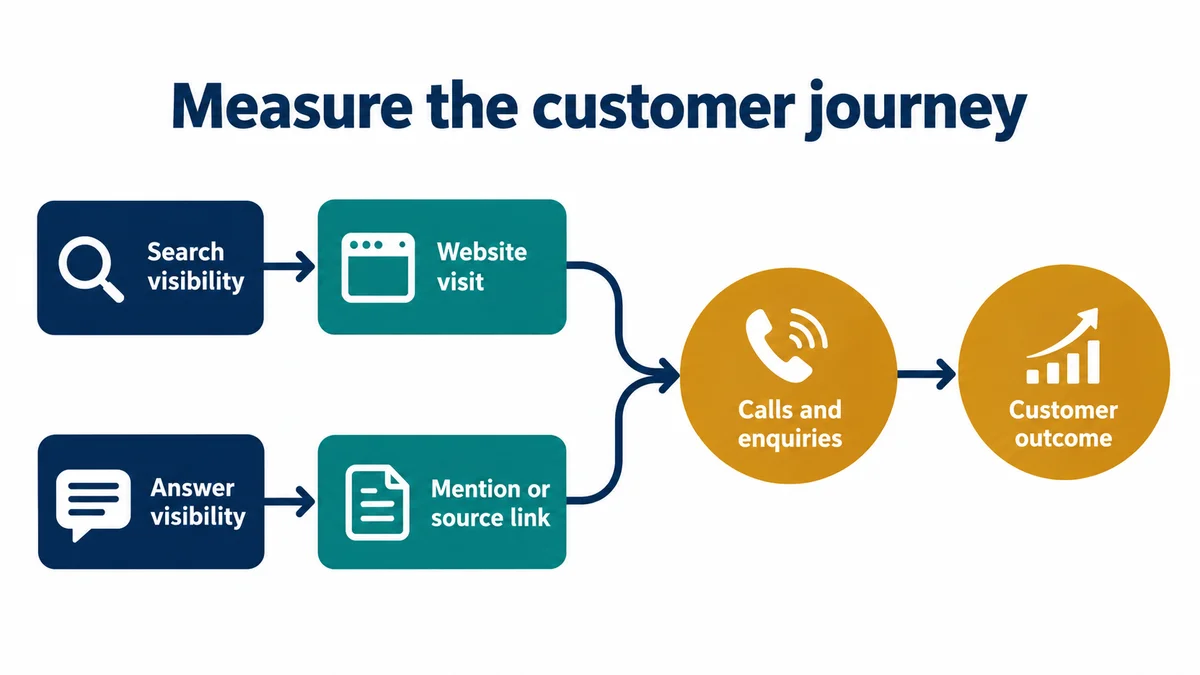
There are two real differences, and they are both about measurement rather than technique.
Clicks stop being the whole story. If an AI Overview answers a searcher's question about your opening hours directly on the results page, you may get zero click-through for that query even though your business was the source Google cited. This is the same shift we unpack in our guide to zero-click search: Google's own guidance now advises looking beyond clicks to measures like calls, direction requests, enquiry form submissions, and ultimately sales, because a chunk of valuable visibility genuinely no longer shows up as a visit in your analytics. This is uncomfortable for anyone used to judging SEO purely by traffic graphs, but it reflects reality rather than a sales pitch.
Citation competition is different from ranking competition. On a traditional results page, you compete for ten blue-link positions. Inside an AI Overview or AI Mode answer, Google, or ChatGPT if you are tracking how to get mentioned there too, might cite three or four sources to construct one answer, and being cited at all, even in a smaller font below the summary, can still drive an enquiry from a motivated reader. The skill shifts slightly from "outrank the other nine results" to "be clearly, unambiguously the best single source to quote on this specific sub-question," which rewards precision and specificity over generic broad-match content.
Everything else, technical crawlability, page speed, mobile usability, backlink authority, content depth, remains exactly the SEO fundamentals your business should already be investing in. If you are still deciding whether SEO itself is worth the investment in an AI-search world, that is a slightly different and equally important question we have covered in detail separately.
Is This Worth Your Time and Budget as a Small Business?

Yes, but mostly because almost nobody else in your category is doing it properly yet, which is a genuine window of opportunity. A Constant Contact survey of small and medium businesses across Australia and New Zealand, reported in November 2025, found that only around 26% of ANZ SMBs say they are actively optimising their sites for AI-driven search.6 That is actually the highest of the markets surveyed, ahead of Canada at 22% and the US at 17%, though slightly behind the UK at 27%, but it still means roughly three in four Australian small businesses have done nothing about this. For a trades, health, property, finance, or wellness business competing locally, that is a real gap: the handful of competitors who structure their content and local listings properly over the next twelve months will be disproportionately rewarded while most of the category stays flat-footed.
The honest caveat: do not treat this as a separate line item in your marketing budget, demanding a separate "AI SEO" retainer on top of what you are already paying for SEO. If an agency is pitching you AI search optimisation as a wholly new, additional service with its own pricing tier, ask specifically what it includes that genuine, well-executed SEO does not already cover. In most cases, the honest answer is "sharper content structure and a willingness to measure success beyond clicks," which should be baked into your existing SEO work, not sold as an upsell.
If you have been putting off proper SEO because you assumed AI search was about to make it irrelevant, the opposite is closer to true: Google is telling you, in its own words, that the fundamentals still decide who gets cited. The businesses that will lose visibility over the next year are the ones with thin, poorly structured, inconsistent content and listings, AI search or not. The ones that will gain ground are the ones who tighten up what they already should have been doing, and start measuring success beyond the click. At OZ Media Digital, we build local SEO and AI-ready content structure as one integrated approach, not two separate services with two separate invoices. If you want a clear read on where your site currently stands for both classic rankings and AI citation readiness, book a free session and we will walk you through exactly what is working and what is not.
FAQ
Is AI search optimisation the same as SEO?
Largely yes. Google's own developer documentation states there are no additional technical requirements or special optimisations needed to appear in AI Overviews or AI Mode beyond standard SEO eligibility, indexing, and good content. The differences are in measurement and emphasis, not in a separate technical discipline.
Do I need to add special schema markup or an AI robots file for my site to appear in AI Overviews?
No. Google explicitly states there is no special schema.org structured data and no additional machine-readable file required for AI Overviews or AI Mode eligibility. Standard, consistent structured data that matches your visible page content is all that is needed.
Will AI Overviews and AI Mode reduce my website traffic?
Likely yes, for some queries, particularly simple factual ones like opening hours or basic pricing that can be answered directly on the results page. Data on US searches shows roughly 68% ended without a click in early 2026. The practical response is to measure calls, enquiries, and direction requests alongside clicks, not clicks alone.
What is the difference between GEO and AEO?
In practice, both terms describe optimising content so AI systems, Google's AI features, ChatGPT, Perplexity, and similar tools, can understand and cite it accurately. "Generative engine optimisation" (GEO) tends to be used more broadly for generative AI search tools, while "answer engine optimisation" (AEO) is used more specifically for being cited as a direct answer source. Neither requires different fundamentals from solid SEO.
Should I pay extra for an "AI SEO" or "GEO" service separate from my existing SEO?
Be cautious. Ask exactly what additional work is included. If it is genuinely new work, deeper content structuring, a dedicated FAQ build-out, Google Business Profile and local data consistency audits, it can be worth it. If it is a rebrand of existing SEO deliverables with a new name and a new invoice line, it is not.
How long does it take to see results from improving AI search visibility?
There is no separate timeline, because there is no separate ranking system to wait on. Improvements that help your classic SEO, clearer structure, better technical health, stronger local data consistency, feed into AI visibility on the same schedule as they feed into standard rankings, typically weeks to a few months depending on your starting position and competition.