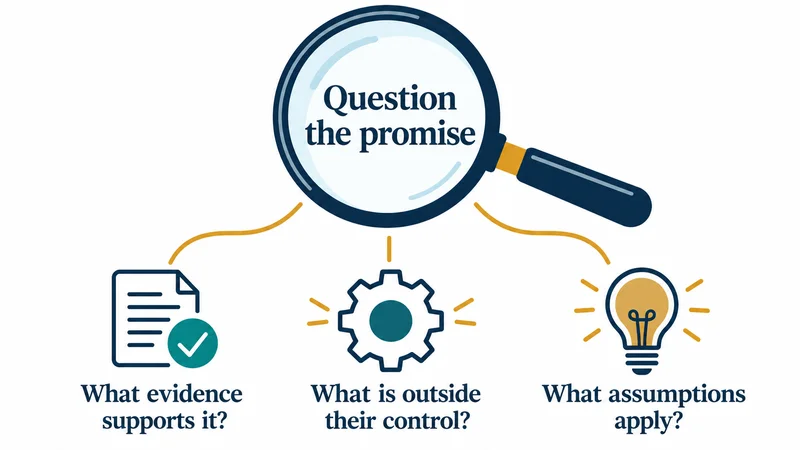

The questions that actually matter before hiring a marketing agency test strategy, measurement, operations and commercial transparency, not just the creative ideas in the pitch deck. Ask about team structure, reporting cadence, data ownership and exit terms before you ask about campaign concepts, and you will find out far more about what working with that agency will actually be like.

TL;DR, what to ask before you sign:
- Start with your own goals, not a channel. Define a specific business problem before asking whether you need SEO, Google Ads or social media.
- Test their strategic rigour. Present a business challenge and see if they ask about your margins and sales cycle, or jump straight to tactics.
- Ask how they will measure success. Get a specific, accountable commitment tied to revenue or cost per lead, not just clicks and impressions.
- Check roster integration. Confirm how they will work with your existing web developer, PR firm or media buyer.
- Get references from outside marketing. Ask for a reference from procurement, finance or legal, not just a marketing contact.
- Confirm account ownership. Your ad accounts, analytics and domain should sit under your business, not the agency's.
- Understand the real commercial model. Ask who specifically works on your account and how many other accounts they hold.
Choosing a marketing agency is one of the biggest investment decisions an Australian small business owner can make. With over AUD $13 billion spent on digital ads in Australia in 2025 and a common target return on ad spend of 3:1, the stakes are high. A poor choice can mean wasted ad spend, poor lead quality and campaigns that drain time without delivering results.
Too many agency pitches still feel like a beauty pageant, where flashy creative ideas steal the show. A smarter, structured approach shifts the focus from "do you like this idea?" to "can we trust this team, their process and their commercials to deliver measurable business outcomes?"
For most Australian businesses, a typical retainer lands between AUD $3,000 and $15,000 per month. Asking the right questions upfront prevents missed follow-ups, inefficient campaigns and the frustration of chasing an agency that is not delivering. For local service businesses, a team like OZ Media Digital starts with strategy before ad spend and offers no lock-in contracts after the first three months, so trust is earned month by month.
Start With Your Own Goals, Not a Channel

Before you even start interviewing agencies, get clear on what you actually want to achieve. A common trap is jumping straight to a specific channel, such as "we need more Instagram posts" or "I want to run Google Ads," without first asking the more fundamental question: what business problem are you trying to solve?
Define your objectives first: brand awareness, lead generation, conversion optimisation or customer retention. Once you know that, set specific, measurable goals so you can compare proposals on a level playing field. "Increase revenue from existing customers by 20 per cent in six months" is far more useful than "get more website traffic."
When you meet an agency, present a business challenge rather than a marketing brief. Say something like "we need to reduce our cost of customer acquisition by 30 per cent" and see how they respond. Strategic partners ask about your margins, sales cycle and competitive positioning before they start talking about tactics. If an agency jumps straight to channel suggestions without understanding your business model, that is a sign they are an executor, not a strategic partner.
Link every goal to measurable outcomes like revenue growth or lead quality, not vanity metrics like impressions or follower counts. An agency focused on clicks alone will not help your bottom line. At OZ Media Digital, every engagement starts with a strategy session that drills into your specific business metrics and local service area before recommending any channel mix, which is exactly the kind of Local SEO and AI SEO or paid channel approach that only makes sense once the goal is clear.
Strategic Rigour: Do They Really Understand Your Problem?

A standout strategic agency treats your brief as the starting point, not the finish line. Ask: "Based on our measurable goal and current challenge, how would you articulate the core problem we must solve, and what is the single most critical assumption in your approach?" An agency with genuine rigour will distinguish symptoms from root causes and ask about your margins, sales cycle and competitive positioning before they discuss tactics. An executor jumps straight to channels and budgets.
Watch for signs of honest, strategic thinking. An agency that willingly discusses multiple options, including ones they do not offer, shows they are working for your outcome, not their product list. If an agency pushes a specific channel like TikTok that does not match your B2B audience on LinkedIn, that is a red flag. The best partners use market research to shape keyword strategies, content creation and messaging, not just a menu of services.
A practical test is to present a business challenge like "we need to reduce customer acquisition cost by 30 per cent" rather than a marketing brief. A strategic agency will ask questions, while a less capable one will jump to tactics. For Australian small businesses, this distinction matters: you want a partner who sees the full picture before they touch a single campaign.
A channel cannot compensate for an unclear market, a generic offer or weak economics.
Measurement and ROI: How Will They Prove Their Worth?

When a marketing agency cannot clearly explain how they will measure success, you are likely signing up for a report full of clicks, impressions and follower counts that do not translate to more customers or revenue. Ask: "How will you measure the success of our first 12 months together, and what is your specific, accountable commitment to the outcome defined in our brief?" This moves the focus from activity to accountability. A strong agency will commit to concrete business results like revenue growth or a lower cost per lead.
Top agencies in 2026 rely on clear, connected reporting that ties marketing activity directly to sales outcomes. Ask to see a sample report before signing. It should be clear and actionable, not just a collection of platform screenshots. For Australian businesses, the key metrics to look for include return on ad spend, conversion rate per channel, cost per lead and the quality of organic traffic. If an agency cannot show how they attribute a conversion from a Google Ad or a blog post back to a booked job, they cannot prove their work is worth the fee.
Look for an agency that provides this level of transparency from day one, with a clear measurement framework tied directly to your brief and regular, straightforward reporting that shows what is working and why.
Roster Integration: Can They Play Well With Others?
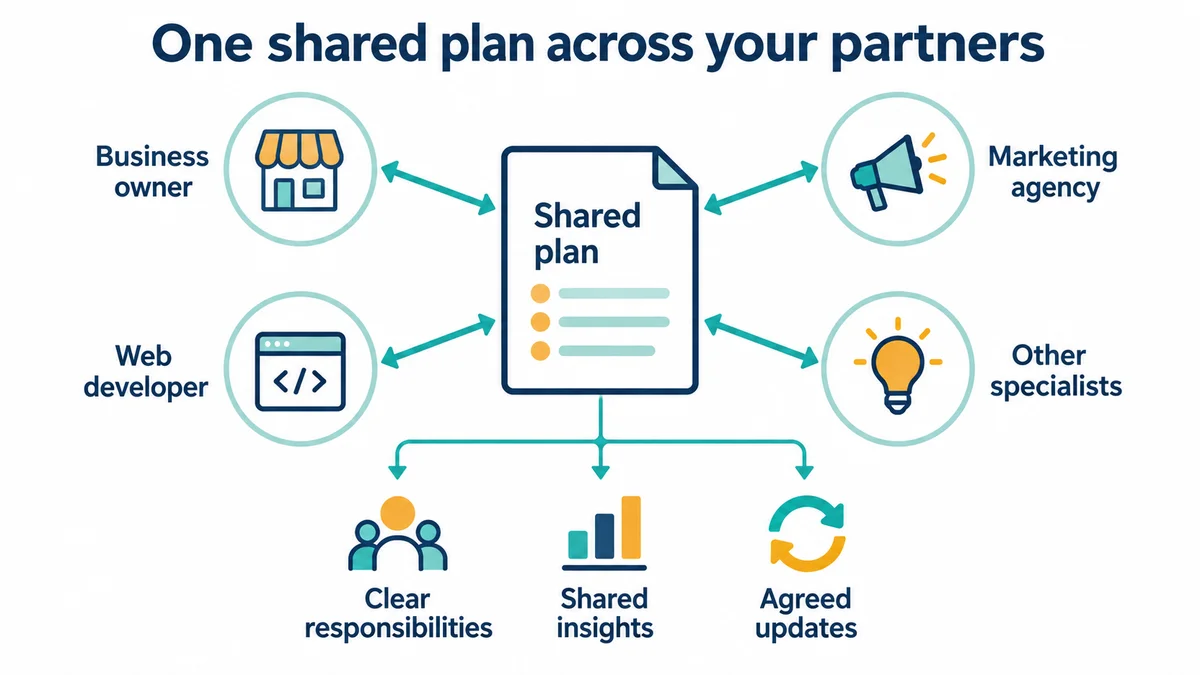
If you already work with a web developer, a PR firm or a media buyer, your new agency needs to fit into that ecosystem without causing friction. Ask: "How will you work with our current marketing partners to make sure everyone is on the same page and we are not duplicating work?" An agency that answers with vague promises rather than concrete integration steps is signalling that it prefers to operate in a silo.
Cross-channel integration matters because your channels are interdependent. Paid search data should inform your SEO strategy. Social media insights should shape your email content. Conversion rate optimisation findings should feed back into your ad creative. Ask how the agency's service teams communicate with each other and whether insights from one channel systematically flow into others. An agency that treats each service as a separate island will waste your budget through duplicated effort and missed opportunities.
A full-service agency can simplify this by keeping strategy, creative, SEO and paid media under one roof, which often delivers better brand consistency than stitching together multiple single-channel vendors. Before you sign, confirm the agency sees your roster as a team it joins, not a set of obstacles it works around.
Operational Proof: Check the Back Office Too

Case studies tell you what an agency has achieved, but they do not tell you how it operates day-to-day. To check that, you need to speak with people who have seen the agency in action behind the scenes.
Ask: "Can you provide two current client references from non-marketing roles, such as procurement, finance or legal, who can speak to your team's consistency, commercial governance and operational delivery under pressure?" Getting a reference from outside the marketing department reveals how disciplined the agency is with budgets, timelines and processes.
When you do call those references, ask for clients that are a similar size and in a similar industry to yours. Focus on long-term clients of more than 12 months, which is a sign of sustained value. Key questions for the reference include how the onboarding process went, how the agency handled a period of underperformance, whether it was responsive when things got tight, and whether they would hire the agency again.
You can also get a quick read on an agency's standards by looking at its own website. If it is slow, poorly designed or full of errors, that is a red flag. An agency that practices what it preaches in its own marketing is a strong indicator of genuine expertise, in the same way our own websites built to convert enquiries are something we expect every client to hold us to.
Problem-Solving Chemistry: How Do They Handle Bumps?

No partnership is friction-free. The real test is how the agency handles the inevitable disagreements that arise over strategy, creative or process. Effective marketing strategies are collaborative, blending the agency's expertise with your business insights.
A strong question to ask is: "Tell us about a time you had a fundamental disagreement with a client on strategy, creative or process, and how you successfully navigated that tension to a positive business result." This tests the agency's ability to navigate friction while maintaining focus on shared business goals. You are looking for resilience, honesty and a collaborative spirit, not just agreement.
Pay close attention to the interaction during the sales process itself. Promptness, professionalism, listening skills and clarity of answers are a direct preview of what it will be like to work with the agency regularly. A great partner is transparent about both successes and failures, so you should never feel your campaign data is locked in a black box.
Cultural Fit and Ethical Practices: Align Values From Day One
A good partnership functions on shared values, not just shared goals. Ask a direct question: "How does your agency's internal culture and stated values directly translate into how you approach client budgets, manage confidential data and ensure ethical media or supplier practices?" This tests whether the agency's talk of integrity extends to handling your budget and data.
In Australia, agencies must comply with the Australian Privacy Principles, the Spam Act 2003, and Australian Competition and Consumer Commission advertising guidelines.1 An agency should proactively explain how it aligns its practices with these laws. Ask about its approach to ethical SEO. Methods like keyword stuffing or buying backlinks might deliver short-term gains but risk Google penalties that can set your business back months.
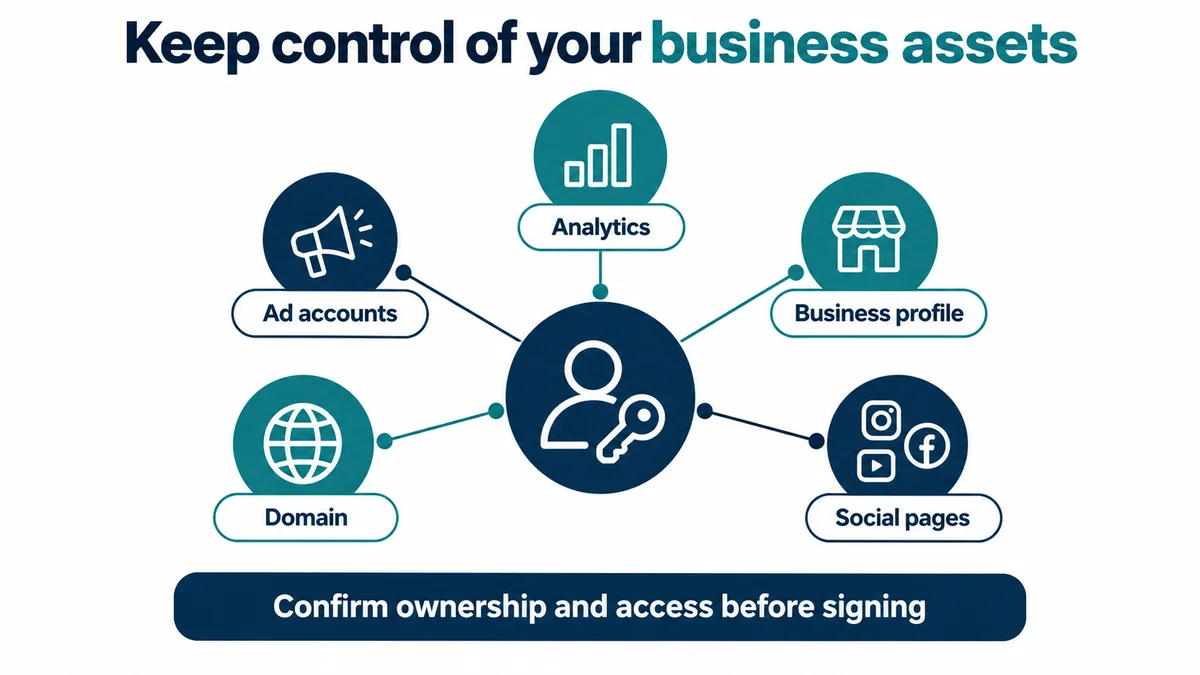
A crucial but often overlooked part of ethical practice is data ownership. Ensure you retain ownership of all content, campaign assets and accounts created during the partnership. The safest approach is to set up your own ad accounts, CRM, analytics and email lists, then grant the agency access, not the other way around. This protects you if the partnership ends, giving you full control and historical performance data. We cover exactly this problem, and the warning signs that precede it, in 10 Red Flags to Watch for Before Hiring a Marketing Agency.
Set up your own ad accounts, CRM, analytics and email lists, then grant the agency access, not the other way around.
Commercial Transparency: Know What You're Paying For

The pitch is over, you have clicked with the team, and now it is time to talk dollars. This is where commercial transparency separates a true partner from a sales machine. Your core question: "Can you detail the proposed team structure and the commercial model, specifically outlining how you will guarantee a sustained level of senior-level involvement and consistency beyond the pitch phase?"
Demand precise data on who will actually do the work. The senior strategist who impressed you in the sales meeting often hands off to a junior once the contract is signed. Ask how many other accounts your designated point person handles. If that number is 30 or more, your business is unlikely to get the attention it needs.
Australian small-to-medium businesses typically pay between AUD $3,000 and $15,000 per month on a retainer, though project-based, performance-based and hourly models also exist. A retainer aligns the agency's focus with your long-term goals. Be wary of agencies that charge a commission on ad spend, since this can create an incentive to spend more rather than spend smarter.
Look for monthly or quarterly contracts with clear exit clauses, such as a 30-day notice period, and avoid contracts with excessive penalties for ending the agreement. At OZ Media Digital, the model is built around a three-month initial commitment with no lock-in contracts after that, so you are never stuck with a partner that is not delivering. Always check that the proposal lists the actual team members and their experience levels, which is the only way to confirm your fee aligns with the talent you are promised.
Technology and AI: What's Under the Hood?
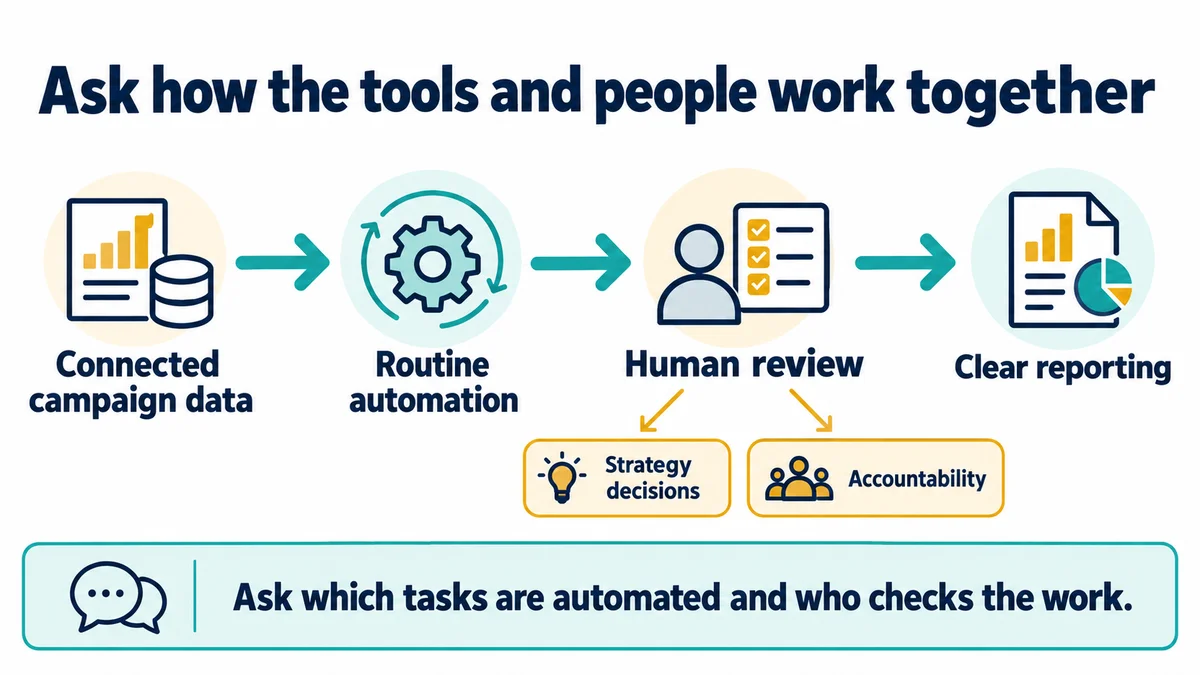
The tools and platforms an agency uses reveal a lot about how it will actually deliver for you. Ask it to walk through its tech stack: what platform does it use to centralise campaign data, and how does it ensure accuracy across channels like Google Ads, Facebook and your CRM? You should also ask whether you will get direct, on-demand access to your own performance dashboards.
When an agency has its data infrastructure sorted, it can provide accurate data, timely reports and efficient onboarding. Without a unified view of your data, you are essentially flying blind, and the agency will be slow to react when a campaign needs tweaking.
AI is another area worth exploring. Find out which tasks the agency automates, such as follow-ups, SMS reminders, review requests and lead nurturing sequences that often slip through the cracks for busy small businesses. The right balance means automation handles the repetitive work, while experienced humans make the strategic calls. Agencies that lean too far in either direction, either no automation or fully automated with no human oversight, are unlikely to serve your business well.
Before you sign anything, request a sample report. It should be clear, actionable and easy for you to understand, not just a jumble of screenshots or a complex data dump. At OZ Media Digital, our approach reflects these same priorities: tools that centralise data, automate lead nurturing and review requests, and deliver straightforward reporting that connects activity to real business results.
Red Flags and Deal-Breakers to Watch For

Knowing what questions to ask is only half the battle. You also need to spot the warning signs that an agency is not the right fit. Some red flags are obvious, but others hide behind polished pitches.
- Guaranteed rankings. Any agency that promises "we guarantee number 1 Google rankings" is not being honest. No reputable agency can control Google's algorithms, and the Australian Competition and Consumer Commission treats an unsubstantiated performance claim as a compliance issue.2
- Cookie-cutter proposals. A one-size-fits-all strategy with no detail about your specific business is a sign the agency is not listening.
- Hidden costs and no transparency. If an agency will not share sample reports, cannot detail its team structure, or has hidden fees in its contract, walk away.
- Offshore teams and high turnover. Agencies that outsource all their work offshore without clear oversight can lead to quality issues and communication delays.
- Vanity metrics only. If an agency only talks about clicks, impressions and follower counts, and cannot connect those to leads or revenue, it is focused on activity rather than results.
- Pushing the wrong platform. If an agency pushes TikTok when your B2B customers are on LinkedIn, or pushes expensive ads when your data shows organic search drives the best leads, that is a major red flag.
A lack of local case studies is another deal-breaker. An agency that cannot show proven results with similar Australian businesses is asking you to take an unnecessary risk. Before signing, ensure the contract has clear exit clauses and that you retain ownership of your data, ad accounts and content. For the full list of warning signs worth checking before you sign anything, see 10 Red Flags to Watch for Before Hiring a Marketing Agency.
Trust Your Gut and Do Your Homework
You have asked the tough questions, checked the references and compared the proposals. Now comes the part that data cannot fully decide: do you trust the people in front of you? The best agencies work with you, not just for you. They blend their expertise with your unique insights, and they show genuine curiosity about how your business actually runs. If the team you are considering seems more interested in selling you a pre-packaged plan than understanding your specific situation, that disconnect only grows after you sign.
Use a simple scorecard to weigh your final candidates. Compare them on industry experience, service expertise, data and analytics capability, strategic approach, past results, communication clarity, cultural fit and overall value for price. How an agency handles its own marketing performance can be a revealing test: if it does not practice what it preaches in its own campaigns, that flags a gap between promise and execution.
The first 90 days of any new partnership set the tone for everything that follows. A smooth, well-organised onboarding process is a strong signal of the agency's operational discipline. If an agency struggles to get you set up in the first few weeks, that pattern tends to continue. Also keep realistic timeframes in mind: SEO and content marketing typically take 3 to 6 months to show measurable impact. Look for gradual, steady progress rather than promises of overnight results. If you would like structured support putting a plan like this into practice, our digital marketing strategy and coaching program is built for exactly this.
At the end of the process, reduce everything to a single question: can we trust this team, their process and their commercials to deliver our measurable business outcome? If the answer is a clear yes, and your gut agrees with the spreadsheet, you have found your partner. If you would like a second opinion on a proposal you have already received, our full range of marketing services is built around the same transparency this article describes. Book a free session and we will give you a straight answer.
FAQ
What is the single most important question to ask a marketing agency?
Present a business problem rather than a marketing brief, such as reducing your cost of customer acquisition by 30 per cent, and see how they respond. A strategic partner asks about your margins, sales cycle and competitive position before suggesting a channel. An agency that jumps straight to tactics is an executor, not a strategic partner.
How much does a digital marketing agency cost in Australia?
Most Australian small to medium businesses pay between AUD $3,000 and $15,000 per month on a retainer, though project-based, performance-based and hourly models also exist. Be cautious of agencies that charge a commission on ad spend, since that can create an incentive to spend more rather than spend smarter.
Should I own my own ad accounts and marketing data?
Yes. Set up your own Google Ads, Analytics, Google Business Profile, CRM and email list accounts, then grant the agency access, rather than letting the agency create and control them. This protects you if the partnership ends, giving you full control and historical performance data.
What are the biggest red flags when hiring a marketing agency?
Guaranteed rankings or guaranteed leads, a cookie-cutter proposal with no detail about your specific business, hidden costs or refusal to share sample reports, offshore teams with no oversight, a focus on vanity metrics only, and pushing a platform that does not match your audience.
How long does it take to see results from a new marketing agency?
SEO and content marketing typically take 3 to 6 months to show measurable impact. A smooth, well-organised onboarding process in the first 90 days is a strong signal of the agency's operational discipline, and that pattern tends to continue through the rest of the relationship.
What should a sample marketing report actually show me?
It should be clear and actionable, tied directly to your brief, not just a collection of platform screenshots. Look for return on ad spend, conversion rate per channel, cost per lead and the quality of organic traffic, and ask the agency to show how a conversion is attributed back to a booked job.