
Your mega sale season emails, spanning Black Friday, Cyber Monday, Click Frenzy, Christmas, Boxing Day and New Year's, should do three jobs and nothing more: tell customers when you're running offers or open and closed, give them a genuine reason to buy or book before a deadline passes, and bring them back with a clear, low-pressure offer once each event is over. Most small businesses either send almost nothing across this stretch or send the same generic "Merry Christmas from the team" email everyone else sends, both waste the highest-attention ten weeks of the Australian retail calendar.
TL;DR, What to send, in order
- Late November, Black Friday and Cyber Monday: one genuine offer email tied to the actual Black Friday/Cyber Monday weekend, not a vague "sale now on" that runs for a month.
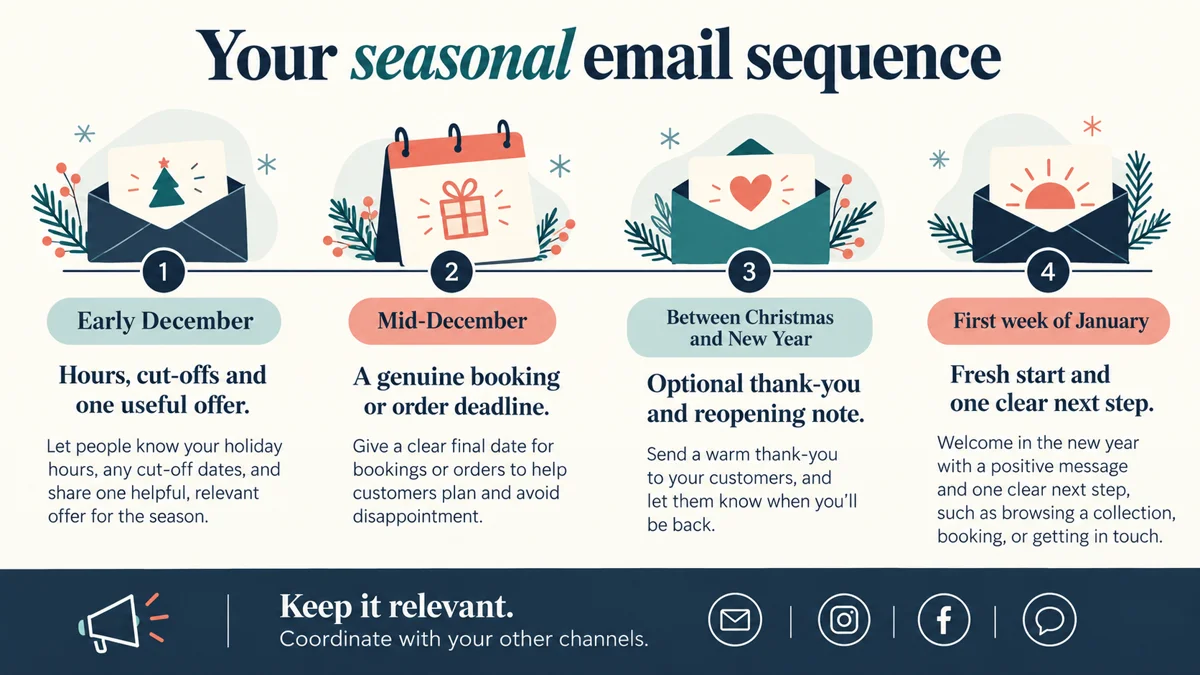
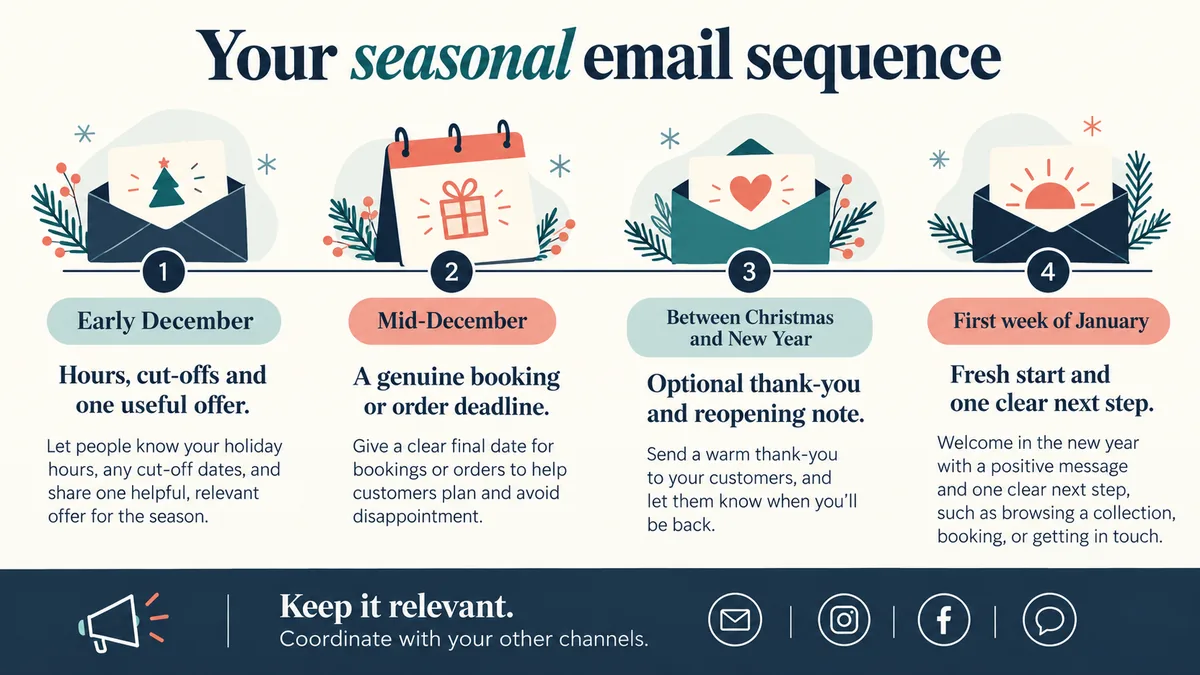
- Early December: one "heads up" email with your Christmas trading hours, cut-off dates for orders/bookings, and one simple offer, not a sales blast.
- Mid-December: one genuine "last chance" email with a real deadline (a courier cut-off, a booking calendar closing, limited appointment slots), urgency has to be true, not manufactured.
- Christmas Eve to Boxing Day: say less, not more. A short thank-you note beats a discount code nobody will act on while they're at the beach or at their in-laws', though a genuine Boxing Day offer email still performs well for retail-style businesses.
- Between Christmas and New Year: this is the most skipped slot and the easiest one to win, a "while we're closed" or "planning ahead for 2027" email keeps you top of mind without asking for anything.
- First week of January: your actual sales email, fresh-start framing, a clear offer, and a strong, obvious call to action.
- Every commercial email in this sequence must comply with the Spam Act 2003: consent, accurate sender identification, and a working unsubscribe link. The Australian Communications and Media Authority (ACMA) issued a $3.96 million penalty in April 2026 for exactly these failures, more on that below.
What Actually Belongs in a Mega Sale Season Email Campaign for a Small Business?
A mega sale season email campaign for a trades, health, property, finance, wellness or local professional services business is not the same as a retailer's. You're not running a straight percentage-off sale against a countdown clock on every event, you're managing several different problems across ten weeks: getting customers to act on a genuine Black Friday or Cyber Monday offer, getting them to book before you close for Christmas, and staying relevant while you're shut over the break.
That means every email in the sequence should answer one of three questions for the reader: when can I still get this done this year, what happens if I don't book now, and what should I expect from you in the new year. If an email doesn't answer one of those three, cut it.
Bold the trading information. Whatever else is in the email, your Christmas and New Year opening hours, your last appointment/booking date, and your reopening date need to be impossible to miss, not buried under three paragraphs of festive copy. This is the single most-forwarded, most-saved piece of information in any small business's December email, and it's also what most businesses bury.

What Should Go in Your Black Friday and Cyber Monday Emails?
Black Friday lands on the last Friday of November and Cyber Monday the following Monday, with Click Frenzy running its own dedicated sale events at other points in the calendar. For a service business, these dates matter less as a discount opportunity and more as a genuine, time-boxed reason to email a list that's already primed to expect offers in that exact window.
Keep it to one email, sent the Thursday or Friday before, with a real offer tied specifically to Black Friday/Cyber Monday (a booking discount, a bundled service, an early-bird slot for December work) and a hard end date. Don't stretch a "Black Friday sale" across three weeks, that undoes the scarcity that made the date worth using in the first place, and it trains your list to ignore your deadlines later in the sequence too.
How Many Emails Should You Actually Send Across Mega Sale Season?
Fewer than you think, and spaced further apart than feels comfortable. This sits inside the same discipline covered in The 3-3-3 Rule and the 40-40-20 Rule Explained: pick a small number of channels and messages and commit to them properly, rather than firing something at every channel every few days because "it's sale season."
For most service businesses, four emails across the whole Black Friday to New Year period is enough: one Black Friday/Cyber Monday offer in late November, one trading-hours-and-offer email in early December, one genuine deadline email in mid-December, and one re-engagement email in the first week of January. A fifth, short "thank you, we're closed" note between Christmas and New Year is optional but high-value because almost nobody else sends it.
If you're already running SMS or social alongside email, read How Do You Avoid Overwhelming Your Customers with Christmas Marketing? before you finalise the calendar, the overwhelm problem is almost always a cross-channel frequency problem, not an email-specific one. Three emails plus three SMS plus daily social posts in the same fortnight will feel like harassment even if each individual email is well written.
What Should Go in Your Early December "Heads Up" Email?
This is your highest-open-rate email of the period because people are actively looking for exactly this information in early December: when are you open, when do you close, and what's the last date to get something booked or ordered before then.
Include, in this order:
- Your Christmas/New Year trading hours (dates, not just "closed over the holidays")
- The last date to book an appointment, lodge a job, or place an order for Christmas delivery
- One simple, genuine offer or reminder relevant to your service, not a generic "10% off everything"
- A single, obvious call to action (book now, order now, call now)
If you sell anything that depends on a courier or supplier, check Australia Post's own cut-off dates before you commit to a date in your email: Australia Post's 2026 guidance lists 22 December for same-state Parcel Post, 21 December for most interstate Parcel Post (earlier again for Tasmania, Western Australia and the Northern Territory), and 23 December for Express Post within most of Australia. Build your own internal deadline with a buffer before those dates, don't quote Australia Post's cut-off as if it's yours.

What Should Go in Your Mid-December "Last Chance" Email?
This is the one email in the sequence that's allowed to create real urgency, but it has to be true urgency, not manufactured scarcity. "Only 3 appointment slots left before Christmas" works if it's actually true and verifiable from your booking calendar. "Last chance, offer ends soon!" with no real deadline is the kind of copy that trains customers to ignore your emails.
Good, honest deadlines for a service business in mid-December:
- Your actual last trading day before the break
- A courier or supplier cut-off (confirmed against Australia Post's or your supplier's published 2026 dates, not guessed)
- A genuinely limited number of remaining appointment or booking slots
- The date your phones/booking system switches to automated/holiday mode
What Should You Send Between Christmas and New Year?
Most Australian small businesses send nothing between 25 December and 1 January, treating it as dead air. That's a missed opportunity, not a safe default, your competitors are also silent, so a short, low-pressure email here stands out by contrast alone.
A good "quiet week" email is short: thank customers for the year, confirm you're closed (or on reduced hours) with the exact reopening date, and optionally tease one thing coming in the new year, a new service, a seasonal offer, an updated booking system. It should not ask for a sale. The goal is simply to be the business people remember opened their inbox on 28 December when nobody else did.

What Should Your New Year Email Actually Say?
Your first-week-of-January email is where you can sell properly again, and it performs well precisely because inboxes have gone quiet for a week and attention is higher. Use "fresh start" framing honestly, a new year prompt to book the job they'd been putting off, a January-specific offer, or a simple "here's what we're doing differently in 2027" note, and give it one clear call to action.
This is also the right moment to point people toward anything that makes the relationship easier going forward, such as an automated booking reminder or follow-up sequence. If you haven't set one up, What Is Marketing Automation and Does Your Small Business Actually Need Nurture Sequences in 2026? covers what a basic nurture sequence actually involves and when it's worth the setup cost for a business your size.

Do Christmas and New Year Marketing Emails Need to Follow the Spam Act?
Yes, the Spam Act 2003 applies to every commercial electronic message you send, including a Christmas offer, a New Year promotion, or an SMS reminder, with no seasonal exemption. Three requirements matter most: consent (the recipient agreed to receive marketing messages from you), accurate sender identification (real contact details for your business, not a generic "no-reply" address with no way to reach you), and a working unsubscribe mechanism that actually processes the request.
The Australian Communications and Media Authority enforces this, and it is not theoretical. In April 2026, ACMA fined Latitude Finance Australia $3.96 million after finding more than 2.7 million breaches, including over 2.3 million marketing messages that lacked accurate sender contact information, and 344,416 messages where the "reply STOP to unsubscribe" instruction simply didn't work. It was Latitude's second spam penalty, after a $1.55 million fine in 2022 for similar failures, and the business is now under a court-enforceable undertaking requiring independent compliance audits.
The lesson for a small business running a December email push isn't "this only happens to big financial institutions", it's that unsubscribe links genuinely need to be tested, not just present, and that whoever sends your Christmas emails needs real, checkable contact details in the message, not just a sender name. If you also send holiday SMS reminders, What Are Australia's New SMS Sender ID Rules and Is Your Business Compliant in 2026? covers the parallel rules for text messages, which tightened further in 2026.
This is general information, not legal advice, if you're unsure whether your email list or sending setup is compliant, that's worth a conversation with your own adviser or a direct check of ACMA's current guidance, not a guess.
What Mistakes Should You Avoid in Mega Sale Season Email Campaigns?
Running a "Black Friday sale" that lasts three weeks. If the offer is live from mid-November to mid-December, it isn't a Black Friday offer anymore, it's just a long sale, and it loses the urgency that made the date worth emailing about.
Sending the trading-hours email too late. If it lands after customers have already assumed you're open (or closed) and made other plans, it hasn't done its job. Early December, not 20 December.
Burying the one thing people actually need. Trading hours and deadlines belong at the top, in bold, not in paragraph four under a seasonal graphic.
Going completely silent for a week and calling it "giving customers a break." Customers don't notice the break; they just notice you weren't there when a competitor was.
Manufacturing urgency that isn't real. If your "last chance" deadline isn't tied to something actually true, a courier cut-off, a booking calendar, a staffing date, customers eventually stop believing any of your deadlines, including the real ones.

Treating the New Year email as an afterthought. It's often your best-performing email of the whole sequence because attention returns to inboxes in the first week of January and most competitors still haven't sent anything.
Frequently Asked Questions
How many emails should a small business actually send across mega sale season?
Four is usually enough for a service business: a late-November Black Friday/Cyber Monday offer, an early-December trading-hours-and-offer email, a mid-December genuine deadline email, and a first-week-of-January re-engagement email. A short, optional thank-you note between Christmas and New Year is a cheap way to stand out, since most competitors send nothing in that window.
Is it against the law to send Black Friday or Christmas marketing emails to my customer list?
Not if you have consent to email them, your sender details are accurate and contactable, and your unsubscribe link actually works. Those three requirements come from the Spam Act 2003, which ACMA actively enforces, it fined one Australian business $3.96 million in April 2026 for exactly these failures, applied to ordinary marketing messages, not a special Christmas category.
Should I email customers on Christmas Day itself?
Generally no. If you send anything on the day, keep it short and low-pressure, a thank-you note, not an offer, because almost nobody is in buying mode on 25 December and a sales pitch that day reads as tone-deaf.
What should I send if my business is completely closed between Christmas and New Year?
A short email confirming you're closed, your exact reopening date, and optionally one line teasing something coming in the new year. It doesn't need an offer or a call to action, the goal is simply to be remembered.
What's the single most important piece of information to get right in a Christmas email?
Your trading hours and last-booking/order date, stated clearly and prominently, not folded into festive copy. It's the most-needed and most-often-buried detail in small business Christmas emails.
Do New Year emails actually perform better than Christmas ones?
Often, yes. Inbox competition drops sharply over the break and picks up again in the first week of January, which means a well-timed New Year email can get more genuine attention than anything sent in the Christmas rush itself.
Getting Your Mega Sale Season Email Sequence Right
Most of what goes wrong with Christmas and New Year email campaigns isn't a writing problem, it's a planning and compliance problem. Businesses either leave it until mid-December and scramble, or they set up a list years ago and have never checked whether the unsubscribe link still works. Both are fixable with about half a day of proper setup before the rush starts.
At OZ Media Digital, this is exactly the kind of thing we build into a client's AI-assisted marketing automation setup, a mega sale season email sequence that's planned once, checked for Spam Act compliance, and then runs on schedule instead of being written under pressure the week before Black Friday. If you want a second set of eyes on your mega sale season email plan before you send anything, you can see our full range of services at ozmedia.digital/services, or book a free session directly: Book a free strategy session.