OZ Media Digital
If your budget is under roughly $3,000 a month in ad spend and you need one person who's fast to reach and cheap to test with, a freelancer is usually the better starting point. If you're spending $5,000 a month or more, running ads across multiple platforms, or you need creative, copy, landing pages and reporting handled as one system, an agency earns its higher fee. The wrong choice in either direction is the more expensive mistake, not the fee itself.
That's the short answer. The rest of this guide breaks down what each option actually costs in Australia right now, where each one quietly fails small businesses, and the specific questions to ask before you sign anything.
TL;DR
- Freelancers typically charge $25, $120/hour or $500, $2,000+/month flat, depending on experience and scope, cheaper up front, but a single point of failure with no backup if they're sick, booked out, or move on.
- Agencies typically charge 10 to 20% of ad spend, a flat retainer, or both, Redback Solutions puts the range at 20 to 50% of ad budget depending on service level; expect a higher floor but a team behind the account instead of one person.
- Below about $3,000/month in ad spend, percentage-based agency fees stop making sense, the management fee can end up close to, or bigger than, the media budget itself.
- A freelancer working solo has no cover for leave, illness, or burnout; an agency has redundancy built in, which matters more the longer you plan to run ads.
- Neither option should ever promise a specific number of leads, sales, or ROAS, under Australian Consumer Law, a business "must be able to prove any claim they advertise," and vague future-performance guarantees are exactly the kind of claim the ACCC scrutinises.
- A month-to-month trial period, with clear asset ownership from day one, protects you regardless of which option you pick.
What's the real cost difference between a freelancer and an agency?
The honest answer is that both categories cover a wide range, and the labels "freelancer" and "agency" tell you less about price than about structure.

On the freelancer side, Superscale's 2026 breakdown of Meta ads management costs puts specialist freelancer rates on platforms like Upwork at roughly $15, $40 an hour, with a median around $25, typically suited to smaller accounts, one-off audits, or part-time management rather than full-scale, always-on optimisation. Looking at the adjacent role of a freelance social media manager, the person often bundled in with ad management for small Australian businesses, Adelaide Socials breaks pricing into three tiers: entry-level freelancers (0 to 2 years) at $300, $600 a month, covering 8 to 12 posts without original photography; mid-level freelancers (2 to 5 years) at $700, $1,400 a month, with some original content and basic graphics; and senior specialists (5+ years) at $1,500, $3,000 a month, who bring genuine strategy and category expertise. Per-post rates run $50, $150, and senior hourly rates sit at $60, $120.
On the agency side, the numbers shift meaningfully. Superscale cites a typical agency percentage model of 10 to 20% of monthly ad spend, alongside a flat-retainer average of roughly $5,108 a month across social media projects broadly (a global figure, not Australia-specific, so treat it as a ceiling reference rather than a local benchmark). Redback Solutions' own guidance, aimed specifically at the Australian market, puts agency management fees at 20 to 50% of ad budget, meaning a $10,000 monthly ad spend could carry $2,000, $5,000 in management fees on top of the media cost itself. ClicksGeek's agency-vs-freelancer breakdown gives a similar picture with a concrete example: a $5,000 monthly ad spend at a 15% agency fee works out to $750 in management costs, versus a freelancer typically billing $1,000, $2,000+ a month flat or by the hour regardless of spend size.
The pattern that matters for a small Australian service business: at low ad spend, percentage-based agency pricing gets disproportionately expensive relative to the media budget itself. Superscale flags this directly, "at monthly ad spends under $5,000, percentage-based agency fees become impractical, often creating management costs exceeding the actual ad budget." If you're spending $1,500 a month on ads, a 15% fee is only $225, too low for most agencies to service properly, which is why many agencies set a flat minimum retainer instead, and that minimum is often where the real sticker shock shows up for a business just starting with paid social.
For context on your total ad budget (separate from the management fee), our own guide on how much does it cost to hire someone to run your Facebook ads breaks down Australian CPC, CPM and cost-per-lead benchmarks by city and industry in more depth.
What do you actually get for the higher agency fee?
Structure and redundancy, not necessarily better creative or a bigger budget going further.

ClicksGeek's comparison lays out the trade-off cleanly. An agency typically brings team-based expertise, a media buyer, a creative strategist, a copywriter and an analyst working from the same brief, rather than one generalist wearing every hat. That team structure gives you built-in redundancy: if your account manager leaves the agency, someone else picks up the account with minimal disruption, because the knowledge lives in shared systems, not one person's head. Agencies also typically operate under formal contracts and carry business insurance, which matters more than it sounds like it should if a campaign misfires and causes measurable loss. And because they run multiple accounts on shared infrastructure, agencies are generally better set up to handle rapid scaling, if your ad spend triples in three months, an agency's systems are built for that; a solo freelancer's aren't.
The trade-offs run the other way too. Agencies can mean less strategic attention as your account competes for time against bigger retainers in the same building. Communication often runs through an account manager as an intermediary, which adds a layer between you and the person actually managing your campaigns. And for a genuinely simple, single-platform campaign, an agency's full-service model can be more structure than the job needs, you may be paying for specialists your campaign doesn't use.
What does a freelancer do better?
Speed, focus, and direct access to the person actually running your ads.

The clearest freelancer advantage is direct communication, no account manager relaying messages, no ticket queue, just you and the person managing the account. That tends to mean faster turnaround on changes and a genuinely direct relationship that can build stronger accountability, because there's no organisational buffer between your results and their reputation. Freelancers are also typically more flexible on terms, month-to-month arrangements are common, which matters if you're still testing whether paid social works for your business at all. And because a good freelancer is managing far fewer accounts than an agency account manager, you often get more focused attention per dollar on a smaller budget.
The risk sits on the other side of the same coin. A freelancer working solo is a single point of failure, if they get sick, go on leave, or simply move on to other work, there's no one else who knows your account, your history, or why a particular audience was excluded three months ago. Adelaide Socials' guidance is blunt about the gap: freelancers typically offer "no cover" during sick leave or holidays, unlike an agency's team structure. Most freelancers also can't afford professional photography or video production at scale, which limits quality for visually driven categories like food, beauty, fitness and hospitality. And if the relationship ends, there's a real risk of knowledge loss, campaign history, audience learnings, and creative testing data that may not transfer cleanly to whoever comes next.
How do you tell a genuinely good freelancer or agency from a red flag?
The scope and the contract tell you more than the pitch does.
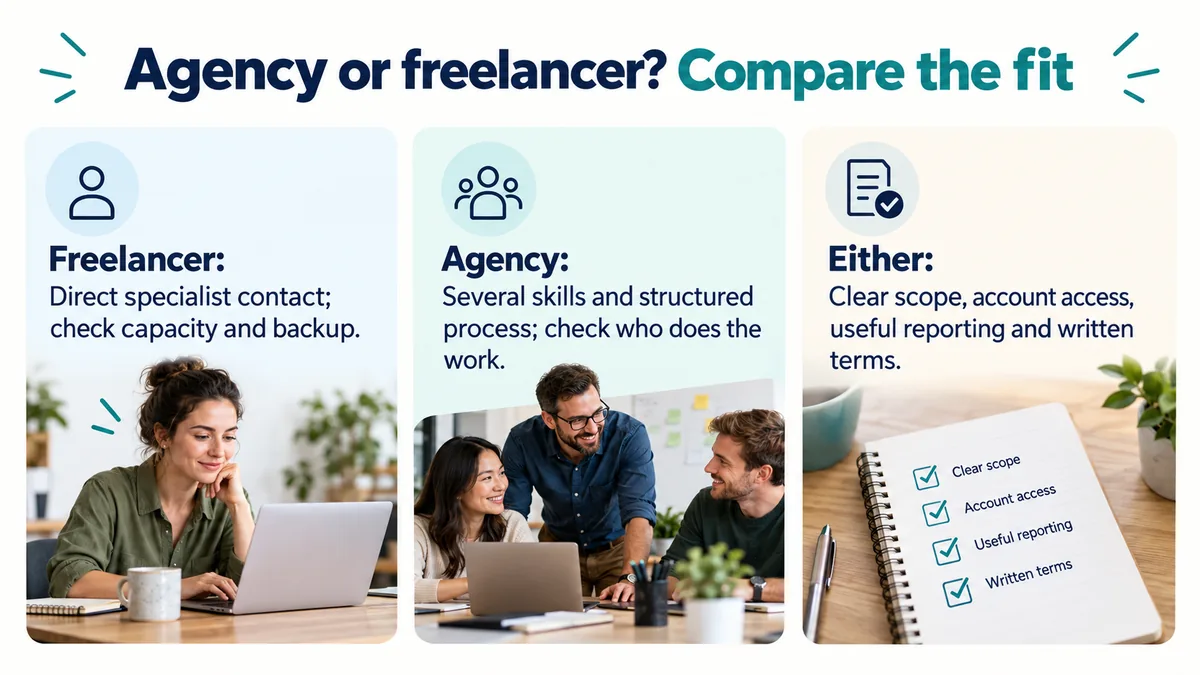
A handful of warning signs show up consistently across both freelancer and agency arrangements. Vague scope, no clear specifics on number of ads, platforms covered, creative volume, reporting frequency, or how many rounds of revisions are included, is the single biggest predictor of scope creep and disappointment down the track. "Unlimited" commitments (unlimited ad variations, unlimited revisions, unlimited platforms) at a flat low price usually mean quality gets sacrificed to make the maths work, because the time has to come from somewhere. Adelaide Socials flags a specific version of this: a $500 monthly retainer that implies 15+ hours of work is either underpriced to the point of being unsustainable, or the actual time spent on your account is far less than advertised.
Missing structure is another tell, no content calendar, no defined approval workflow, no agreed reporting cadence. And watch for unrealistic promised outcomes. Our own diagnostic guide, why am I spending money on ads but getting no sales, covers the operational side of this, tracking, funnel, and landing-page issues that no amount of ad-management skill can fix on its own. But the marketing-claims side matters just as much before you sign anything: under Australian Consumer Law, the ACCC's own guidance states plainly that "a business must be able to prove any claim they advertise," and that predictions about future performance must have "reasonable grounds… at the time of making the claim" and must "adequately address the range of uncertainties and variables involved." A provider, freelancer or agency, who promises you a specific number of leads, a guaranteed cost-per-lead, or a fixed return on ad spend before they've seen your account, your offer, or your market is making exactly the kind of unsubstantiated claim this guidance exists to catch. Genuine specialists talk in ranges and testing plans, not guarantees.
Asset ownership is the practical question too many businesses skip. Before you sign with anyone, confirm in writing that the ad account, pixel, saved audiences, and creative files are owned by your business, not the freelancer's or agency's personal account, so nothing walks out the door if the relationship ends.
Should you start with a trial period either way?
Yes, and this applies whether you're leaning agency or freelancer.

ClicksGeek's framework is worth following directly: avoid long-term contracts initially. Start with a month-to-month agreement or a short, clearly scoped trial (60 to 90 days is common for paid social, since Meta's algorithm needs a genuine learning period before performance stabilises) that lets you judge creative quality, strategic thinking, communication style, and reporting discipline before committing to anything longer. A trial period costs you a small amount of time either way, but it's far cheaper than discovering six months into a 12-month agency contract, or a year into an informal freelancer arrangement, that the fit was wrong from the start.
Before you start that trial, it helps to know what you're actually asking for. Seven questions worth running through with any candidate, freelancer or agency:
- What's my realistic monthly ad spend, and how much of my total budget should go to management versus media?
- Does my campaign need multiple specialised skills (creative, copywriting, landing pages, analytics) or focused execution in one area?
- What does my growth plan look like over the next 12 to 24 months, and can this provider scale with it without becoming a bottleneck?
- Do I want direct, fast communication, or structured reporting and account-manager oversight?
- What happens if my main point of contact leaves, gets sick, or is unavailable for an extended period?
- Who owns the ad account, pixel data, and creative assets if we part ways?
- Am I being asked to commit long-term before we've tested performance together?
If your business is still figuring out which platforms deserve your budget at all, not just who should run the ads, our guide on PPC advertising strategies that deliver real ROI and our companion piece on whether to hire a Google Ads manager or run your own account both work through the same decision logic for the search side of paid media.
The bottom line
There's no universally correct answer between an agency and a freelancer, there's only the right fit for your current spend, your growth plans, and how much redundancy you actually need. Under roughly $3,000 a month in ad spend, a skilled freelancer with clear scope and a trial period is usually the more sensible starting point. Above that, or once you need creative, copy, and cross-platform strategy working as one coordinated system, an agency's structure starts to earn its higher fee. Either way, insist on a defined scope, confirmed asset ownership, and a trial period before you commit to anything long-term, and be sceptical of anyone, freelancer or agency, who promises a specific result before they've seen your account.
If you'd rather skip the trial-and-error and get a managed Facebook and Instagram ads setup with clear scope and Australian-based reporting from day one, our social media marketing service covers organic content and paid social management, with packages scaled to different ad-spend levels. Book a time to talk through your numbers and we'll tell you honestly whether an in-house freelancer, an agency, or a hybrid approach makes more sense for where your business is right now.
Frequently Asked Questions
Is it cheaper to hire a freelancer than an agency for Facebook ads?
Usually yes at the outset, freelancer rates typically run $25, $120 an hour or $500, $2,000+ a month flat, versus an agency's 10 to 20% (or, per some Australian guidance, up to 20 to 50%) of ad spend plus retainer minimums. But "cheaper" only holds if the freelancer delivers comparable results; a low fee with poor performance costs more in wasted ad spend than a higher management fee with strong performance.
What percentage of ad spend do Facebook ads agencies typically charge?
Industry figures vary by source: Superscale cites 10 to 20% of monthly spend as typical, while Redback Solutions' Australia-specific guidance puts the range at 20 to 50% depending on service level. At lower ad budgets (under roughly $5,000/month), a flat retainer often replaces a pure percentage fee because percentage-based pricing becomes impractical for the agency to service properly.
Can a freelancer manage Facebook ads as well as an agency?
For a single-platform, well-defined campaign, often yes, a skilled freelancer can match agency-level campaign management at a lower cost, particularly when direct communication and fast turnaround matter more than multi-channel coordination. Where freelancers typically fall short is redundancy (no cover if they're unavailable), production capacity (limited photography/video resources), and scaling support as spend grows significantly.
What should be in a Facebook ads management contract, freelancer or agency?
At minimum: a clear scope (platforms, ad volume, creative inclusions, revision rounds), reporting frequency and format, confirmed ownership of the ad account, pixel and creative assets by your business, a defined trial or initial term (month-to-month or 60 to 90 days is common), and an exit clause specifying what happens to assets and data if the arrangement ends.
Should I be worried if a provider guarantees a specific number of leads or a fixed ROAS?
Treat it as a red flag rather than a selling point. Under Australian Consumer Law, the ACCC requires that any advertised claim, including a prediction about future performance, be backed by reasonable grounds and address the uncertainties involved, a guaranteed lead count or ROAS before a provider has reviewed your account, offer and market is not a claim they can substantiate. Genuine specialists speak in tested ranges, not guarantees.
How long should I trial a freelancer or agency before committing long-term?
A 60 to 90 day trial is common for paid social, since Meta's ad algorithm typically needs a genuine learning period before performance stabilises and becomes a fair basis for judgement. Avoid signing a 12-month contract with either a freelancer or an agency before you've seen at least one full trial cycle of results.
Sources and References
- Facebook Ads Agency vs Freelancer: 7 Key Strategies, ClicksGeek, pros/cons comparison, cost example, decision framework
- Meta Ads Management Cost 2026: Agency Fees vs AI Agents, Superscale, agency percentage/retainer figures, freelancer hourly rates, in-house salary benchmark
- Your 2026 Guide to Facebook Ads Costs in Australia, Redback Solutions, AU-specific agency fee percentage range and ad-spend benchmarks
- How Much Should I Pay a Freelance Social Media Manager?, Adelaide Socials, AU freelancer pricing tiers and risk factors
- Facebook Ads Cost Australia 2026, BuzzPilot, AU-specific CPC/CPM/CPL benchmarks by city and industry
- False or Misleading Claims, Advertising and Promotions, Australian Competition and Consumer Commission, primary source on substantiating performance claims
All figures current as of the publication date and cross-checked live during research. Agency and freelancer fee ranges are industry benchmarks, not OZ Media pricing or guarantees. Meta's own Business Help Center pages could not be independently fetched (blocked by robots.txt), no Meta-specific figures in this article rely solely on an unverifiable Meta source.