OZ Media Digital
Cheap SEO and quality SEO are not the same service at two different prices, they're often not the same service at all. A cheap package (roughly $300, $1,000 a month in Australia) typically buys a templated audit, generic on-page tweaks, and sometimes backlinks bought in bulk from low-quality sites, tactics that sit close to, or over, the line Google's own spam policies explicitly prohibit. Quality SEO (typically $1,500, $5,000+ a month) buys a strategy built around your actual business, technical work that holds up to scrutiny, content aimed at people ready to buy, and reporting you could hand to an accountant without embarrassment. The gap between the two shows up less in the invoice and more in what happens to your rankings twelve months later.
TL;DR
- Price bands in Australia, 2026: budget/entry-level SEO sits around $500, $1,500 a month; mid-tier "growth" SEO where most small businesses see real traction runs $1,500, $3,000 a month; premium/authority SEO is $4,000, $5,000+ a month. Hourly rates run $150, $300/hour, and one-off projects (audits, migrations) typically land $2,000, $10,000.
- The real difference isn't effort, it's process: a genuine technical audit versus a template, content built for your specific customers versus AI-spun filler, earned or built links versus purchased ones, and a monthly report you can actually interrogate versus a vague PDF.
- Google's own spam policies (last updated 28 August 2026) explicitly prohibit buying or selling links for ranking purposes and describe manipulative tactics as techniques used "to deceive users or manipulate Search systems", a cheap provider using these tactics on your site can trigger a manual action that erases your rankings, not just slow them down.
- A guaranteed #1 ranking is not a sales pitch, it's a warning sign, no one controls Google's algorithm, and under Australian Consumer Law a business making a promise it can't substantiate is exactly the kind of claim the ACCC says must be backed by "reasonable grounds."
- Cheap SEO's real cost usually shows up later: disavowing spammy backlinks, rewriting AI-generated content that search engines have started to discount, and recovering from a manual action often costs more, in money and in lost time, than paying for it properly the first time.
- Cheap isn't always wrong, for a genuinely low-competition niche or a business just testing whether SEO is worth investing in at all, a lighter, lower-cost engagement can be a reasonable first step. The problem is cheap SEO sold as if it were the full service, with none of the disclosure.
What Actually Separates Cheap SEO from Quality SEO?
The honest answer is process, not effort. Two agencies can both call their offering "SEO" and produce wildly different outcomes because of what happens inside the engagement, not what's printed on the invoice.

A cheap engagement typically starts with an automated audit tool run against your site, a templated list of fixes that reads the same for a plumber in Penrith as it does for a dentist in Parramatta, and content written to hit a keyword density rather than answer a real customer's question. Backlinks, if they're built at all, often come from link farms, private blog networks, or bulk-purchased guest posts on irrelevant sites, the exact category of links Google's spam policies name directly: "exchanging money for links, or posts that contain links" as a ranking-manipulation tactic. Reporting tends to be a screenshot of a rank tracker with no context for why a position moved or what's being done about it.
A quality engagement starts with a technical audit that's actually read by a person who understands your industry, not just a crawl report, but judgement about which of the forty issues it flags actually matter for your business. Keyword research maps to buyer intent specifically for your services and your local area, not a generic national list. Content is written (or closely directed) by someone who understands the business well enough to answer the questions your actual customers ask before they call. Links are earned through digital PR, partnerships, or content worth linking to, or built carefully and disclosed, never bought in bulk. And reporting ties activity back to business outcomes: which pages are ranking, which of those are converting, and what's planned next, not just a vanity-metric scoreboard.
How Much Does Cheap SEO Cost vs Quality SEO in Australia?
Australian SEO pricing in 2026 roughly breaks into three bands, based on current market data from Australian SEO providers:
Entry-level / budget: $500, $1,000 a month. Covers a basic audit, light on-page fixes, and minimal link-building. This tier can be a reasonable starting point for a micro-business in a genuinely low-competition niche, but it rarely builds the kind of topical authority that moves the needle in a competitive local market.
Growth-focused: $1,500, $3,000 a month. This is where most Australian small and medium businesses see real traction, proper keyword research, regular content production, technical fixes beyond the basics, and the beginning of a genuine link-building programme. Our own Local SEO packages sit in and above this range (Starter from $1,299/month + $799 setup, scaling to Growth at $2,499/month + $1,299 setup), reflecting what this level of work actually takes to deliver properly for a local service business, see our full local SEO pricing breakdown for the detail behind those numbers.
Authority / premium: $4,000, $5,000+ a month. Comprehensive strategy, advanced technical SEO, large-scale content programmes, digital PR, and increasingly, optimisation for how AI search tools summarise and cite businesses, relevant work covered in our piece on whether SEO is still worth it in the age of AI search.
The uncomfortable truth in the middle of these numbers: cheap SEO "might patch surface issues but rarely builds authority," and it "often becomes the most expensive when results stall or penalties appear", because you end up paying twice, once for the cheap work and again to undo it.
What Are the Warning Signs of a Bad or Cheap SEO Provider?
A handful of signals show up consistently across providers that cut corners:
Guaranteed rankings. Nobody, not OZ Media, not any agency, controls Google's algorithm. A guarantee of a specific position is either dishonest or relies on tactics that put your site at risk.
Spammy backlinks. Links purchased in bulk from irrelevant or low-quality sites, rather than earned or carefully built, are the single clearest tell of a corner-cutting provider.
Black-hat tactics. Keyword stuffing, hidden text, cloaking, and mass-generated AI content with no human review or fact-checking all fall into the category Google's own policies describe as attempts "to deceive users or manipulate Search systems."
One-size-fits-all packages. If the strategy document could be handed to any business in any industry with the name swapped out, it isn't a strategy.
Vague or missing reporting. Minimal updates, no clear link between activity and results, and slow or evasive responses when you ask what's actually being done.
If you recognise your current provider in more than one of these, it's worth a direct conversation before the next invoice, not after the next ranking drop.
Why Does Cheap SEO Often Get You Penalised by Google?
This is the part cheap-SEO sales pitches rarely mention: Google's spam policies are not vague guidelines open to interpretation, they're an explicit, published rulebook, and violating it carries real consequences. The policy states plainly that "buying or selling links for ranking purposes", including "exchanging money for links, or posts that contain links", is prohibited, along with excessive link exchanges, automated link-creation programs, and advertorial content that includes paid links without proper disclosure.
When a provider uses these tactics on your site to produce a quick ranking bump, you, not the provider, carry the risk. A manual action from Google can push a page, a section, or an entire site out of search results, sometimes overnight and sometimes months after the tactic was used, once Google's systems catch up. By the time it happens, the agency that caused it has often moved on to the next client.
What Happens If Your Site Gets Hit With a Google Penalty?
Recovery is possible, but it is rarely quick or cheap. It typically involves a full backlink audit to identify every spammy link pointing at your site, a disavow request to Google for the links you can't get removed directly, a genuine content and technical clean-up, and then a waiting period for Google to reassess the site, which can run from weeks to several months depending on the severity of the issue. The irony is hard to miss: the money saved by choosing the cheap provider is usually smaller than the cost of hiring someone to clean up afterwards, on top of the revenue lost while the site is effectively invisible in search.
Is Cheap SEO Ever the Right Choice?
Sometimes, with the right expectations set upfront. A genuinely low-competition local niche, a business that wants to test whether organic search is worth investing in before committing to a larger retainer, or a startup with more time than budget can all be reasonable candidates for a lighter, lower-cost engagement. The problem isn't the price point itself, it's cheap SEO sold as if it were the full, comprehensive service, with none of the limitations disclosed. If a provider is upfront that a $600/month package buys basic hygiene and nothing more, that's an honest transaction. If it's sold with guaranteed first-page rankings and no mention of what's actually being done to achieve them, that's the red flag from the section above.
What Should You Actually Get for Your Money With Quality SEO?
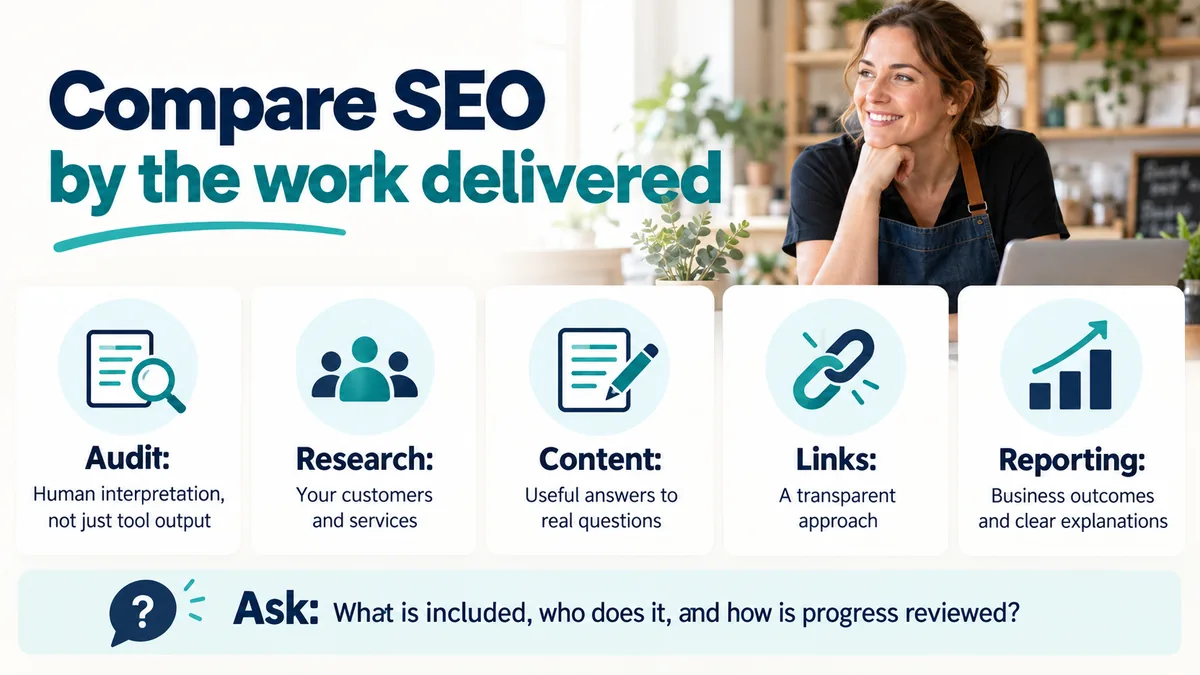
At minimum, a quality engagement should include: a real technical audit interpreted by a person, not just a tool output; keyword research mapped to what your specific customers actually search for and why; content built around genuine buyer questions rather than keyword density; a transparent, disclosed approach to link building; and monthly reporting that connects activity to business outcomes, not just rankings, but the leads and enquiries those rankings are meant to produce. If you're unsure what "good" measurement looks like, our guide to what counts as a good cost per lead for an Australian small business is a useful companion piece, SEO that isn't eventually measured against lead cost is still just an activity, not a result.


How Do You Vet an SEO Provider Before You Sign a Contract?
A short checklist before signing anything: ask to see an example of an actual audit or monthly report they've produced for another client (with details redacted); ask directly how they build backlinks and listen for vague answers; check whether their own website ranks for competitive terms in their own market; be wary of any guaranteed-ranking promise; and read the contract's minimum term carefully, a provider confident in their own results rarely needs to lock you in for twelve months to prove it. It's also worth understanding how your customers actually find businesses like yours in the first place, our piece on how customers find local businesses now covers the search, Maps, and AI-driven discovery paths any legitimate SEO strategy needs to account for.

Frequently Asked Questions
Is SEO ever genuinely "too cheap" to work?
Below roughly $500 a month in the Australian market, there typically isn't enough time budgeted for genuine strategy, content, or link-building work, what you're paying for is more likely automation and templates than a tailored service.
Can I move from a cheap SEO provider to a better one without losing my rankings?
Usually yes, but it depends on what the previous provider did. If spammy backlinks were built, a transition should start with a backlink audit and disavow process before new work begins, otherwise the new agency is building on a compromised foundation.
How long does it take to see results from quality SEO?
Meaningful movement typically takes three to six months, with compounding results building over twelve months and beyond, see our broader guide on realistic SEO and digital marketing timelines for what to expect month by month. Anyone promising first-page rankings in weeks is making the same kind of unsubstantiated claim the ACCC's advertising guidance explicitly warns against.
Will a cheaper DIY approach work instead of paying anyone?
For very small, low-competition local businesses, basic DIY SEO (claiming and optimising your Google Business Profile, basic on-page fixes, consistent NAP consistency) can achieve a reasonable baseline. It rarely substitutes for a full strategy once competition increases.
What's a reasonable minimum SEO budget for a small Australian business in 2026?
Based on current market pricing, $1,000, $1,500 a month is a realistic floor for an engagement with genuine strategy behind it, with $1,500, $3,000 a month being where most SMEs see real traction.
How do I know if my current SEO provider is using risky tactics?
Ask directly where their backlinks come from and request to see your site's backlink profile. If they're evasive, or the links are from clearly irrelevant or low-quality sites, that's worth investigating further, potentially with an independent audit.
The Bottom Line
Cheap and quality SEO aren't two prices for the same thing, they're often two entirely different services wearing the same label. The question worth asking isn't "what does SEO cost?" but "what, specifically, am I paying for?" If you'd like a straight answer on what a genuine SEO strategy would look like for your business, our Local SEO packages are priced and scoped transparently, or you can explore the broader marketing packages if SEO is one part of a wider plan. Either way, book a free 30-minute strategy session and we'll tell you honestly whether SEO is the right investment for your business right now, not just sell you a package.
Sources and References
- Google Search Central, Spam Policies for Google Web Search, last updated 28 August 2026, fetched live today. Primary source for link-scheme and manipulative-SEO prohibitions quoted in this article.
- Australian Competition and Consumer Commission, False or misleading claims, fetched live today. Primary source for the substantiation standard applied to guaranteed-ranking claims.
- eWeb Marketing, "Is it a scam? 5 red flags of cheap SEO pricing", fetched live today. Australia-specific red-flags list and pricing benchmark, flagged as a vendor source and used only for the specific checklist items independently corroborated elsewhere.
- StudioHawk, "SEO Pricing Australia 2026: How Much Does SEO Cost?", fetched live today. Primary pricing-tier source for this article's Australian dollar ranges.
- Backlinko, December 2025 SEO pricing survey (300+ SEO professionals), previously fetched and verified for the 2026-09-19 local SEO pricing article; not independently re-fetched today, carried forward as a consistent cross-check on pricing ranges.
- Whitespark, 2026 Local Search Ranking Factors report (~50 expert contributors), previously fetched and verified for the 2026-09-19 local SEO pricing article; not independently re-fetched today.
Note on source quality: No AU-specific, independently-commissioned survey comparing "cheap" vs "quality" SEO provider outcomes exists publicly, this continues a gap flagged in prior runs (no dedicated AU study exists for local SEO, general SEO, website-build, Facebook/Meta ads, social-media-management, or AI-employee pricing/outcomes either). Pricing ranges in this article are cross-checked across multiple current Australian industry sources rather than relying on a single survey.