 OZ Media Digital
If you're trying to decide between Google Ads, social media, SEO, email and everything else, start here: most small businesses don't need five channels running at once, they need one or two done properly, chosen to match how their customers actually search for and buy their service, with a clear rule for when to add a third. Spreading a modest budget across four or five channels usually means every channel gets starved of the spend and time it needs to actually work, and you end up with mediocre results everywhere instead of strong results somewhere.
This guide gives you a practical framework for choosing your channel mix, not a generic list of "the top 10 marketing channels for 2026" that tells you to do everything.
The short version:
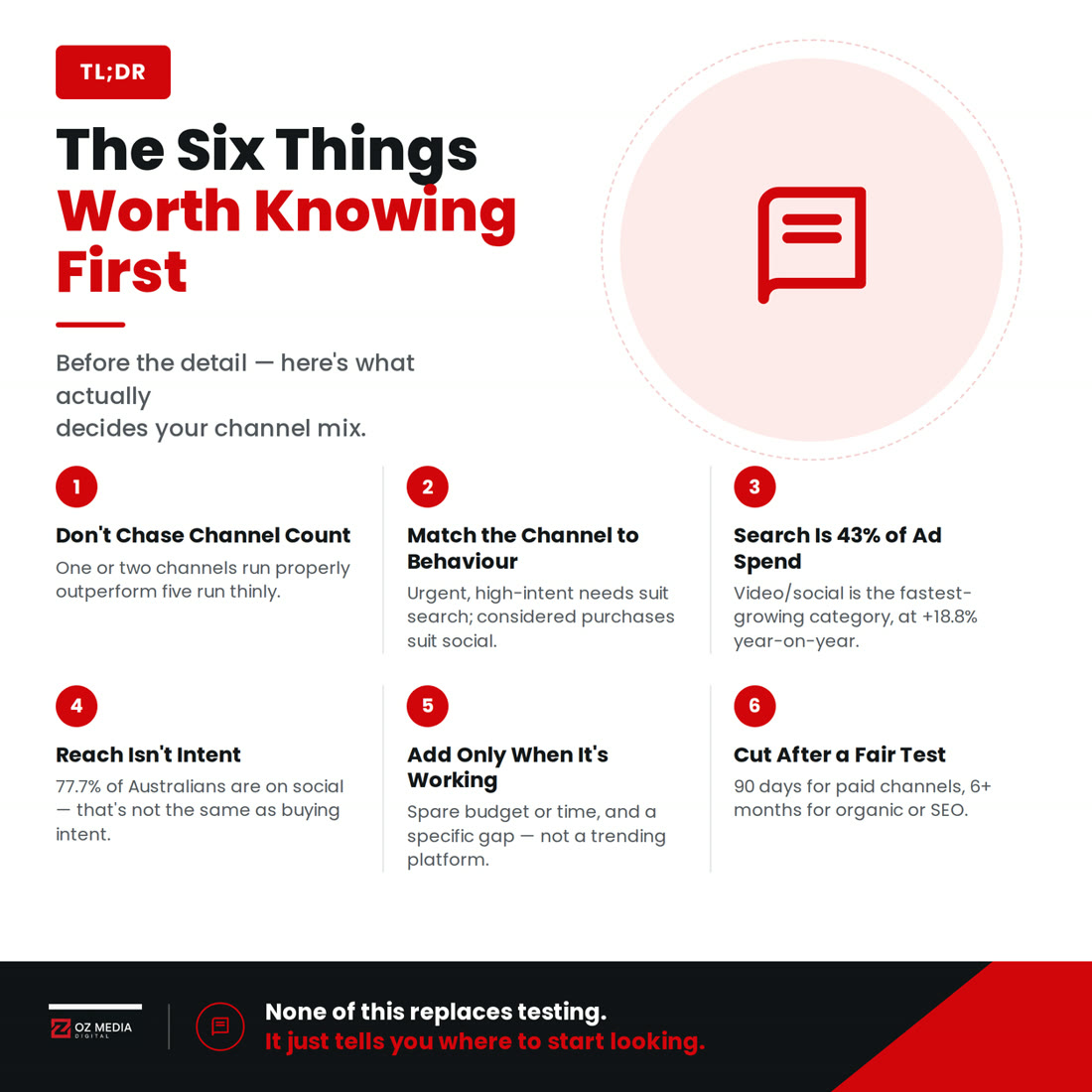
- Don't chase channel count. One or two channels run properly will outperform five run thinly, especially on a small business budget.
- Match the channel to the buying behaviour. High-intent, "I need this now" services (trades, emergency repairs, urgent health) should prioritise Google Search and Google Business Profile. Considered, higher-value purchases (finance, property, wellness programs) do better with a mix of search plus content and social proof over a longer decision window.
- Search-based channels now take 43% of Australia's $19.8 billion annual internet ad spend, and video/social is the fastest-growing category at +18.8% year-on-year (IAB Australia, FY26 report, released 31 August 2026), both are legitimate default starting points, but the right one depends on your sales cycle.
- Social media reaches 21 million Australians (77.7% of the population), but reach isn't the same as intent, someone scrolling Instagram isn't in the same buying mindset as someone typing "emergency plumber near me" into Google (DataReportal, Digital 2026: Australia).
- Add a channel only when your current one or two are performing and you have spare budget or time, not because a platform is trending or a competitor is on it.
- Cut a channel when it's not converting after a fair test period (roughly 90 days for paid channels, 6+ months for organic/SEO), not just when it feels tired.
Why "be everywhere" is bad advice for a small business budget
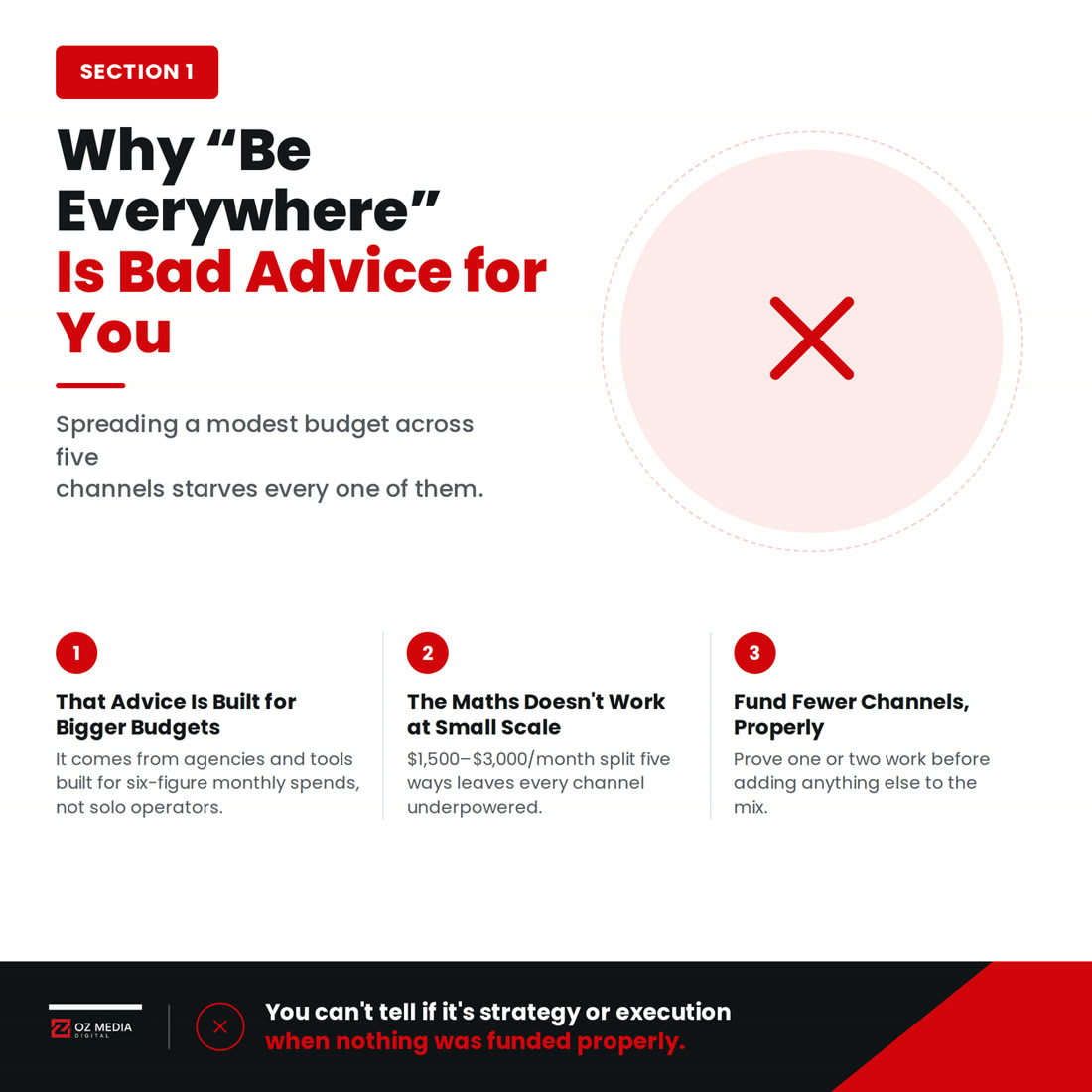
A lot of generic marketing content tells small businesses to run Google Ads, Meta Ads, SEO, email, and an organic social presence across three platforms, all at once. That advice usually comes from agencies and tools built for businesses with marketing teams and six-figure monthly budgets, not from the reality of a tradie, allied health clinic, or local finance broker running marketing alongside actually delivering the service.
The maths doesn't work at small-business scale. If you're spending $1,500 to $3,000 a month on marketing, a realistic range for most service businesses, as covered in our guide to small business marketing budgets, splitting that across five channels leaves each one with a few hundred dollars a month. That's not enough for Google Ads to gather the data it needs to optimise, not enough content volume for SEO to build authority, and not enough consistency for social media to build an audience. Every channel ends up underpowered, and you can't tell whether the strategy failed or the execution did.
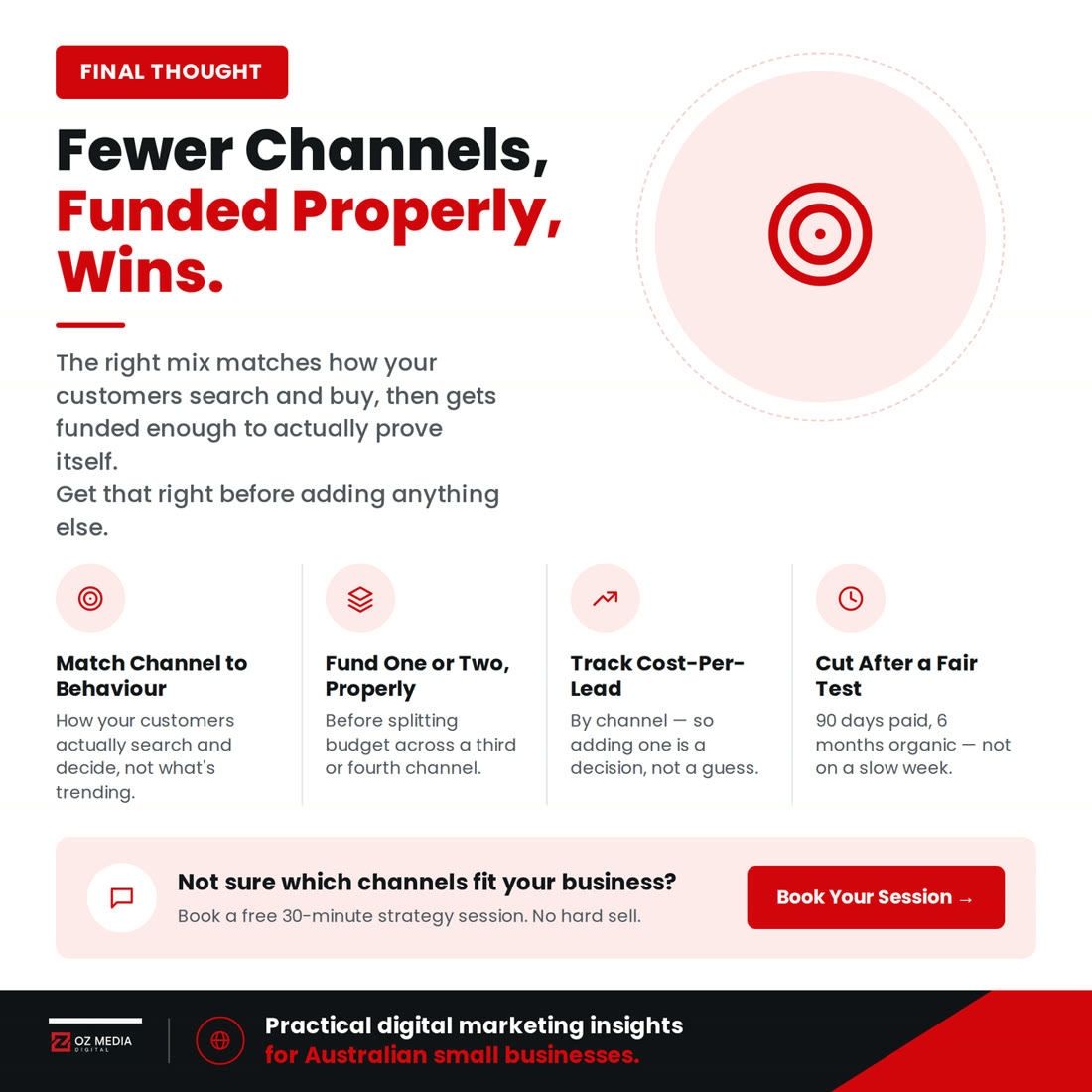
The better approach: pick the one or two channels that best match how your specific customers search for and choose a business like yours, fund them properly, and prove they work before adding anything else.
How do you actually choose the right marketing channels for your business?
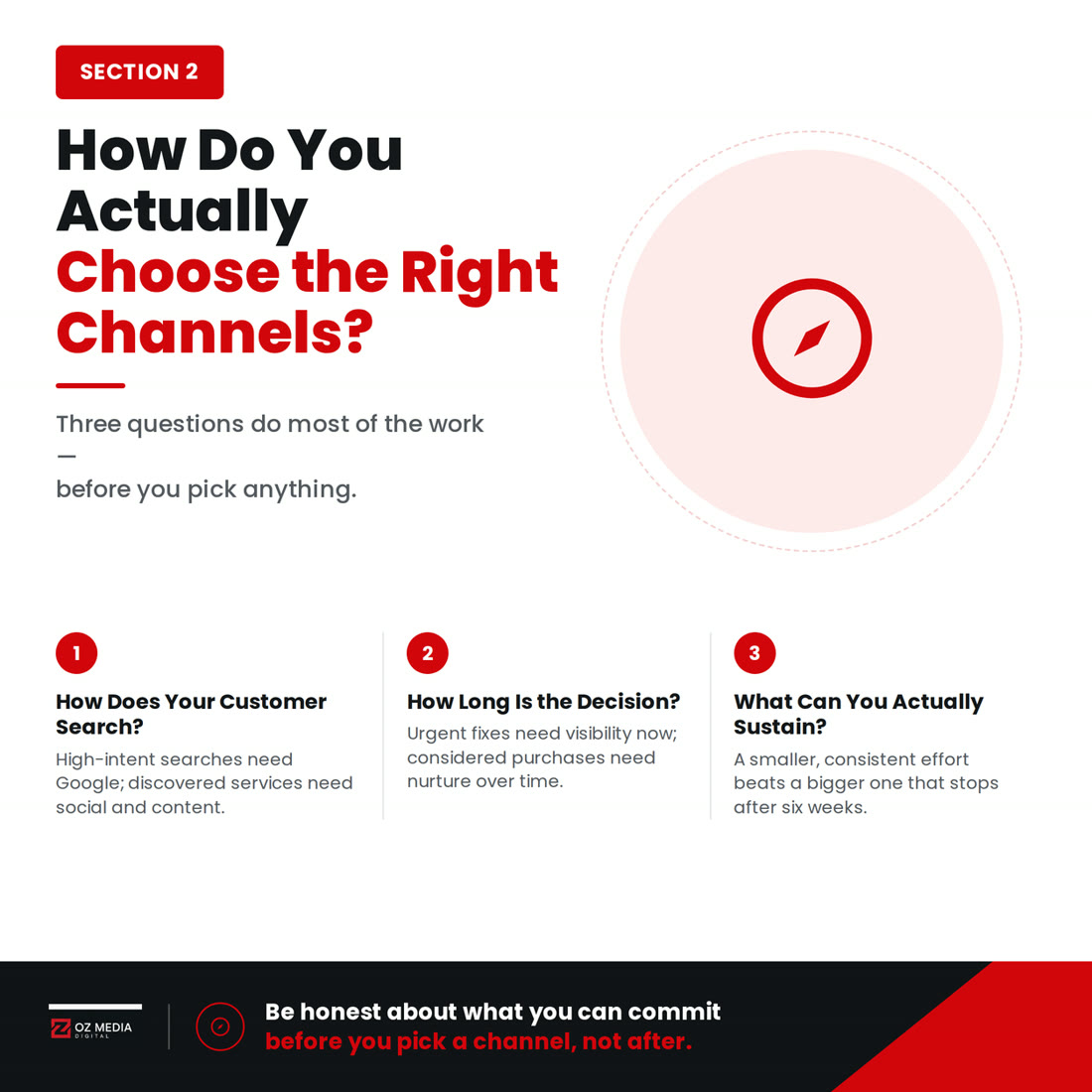
Three questions do most of the work.
1. How does your customer search when they need you?
If someone typically searches with intent, "electrician [suburb]", "family lawyer near me", "24 hour vet", they're already looking for a solution and Google Search (organic and/or paid) is where you need to be found. If your service is something people discover rather than search for, a new wellness studio, a boutique interior design service, a niche fitness offering, social media and content marketing do more of the early-stage work, because you're creating demand rather than capturing it.
2. How long is the decision, and how big is the purchase?
A blocked drain or a broken car window gets fixed today, the buyer wants the fastest credible option, so visibility at the moment of search (Google Business Profile, Google Ads, reviews) matters more than a long nurture sequence. A mortgage, a kitchen renovation, or a multi-month wellness program is a considered purchase, buyers research, compare, and often need multiple touchpoints before committing, which is where content, email, retargeting and social proof earn their place alongside search.
3. What can you actually sustain?
A channel only works if you can maintain it. Weekly social posting that stops after six weeks does less for you than a smaller, consistent effort. An SEO strategy that needs 12 months of content but gets abandoned at month four wastes what was already spent. Be honest about the time or budget you can commit before you pick, not after.
Search vs social vs local vs paid ads: what does each channel actually do well?
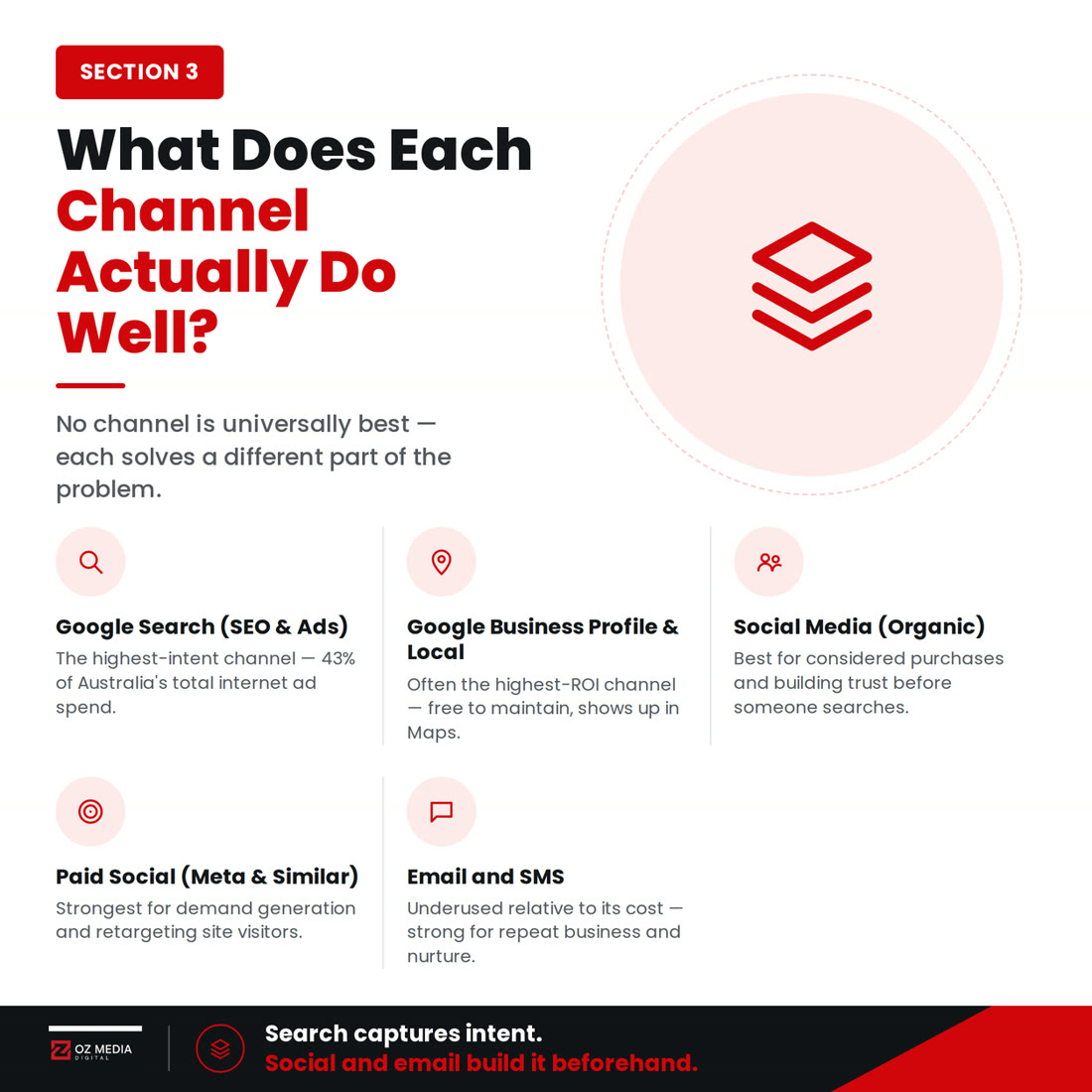
No channel is universally "best." Each one solves a different part of the problem.
Google Search (SEO and Google Ads). This is where people go when they already know what they need and are actively looking for who to buy it from. It's the highest-intent channel available, which is why search still commands 43% of Australia's total internet ad spend, $8.6 billion of the $19.8 billion FY26 total (IAB Australia, 31 August 2026). SEO builds compounding, lower-cost-per-lead visibility over months; Google Ads buys immediate visibility while that compounding effect builds. Our guide on whether SEO is still worth it in the age of AI search covers how AI Overviews and AI Mode are changing, but not eliminating, this channel's value, and our breakdown of AI Max and Performance Max in Google Ads covers what's changed on the paid side.
Google Business Profile and local search. For any business with a physical location or a defined service area, this sits alongside, not instead of, Search and is often the highest-ROI channel available because it's free to maintain and shows up directly in Maps and local pack results. It's a core part of our Local SEO service, and we cover the discovery side in detail in how customers find local businesses now.
Social media (organic and paid). Best for considered purchases, visual services, and building brand recognition and trust before someone is ready to search. With 21 million Australians on social platforms and video the fastest-growing ad category (+18.8% year-on-year, IAB Australia FY26), it's a legitimate channel, but reach and engagement don't automatically convert to leads the way search intent does, so it needs a clear conversion path (a landing page, a booking link, a lead form), not just visibility. Our social media marketing service and 2026 social media strategy guide have the platform-by-platform detail.
Paid social (Meta Ads and similar). Strongest for demand generation, showing your business to people who fit your ideal customer profile but aren't actively searching yet. It's generally a slower path to a booked job than Google Ads for urgent-need services, but effective for considered purchases and for retargeting people who've already visited your site.
Email and SMS. Underused by small businesses relative to its cost-effectiveness, particularly for repeat business, seasonal reminders, and nurturing considered-purchase leads who aren't ready to buy on their first visit.
What does a sensible channel mix look like for different service businesses?
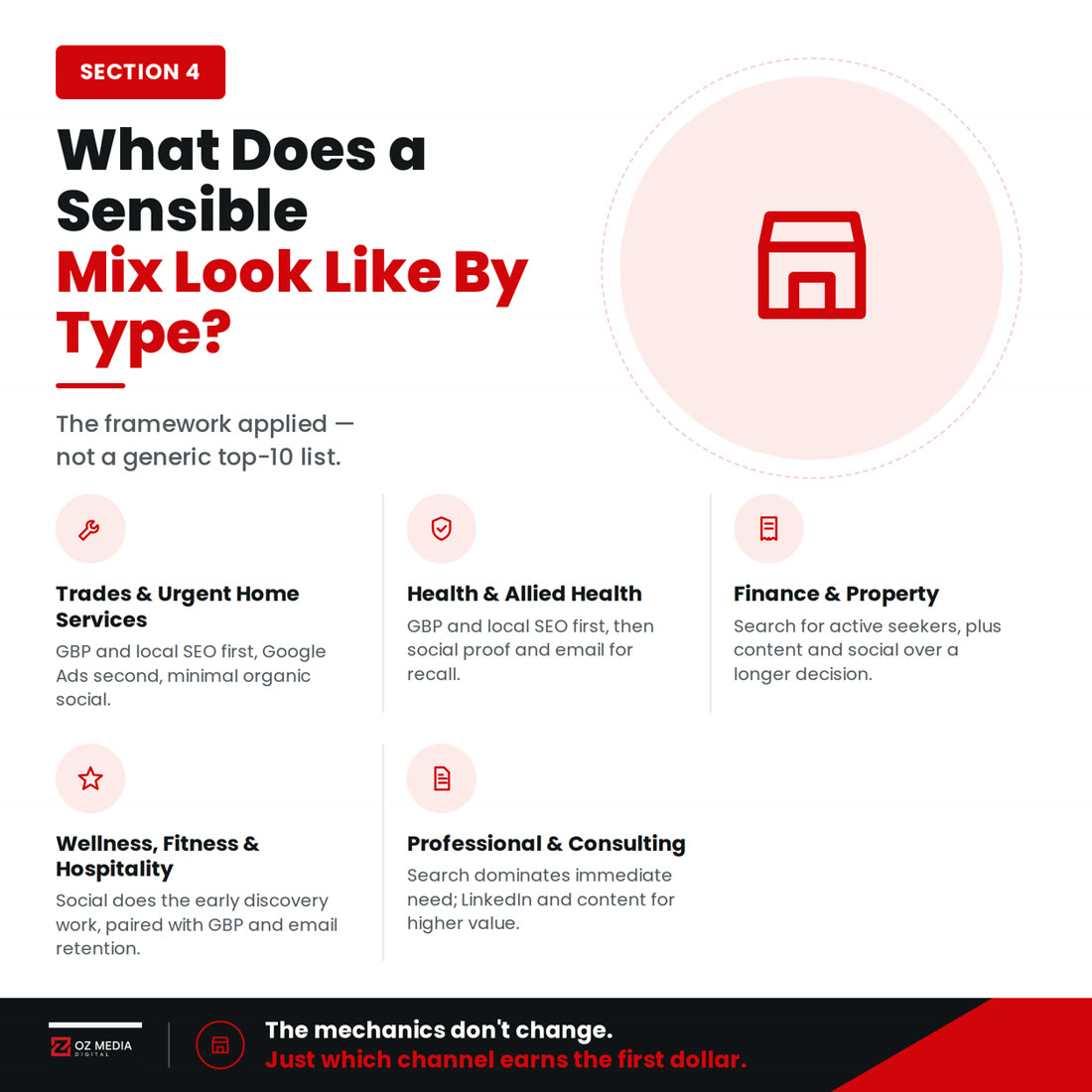
Rather than a generic list, here's how the framework plays out by business type:
Trades and urgent home services (plumbers, electricians, locksmiths): Google Business Profile and local SEO first, Google Ads second for immediate volume, minimal or no organic social. Customers are searching with high intent and want the fastest credible option, this is where our guide on ranking on Google without paying for ads is most relevant.
Health and allied health practices (dental, physio, allied health clinics): Google Business Profile and local SEO first, then a considered-purchase layer of social proof (reviews, before/after content where appropriate, patient education content) and email for recall and referral nurturing.
Finance and property services (mortgage brokers, buyers agents, financial advisers): Search (organic and paid) for people actively looking, plus content and social to build trust over a longer decision window, since these are high-value, high-consideration purchases. Our piece on buyers agents winning clients with local SEO is a useful reference point here.
Wellness, fitness and hospitality: Social media (particularly visual platforms) does more of the early-stage discovery work here than search, paired with Google Business Profile for anyone searching by location and email/SMS for retention and repeat bookings.
Professional and consulting services (accountants, lawyers, consultants): Search dominates for anyone with an immediate need, LinkedIn and content marketing matter more for higher-value, relationship-driven engagements, and referral/email nurture supports longer sales cycles.
How many marketing channels should a small business actually run at once?
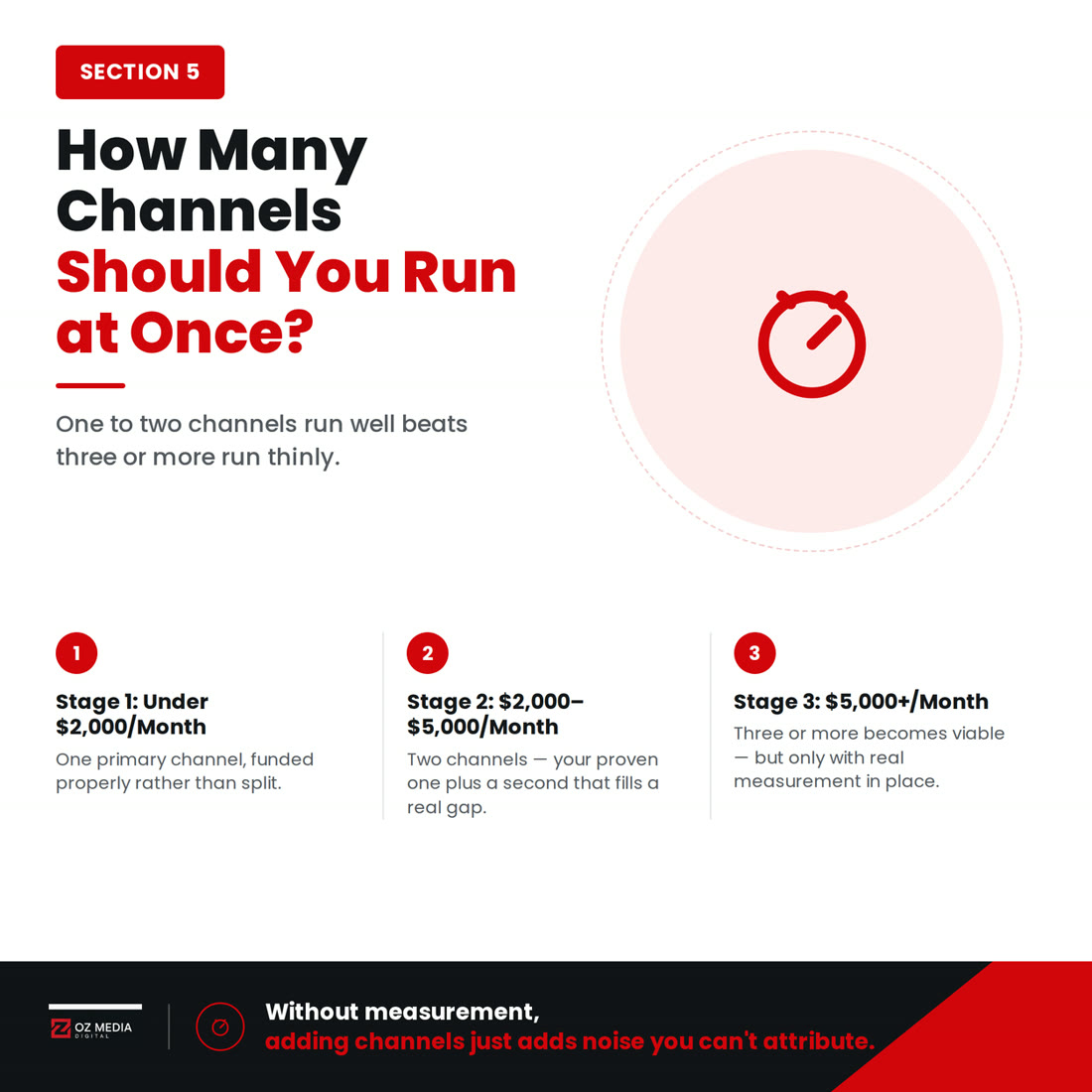
For most businesses under roughly $5,000 a month in total marketing spend, one to two channels run well beats three or more run thinly. A practical staging approach:
Stage 1 (getting started or under $2,000/month): One primary channel matched to your buying behaviour, usually Google Business Profile plus either SEO or Google Ads, funded properly rather than split.
Stage 2 (established, $2,000–$5,000/month): Two channels, your proven primary channel plus a second that addresses a gap (adding paid social for demand generation if you're search-only, or adding search if you've been social-only and want higher-intent leads).
Stage 3 ($5,000+/month, established systems): Three or more channels becomes viable, but only once you have the measurement in place to know which channel is actually producing paying customers, not just clicks or leads. This is where building a proper lead-tracking and measurement system earns its keep, because without it, adding channels just adds noise you can't attribute.
When should you add a new channel, or cut one?
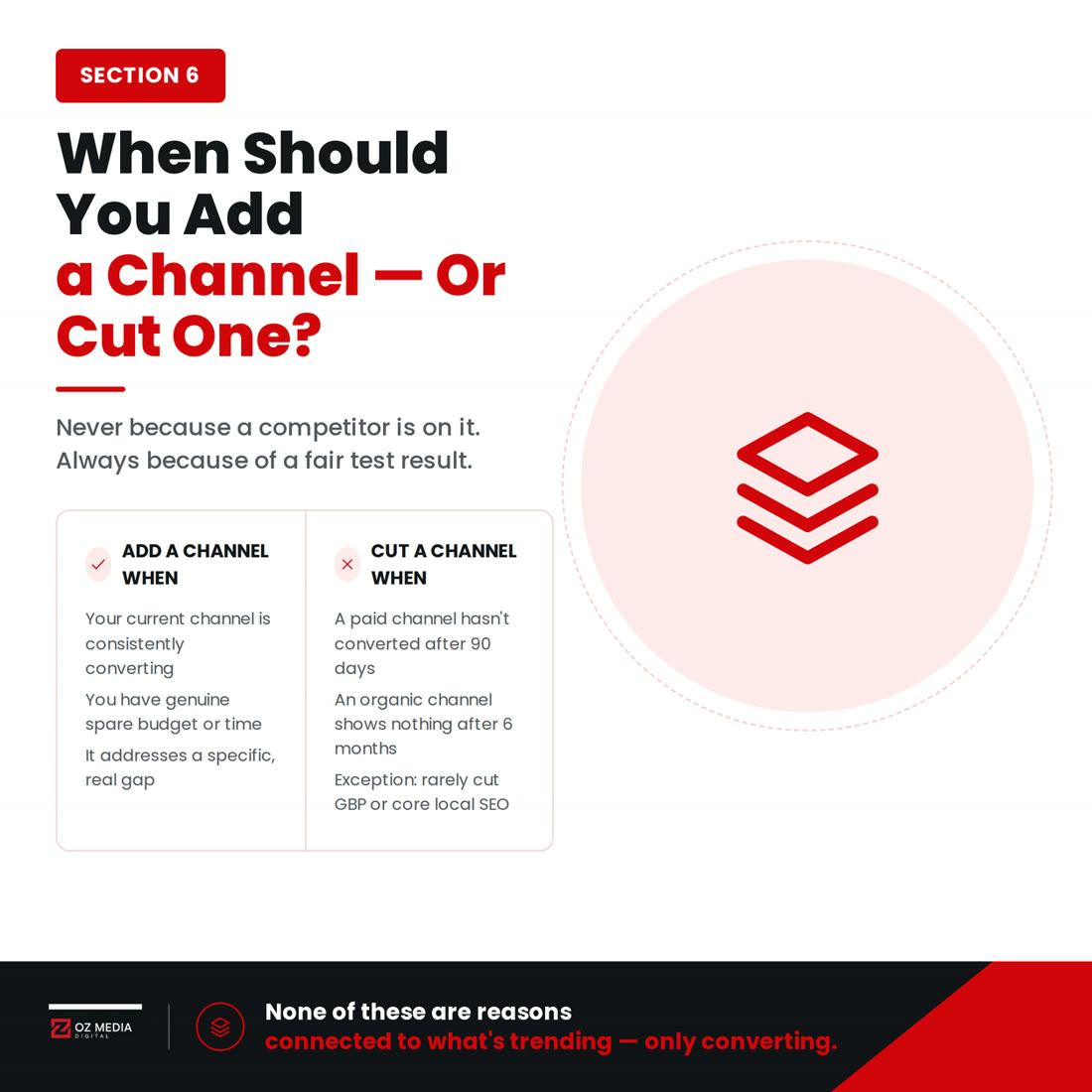
Add a channel when: your current channel(s) are consistently producing leads or bookings at a cost you're comfortable with, you have genuine spare budget or time (not budget borrowed from what's already working), and the new channel addresses a specific gap, reaching people earlier in their decision, reaching a different audience segment, or reducing reliance on a single source of leads.
Don't add a channel because: a competitor is doing it, a platform is trending, or someone told you "you need to be everywhere." None of those are reasons connected to your customers' actual buying behaviour.
Cut a channel when: a paid channel hasn't produced a qualified lead after a fair test, generally 90 days and enough spend to exit the platform's learning phase, or an organic channel (SEO, organic social) hasn't shown measurable movement after 6 months of consistent effort. The exception is Google Business Profile and core local SEO, which should almost never be cut entirely since they're low-cost to maintain and remain relevant regardless of what else you're running.
Frequently Asked Questions
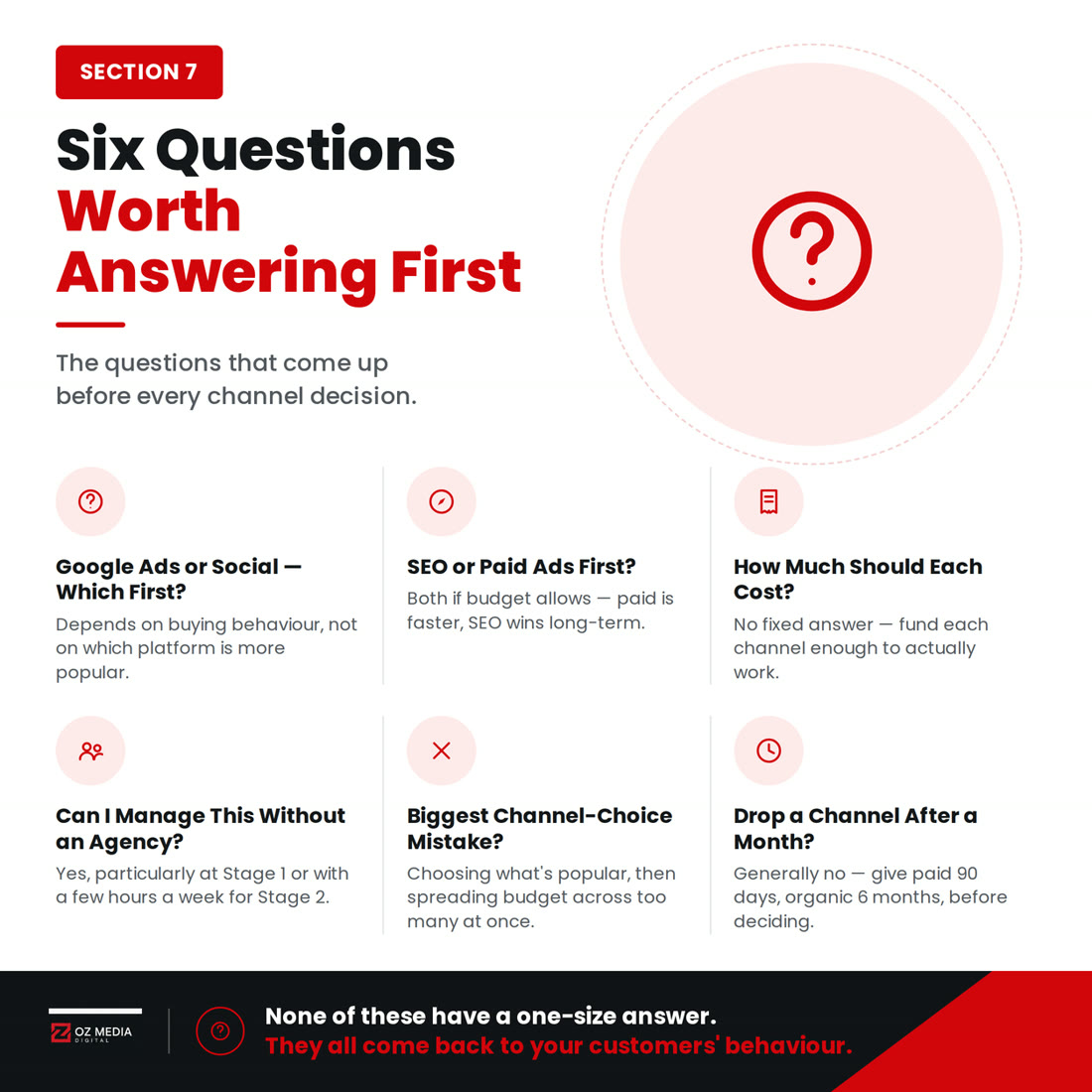
Is Google Ads or social media better for a small business?
It depends on buying behaviour, not on which platform is more popular. Google Ads suits businesses where customers actively search when they need the service (trades, urgent health, professional services). Social media suits businesses selling considered purchases or visually-driven services where customers need to be introduced to the business before they're ready to search. Many businesses eventually use both, but rarely need to start with both.
Should a small business do SEO or paid ads first?
If budget allows for both, run them together, Google Ads for immediate visibility while SEO builds over months. If budget only allows for one, paid ads generally produce faster, more measurable results in the first 90 days, while SEO becomes the better long-term value once it's established (typically 6–12 months). The right starting point depends on how urgently you need leads versus how much runway you have to invest before requiring return.
How much should each marketing channel cost?
There's no fixed answer, it depends on your industry, location, and competition. What matters more than the exact number is whether each channel is funded enough to actually work: a Google Ads campaign needs enough daily spend to exit the platform's learning phase, and an SEO or content strategy needs enough consistent output to build authority. Underfunding either produces results that look like the channel doesn't work, when actually it was never given a fair test.
Can a small business manage multiple marketing channels without an agency?
Yes, particularly at Stage 1 (one channel) or with a few hours a week for Stage 2. The constraint is usually time and consistency rather than complexity, Google Business Profile and basic local SEO are genuinely manageable in-house. Google Ads and multi-channel campaigns become harder to manage well without support once you're running paid spend across more than one platform, largely because the optimisation work (not the setup) is where time and expertise actually matter.
What's the biggest mistake small businesses make when choosing marketing channels?
Choosing based on what's popular or what a competitor is doing, rather than on how their own customers actually search for and decide on a service. The second most common mistake is spreading a modest budget across too many channels at once, which usually means none of them get funded well enough to prove whether they work.
Should I drop a channel that isn't performing well after a month?
Generally no, a month is rarely a fair test, especially for paid channels still in a platform's learning phase or for SEO, which typically needs several months to show measurable movement. Give paid channels roughly 90 days with adequate spend, and organic channels 6 months of consistent effort, before deciding whether to cut them.
Where to go from here
Choosing the right channel mix is a strategy decision, not a guessing game, and getting it wrong is an expensive way to learn. If you want a second opinion on where your marketing budget should actually be going, our digital marketing services page covers how we approach channel strategy for service businesses, and our Smart Growth Digital Mastery package is built specifically around this kind of channel-prioritisation work for small and medium businesses. If you'd rather talk it through directly, book a free strategy call and we'll map out a channel mix based on how your customers actually search and buy, not a generic checklist.