 OZ Media Digital
If you're spending money on ads, SEO or social media and still don't have enough of the right customers, the problem usually isn't your marketing, it's everything that happens after someone clicks. A lead generation system is the connected set of steps that takes a stranger from "found you on Google" to "paid customer": discovery, capture, follow-up, nurture, conversion and measurement. Most small businesses have one or two of these steps working reasonably well and three or four missing entirely, which is why campaigns that should be profitable quietly aren't.
This guide walks through what a working system actually looks like for a service-based small business in Australia, trades, health, property, finance, wellness, hospitality and local professional services, what to build first, what can wait, and what it realistically costs to get right.
The short version:
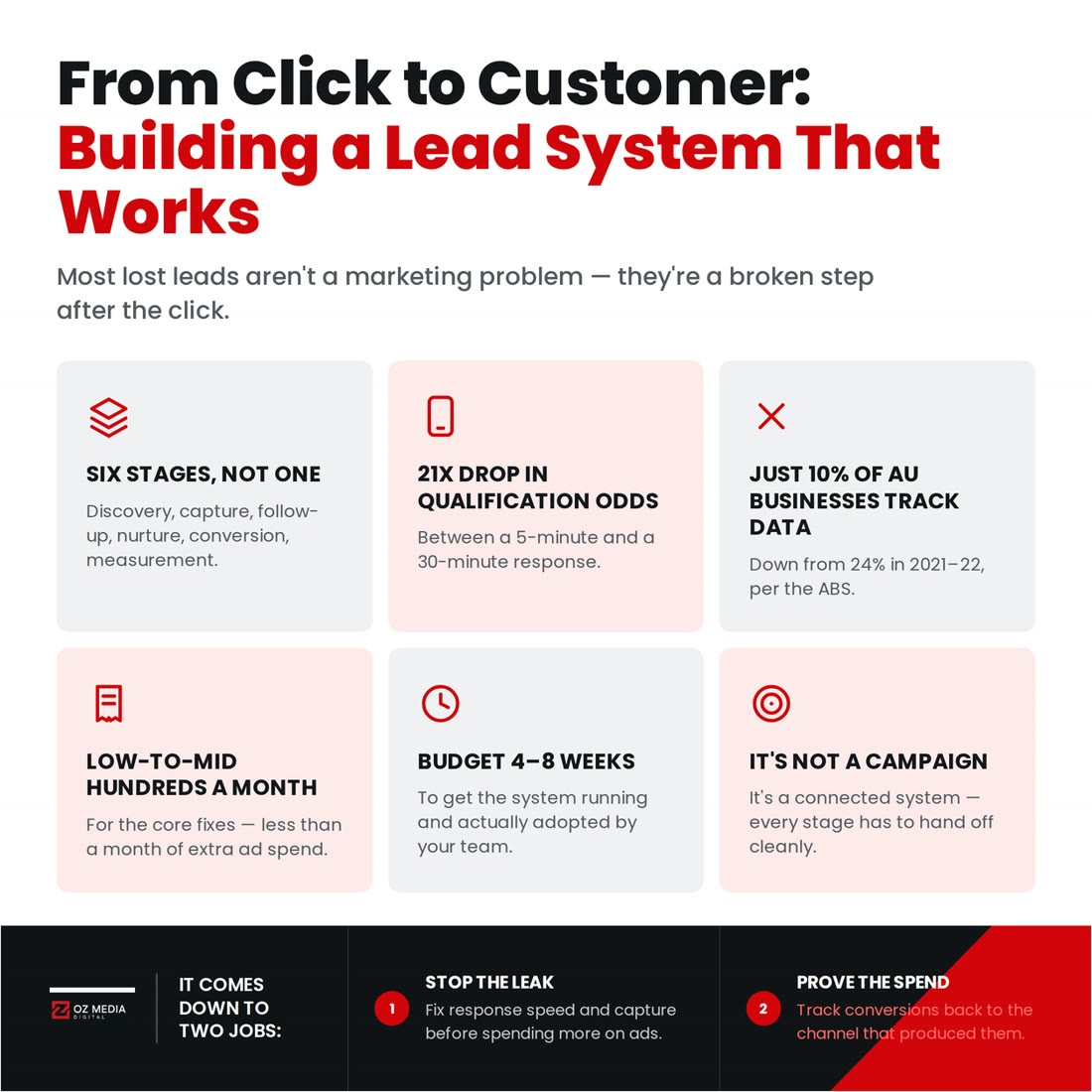
- A lead generation system has six connected stages: discovery, capture, follow-up, nurture, conversion, measurement. Weak marketing gets blamed for what's usually a broken stage further down the chain.
- Response speed is the single highest-leverage fix available to most small businesses. Independent research on B2B lead response found the odds of qualifying a prospect drop by roughly 21-fold between a 5-minute and a 30-minute response, and contact rates fall more than tenfold after just one hour.
- Only 10% of Australian businesses actively collect or analyse data to inform decisions, according to the Australian Bureau of Statistics, down from 24% in 2021–22. Most businesses are flying blind on which channels actually produce customers.
- You don't need enterprise software to fix this. A simple CRM, a documented follow-up process, and basic conversion tracking will outperform a bigger ad budget layered on top of a broken funnel.
- Google Ads and Meta both support importing offline conversions (calls, quote acceptances, signed jobs) back into the platform. Without this, the algorithm is optimising for clicks and form-fills, not paying customers.
- Budget a realistic 4–8 weeks to get the core system running properly, not a weekend. Rushing this stage is the most common reason automation projects get abandoned.
What actually breaks between a click and a paying customer?
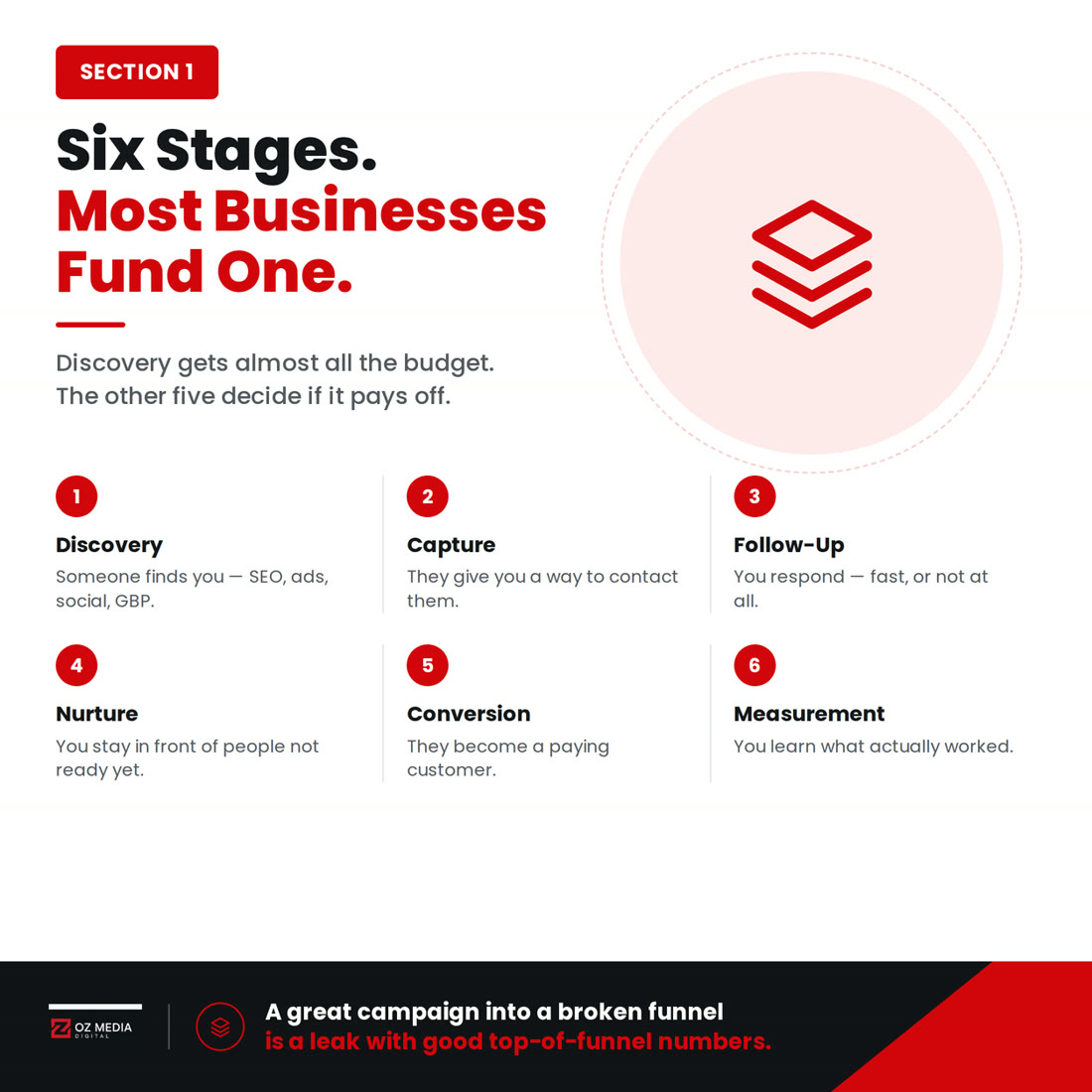
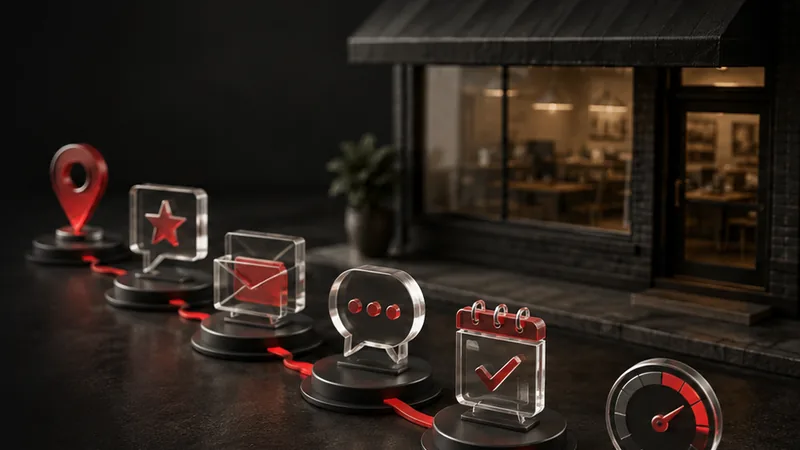
Picture the journey in six stages: discovery (someone finds you), capture (they give you a way to contact them), follow-up (you respond), nurture (you stay in front of people not ready yet), conversion (they become a paying customer), and measurement (you learn which of this actually worked). Most businesses invest almost all their attention and budget in discovery, SEO, Google Ads, social content, and almost none in the other five stages.
That imbalance is expensive. If your website converts visitors to enquiries at 2% instead of 4%, doubling your ad spend to compensate costs far more than fixing the page that's losing half your leads. If a lead sits in your inbox for six hours before anyone replies, no amount of extra traffic recovers what you've already lost to a faster competitor. The stages after the click are where most of the controllable value sits, and they're also the stages Australian small businesses tend to skip, because they feel like "admin" rather than "marketing."
Why do qualified leads go cold before they ever become customers?
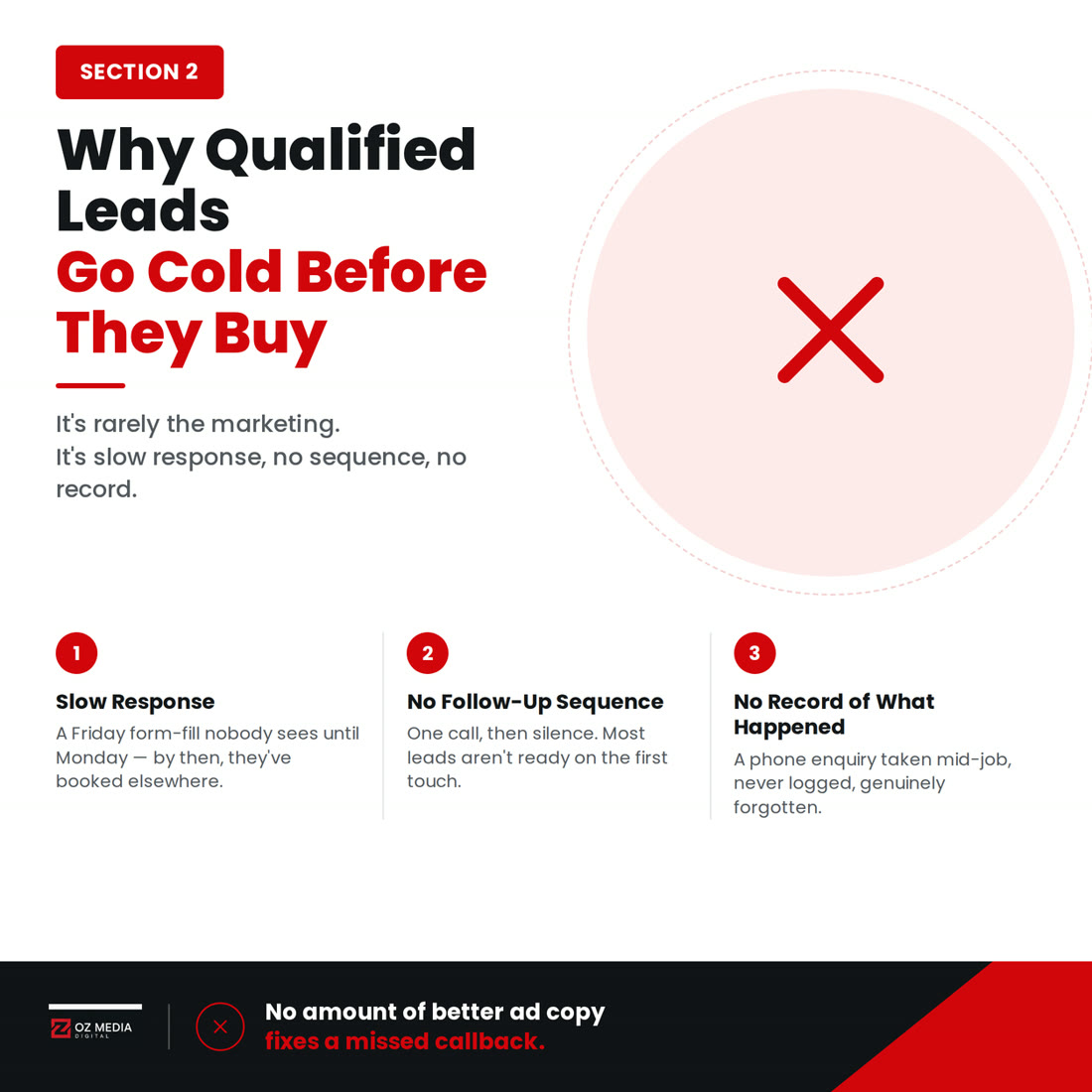
Three reasons show up again and again in service businesses: slow response, no follow-up sequence, and no record of what happened. Someone fills in a quote form on a Friday afternoon; nobody sees it until Monday; by then they've booked with whoever called them back first. A phone enquiry comes in while the business owner is on a job; there's no system to log it, so it's genuinely forgotten. A lead isn't ready to buy today, gets a single follow-up call, and then falls out of the process entirely because there's no scheduled next touch.
None of this is a marketing problem in the traditional sense, no amount of better ad copy fixes a missed callback. It's a process and systems problem, and it's fixable with tools that cost less than a single day of ad spend for most small businesses.
The data backs up how much this specific gap costs. The original Lead Response Management study, one of the most cited pieces of research on this topic, found that the odds of successfully qualifying a lead fall by roughly 21-fold when response time stretches from 5 minutes to 30 minutes, and that contact rates alone drop by more than tenfold once an hour has passed. Even the jump from 5 to 10 minutes carries a measurable, fourfold drop in qualification odds. For a trades business quoting jobs worth thousands of dollars, or a clinic booking a course of treatment, that's not a marginal effect, it's often the difference between winning and losing the job before you've even spoken to the customer.
What does a working digital marketing system actually look like?
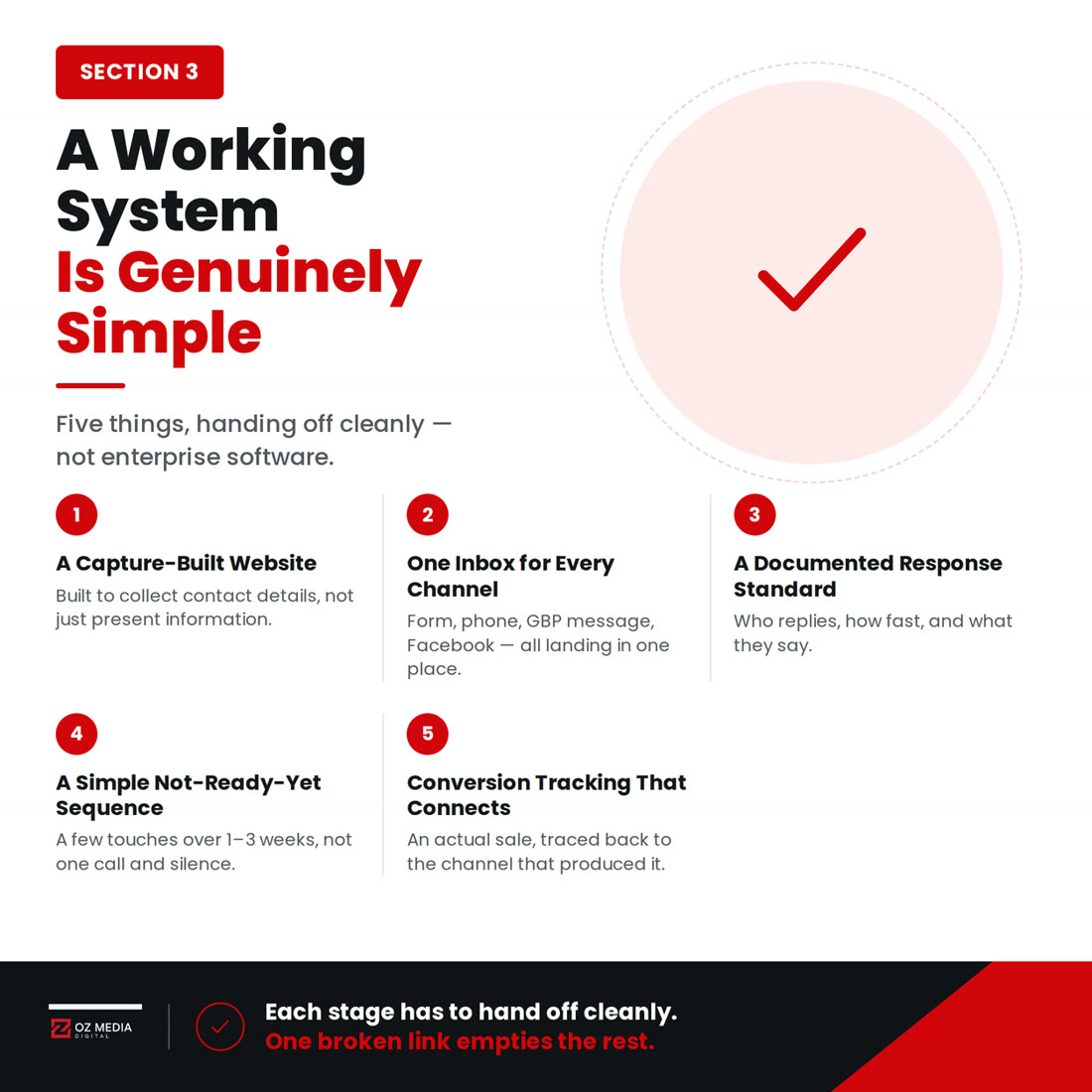
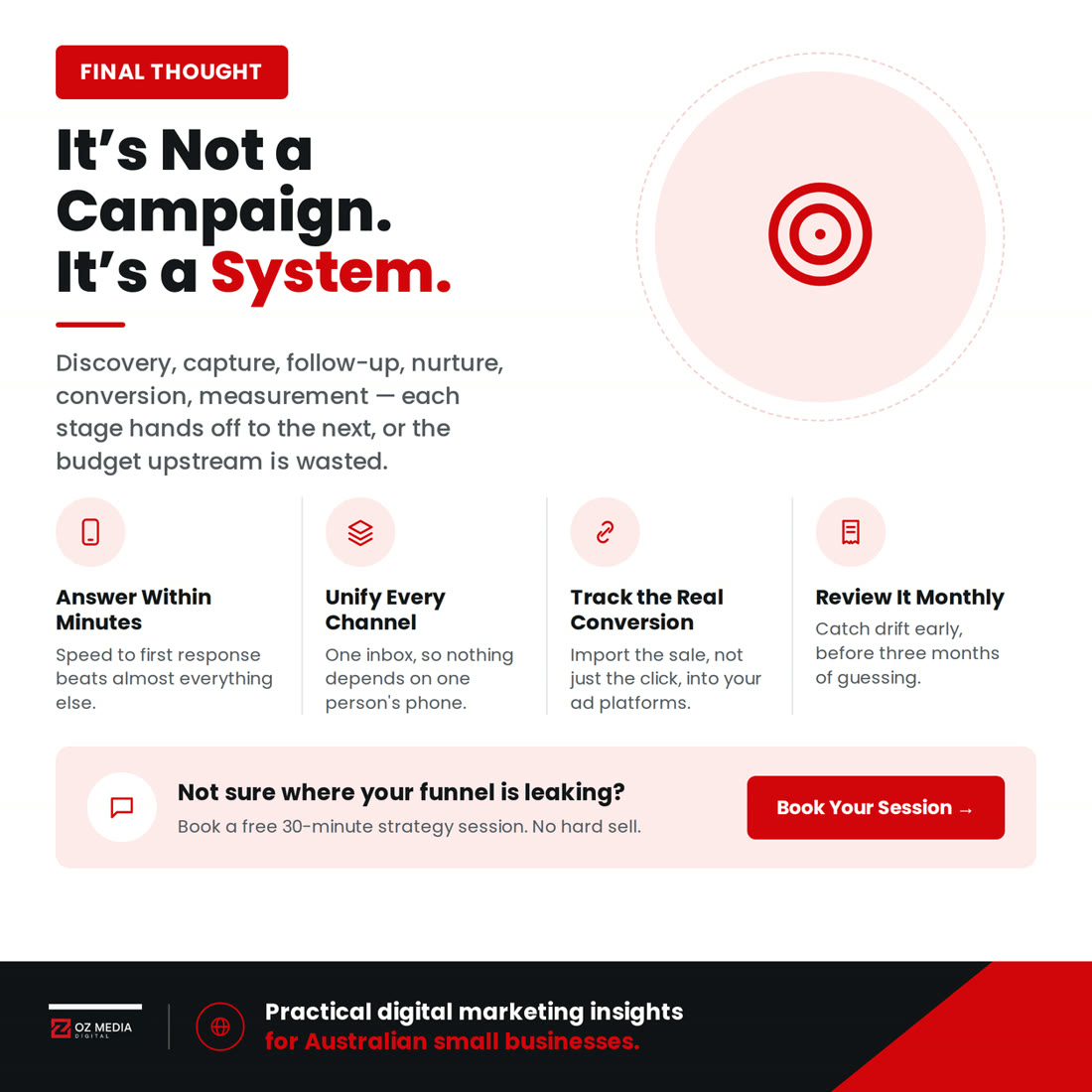
Strip away the jargon and a working system is genuinely simple: a way for the right people to find you, a low-friction way for them to raise their hand, a fast and consistent way you respond, a process for staying in front of people who aren't ready yet, a clear path to close the sale, and a way to see which of it is actually working. Each stage needs to hand off cleanly to the next, a beautifully optimised Google Ads campaign that dumps leads into an inbox nobody checks is not a system, it's a leak with good top-of-funnel numbers.
For most service businesses, this doesn't require enterprise marketing software. It requires:
- A website or landing page built to capture contact details, not just present information
- One inbox or CRM where every enquiry lands, regardless of channel (form, phone, Google Business Profile message, Facebook message)
- A documented response standard, who replies, how fast, and what they say
- A simple sequence for leads who aren't ready yet (a few follow-up touches over 1–3 weeks, not one call and silence)
- Conversion tracking that connects an actual sale back to the channel that produced it
We cover the discovery side of this, how people actually find local businesses through Google, Maps, reviews and AI search, in more depth in How Customers Find Local Businesses Now. This article focuses on what happens once they've found you.
Discovery: how do the right people actually find you?
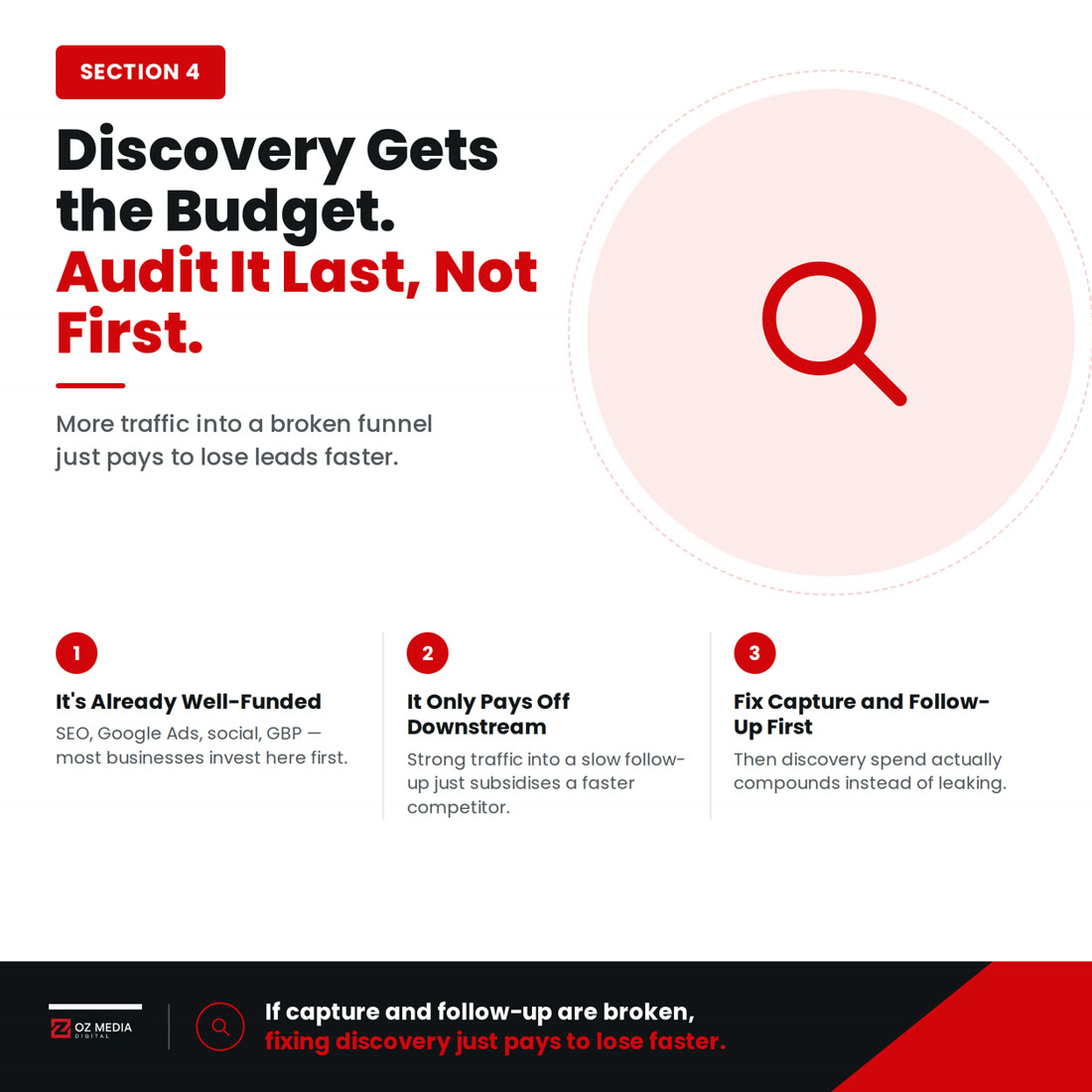
Discovery is the stage most small businesses already spend money on, SEO, Google Ads, social media, Google Business Profile, and it's genuinely important to get right. But discovery only produces value if what happens next doesn't waste it. A well-targeted Google Ads campaign built around AI Max and Performance Max automation, for instance, can bring in strong volumes of relevant traffic, we go deeper on what's changed there in Google Ads in the AI Era, but if your landing page doesn't make it obvious how to enquire, or your team doesn't follow up quickly, that spend is subsidising your competitors' response speed rather than your own growth.
The practical takeaway: audit discovery last, not first. If your capture, follow-up and measurement stages are broken, fixing discovery just means paying more to lose more leads at the same rate.
Capture: what happens the moment someone shows interest?
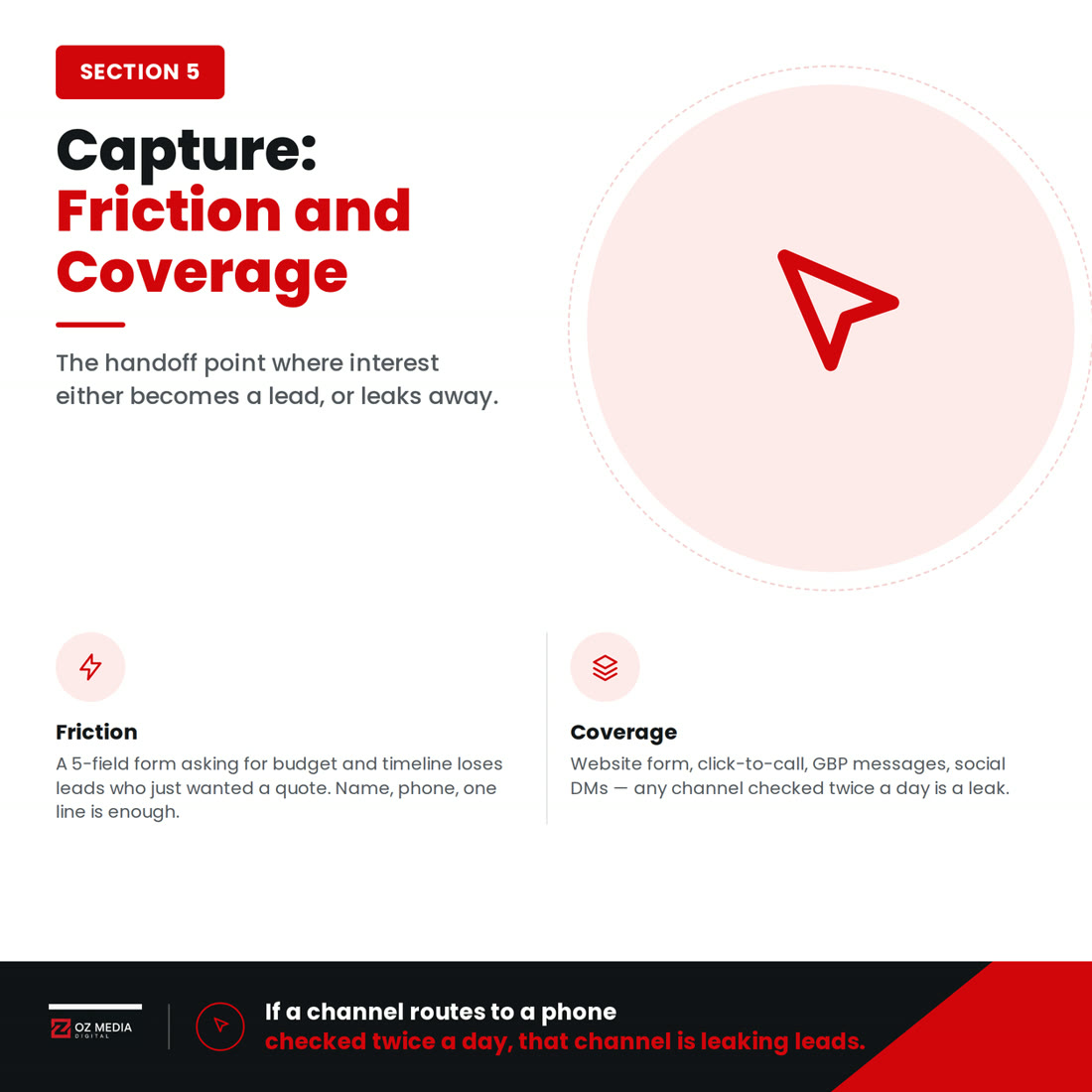
Capture is the handoff point, the form, the call button, the booking widget, the Google Business Profile message. Two things matter here more than anything else: friction and coverage.
Friction is how much effort it takes someone to raise their hand. A five-field form asking for budget, timeline, and a detailed project description before someone has even spoken to you will lose a meaningful share of otherwise-qualified leads who just wanted a quote. Name, phone number, and a one-line description of what they need is usually enough to start a conversation, you can qualify further once you're talking to them.
Coverage means capturing every channel someone might use to reach you, not just the contact form. For a local service business, that typically includes: the website form, a click-to-call number, Google Business Profile messaging and calls, and often Facebook or Instagram direct messages. If any of these channels routes to a phone that gets checked twice a day, that channel is leaking leads. If you're not sure how many of your enquiries are coming through your Google Business Profile specifically versus your website, that's worth checking, we cover the DIY-versus-managed decision for that channel in Do I Really Need to Hire Someone to Manage My Google Business Profile?
Follow-up: why does response speed decide more deals than your ad spend?
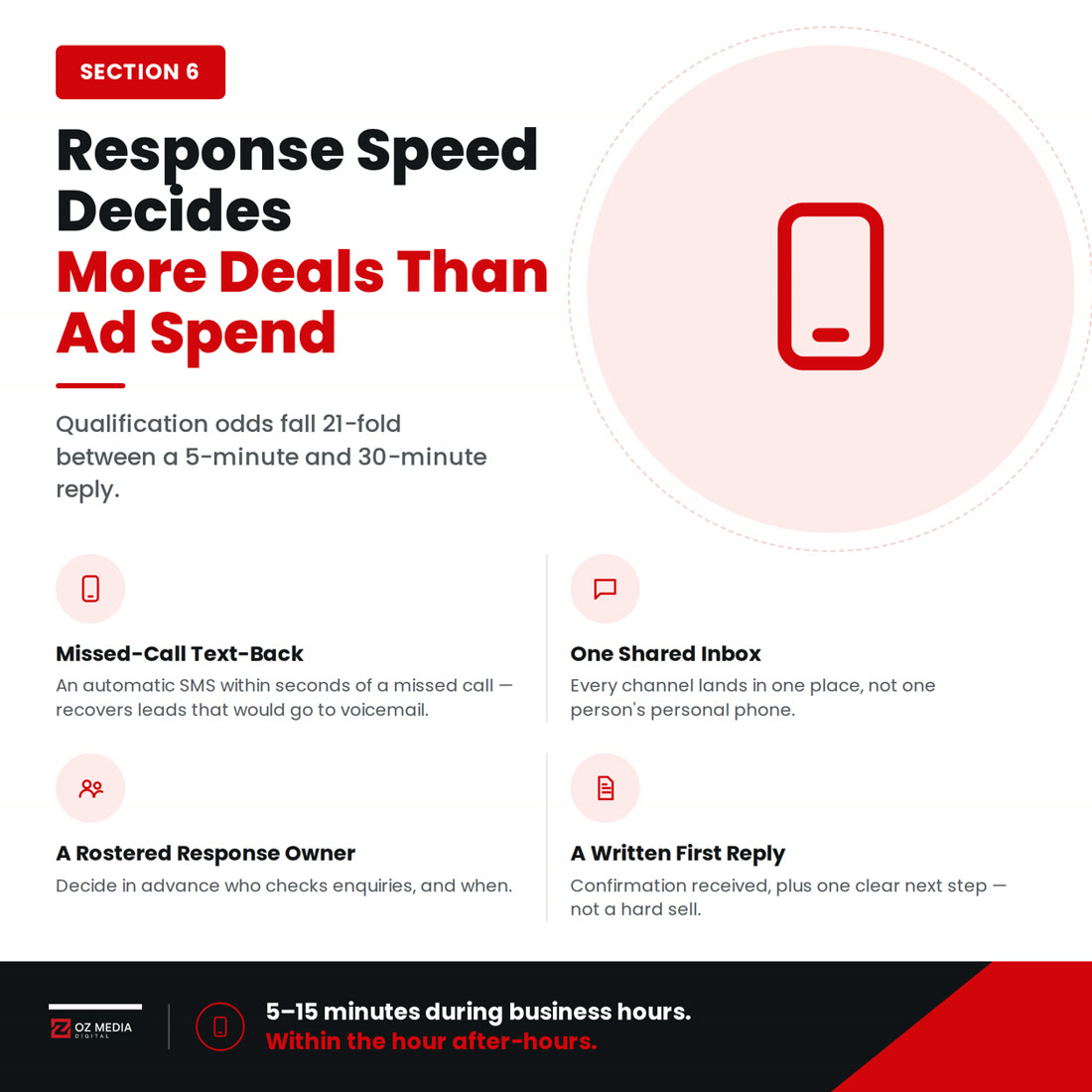
This is the highest-leverage fix available to most small businesses, and it's almost always free or near-free to implement. The research above is unambiguous: speed to first response is one of the strongest predictors of whether a lead converts at all, let alone converts profitably.
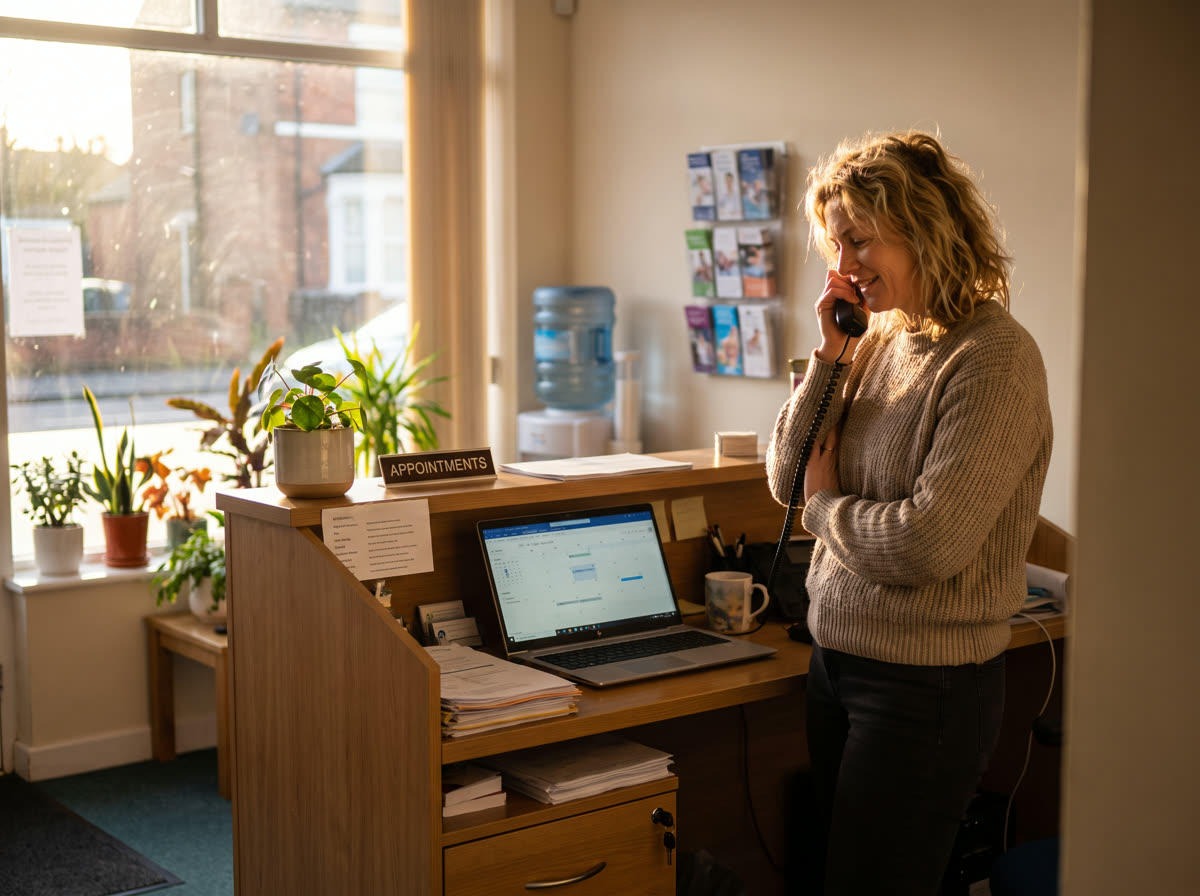
A realistic standard for a small service business: respond to every enquiry within 5–15 minutes during business hours, and within the first hour of opening the next business day for after-hours enquiries. That doesn't mean you personally answer every call, it means the system (a person, a rostered responsibility, or an automated first-touch message that buys time) makes sure nothing sits untouched.
Practical ways to close the gap without hiring anyone:
- Missed-call text-back: an automatic SMS sent within seconds of a missed call, acknowledging the enquiry and setting expectations for a callback time. This alone recovers a meaningful share of leads that would otherwise go to voicemail and be forgotten.
- A single shared inbox or CRM for all enquiry channels, so nothing depends on one person's personal phone or email being checked.
- A rostered response owner, even in a one- or two-person business, decide in advance who checks enquiries and when, rather than assuming "someone will see it."
- A written response script for the first reply, not a hard sell, just confirmation you've received the enquiry and a clear next step (a call time, a question, a booking link).
None of this requires marketing automation software to start. It requires a decision about who's responsible and a habit of checking. The software becomes valuable once volume grows past what one person can track reliably by memory.
Nurture: what do you do with leads who aren't ready yet?
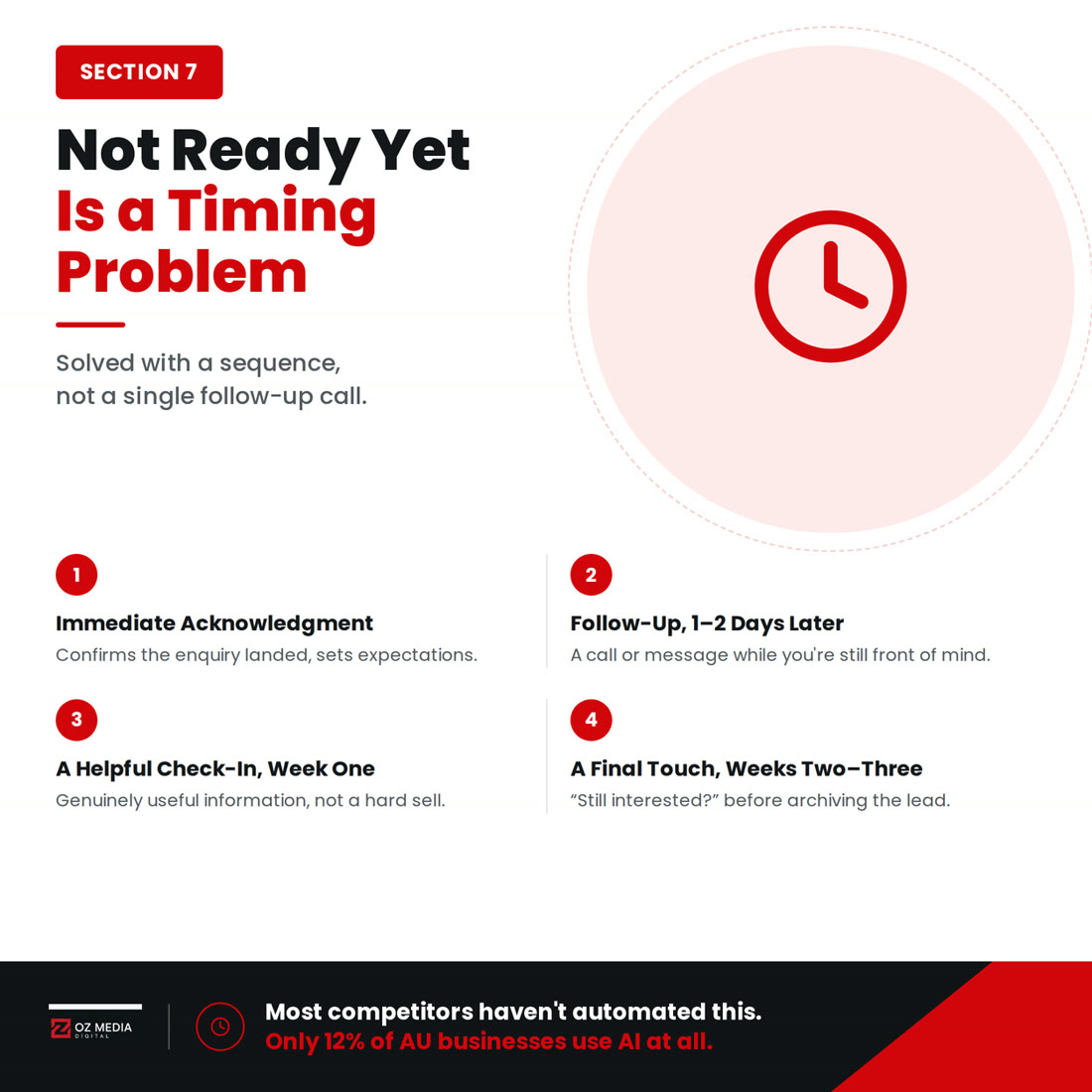
Most small businesses treat "not ready right now" as a dead end. It isn't, it's a timing problem, and timing problems are solved with a sequence, not a single follow-up call. A simple nurture sequence for a service business might look like: an immediate acknowledgment, a follow-up call or message 1–2 days later, a helpful check-in a week after that (not a hard sell, genuinely useful information, a relevant case study, or an answer to a common objection), and a final "still interested?" touch after two to three weeks before archiving the lead.
This is where basic CRM or marketing automation earns its cost. Manually remembering to follow up with every lead at the right interval doesn't scale past a handful of enquiries a week, a simple automated sequence does it consistently, whether you have five leads a week or fifty. It's worth noting the practical reality here too: the Australian Bureau of Statistics' most recent Characteristics of Australian Business release found just 12% of businesses reported using AI in 2024–25 (up sharply from 1% in 2022–23), and only 19% of innovation-active small businesses had adopted it, meaning most of your competitors almost certainly haven't automated this yet, which is exactly why it's still a meaningful point of difference rather than table stakes.
Conversion: how do you actually turn a qualified lead into a paying customer?
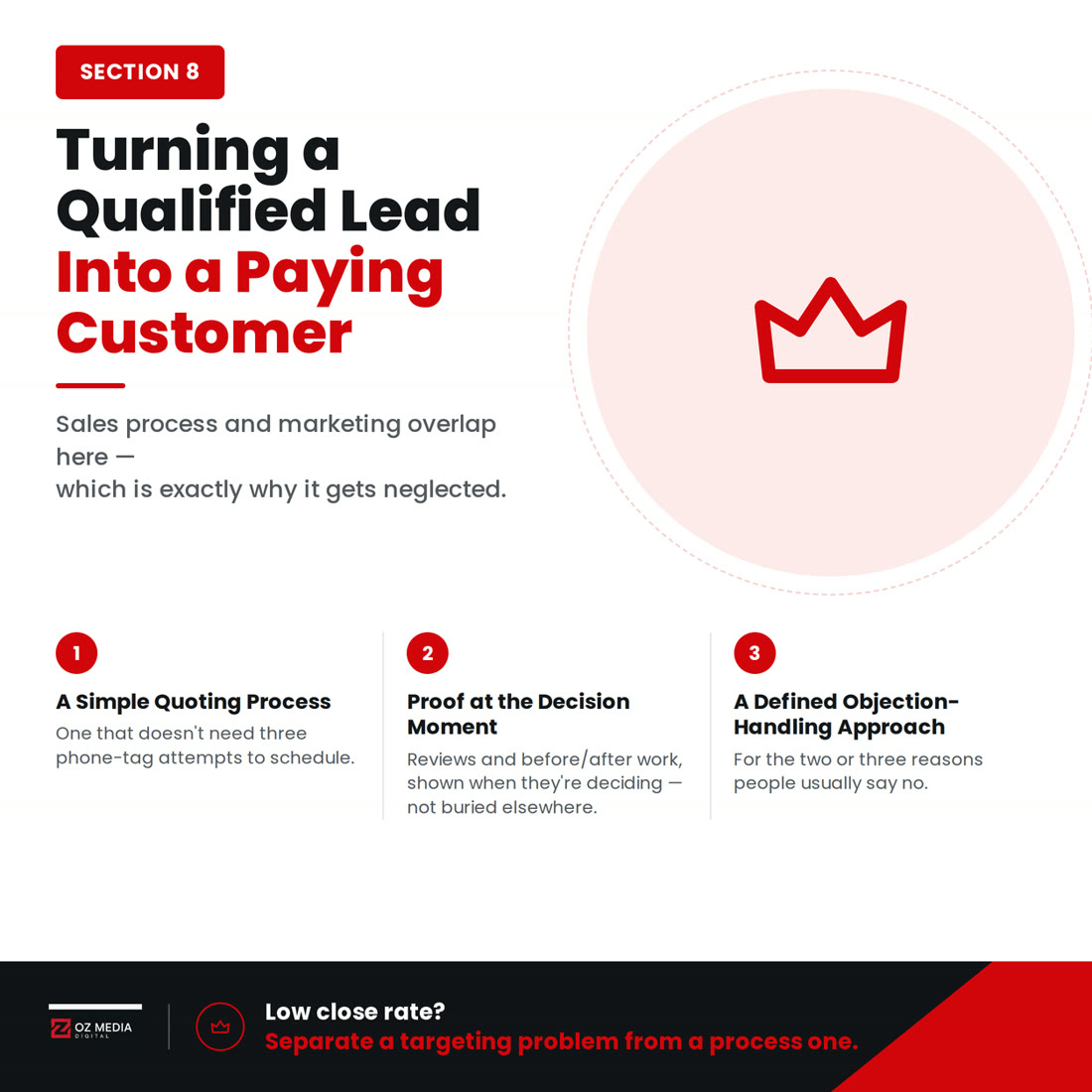
Conversion is where sales process and marketing overlap, and it's the stage most likely to be treated as "not marketing's job," which is exactly why it gets neglected. A few things consistently move the needle for service businesses: a clear, simple quoting or booking process that doesn't require three phone tag attempts to schedule; proof points (reviews, before/after work, credentials) presented at the moment someone is deciding, not buried on a separate page; and a defined objection-handling approach for the two or three reasons people usually say no.
If your close rate on qualified leads is low, it's worth separating two very different problems before assuming your marketing needs to change: are you getting enough of the right leads (a targeting and messaging problem), or are you losing good leads at the sales conversation (a process problem)? Fixing the wrong one wastes budget without fixing the actual leak.
Measurement: how do you know which channels are actually working?
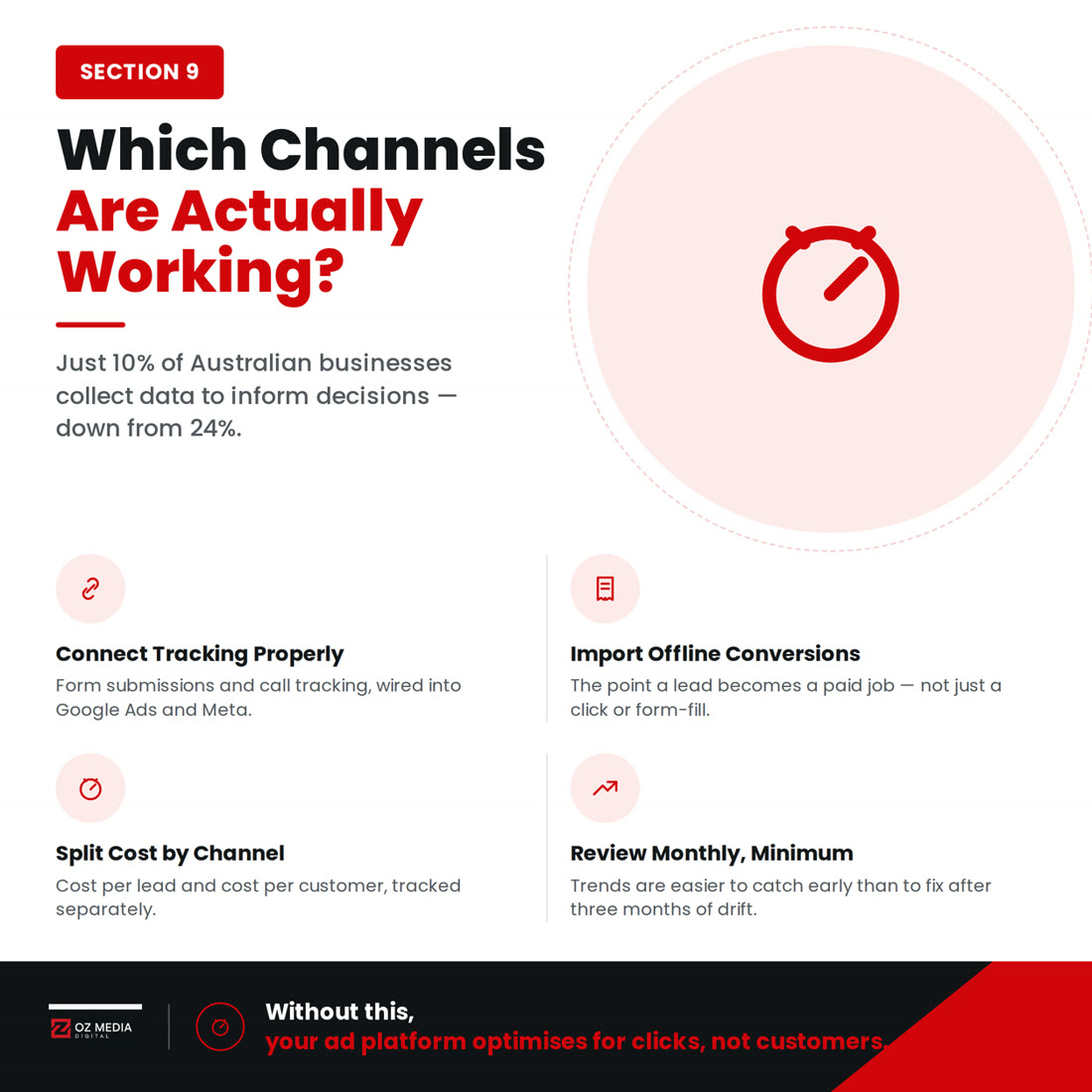
This is the stage almost every small business gets wrong, and it's the one that determines whether every other fix in this guide is even possible to evaluate. Without measurement, you're guessing which channel, campaign or change actually produced a customer, and guessing tends to favour whichever channel is loudest or most recently discussed, not whichever one is actually profitable.

The ABS data on this is worth sitting with: only 10% of Australian businesses actively collect or analyse data to inform decisions, and that figure has fallen from 24% in 2021–22, not risen. Separately, CPA Australia's most recent Asia-Pacific Small Business Survey found only 30% of Australian small businesses said their 2025 technology investment actually improved profitability, one of the weakest results in the region. Put together, these two data points tell a consistent story: most small businesses are investing in tools and channels without a reliable way to tell which of it is working, and that gap is a direct cause of technology spend not paying off.
The fix doesn't require a data science team. At minimum:
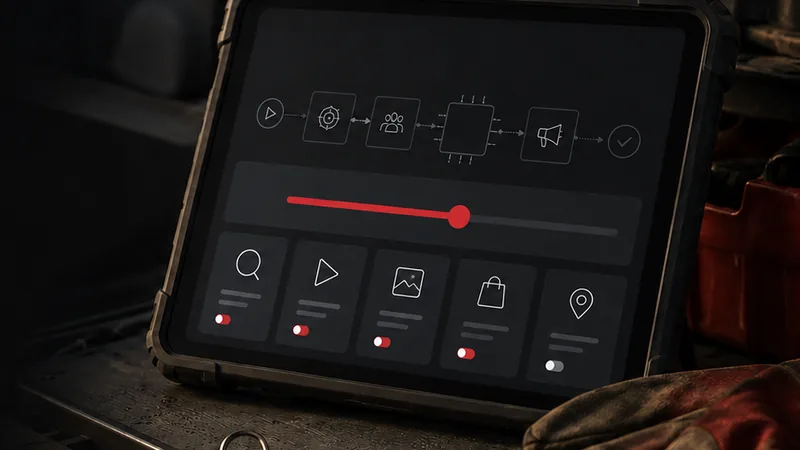
- Connect form submissions and call tracking to Google Ads and/or Meta Ads conversion tracking, so the platforms know which clicks actually became enquiries.
- Import offline conversions, the point where a lead becomes an actual paying job or sale, back into your ad platforms. Google Ads explicitly supports this through offline conversion imports and Enhanced Conversions for Leads, designed for exactly the situation where an ad doesn't lead directly to an online sale, but instead starts a customer down a path that ultimately leads to a sale in the offline world, a phone call, a quote, an in-person job. Without this step, your campaigns are being optimised toward clicks and form-fills, not toward the customers who actually paid you.
- Track cost per lead and cost per customer separately by channel, not just overall. A channel with a higher cost per lead but a much higher close rate can easily be your most profitable one, you can't see that without splitting the numbers.
- Review the numbers monthly at minimum, not just when something feels wrong. Trends are far easier to catch early than to fix after three months of unnoticed drift.
This is also where the wider shift toward AI-driven search and discovery complicates measurement further, AI Overviews and chat-based answers often don't generate a traditional click at all, so relying only on last-click attribution understates how much of your pipeline those channels are actually influencing. We map out how this fits into the bigger picture in our master guide, Digital Marketing for Australian Small Businesses in 2027.
What tools do you actually need, and what can wait?
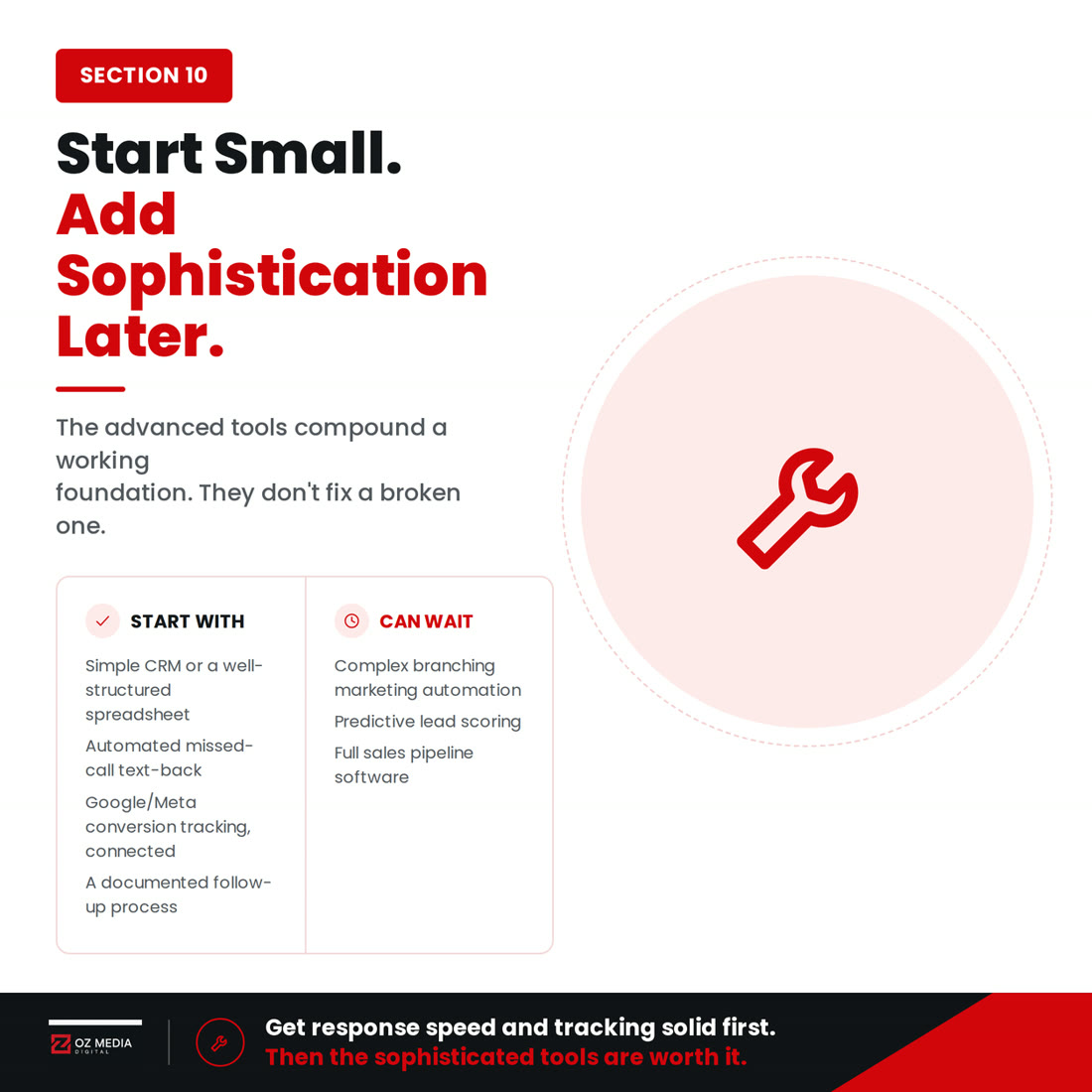
Start smaller than you think. A genuinely workable starting system for most Australian service businesses is: a simple CRM or even a well-structured shared spreadsheet for lead tracking, an automated missed-call text-back tool, Google Ads and/or Meta conversion tracking connected properly, and a documented follow-up process everyone on the team actually follows.
What can usually wait: multi-channel marketing automation platforms with complex branching logic, predictive lead scoring, and full sales pipeline software with custom stages and reporting. These have real value once volume and team size justify them, but implementing them before the basics are solid just adds complexity to a system that's already leaking leads at simpler points. Get response speed, capture coverage and conversion tracking solid first, the sophisticated tools compound the value of a working foundation; they don't fix a broken one.
How much should this cost, and how long does it realistically take?
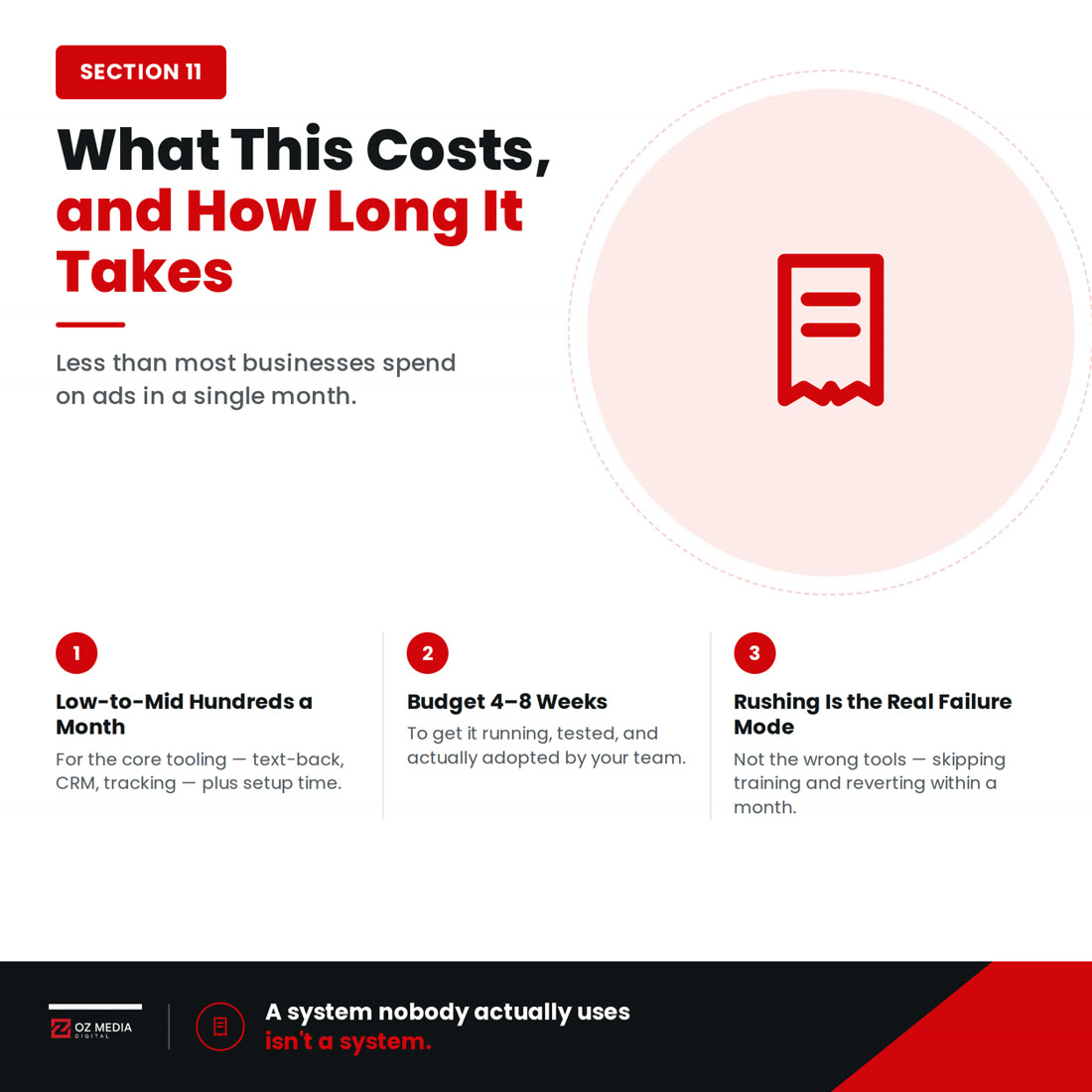
For a small service business, the core fixes in this guide, missed-call text-back, a basic CRM, conversion tracking setup, and a documented follow-up process, typically sit in the low-to-mid hundreds of dollars a month in tooling, plus the time to set it up properly (or the cost of having someone set it up for you). That's materially less than most businesses spend on advertising in a single month, which is exactly why it's worth fixing before spending more on traffic.
On timeline: budget 4–8 weeks to get the core system genuinely running, tested, and adopted by your team, not a weekend project. The most common failure mode isn't picking the wrong tools; it's rushing the rollout, not training the team on the new process, and watching everyone quietly revert to the old habits within a month. A system nobody actually uses isn't a system.
What are the biggest mistakes Australian small businesses make here?
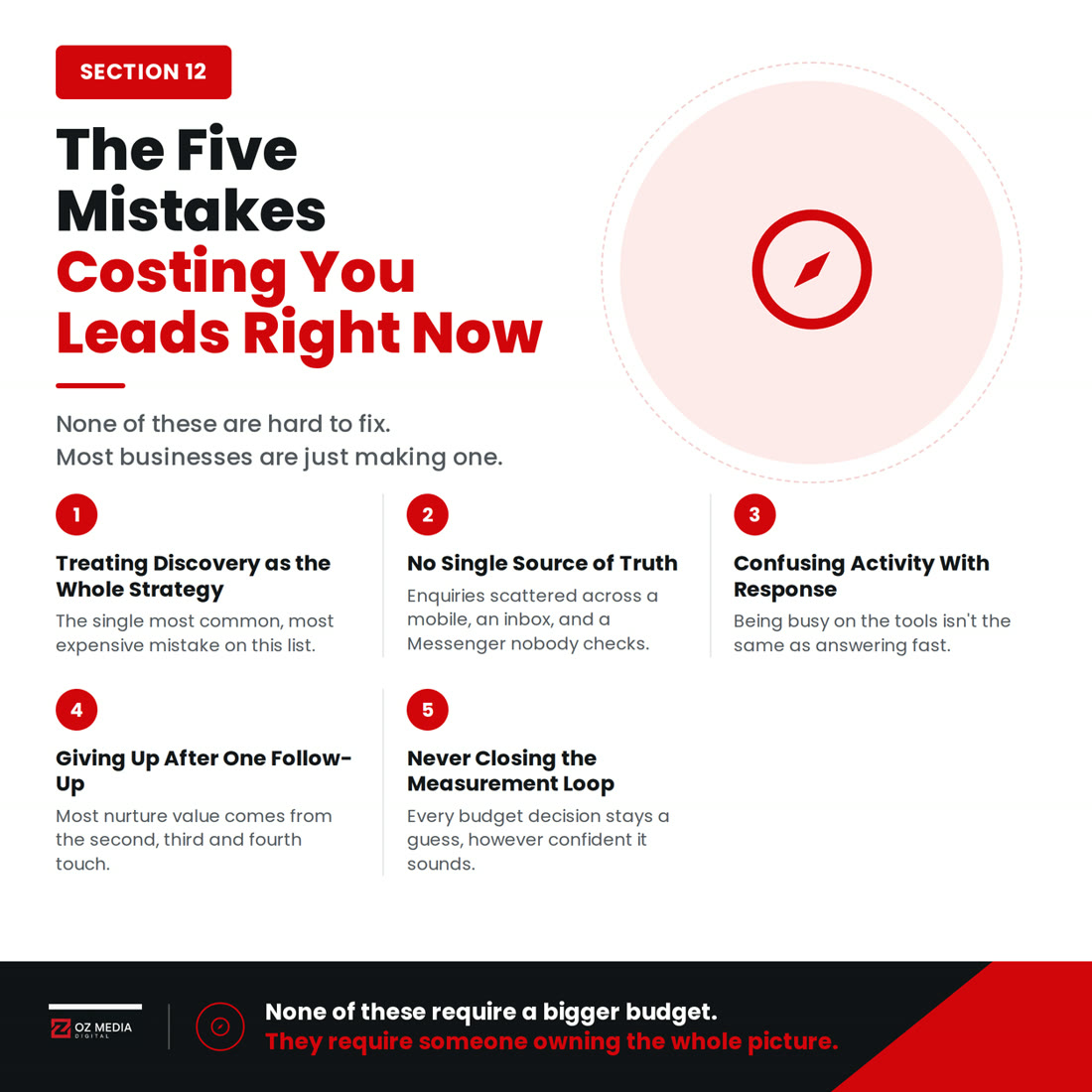
- Treating discovery as the whole strategy. Ploughing more budget into ads or SEO without checking whether the leads that arrive are being handled well is the single most common and most expensive mistake in this list.
- No single source of truth for leads. When enquiries land across a personal mobile, a shared email inbox, a Facebook Messenger nobody's assigned to check, and a Google Business Profile, leads inevitably fall through gaps, not because anyone's careless, but because no one owns the whole picture.
- Confusing activity with response. Being busy on the tools all day doesn't mean leads are being answered fast. Response speed needs to be measured, not assumed.
- Giving up on leads after one follow-up attempt. Most nurture value comes from the second, third and fourth touch, not the first.
- Never closing the loop on measurement. Running ads for months without connecting actual sales back to the channel that produced them means every budget decision is a guess, however confident it sounds.
Frequently Asked Questions
How fast should I respond to a new lead?
Aim for 5–15 minutes during business hours where possible, and within the first hour of reopening for after-hours enquiries. Independent research on lead response has found qualification odds fall roughly 21-fold between a 5-minute and a 30-minute response, speed is one of the highest-leverage, lowest-cost fixes available to a small business.
Do I need expensive software to build a lead generation system?
No. A simple CRM or well-organised spreadsheet, an automated missed-call text-back tool, and properly connected conversion tracking cover the core of what most service businesses need. More sophisticated automation platforms add value once volume justifies them, but they're not the starting point.
What's the difference between a lead and a qualified lead?
A lead is anyone who's raised their hand, filled in a form, called, messaged. A qualified lead has been confirmed to have a genuine need, the right timeline, and the ability to pay for what you offer. Capturing more leads without a process to qualify them quickly just moves the bottleneck further down the funnel rather than removing it.
Why isn't Google Ads or Meta Ads showing me accurate results?
In most cases, it's because the platform only sees the click or the form-fill, not what happened afterwards. Without offline conversion imports (connecting an actual sale or signed job back to the original ad click), Google Ads is optimising toward form-fills, not customers, which can steer budget toward the wrong campaigns even when the reported numbers look fine.
How do I know if my problem is marketing or my sales process?
Separate the two questions: are enough of the right people finding and enquiring with you (a discovery and targeting question), and are enough of those enquiries actually converting to paying customers (a follow-up and conversion question)? Tracking these as distinct numbers, enquiry volume versus close rate, usually makes it obvious which one needs attention first.
Should I fix my funnel before or after increasing ad spend?
Before, in almost every case. Increasing spend into a funnel that's losing leads to slow follow-up or poor tracking just means paying more to lose more leads at the same rate. Fixing response speed, capture and measurement first is typically the higher-return move, and it's usually cheaper than a month of extra ad spend.
Where to start
If you're already running ads or investing in SEO and know your enquiry numbers don't match your sales, start with the free fixes: measure your current response time, check every channel someone can reach you through, and confirm whether your ad platforms actually know when a lead becomes a paying customer. Those three checks alone surface most of the leaks covered in this guide.
If you'd rather have this built and connected properly, CRM setup, missed-call automation, and conversion tracking wired back into your Google Ads and Meta accounts, that's exactly the kind of system we build as part of our AI Marketing and Google Ads management services, or as a fuller build within our all-in-one packages. Book a free session and we'll walk through where your current funnel is actually leaking leads before recommending anything.