 OZ Media Digital
The best way to market a dental practice online is not to choose between SEO, Google Ads, social media or Google reviews.
It is to build a system in which each channel does a specific job.
For most dental practices, that means:
Demand → Visibility → Trust → Conversion → Retention → Measurement
Someone searches for an emergency dentist. Another researches dental implants for three months. A parent looks for a children's dentist nearby. An existing patient is overdue for a check-up.
They are all potential patients, but they are at different stages and should not receive the same marketing.
That distinction matters in a sizeable market. The Australian Institute of Health and Welfare dental expenditure data shows approximately $13.2 billion was spent on dental services in Australia during 2023–24, with individuals directly funding 61% of that expenditure.
At the same time, cost and access remain genuine barriers. ABS Patient Experiences 2024–25 data shows that 25.2% of Australians aged 15 and over delayed or did not see a dental professional when they needed one, while 16.1% cited cost as a reason.
That means effective dental marketing has to do more than make a practice visible. It needs to help prospective patients understand what you offer, decide whether you are right for them, and take the next step without unnecessary friction.
What actually works in dental marketing?
The strongest dental marketing strategy normally combines four different functions:
- Capture existing demand through Google Business Profile, Local SEO, SEO and Google Ads.
- Build confidence through a strong website, useful treatment information, reviews, clinicians and practice information.
- Convert interest through clear calls to action, convenient contact options and an effective enquiry or booking process.
- Retain and reactivate patients through appropriate recall, email, SMS and patient communication.
Measurement connects all four.
The right mix depends on your practice. A new clinic opening in a competitive Sydney suburb has a different problem from an established regional practice with a strong referral base but little Google visibility.
This is why copying another dental practice's marketing channel mix rarely produces a useful strategy.
1. Start with how prospective patients actually search
Dental searches carry different levels of intent.
Compare:
- dentist near me
- emergency dentist Hornsby
- dental implants Sydney
- Invisalign dentist near me
- how much do dental implants cost?
- toothache at night what should I do?
- children's dentist
- teeth whitening cost
These are not interchangeable keywords.
A person searching “emergency dentist near me” may be trying to make a decision immediately.
Someone searching “dental implants cost” may still be researching options, suitability and financing.
Someone asking a detailed oral-health question may not be ready to choose a dentist at all.
Your marketing needs to reflect those differences.
A useful way to map dental search demand is:
Immediate treatment intent
Examples include:
- emergency dentist
- broken tooth dentist
- toothache dentist
- same-day dentist
Prioritise strong local visibility, Google Ads where commercially viable, clear availability information and a low-friction contact path.
Treatment-comparison intent
Examples include:
- dental implants
- Invisalign or clear aligners
- veneers
- cosmetic dentistry
These searches normally require significantly more information before a prospective patient makes contact.
Strong treatment pages, clinician information, FAQs, costs or financing information where appropriate, and consultation pathways become more important.
General local intent
Examples include:
- dentist near me
- dentist Hornsby
- family dentist
- children's dentist near me
Google Maps, Google Business Profile and Local SEO become particularly important.
Informational intent
Examples include:
- why does my tooth hurt when I bite?
- dental implant recovery
- how often should children visit a dentist?
Useful educational content can introduce your practice to prospective patients earlier in their decision process.
The mistake is treating every search as though the person is ready to book today.
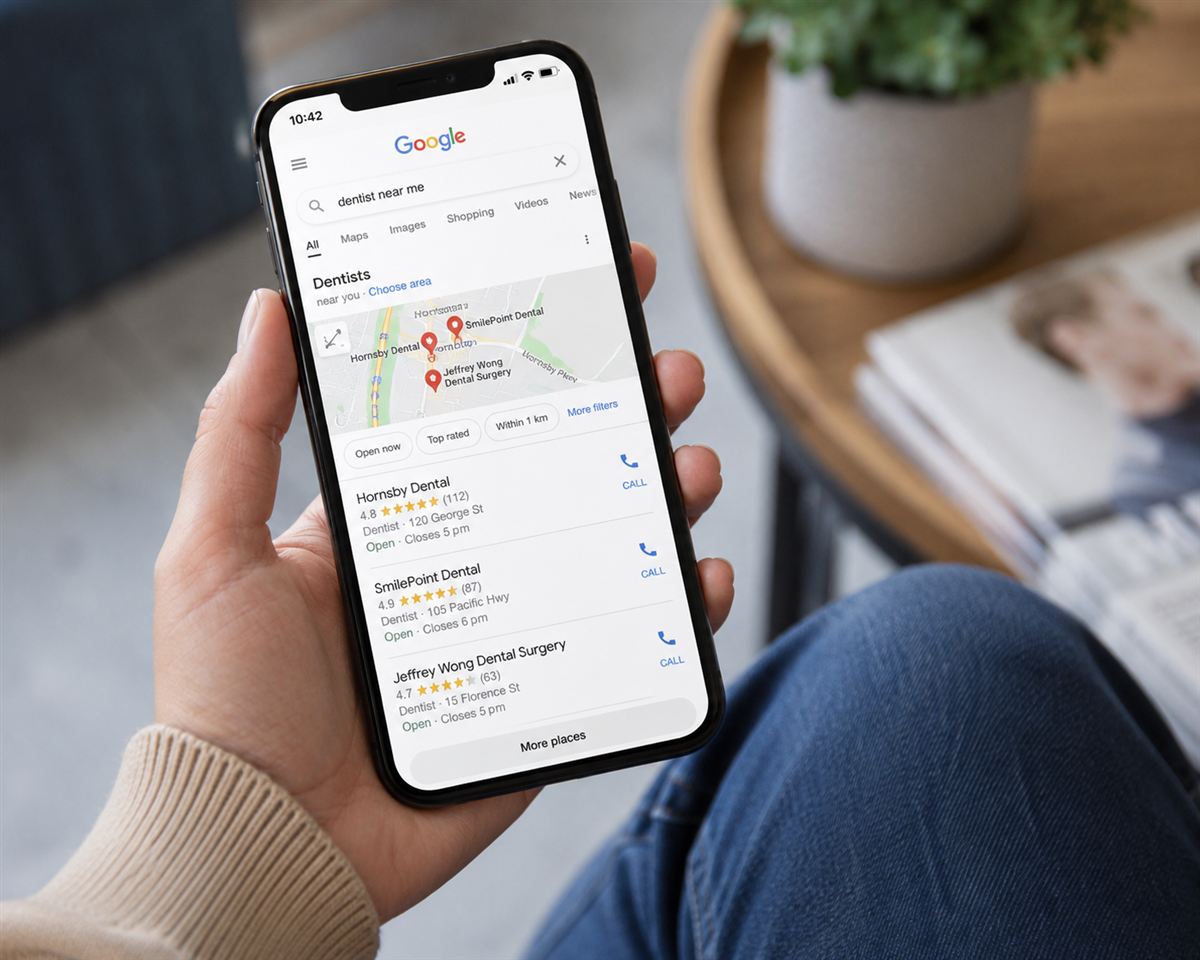
Where a patient's search sits on this ladder should shape which channel answers it — not the other way around.
2. Make Google Business Profile a priority for local discovery
For a location-based healthcare business, your Google Business Profile is one of your most important digital assets.
It can surface your practice in Google Search and Maps and gives prospective patients immediate access to information such as your location, opening hours, telephone number, website, photos and reviews.
Google's guidance on local rankings says its local results are primarily determined by relevance, distance and prominence. It also states that complete and accurate business information can help Google understand a business and match it with relevant searches.
What should a dental practice optimise?
Start with the fundamentals:
- correct business name
- appropriate primary and secondary categories
- accurate address and telephone details
- current opening hours
- website URL
- relevant services
- practice description
- genuine practice and team photography
- appointment or enquiry options where supported
- review monitoring and responses
Do not turn the business name or description into a collection of keywords. Follow Google Business Profile representation guidelines rather than trying to manipulate local visibility.
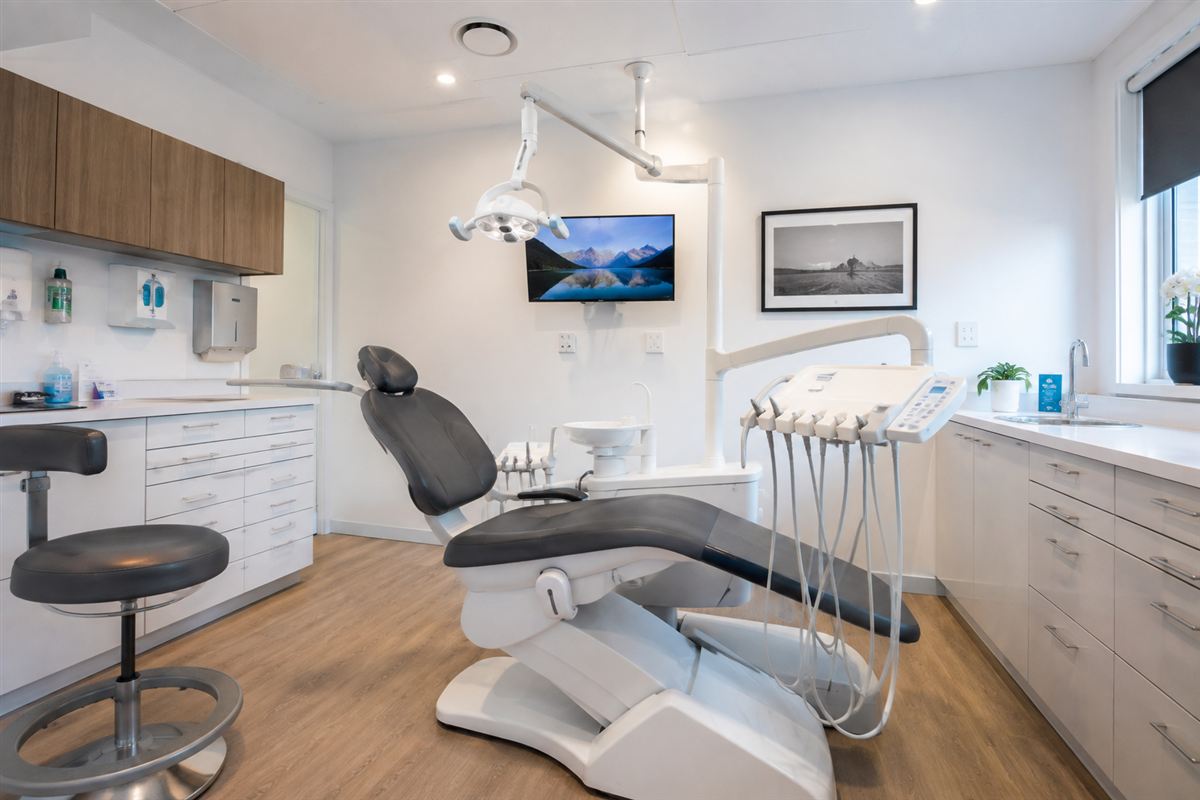
Genuine practice photography, not stock imagery, is one of the fastest-updating trust signals on a Google Business Profile.
The common mistake
Treating Google Business Profile as something you set up when the practice opens and never review again.
Changes to clinicians, hours, services, contact information and images can leave the profile out of step with the actual practice.
What to measure
Look beyond profile views.
Track actions that indicate commercial intent, such as:
- website visits
- calls
- direction requests
- appointment interactions where available
- qualified enquiries
- ultimately, appointments attributed to local search where your tracking allows it
3. Build SEO around treatments and patient intent
Dental SEO is the process of making your website easier for search engines to understand and more useful to people searching for relevant dental information or services.
Google Search Central's SEO Starter Guide describes SEO as helping search engines understand content while helping users find a site and decide whether they should visit it.
For dentists, SEO should not mean simply “rank the homepage for dentist”.
A dental practice typically has multiple search opportunities:
- general dentistry
- emergency dentistry
- dental implants
- clear aligners
- children's dentistry
- restorative dentistry
- root canal treatment
- cosmetic dentistry
- teeth whitening
- location-specific dentist searches
Each represents a different patient need.
Why one generic Services page is rarely enough
Suppose your entire implant offering is described in three sentences on a page called “Our Services”.
A prospective implant patient may want to know:
- what dental implants are
- who may be suitable
- what the treatment process involves
- what alternatives exist
- recovery considerations
- risks and limitations
- the clinicians involved
- costs or financing information where appropriate
- how to arrange an assessment
A genuinely useful implant page can address those questions far better than a generic services list.
The same principle applies to other important treatments.
On-page SEO basics
For each important page:
- give it one clear purpose
- match the content to the searcher's intent
- use a descriptive page title
- write an accurate meta description
- use a logical heading structure
- answer important questions clearly
- link to related treatment and information pages
- include appropriate clinician or practice information
- ensure important content is accessible to users and search engines
None of those actions guarantees rankings individually.
Together they make the page easier to understand and more useful.
4. Connect Local SEO with website SEO
Google Maps visibility and traditional organic website rankings are related parts of search marketing, but they are not the same thing.
Local SEO focuses heavily on your relevance to a geographic search. That includes:
- Google Business Profile
- location information
- consistent business details
- local relevance
- reviews
- relevant citations
- local authority and links
- the quality and relevance of your website
Organic SEO has a broader remit and can help individual website pages become visible for treatment and informational searches.
A practice should therefore avoid thinking:
“Our Google Business Profile is optimised, so our SEO is done.”
Or:
“Our website ranks, so we don't need to care about Maps.”
For a local dental business, both surfaces can matter.
5. Fix the website before buying more traffic
One of the easiest ways to waste a dental marketing budget is to send more people to a website that makes choosing the practice difficult.
Australian internet behaviour makes mobile experience particularly important. ACMA's 2025 Australian internet usage research reported that 97% of Australian adults used a mobile phone to access the internet in 2025, with 92% accessing the internet by mobile daily.
A prospective patient should not need to zoom into a page, hunt for your phone number or open five menus to find the service they searched for.
A strong dental website should answer five questions quickly
1. Where are you? Make the suburb, address and service area easy to understand.
2. What do you treat? Important treatments should be discoverable without navigating a vague menu.
3. Why should a prospective patient consider your practice? Use factual differentiators: services, clinicians, accessibility, technology, availability, patient groups served and other verifiable information.
4. What happens next? Make calls, enquiries and booking paths obvious.
5. Can I trust the information? Show clinicians, qualifications where appropriate, genuine practice photography, clear treatment explanations and current contact details.
Conversion optimisation is not about manipulating patients
Good conversion rate optimisation removes unnecessary friction between legitimate interest and the next appropriate step. Examples include:
- making the telephone number clickable on mobile
- reducing unnecessary fields in enquiry forms
- placing the relevant CTA near treatment information
- explaining what happens after an enquiry
- avoiding intrusive pop-ups
- making booking options easy to find
- ensuring pages load and function properly on mobile
If your site isn't doing this today, that usually calls for dental website development built around conversion from the outset, rather than another campaign pointed at the same weak pages.
6. Use Google Ads when you need to capture high-intent demand
SEO can build organic visibility over time. Google Ads management can give a practice access to paid search visibility while campaigns are active.
That makes the two channels complementary rather than mutually exclusive.
Google Ads can be particularly useful when:
- the practice is new
- organic visibility is weak
- you want to promote particular treatments
- there is clear local search demand
- you need more immediate market visibility
- you can track meaningful conversions
Structure campaigns around intent, not traffic
There is a substantial difference between:
- emergency dentist near me
- dentist
- dental implants Sydney
- cheap dentist
- what are dental implants
They may all produce clicks. They do not necessarily represent equivalent commercial opportunities.
Campaign structure, keyword selection, negative keywords, geographic targeting and landing-page relevance need to reflect the patients the practice is actually trying to attract.
Do not measure Google Ads by clicks alone
Google Ads conversion measurement tracks actions taken after an ad interaction and supports measurement of calls generated by ads and websites.
Useful dental advertising metrics can include:
- qualified telephone calls
- booking submissions
- enquiry forms
- booked consultations
- new patient appointments
- treatment type
- cost per qualified enquiry
- where possible, actual patient value
A campaign generating 300 clicks and few relevant enquiries is not inherently better than one generating 100 clicks and a stronger set of appropriate patient enquiries.
7. Build a systematic Google review process
Reviews serve two different functions.
First, they help prospective patients understand other people's experiences with the practice.
Second, Google Business Profile local ranking guidance states that review count and positive ratings can contribute to local search ranking.
That does not mean reviews alone determine Maps rankings. Distance, relevance and wider prominence still matter.
A better review process
Build review requesting into an appropriate patient workflow rather than running occasional bursts. For example:
- identify the appropriate point in the patient journey
- provide an easy link to the review platform
- request genuine feedback consistently
- monitor new reviews
- respond appropriately
- never manipulate, fabricate or selectively manufacture review sentiment
Dental practices also need to consider their healthcare advertising obligations when reusing patient feedback in promotional material. Ahpra's advertising guidelines for regulated health services provide specific guidance around advertising regulated health services and testimonials.
For a first-hand look at how a local dental market is actually performing on exactly this measure, see our 2026 Hornsby dental marketing audit. It covers one Sydney suburb in detail rather than the country as a whole, but the review-response and review-volume patterns it found are a useful benchmark to check your own practice against.
8. Create content when it solves a real patient question
A blog is not automatically an SEO strategy.
Publishing four generic AI-generated posts every month about “the importance of brushing your teeth” is unlikely to create meaningful commercial value merely because content is being published.
Google's people-first content guidance emphasises helpful, reliable, people-first content and warns that producing large quantities of AI-generated material without adding value can breach its scaled-content policies.
A better dental content strategy begins with genuine questions. Examples could include:
- What should I do if I break a tooth?
- How does a dental implant consultation work?
- Dental implants versus bridges: what is the difference?
- How long does Invisalign treatment usually involve?
- What should parents know before a child's first dental visit?
- When is tooth pain considered a dental emergency?
The clinical content must, of course, be accurate and appropriately reviewed by a suitably qualified dental professional.
Treatment pages and blog content have different jobs
A treatment page should normally help someone evaluate a specific service.
An educational article can answer a related question earlier in the journey.
The article then links naturally to the relevant service page when appropriate.
That creates a useful information architecture instead of an isolated collection of blog posts.
9. Use social media primarily to build familiarity and trust
Social media matters, but it should not automatically receive the largest share of a dental practice's marketing budget.
DataReportal's Digital 2026 Australia report estimates Australia had 21 million social-media user identities in late 2025, though its methodology notes these figures should not be treated as 21 million unique individuals.
The audience exists. The strategic question is what role social should perform.
For many dental practices, organic social is strongest at:
- showing the clinicians and team
- demonstrating practice culture
- introducing services
- answering common questions
- providing educational material
- remaining familiar to existing patients
- supporting broader reputation and brand activity
What it does not automatically provide is the same level of immediate intent as someone actively Googling “emergency dentist near me”.
That is why follower count should rarely be the primary dental marketing KPI.
10. Use Meta advertising where interruption-based advertising makes sense
Google Search largely captures people already expressing an intention.
Meta advertising works differently. You are usually reaching people while they are consuming content rather than actively searching for a dentist.
That can make Meta more appropriate for:
- local practice awareness
- educational campaigns
- certain consultation-led services where advertising is compliant
- retargeting appropriate website audiences
- introducing a new practice or location
- building familiarity before active treatment consideration
It is less sensible to assume Facebook or Instagram advertising should replace search marketing simply because the potential audience is large. Where it does fit your acquisition mix, Meta Ads management run with dental-specific compliance in mind is a different exercise to boosting posts for reach.
Dental advertising must also comply with applicable Ahpra requirements and, depending on the activity, potentially other privacy, consumer and therapeutic advertising obligations.
11. Retarget interest carefully
A person who visited an implant page yesterday has already demonstrated more interest than a randomly selected local social-media user.
That creates a potential case for remarketing.
But healthcare deserves additional care.
Do not build marketing processes that casually expose, infer or exploit sensitive health information.
Australian privacy guidance treats health information as sensitive information, and the OAIC guidance for healthcare communications with patients states that direct marketing using sensitive information has specific consent requirements.
The practical rule is simple: effective targeting does not override healthcare privacy obligations.
12. Do not ignore your existing patient database
Marketing is not solely about acquiring strangers.
Existing patients already know your practice.
Depending on consent, clinical appropriateness and applicable communications requirements, your database can support:
- recall communication
- appointment reminders
- practice updates
- educational information
- reactivation
- relevant service announcements
There is an important distinction between clinical communication and direct marketing.
The OAIC's healthcare communications guidance specifically addresses this distinction for healthcare providers, including the circumstances in which consent may be required for marketing communications.
This is an area where the practice's privacy and marketing processes should work together.
13. Reduce friction between enquiry and appointment
Marketing does not end when a form is submitted.
Suppose two practices generate the same 20 enquiries.
Practice A:
- misses calls
- takes two days to reply
- gives unclear next steps
- never follows up
Practice B:
- answers or returns enquiries promptly
- explains the next step clearly
- captures relevant information
- follows up appropriately
- records whether the enquiry became an appointment
The advertising platforms may report the same number of leads. The business outcomes can be very different.
This is why the patient-acquisition system needs to include reception and follow-up processes.
Useful metrics include:
Website visit → enquiry → qualified enquiry → appointment → attended appointment → treatment outcome where appropriate
The further you can responsibly measure through that chain, the more informed your marketing decisions become.
14. Measure patient acquisition, not marketing activity
Every channel produces attractive-looking numbers.
SEO has rankings and impressions. Google Ads has clicks. Facebook has reach. Instagram has followers. Websites have sessions.
None is the final commercial objective.
For most dental practice marketing, the meaningful questions are:
- How many appropriate enquiries did we receive?
- Which channels generated them?
- Which treatments were they interested in?
- How many became appointments?
- How many attended?
- Which patient types and treatments are commercially sustainable for the practice?
- What did acquisition cost?
- Are enquiries growing without sacrificing lead quality?
Google's current advertising tools support website and call conversion measurement, and Search Console provides query and website-search performance data.
Connecting those systems with practice-level outcomes is where marketing reporting becomes significantly more useful.
Which dental marketing channels should you prioritise?
There is no universal channel order.
| Marketing channel | Particularly useful for | Potential speed | Long-term value | Main limitation | Measure |
|---|---|---|---|---|---|
| Google Business Profile | Local discovery | Existing visibility can change as optimisation and market conditions change | High for local presence | Geography and competition matter | Calls, directions, website actions, enquiries |
| Local SEO | Local-intent searches | Usually cumulative rather than immediate | High | Competitive markets require sustained work | Local visibility and qualified organic enquiries |
| Organic SEO | Treatments and informational searches | Usually cumulative | High | Requires useful pages, technical quality and authority | Organic enquiries and relevant search visibility |
| Google Ads | Existing high-intent demand | Can create visibility once campaigns are live | Depends on ongoing economics | Visibility stops when advertising stops | Qualified conversions and appointment outcomes |
| CRO | Converting existing website demand | Can affect existing traffic without adding a new acquisition channel | High | Cannot compensate for irrelevant traffic | Enquiry and booking conversion |
| Reviews | Trust and local reputation | Continuous | High | Must be genuine and managed appropriately | Review quality, volume, recency and enquiry impact |
| Organic social | Familiarity and trust | Usually gradual | Medium | Lower direct intent | Relevant engagement and assisted enquiries |
| Meta Ads | Awareness and selected demand generation | Campaign dependent | Medium | Interruption-based; targeting/compliance matter | Qualified leads and downstream appointments |
| Email/SMS | Existing-patient communication and retention | Can be relatively direct | High | Consent and database quality matter | Reactivation, recalls and booked appointments |
For a brand-new practice
Priorities may be:
- website and conversion foundations
- Google Business Profile
- Local SEO
- appropriate Google Ads for immediate visibility
- review-generation process
- tracking
For an established practice with weak search visibility
Priorities may be:
- Local SEO audit
- Google Business Profile optimisation
- website/treatment-page improvements
- review process
- content and authority development
- selective paid search where useful
For a practice already generating plenty of leads
The highest-value investment may instead be:
- conversion optimisation
- enquiry handling
- treatment mix
- lead qualification
- retention
- attribution
More traffic is not automatically the answer.
What do dental practices commonly waste money on?
Driving paid traffic to a weak website
Advertising amplifies what already exists. If the landing experience is confusing, more clicks simply expose more people to the same problem.
Buying broad traffic instead of treatment intent
Traffic volume can look impressive while patient quality deteriorates.
Measuring clicks as though they were patients
Clicks are an intermediate metric.
Publishing generic AI content at scale
Google explicitly recommends useful, non-commodity content and warns against scaled low-value AI-generated publishing.
Trying to dominate every channel at once
A modest budget divided between SEO, Meta, Google Ads, video, email, influencers and five social platforms can leave every channel under-resourced.
Creating dozens of near-duplicate suburb pages
Changing a suburb name on effectively identical pages is not a genuine local content strategy.
Ignoring enquiry handling
Marketing cannot compensate indefinitely for unanswered calls or weak follow-up.
Treating social followers as the business outcome
An audience is useful only when it contributes to a strategic objective.
SEO or Google Ads: which is better for dentists?
Neither is universally better.
SEO is appropriate when the practice wants to build relevant organic and local visibility over time.
Google Ads is appropriate when the practice wants paid access to existing search demand and can make the economics and conversion process work.
Using both can make sense.
For example, a new practice might use Google Ads while developing organic visibility. An established practice already ranking strongly for general dentistry might advertise selectively for a treatment where organic visibility is weak.
The decision should be based on the practice's visibility, treatment priorities, competition, budget and need for immediate versus longer-term acquisition.
What about AI search?
AI search does not require a completely separate dental content strategy.
Google's guidance for AI Overviews and AI Mode says the SEO fundamentals used for conventional Search remain relevant because its generative-search experiences draw on Google's existing search and quality systems.
For a dental practice, that means continuing to focus on:
- technically accessible pages
- accurate, useful content
- clear treatment information
- genuine expertise
- relevant images and video
- good internal structure
- current business information
- information that directly answers patient questions
Google also explicitly says you do not need special AI files, artificial “chunking” or content rewritten solely for AI systems.
For healthcare content in particular, accuracy and professional review matter considerably more than chasing the latest AEO trick.
Dental marketing also has a compliance layer
Australian dental marketing cannot be planned in exactly the same way as marketing an ordinary retail product.
Advertising regulated health services is subject to the National Law and Ahpra advertising guidance. The Dental Board has also continued publishing guidance for practitioners about advertising and social media.
Before publishing advertising, practices should consider issues including:
- misleading or deceptive claims
- inappropriate clinical testimonials
- before-and-after material
- claims about expected results
- cosmetic procedure advertising
- social media and influencer activity
- patient privacy
- direct marketing consent
- other applicable consumer and therapeutic advertising rules
Marketing performance is not a defence for non-compliant advertising.
Compliance should therefore be part of campaign planning, not something checked after the creative has been published.
So what is the best dental marketing strategy?
For most Australian dental practices, the strongest strategy is:
- Understand the treatments and patients you want to attract.
- Capture high-intent local demand through Google Business Profile, Local SEO, SEO and, where appropriate, Google Ads.
- Give each important treatment a useful destination on your website.
- Build trust through accurate information, clinicians, genuine reputation signals and transparent next steps.
- Remove friction from enquiry and booking.
- Use social, content and paid social where they have a defined role rather than because every competitor uses them.
- Communicate appropriately with existing patients.
- Track enquiries through to actual appointment outcomes wherever practical.
- Invest more heavily in the channels producing appropriate patients rather than spreading budget evenly across everything.
That is considerably more useful than asking whether SEO, Facebook or Google Ads is the “best” marketing channel.
The best channel is the one solving the most important constraint in your current patient-acquisition system.
When should a dental practice consider professional marketing support?
Professional support becomes useful when the challenge moves beyond executing an isolated tactic.
For example, you may have:
- a website receiving traffic but few enquiries
- Google Ads producing leads but unknown patient value
- weak Google Maps visibility
- multiple treatment priorities competing for budget
- an unclear SEO strategy
- no reliable attribution
- different agencies managing channels independently
- plenty of marketing reports but little clarity about what is producing appointments
This is where strategy matters more than adding another tactic.
OZ Media Digital works across SEO, Local SEO, paid search, websites, CRO and digital marketing strategy, allowing the wider patient-acquisition system to be assessed rather than looking at one channel in isolation.
If SEO is currently the main constraint, start by reviewing your Local SEO strategy before adding more traffic.
Frequently asked questions
What is the best marketing strategy for a dental practice?
The strongest strategy depends on the practice's biggest current constraint. For many clinics, a combination of local search visibility, strong treatment pages, reputation, conversion optimisation and appropriate paid search provides the foundation. Existing-patient retention and accurate measurement should then support acquisition activity.
How do dentists attract more patients online?
Start by becoming visible where people already search for dental services, then make it easy for them to evaluate and contact the practice. Google Business Profile, Local SEO, organic SEO and Google Ads can capture search demand, while reviews, website information and conversion optimisation help turn that visibility into enquiries.
Is SEO worth it for dentists?
SEO can be valuable when prospective patients search Google for the treatments and locations the practice serves and the practice is prepared to invest in sustainable search visibility. It is less useful when treated as a standalone ranking exercise without adequate website quality, conversion tracking or commercial objectives.
Should dentists use Google Ads?
Google Ads can be useful when a practice has clear treatment priorities, sufficient relevant search demand, appropriate landing pages and reliable conversion measurement. It should be judged by qualified patient acquisition rather than clicks alone.
Is social media effective for dental practices?
It can be. Social media is often best suited to familiarity, education, practice personality and existing-patient engagement rather than replacing high-intent search channels.
How important are Google reviews for dentists?
Reviews can influence prospective-patient confidence, and Google states that review count and positive ratings can contribute to local ranking. Reviews are only one part of local visibility, however; relevance, distance and broader prominence also matter.
How much should a dental practice spend on marketing?
There is no responsible universal percentage that fits every practice. Budget should reflect treatment economics, available capacity, location, competition, existing visibility, conversion rate, patient value and growth objectives. Start by determining what the practice can sustainably spend to acquire an appropriate patient rather than selecting a percentage because another clinic uses it.
How long does dental SEO take?
There is no universal dental SEO timeline. Competition, current website authority, technical condition, location, content quality and the searches being targeted all affect progress. SEO should therefore be evaluated as cumulative work rather than sold with a guaranteed ranking date.
Should a dental practice choose SEO or Google Ads?
The channels solve different problems. SEO develops organic visibility; Google Ads buys search visibility while campaigns are active. A practice may sensibly use either or both depending on its need for immediate demand capture and longer-term organic growth.
What should a dental practice website contain?
At minimum: clear location and contact information, clinician information, relevant treatment pages, useful patient information, strong mobile usability, obvious enquiry or booking paths, privacy information and a technically sound structure that search engines can crawl.
How can a dentist rank higher on Google Maps?
Begin by maintaining accurate and complete Google Business Profile information, choosing appropriate categories, improving website and local relevance, developing a genuine review process and building legitimate prominence. Google says local results are primarily based on relevance, distance and prominence, so no single optimisation guarantees higher Maps rankings.
Build the system before adding another channel
The central dental marketing question is not:
“Should we do more SEO, Google Ads or social media?”
It is:
“Where are we losing prospective patients between search, trust, enquiry and appointment?”
Answer that first. Then invest in the channel or process that fixes the constraint.
If you are unsure where that constraint sits, OZ Media Digital can review your practice's Google visibility, website, Local SEO, advertising and conversion journey to identify the strongest opportunities and where additional marketing spend is least likely to be wasted.
Sources and References
- Australian Bureau of Statistics — Patient Experiences 2024–25
- Australian Institute of Health and Welfare — Oral health and dental care in Australia
- Australian Communications and Media Authority — Australian internet/mobile usage
- Google Business Profile Help — Local ranking guidance
- Google Search Central — SEO Starter Guide
- Google Search Central — People-first content guidance
- Google Search Central — Generative AI optimisation guidance
- Google Ads Help — Conversion measurement
- Ahpra — Advertising regulated health services
- OAIC — Communications with patients
- DataReportal — Digital 2026: Australia